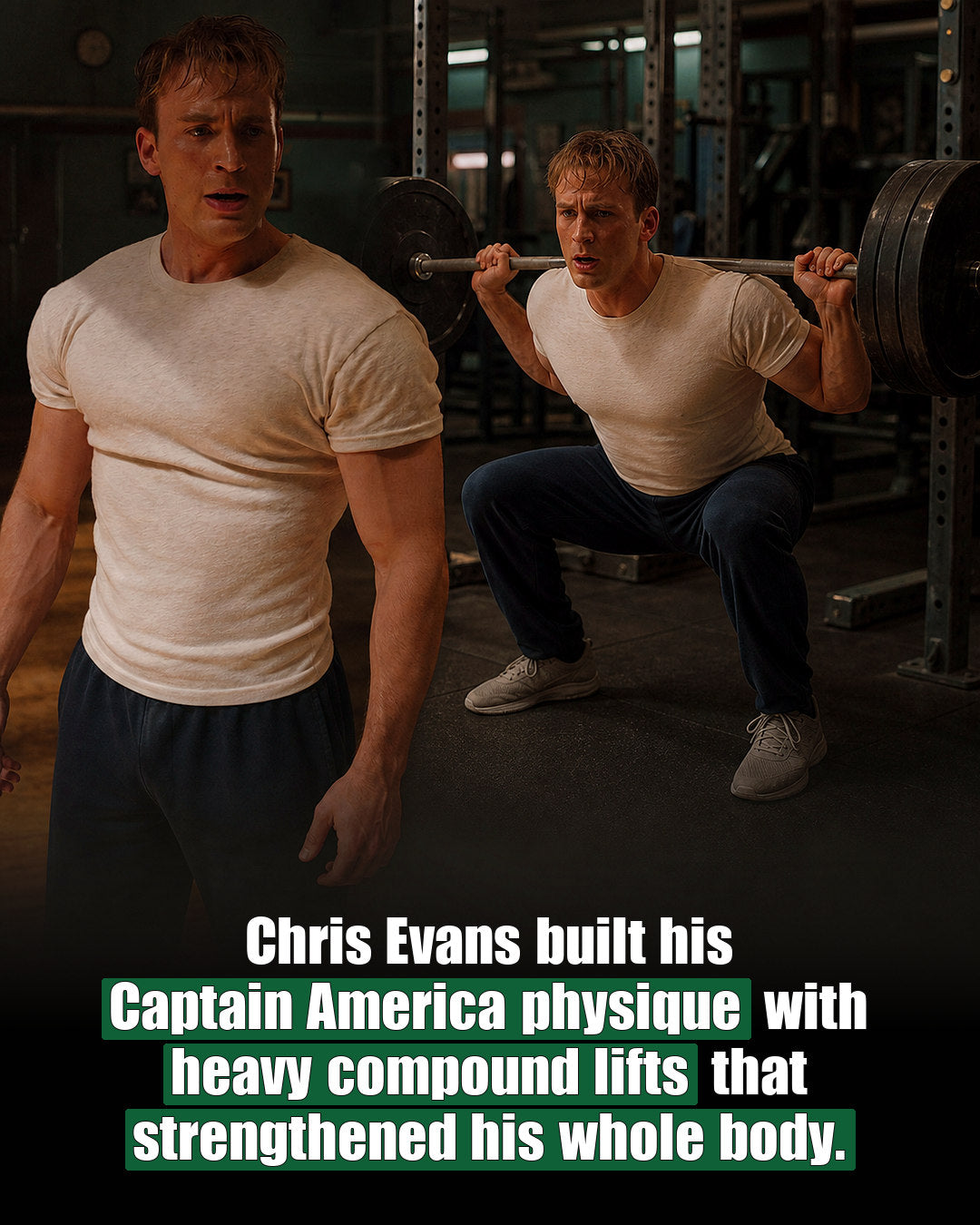

Chris Evans is an American actor best known for playing Steve Rogers, also called Captain America, in the Marvel Cinematic Universe.
He first put on the shield in 2011 for “Captain America: The First Avenger.”
He kept playing the role through nine Marvel films.
His run ended with “Avengers: Endgame” in 2019, and he later returned briefly for “Deadpool & Wolverine” in 2024.
Before landing the role, Evans had a normal actor’s gym body.
He has described his old workouts as focused on what he called mirror muscles.
Those are the muscles you see when you check yourself out in a mirror, like biceps, chest, and abs.
Playing a super soldier meant building a completely different kind of body.
The character needed to look like he could lead a platoon into battle, not just pose for a magazine cover.
That meant a new training approach, built by a trainer who had already built that kind of physique before.
Who Trained Him and What Changed
Evans trained with Simon Waterson, a British trainer known for his work on action films.
Waterson has also trained Daniel Craig for the James Bond films, which connects two very different franchises through the same training philosophy.
According to reporting on the transformation, Waterson looked at Evans’s old routine and found it incomplete.
Evans had strong arms and a strong chest already.
His back and legs were undertrained by comparison, a common gap in gym routines built mostly around what shows up in a t shirt.
Waterson rebuilt the program around big, multi joint lifts instead of small isolation moves.
The new plan reportedly ran about two hours a day, four months before filming began.
Evans has described just how hard those sessions were.
“The workouts were exhausting. It’s the workout that, you know, makes you want to vomit. It’s horrible. You try to think of any way to get out of it before you go.”
That is not a marketing line written to sound tough.
It is an actor describing real dread before a training session, which is a very human thing to admit.
The Real Compound Lifts Behind the Shield
Reporting on the program lists a short set of heavy compound lifts done for four sets of five reps each.
A compound lift is the general term for an exercise that moves more than one joint at a time.
The core lifts named across multiple training reports include the back squat, the deadlift, the bench press, the front squat, and the trap bar deadlift.
Around those lifts, the program reportedly added pulling work like pull ups, plus bodyweight circuits and dynamic athletic drills.
The training week was structured across the whole body, not just one muscle group per day.
Some days focused on lower body power.
Other days mixed upper body pushing and pulling.
One day was built around explosive, athletic movement.
Another combined core work with general conditioning.
That structure is common in strength programs built for full body performance, not just for size in the mirror.
Why Compound Lifts Build a Body Like This
Compound lifts recruit more total muscle at once than an isolation exercise like a bicep curl.
A squat uses the quads, glutes, hamstrings, and core together in a single movement.
A deadlift adds the back and grip into that same list.
That is part of why these lifts are efficient for building both strength and size in a short window of time.
A 2017 study in Frontiers in Physiology compared training built mostly around multi joint compound lifts to training built around single joint isolation moves, using an equal total workload for both groups (Paoli et al., 2017).
The compound lift group saw better improvements in body composition and cardiorespiratory fitness for the same amount of total training time.
That result lines up with why a four month deadline would favor a program built on squats and deadlifts over one built on curls and leg extensions.
There is one popular claim worth correcting here.
Many people believe heavy compound lifts work partly because they spike testosterone and growth hormone right after the set.
A 2012 study in the European Journal of Applied Physiology tested that idea directly, tracking a large group of men through months of real training (West & Phillips, 2012).
The researchers found no meaningful link between those short post workout hormone spikes and how much muscle a person actually built over time.
The real driver of the results looks closer to total training volume, load, and consistency, not a hormone rush that fades within an hour of leaving the gym.
What actually seems to matter most is a principle called progressive overload.
Progressive overload just means slowly asking your muscles to do a little more over time, whether that is more weight, more reps, or better control of the same weight.
Compound lifts make progressive overload easy to track, because one number on a barbell reflects work done by several major muscle groups at once.
Compound Lifts vs the Mirror Muscle Routine He Started With
Evans’s earlier routine sounds like a fairly standard body part split, the kind built around chest day, arm day, and ab day.
That style of training can absolutely build visible muscle in the exact muscles it targets.
What it tends to miss is the back, the posterior chain, and the kind of full body strength that makes someone look capable of real movement, not just size.
A body built entirely on isolation work can look strong while still being weak at basic tasks, like carrying something heavy up a flight of stairs.
Waterson’s compound lift program was built to close exactly that gap.
Based on how the training has been described, the goal was a body that moved like an athlete first and looked impressive as a side effect of that movement.
A well known Sports Medicine review on athletic performance backs up why that order matters (Suchomel, Nimphius, & Stone, 2016).
The review found that a person’s baseline muscular strength influences almost every other athletic quality, including speed, jumping power, and the ability to change direction quickly.
Isolation training rarely improves any of those qualities on its own.
Common Mistakes People Make Copying This Program
The most common mistake is skipping the technique work that made these lifts safe for Evans in the first place.
A trap bar deadlift and a barbell back squat both require real coaching to load safely, and hiring a qualified personal trainer for even a few sessions can catch form problems you cannot see in a mirror.
Doing four sets of five with poor form on a heavy squat is a fast way to get hurt, not a fast way to look like Captain America.
A second mistake is copying the training volume without copying the recovery that supported it.
Evans reportedly trained about two hours a day for four months, with a trainer also managing his food, sleep, and recovery around that load.
Most people trying to copy this routine are also working a full time job, raising a family, and sleeping six hours a night.
A third mistake is expecting four months to be enough time without also matching the calorie surplus and protein intake that supports that kind of training.
Muscle does not grow from the workout alone.
It grows from the workout plus the food and rest that follow it.
Who Should Be Cautious With Heavy Compound Lifts
Anyone new to lifting should not start with heavy four rep sets on a back squat or a deadlift.
Beginners get more benefit, with far less risk, from lighter loads and higher reps while they build technique first.
People with a history of lower back injury should talk to a doctor or physical therapist before loading a deadlift heavily.
The deadlift in particular puts real load on the spine if the lower back rounds under weight.
Anyone managing a current joint issue in the knees, hips, or shoulders should also get individual guidance before starting a program built around four heavy compound lifts a day.
Pregnant women and anyone recovering from recent surgery should check with their doctor before starting any new heavy lifting program.
Older adults who are new to lifting are not excluded from compound lifts, but they usually need a slower ramp up and closer form coaching.
A position statement from the National Strength and Conditioning Association found that resistance training, including compound movements, is both safe and beneficial for older adults when it is introduced gradually and supervised at first (Fragala et al., 2019).
The caution is about the pace of loading, not about avoiding these lifts entirely.
A Practical Way to Build Your Own Compound Lift Routine
You do not need Evans’s schedule to get real benefit from this style of training.
Start with three sessions a week, each built around one major compound lift.
A simple structure is a squat pattern on day one, a hinge pattern like a deadlift on day two, and a press pattern like a bench press on day three.
Begin with a weight you can lift for eight to ten reps with clean form, not a weight that makes rep five look ugly.
Add pulling work, like rows or pull ups, on each of those days to balance out the pressing movements.
Warm up with a lighter version of the day’s main lift before adding weight.
Two or three light sets before your working sets is usually enough.
Progress slowly, adding small amounts of weight every week or two once the current weight feels controlled and your form stays clean through every rep.
Give yourself at least one full rest day between sessions that hit the same muscle groups hard.
Track your lifts in a simple notebook or app so you can see real progress over months, not just guess at it.
Eat enough protein to support the muscle you are asking your body to build.
A common, well supported target is roughly 0.7 to 1 gram of protein per pound of body weight each day for someone actively strength training.
Sleep matters just as much as the workout itself.
Most of the actual muscle repair happens while you are asleep, not while you are lifting.
This slower version will not build a Marvel physique in four months.
It will build real strength safely, which is a better goal for almost everyone reading this.
What This Transformation Does Not Prove
Evans’s transformation is real, and the compound lifts behind it are backed by real training science.
What it does not prove is that any person can get the same result on the same timeline.
Evans had a full time trainer, a structured diet, and training as his literal job for those four months.
Genetics also play a real role in how fast someone can build visible muscle, and that part of the story rarely makes it into workout breakdowns.
The lifts themselves are legitimate, and the science behind why they work holds up under research.
The four month movie transformation timeline is not a realistic promise for someone training around a full time job and a normal life.
References
- Men’s Journal, “15 Years Ago Today: One of the Best Superhero Movies Premiered and Its Star Endured ‘Brutal’ Training”
- AOL, “Chris Evans’ 4-Month Training Journey to Become Captain America Revealed”
- Generation Iron, “Chris Evans Workout Routine & Diet”
- Paoli, A., Gentil, P., Moro, T., Marcolin, G., & Bianco, A. (2017). Resistance Training with Single vs. Multi-joint Exercises at Equal Total Load Volume: Effects on Body Composition, Cardiorespiratory Fitness, and Muscle Strength. Frontiers in Physiology, 8, 1105.
- West, D. W. D., & Phillips, S. M. (2012). Associations of exercise-induced hormone profiles and gains in strength and hypertrophy in a large cohort after weight training. European Journal of Applied Physiology, 112(7), 2693 to 2702.
- Suchomel, T. J., Nimphius, S., & Stone, M. H. (2016). The Importance of Muscular Strength in Athletic Performance. Sports Medicine, 46(10), 1419 to 1449.
- Fragala, M. S., Cadore, E. L., Dorgo, S., Izquierdo, M., Kraemer, W. J., Peterson, M. D., & Ryan, E. D. (2019). Resistance Training for Older Adults: Position Statement From the National Strength and Conditioning Association. Journal of Strength and Conditioning Research, 33(8), 2019 to 2052.
This article is for general information and is not personal medical or training advice. Talk to a doctor or a qualified strength coach before starting a new lifting program, especially if you have an injury or a health condition.