

Does vaping affect athletic performance? Human studies have found lower measured aerobic fitness or exercise capacity among some regular e-cigarette users, and a small experiment found that nicotine vaping briefly raised heart rate and blood pressure. Those findings are a reason to take the question seriously, but group comparisons do not prove how much vaping changes any one athlete’s race time or recovery.
The distinction is between an immediate nicotine response, an observed exercise-test difference and a proven training outcome. Here is what each type of evidence can actually answer.
What was measured, and what was not
| Study | Participants and test | Finding | Limit for athletes |
|---|---|---|---|
| Gonzalez and Cooke, 2021 | Young nonsmokers inhaled from a nicotine JUUL or nicotine-free placebo device | Nicotine condition raised heart rate and arterial pressure in that acute protocol. | No run, ride, lift or recovery test was performed. |
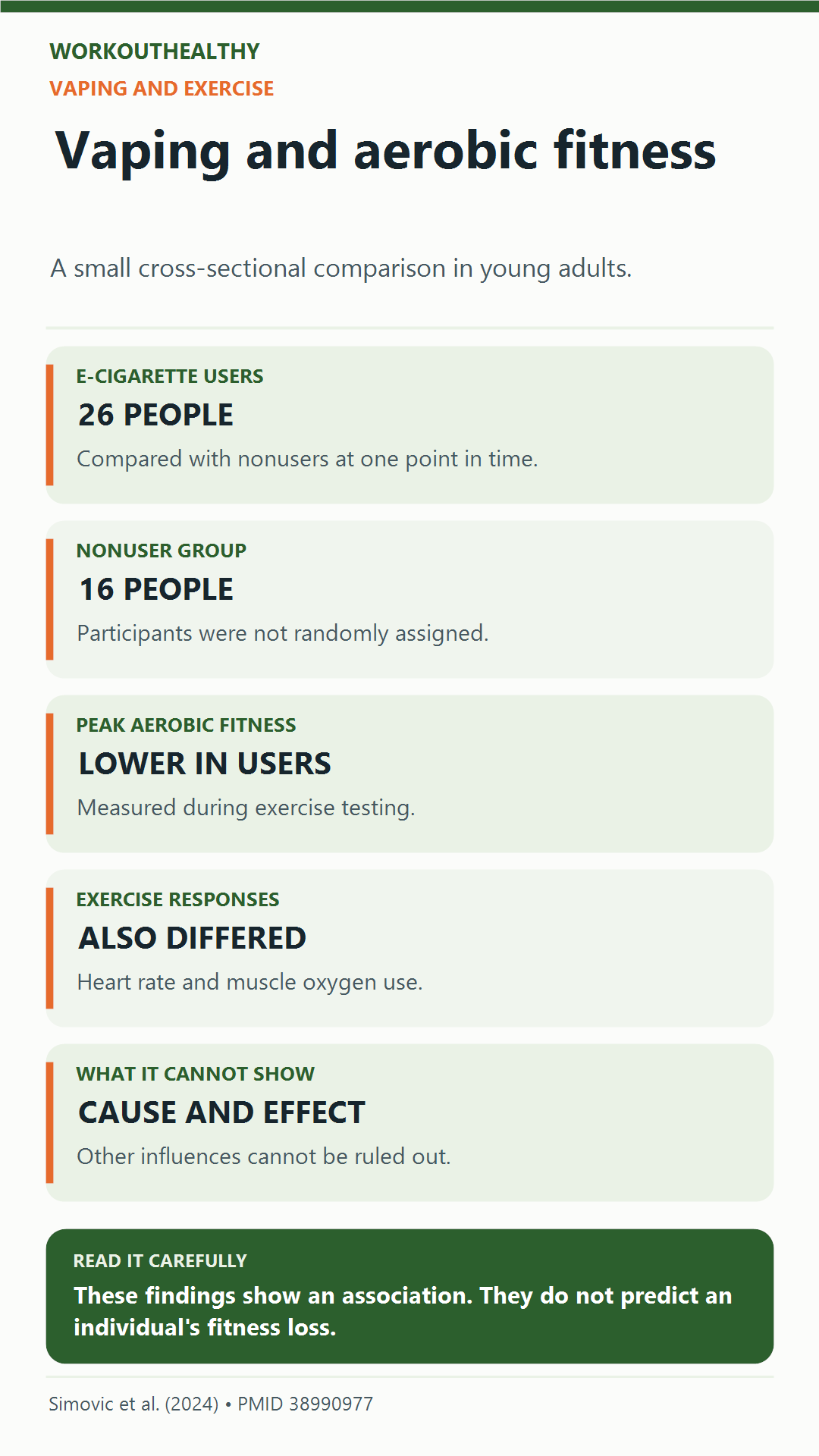
| Simovic et al., 2024 | 26 regular users and 16 nonusers completed maximal exercise testing | Users had lower peak aerobic fitness and different heart-rate and muscle-oxygen responses. | Small cross-sectional comparison; it cannot isolate vaping as the cause of every difference. |
| Exercise-capacity study, 2026 | 75 active adults ages 18 to 30, in three groups of 25, completed cycle testing | Vaping and cigarette groups had lower peak cycling power and oxygen uptake than never-user controls. | Another group comparison, not a trial assigning people to vape or measuring later competition results. |
| Dinkeloo et al., 2020 | 2,854 male soldiers reported tobacco use, training and fitness-test results | Vape, cigarette and dual-use groups differed from never users; dual users showed the clearest lower scores. | The measures were self-reported and the analysis cannot prove causation. |
| Xie et al., 2022 | Young adults in PATH reported later respiratory symptoms | Current e-cigarette use was associated with later wheezing-related symptoms. | Symptoms, including exercise-related wheeze, are not a VO2 test or sport-performance result. |
The clearest direct exercise findings
The 2024 study compared regular e-cigarette users with matched nonusers during an exercise test. Lower VO2 peak is a direct fitness measure, but a 42-person cross-sectional snapshot cannot rule out differences in training history, health or other exposures.
The newer 75-person study adds a separate exercise test in active young adults. Its vape group averaged 182 watts of peak cycling power versus 219 watts in controls, and 35.1 versus 41.2 mL/kg/min of peak oxygen uptake; these are group averages, not a predicted personal loss.
The study also reported worse ventilatory efficiency and greater breathlessness during submaximal exercise in the vape group. Because participants were grouped by existing behavior, the results remain associations even though the researchers measured exercise performance directly.
What nicotine changes immediately
In the small acute experiment, a nicotine-containing JUUL raised heart rate and mean arterial pressure, while the nicotine-free placebo device did not show the same sympathetic response in that protocol. This supports a short-term nicotine effect on those measures, not the separate claim that one puff necessarily makes the next workout slower.
The result also does not prove that nicotine-free aerosol is harmless for breathing or fitness. Device ingredients, frequency of use, cigarette history and individual health can differ widely.
Respiratory symptoms are a related question
The PATH analysis associated e-cigarette use with later wheezing-related symptoms in young adults after adjustment for several other exposures. It included a report of wheezing during or after exercise, but did not measure timed sports performance or directly test what caused a given person’s symptoms.
The old article treated the never-smoker subgroup as if it ruled out every smoking-related or behavioral explanation. A longitudinal association narrows some alternatives but cannot eliminate all confounding, and subgroup estimates must be interpreted on their own.
What remains unknown
These studies do not give a reliable number for how many seconds vaping changes a mile time, whether it delays muscle recovery, or how an occasional user’s result compares with a daily user’s. They also cannot support a blanket claim that switching from cigarettes to vaping is a full health reset.
Exercise-test differences, respiratory symptoms and immediate blood-pressure changes are related evidence, but they are different outcomes. A ranking claim about one sport needs research in that sport, with exposure, training and other factors measured carefully.
If your training feels different
Record a familiar session’s effort, breathing symptoms and conditions over several days if you want a useful history to discuss with a clinician. A change in performance has many possible explanations, and a home stair test cannot diagnose whether vaping caused it.

Chest pain, fainting, or new severe shortness of breath during exercise warrants prompt medical assessment. If you want to stop vaping, the CDC’s vaping and quitting guidance offers help; a clinician can discuss a plan that fits your situation.
For training context, our stair-climb article explains why a timed effort is not a stand-alone heart-health diagnosis. The same principle applies here: one workout does not establish a medical cause.
Watch the original video
The Texas Department of State Health Services video raises an important question for athletes. The studies above give a more precise answer than a general claim that vaping lowers lung capacity or slows recovery in every user.
Want more like this? Subscribe to WorkoutHealthy Insider for practical explanations behind popular fitness claims.
References
- Gonzalez and Cooke (2021), acute nicotine e-cigarette effects.
- Simovic et al. (2024), cardiorespiratory fitness in e-cigarette users.
- 2026 study of vascular and exercise responses in active young e-cigarette users.
- Dinkeloo et al. (2020), tobacco use and reported Army fitness tests.
- Xie et al. (2022), e-cigarette use and respiratory symptoms in PATH.
- CDC: Vaping and Quitting.
This article is for general information only and is not medical advice. If you have chest symptoms, breathing trouble or a medical condition, talk to a clinician about exercise and nicotine use.