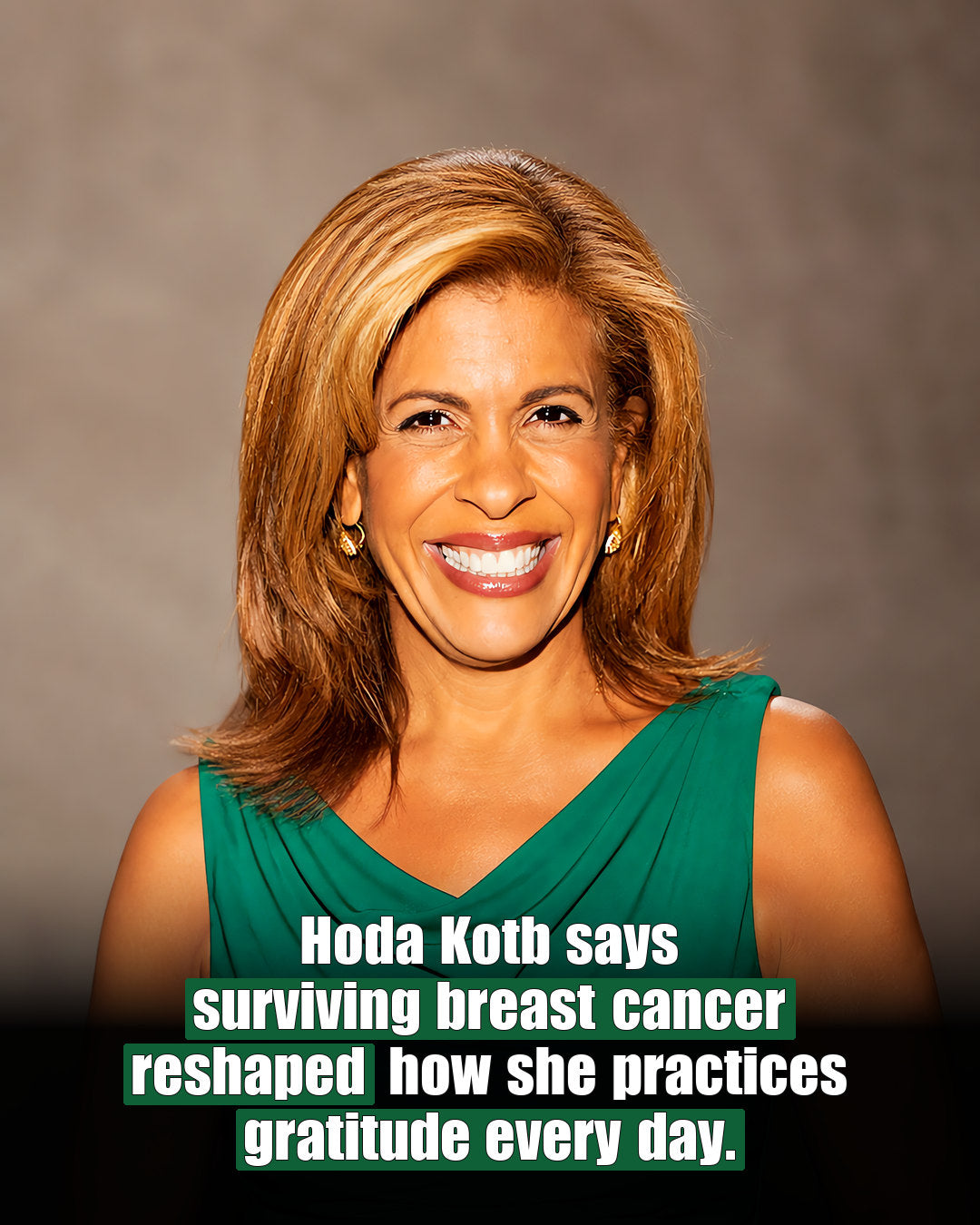

Hoda Kotb is a television journalist best known for co-anchoring NBC’s “Today” show for years.
She stepped down from that role in January 2025, after announcing the decision in 2024.
She briefly returned as a substitute anchor in early 2026, and she remains active in television and public life today.
In March 2007, at age 42, Kotb was diagnosed with breast cancer.
She is alive today, roughly 19 years past that diagnosis, and she speaks publicly about the experience on a regular basis.
Her treatment included what she has described as an extensive eight hour surgery, combining a mastectomy with reconstruction.
She has said the reconstruction involved a long incision across her midsection, along with additional incisions on her chest.
In 2026, Kotb launched Joy 101, a wellness platform and app centered on gratitude, breathwork, and stress reduction.
She has described it as something in its early stages that she is genuinely excited about.
Gratitude has been a consistent theme across her public life since her diagnosis, including two published books built around daily gratitude reflections.
Those books, “I Really Needed This Today” and “This Just Speaks to Me,” collect daily quotes and personal reflections she has gathered over years.
She has described Joy 101 in similar terms, calling it “a whole wellness situation” that she hopes will feel like “a retreat in your pocket” for people who use it.
She has said the goal is partly personal, built from her own question about why her own baseline stress level has changed over time.
What Cancer Survivorship Actually Means
Survivorship is the medical term for life after active cancer treatment ends.
It does not mean a person is guaranteed to be free of cancer forever.
It means active treatment, like surgery, chemotherapy, or radiation, has stopped, and monitoring for any return of the disease continues instead.
That monitoring can include regular checkups, imaging, and bloodwork, often for years after the original diagnosis.
For many types of breast cancer, the risk of the disease coming back does not drop to zero, even decades later.
That is a hard fact for a lot of survivors to sit with, and it is part of why the emotional side of survivorship gets just as much attention from researchers as the physical side.
Kotb’s own comments about scars and body image reflect that same long tail.
Survivorship is not a single finish line.
It is an ongoing relationship with a body and a history that does not simply disappear once treatment ends.
What Current Research Says About Fear of Recurrence
Researchers have a specific term for the worry that cancer will return: fear of cancer recurrence, often shortened to FCR.
A 2013 systematic review in the Journal of Cancer Survivorship looked at how common this fear actually is among adult cancer survivors (Simard et al., 2013).
The review found that moderate to high levels of fear of recurrence affect a substantial share of survivors, often persisting for years after treatment ends.
That research helps explain something Kotb has described in her own words, a shift in identity that does not fully resolve just because active treatment is over.
For breast cancers driven by hormones, research also shows that recurrence risk can remain real for a long time.
A large 2017 study in the New England Journal of Medicine followed women with hormone receptor positive breast cancer and found a meaningful risk of recurrence continued for up to 20 years after the original diagnosis, in cases where the cancer was that specific hormone driven subtype (Pan et al., 2017).
That finding does not describe every breast cancer survivor’s exact risk, since risk varies by the specific type and stage of a person’s original cancer.
It does explain, in general terms, why long term monitoring and a lingering sense of watchfulness are common parts of survivorship for many people, not a sign that something is being handled incorrectly.
What Research Says About Gratitude Practices Specifically
Gratitude focused practices, like the ones Kotb has built her books and her new wellness platform around, have been tested directly in cancer survivors.
A 2016 randomized study in the journal Health Psychology tested a gratitude letter writing exercise specifically against death related fear of cancer recurrence in breast cancer survivors (Otto et al., 2016).
That study did not find a clear overall reduction in fear of recurrence from the gratitude exercise compared to a control activity, an honest and important nuance.
A more recent 2025 randomized controlled trial in the journal Current Oncology tested a different, more structured gratitude journaling program in 60 breast cancer patients over three weeks (Kim & You, 2025).
That study found real, statistically significant improvements in gratitude disposition, resilience, and overall quality of life in the group that journaled, compared to a control group that did not.
Put together, these two studies suggest gratitude practices are genuinely useful for general wellbeing and resilience in survivors.
They are less clearly proven as a direct treatment for the specific fear that cancer will return.
That is a meaningful, honest distinction, not a reason to dismiss the practice.
Hoda Kotb’s Own Words
Kotb has spoken candidly about the physical reality of her surgery.
“The breast cancer I had required an extensive eight hour surgery, which included a mastectomy and reconstruction. Let me tell you, it looks like a roadmap.”
She has also described the emotional side as something that could not be fully anticipated ahead of time.
“When I think about surviving cancer and dealing with body image after the fact, I realize now, you can’t really prepare yourself for it.”
She has been direct about lingering self consciousness, even years later.
“I still pull and tug on things I wear, like bathing suits or when I’m wearing gym clothes. The actual scars are there, that’s forever a part of me.”
She has also framed how she tries to hold that reality without letting it take over.
“It can shape you, but if it defines you, then you will spend your life feeling a certain way.”
What This Evidence Does Not Prove
Kotb’s story, and the research on gratitude practices, do not prove that gratitude alone prevents cancer from coming back.
No study reviewed here claims that.
Gratitude and resilience practices are supportive tools for wellbeing, not medical treatments for the disease itself.
The research also does not prove that everyone benefits from gratitude journaling in the same way.
Both studies discussed here used small to moderate sample sizes, and results can vary by person, by cancer type, and by how much time has passed since treatment.
It is also worth being honest that not every survivor’s experience matches Kotb’s public framing.
Some survivors find gratitude focused messaging unhelpful, or even frustrating, especially soon after diagnosis, and that reaction is a normal, valid part of the range of how people cope.
Sample sizes in this specific area of research also remain fairly small.
The 2025 gratitude journaling study included 60 total participants, and the 2016 study was similarly modest in scale.
Small studies like these are useful for identifying promising directions, but they are not the same as the large, decades long trials that established things like standard chemotherapy protocols.
Who Should Talk to a Doctor First
Anyone currently experiencing persistent anxiety about cancer returning should talk to their oncologist or primary doctor about it directly, since ongoing severe fear of recurrence is a recognized condition with its own treatment options.
Anyone noticing a new lump, unusual pain, or unexplained symptoms after treatment should contact their care team promptly rather than waiting for a scheduled checkup.
Anyone considering starting or stopping hormone therapy or any other prescribed cancer treatment should discuss that decision with their oncologist first, given how much long term outcomes can depend on completing recommended treatment.
Anyone struggling with body image or depression after treatment should ask their care team about a referral to a therapist who specializes in oncology, since this is a common, treatable part of survivorship, not something to manage alone.
This article shares general research and one public figure’s story, not personalized medical guidance, and only a person’s own care team knows their specific history and risk.
A Practical Section for Readers
If you are a survivor, keeping every scheduled follow up appointment matters, even years after treatment ends and even when you feel completely well.
Consider keeping a simple written or app based log of any new symptoms between appointments, so nothing gets forgotten by the time you see your doctor.
If gratitude journaling appeals to you, the research suggests a structured approach works better than a vague intention, such as writing a few specific things down at a set time each day for several weeks.
Do not treat gratitude practice as a replacement for medical monitoring or for professional mental health support if you need it.
Consider connecting with other survivors through a hospital support group or a national organization, since shared experience is consistently one of the most helpful resources people describe during survivorship.
If you are supporting a survivor in your life, following their lead on how much they want to discuss their history is usually more helpful than pushing them toward positivity before they are ready for it.
Survivorship looks different for every person, and there is no single right way to move through it.
Kotb herself has been clear that the process is not linear, describing an initial wave of gratitude toward her medical team followed later by a harder period of avoiding mirrors entirely.
She has said she now considers herself at roughly 90 percent physically recovered, while still working through body image questions that have not fully resolved even years later.
That kind of honesty, rather than a tidy before and after story, is closer to what research on survivorship actually describes.
References
- SurvivorNet, “‘Today Show’ Co-Anchor, Breast Cancer Survivor Hoda Kotb Shares Powerful Message Reminding to Live Your Life”
- SurvivorNet, “Breast Cancer Survivor Hoda Kotb On Aging Graciously At 61”
- AOL, “Hoda Kotb Says Breast Cancer Is ‘Part of Me, but Not All of Me’ Nearly 20 Years Later”
- Wikipedia, “Hoda Kotb”
- NBC Insider, “Hoda Kotb’s New Joy 101 Wellness App Is Here, & It’s a ‘Retreat in Your Pocket'”
- Today.com, “Hoda Kotb Announces New Wellness Brand: What is Joy 101?”
- Simard, S., Thewes, B., Humphris, G., Dixon, M., Hayden, C., Mireskandari, S., & Ozakinci, G. (2013). Fear of cancer recurrence in adult cancer survivors: a systematic review of quantitative studies. Journal of Cancer Survivorship, 7(3), 300 to 322.
- Pan, H., Gray, R., Braybrooke, J., et al. (2017). 20-Year Risks of Breast-Cancer Recurrence after Stopping Endocrine Therapy at 5 Years. New England Journal of Medicine, 377(19), 1836 to 1846.
- Otto, A. K., Szczesny, E. C., Soriano, E. C., Laurenceau, J. P., & Siegel, S. D. (2016). Effects of a randomized gratitude intervention on death-related fear of recurrence in breast cancer survivors. Health Psychology, 35(12), 1320 to 1328.
- Kim, E., & You, M. (2025). Effects of Gratitude Journaling on Patients with Breast Cancer: A Randomized Controlled Trial. Current Oncology, 32(7), 400.
This article shares one person’s publicly reported experience alongside general research for education. It is not personal medical advice and it is not a diagnosis. Talk to your own oncologist or doctor about your specific survivorship care plan.