
A video presents a full-body strength routine for the third week after major breast reconstruction. This is an example of one program, not a clearance date for every patient.
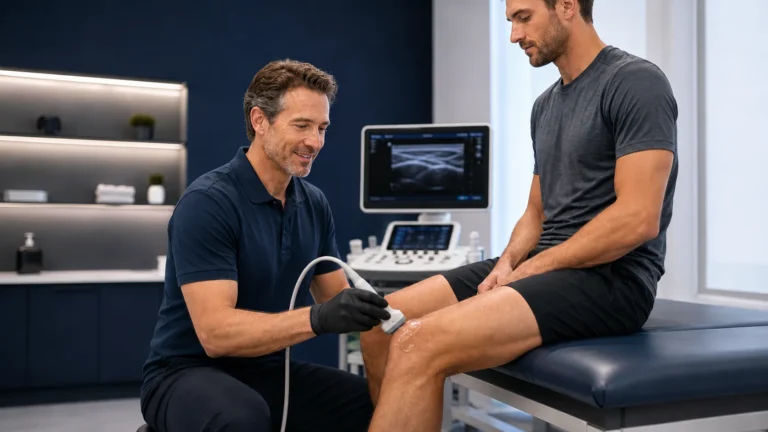
Image note: The featured exercise scene is illustrative. It does not show an assessed patient or establish that resistance-band work is appropriate three weeks after DIEP surgery.
The channel behind it, Outside the Doc Box, frames this as recovery week three after mastectomy and DIEP flap surgery.
DIEP flap reconstruction is a genuinely different operation than a mastectomy by itself, and it comes with its own recovery rules.
This article looks at what real, published research actually shows about recovering the abdominal core after this specific type of surgery.
What the Video Claims
The video presents a week three exercise routine described as full body strength work.
The video discusses recovery after mastectomy and DIEP flap reconstruction, but those are not interchangeable procedures.
Lumpectomy and radiation can also affect shoulder movement and fatigue, yet they do not share the same abdominal donor-site precautions as DIEP surgery.
DIEP flap surgery rebuilds the breast using skin, fat, and blood vessels taken from a patient’s own lower abdomen.
That makes it a fundamentally different procedure than a mastectomy on its own, which does not involve the abdomen at all.
The video’s exercise list reflects one program’s own approved plan for its own patients at one point in their specific recovery.
It is not a universal timeline that applies to every DIEP flap patient at exactly three weeks.
Real recovery timing depends on the procedure, the surgical team, and how the individual patient is healing.
For example, North Bristol NHS Trust separates its DIEP physiotherapy guidance into different stages. It describes home exercises during the first four weeks, adds others later, and reserves its upper-body strengthening and abdominal exercise videos for eight weeks after surgery.
That hospital pathway is not a universal rule either. It shows why a week-three online strength routine should never override instructions from the patient’s own reconstruction team.
Treating any single video’s schedule as a general rule can be risky after a surgery this complex.
Outside the Doc Box describes itself as run by Dr. Knowles, an emergency physician and breast cancer survivor, and Alessandra, an occupational therapist and certified lymphedema therapist.
Those are the channel’s own self-reported credentials.
This article did not independently verify a medical license or a full legal name for either host, since no surname is given for Alessandra and no state license lookup was performed.
An emergency medicine background is not the same specialty as plastic and reconstructive surgery, which is worth keeping in mind.
An occupational therapy and lymphedema certification background is directly relevant training, if the claim is accurate, though it is still not a substitute for a patient’s own surgical team.
What Real Research Shows About the Abdominal Core After DIEP Flap Surgery
DIEP flap surgery takes its donor tissue from the lower abdomen, roughly the same area targeted in a tummy tuck.
To reach the blood vessels it needs, surgeons must open the sheath of connective tissue covering the abdominal muscles.
That sheath, called the anterior rectus sheath, is repaired before the incision is closed.
Researchers have specifically studied how this step affects the strength and shape of the abdominal wall afterward.
One study examined lower abdominal bulging after DIEP flap surgery and examined possible factors involving the abdominal wall, including the rectus sheath (Nahabedian & Momen, 2005).
A more recent study found that a patient’s abdominal wall strength before surgery was linked to their risk of bulging afterward (Tokumoto et al., 2022).
Together, these findings support treating the abdomen as a real surgical site of its own after DIEP flap reconstruction, not just as a donor area.
The abdomen in DIEP flap surgery is not a passive donor site. It is a second surgical wound with its own healing timeline.
What Real Research Shows About Donor Site Strength Compared to Other Flap Types
Not every abdominally based breast reconstruction is done the same way.
Older techniques, like the traditional TRAM flap, take a strip of the abdominal muscle itself along with the tissue.
DIEP flap surgery is designed to spare that muscle and take only skin, fat, and the blood vessels running through it.
A study using ultrasound imaging compared abdominal wall movement after DIEP flap surgery to a muscle-sparing version of the TRAM flap (Seidenstuecker et al., 2016).
It found real differences in donor site function between the two techniques.
A separate study compared abdominal wall strength after muscle-sparing TRAM flap surgery to the strength changes seen after a standard tummy tuck (Momeni et al., 2010).
That comparison suggests some of what patients feel in the abdomen after this surgery overlaps with what any patient feels after abdominal surgery of similar scale.
This does not mean every DIEP flap patient loses core strength.
It means the abdomen goes through a real recovery process that deserves the same caution as any other major surgical site.
What Real Research Shows About Flap Monitoring in the Weeks After Surgery
A DIEP flap depends on a new blood supply connecting the transferred tissue to vessels in the chest.
In the earliest days after surgery, that connection is checked closely and frequently in the hospital.
A systematic review pooling tens of thousands of free flap surgeries looked at when flap problems actually tend to happen (Shen et al., 2021).
It found that the large majority of serious flap complications show up within the first few days after surgery.
The odds of successfully saving a struggling flap dropped sharply the longer a problem went unnoticed.
By the time a patient reaches the three week mark, the flap has typically settled into a stable, established blood supply.
That does not mean week three carries zero risk, but the specific concerns at that stage are different from the first 72 hours.
Later concerns tend to center more on wound healing, swelling, and how much load the abdominal wall can safely handle.
What Real Research Shows About Structured Recovery Pathways
Some hospitals now use a formal, multi-step recovery plan for DIEP flap patients instead of a loose set of general instructions.
This approach is often called an enhanced recovery after surgery pathway, or ERAS.
One study looked at outcomes for DIEP flap patients who followed a structured ERAS pathway (Gort et al., 2021).
It reported positive effects on recovery when pain control, early safe mobilization, and nutrition were all coordinated as one plan.
This supports the idea that recovery timing after DIEP flap surgery works best as an individualized, coordinated plan.
It should not be reduced to a single generic exercise list shared online.
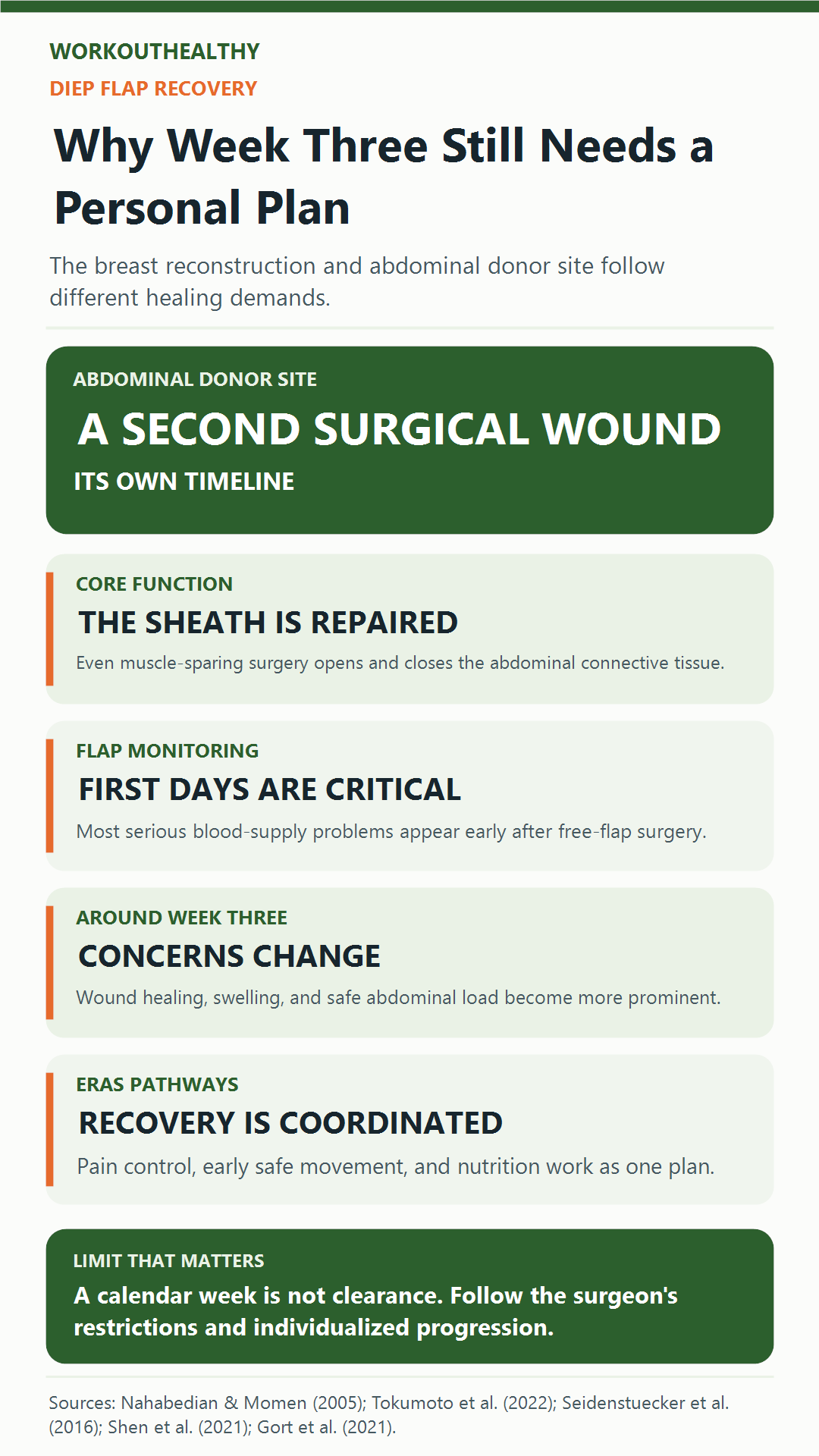
A structured recovery pathway coordinates pain control, movement, and nutrition together. A single exercise video coordinates none of those things.
The Mechanism
Understanding why DIEP flap recovery differs from mastectomy alone starts with what each surgery actually touches.
A mastectomy removes breast tissue from the chest and may involve nearby chest wall muscles or lymph nodes.
DIEP flap reconstruction adds an entirely second surgical site, the lower abdomen, to rebuild the breast.
Surgeons tunnel through the rectus sheath to find and free the small perforator blood vessels that will feed the new tissue.
Even when the muscle itself is spared, that sheath has still been cut open and stitched back together.
Fascia, the tough connective tissue that makes up that sheath, heals more slowly than skin does.
This is a major reason why core movements like sit ups, heavy lifting, and sudden twisting are typically restricted longer than the visible incision would suggest.
The flap and abdominal donor site both need postoperative monitoring and protection. The exact movement and lifting limits come from the operating team, not from a generic pressure rule.
Extended inactivity is not automatically the safer choice either, and our coverage of how weight loss and muscle loss interact during recovery from major medical treatment explains why gradual, guided movement usually beats total rest.
All of this explains why DIEP flap patients typically follow abdominal core precautions well after a straightforward mastectomy patient has resumed normal core activity.
What This Evidence Does Not Prove
None of these studies tested the exact week three routine shown in the video.
The abdominal wall and flap monitoring research describes general patterns across many patients, not a personalized plan for any one person.
Real recovery timing depends heavily on the exact surgical technique used, whether any muscle was taken, and how the individual patient is healing.
Some patients carry additional factors, like prior abdominal surgery, obesity, smoking history, or diabetes, that change these timelines further.
This research also cannot say that any specific exercise is universally safe, or universally unsafe, at exactly three weeks for every patient.
It supports general caution around abdominal loading during this period, not a specific green light for any particular movement.
Who Should Work With a Clinical Team
DIEP flap recovery is not a good candidate for a self-guided exercise plan copied from a video.
Follow the surgical team’s specific activity plan. Do not treat a week-three strength video as clearance to start resistance training after DIEP surgery.
Many breast reconstruction programs include a physical therapist or occupational therapist as part of standard care.
That clinician can review the operation, current healing, drain status, and any complications before recommending specific movements.

A structured, professionally guided recovery plan is not unique to breast reconstruction.
It is common after other major surgeries too, including joint replacement recovery, where progress is paced by a clinical team rather than by a fixed calendar.
Anyone following an online video for guidance should treat it as general education, not a substitute for that clinical input.
If any exercise causes new pain, pulling, swelling, or changes in how the reconstructed breast or abdomen looks, that is a reason to stop and call the surgical team.
Who Should Be Extra Careful
Patients who had muscle taken as part of an older flap technique may face a longer core recovery than DIEP flap patients specifically.
Anyone with a history of abdominal hernia, prior abdominal surgery, or a known connective tissue disorder should get individualized guidance before resuming core work.
Patients managing diabetes, a smoking history, or obesity face documented higher risks of wound healing complications after this surgery.
Anyone still noticing swelling, warmth, or color changes near the reconstructed breast should treat that as a reason to contact their care team.
People who are still in the middle of radiation or chemotherapy alongside their reconstruction may need an entirely different timeline.
Anyone unsure whether their own recovery matches a video’s timeline should default to asking their own surgical team rather than guessing.
A Practical Takeaway
Recovery after DIEP flap surgery moves in stages, and week three is not the finish line.
Early walking is often encouraged well before heavier core work resumes.
General population walking guidance, like the kind covered in our piece on how many miles a day people should aim to walk, is not written for surgical recovery, so any post-surgical patient should confirm their own pace with their surgeon first.
Abdominal core precautions typically stay in place well past the point where the incisions look closed.
Full return to resistance training generally comes later and only with clearance from the surgical team.
Our article on whether lifting weights supports long term brain health covers some of the broader, longer term reasons that eventual return to strength training is worth working toward.
The safest approach blends patience with the abdomen’s slower healing timeline and staying active in the ways a clinical team actually approves.
No single video, however well produced, can replace that individualized plan.
Watch the video
Want more like this? Subscribe to WorkoutHealthy Insider for practical explanations behind popular fitness claims.
References
North Bristol NHS Trust. (n.d.). Physiotherapy after DIEP surgery. https://www.nbt.nhs.uk/our-services/a-z-services/breast-reconstruction/physiotherapy-after-diep-surgery
Gort, N., van Gaal, B. G. I., Tielemans, H. J. P., Ulrich, D. J. O., & Hummelink, S. (2021). Positive effects of the enhanced recovery after surgery (ERAS) protocol in DIEP flap breast reconstruction. The Breast, 60, 53 to 57. https://doi.org/10.1016/j.breast.2021.08.010
Momeni, A., Kim, R. Y., Heier, M., Bannasch, H., & Stark, G. B. (2010). Abdominal wall strength: A matched-pair analysis comparing muscle-sparing TRAM flap donor-site morbidity with the effects of abdominoplasty. Plastic and Reconstructive Surgery, 126(5), 1454 to 1459. https://doi.org/10.1097/prs.0b013e3181ef904b
Nahabedian, M. Y., & Momen, B. (2005). Lower abdominal bulge after deep inferior epigastric perforator flap (DIEP) breast reconstruction. Annals of Plastic Surgery, 54(2), 124 to 129. https://doi.org/10.1097/01.sap.0000147174.31409.3a
Seidenstuecker, K., Legler, U., Munder, B., Andree, C., Mahajan, A., & Witzel, C. (2016). Myosonographic study of abdominal wall dynamics to assess donor site morbidity after microsurgical breast reconstruction with a DIEP or an ms-2 TRAM flap. Journal of Plastic, Reconstructive & Aesthetic Surgery, 69(5), 598 to 603. https://doi.org/10.1016/j.bjps.2015.11.007
Shen, A. Y., Lonie, S., Lim, K., Farthing, H., Hunter-Smith, D. J., & Rozen, W. M. (2021). Free flap monitoring, salvage, and failure timing: A systematic review. Journal of Reconstructive Microsurgery, 37(3), 300 to 308. https://doi.org/10.1055/s-0040-1722182
Tokumoto, H., Akita, S., Kubota, Y., & Mitsukawa, N. (2022). Relationship between preoperative abdominal wall strength and bulging at the abdominal free flap donor site for breast reconstruction. Plastic and Reconstructive Surgery, 149(2), 279e to 286e. https://doi.org/10.1097/prs.0000000000008763
This article is for general information only and is not medical advice. If you have an injury, ongoing pain, or a medical condition, talk to a doctor or physical therapist before you change how you train or eat.