
Victoria Beckham has publicly described an earlier period dominated by cardio and a later shift toward weight training. She credited husband David Beckham with encouraging the change, and trainer Bobby Rich has explained that her current plan cycles through strength, muscle growth, power, endurance, cardiovascular work, recovery, and maintenance.
The viral story is directionally correct but too neat. Beckham did not replace every long workout with a fixed 35-minute lifting block, and current reports still describe cardio before sessions that may last 50, 75, or 90 minutes.
Her Cardio-Heavy History Is Documented
In 2017, Beckham told Vogue Nederland that she ran three miles every morning and then trained for another hour with a personal trainer. Later accounts described a roughly seven-kilometer mix of uphill walking, jogging, and running followed by separate work for legs, arms, and the trunk.
In a 2025 interview, she summarized the old mindset as cardio, cardio, cardio and said the goal had become burn, burn, burn. She connected the shift away from that approach with a healthier emphasis on balance.
That context is more important than a precise treadmill time because it shows a change in purpose. Exercise moved from being judged mainly by calories burned toward building strength and capacity.
The old routine also included trainers, barre-style endurance work, cycling, yoga, and other activities across different years. It was not one unchanging 90-minute StairMaster program.
Bobby Rich Added Measurable Strength Goals
Rich told Vogue that the program uses mini-cycles devoted to strength, hypertrophy, power, endurance, and cardiovascular fitness. He organizes those qualities within broader periods of recovery, maintenance, and intensity.
That is a form of periodization, meaning the training emphasis changes instead of trying to maximize every quality in every session. Measurable targets can include load, repetitions, range, speed, or performance on a specific movement.
Rich has said a properly planned 35-minute session can sometimes be more useful than an unfocused 90-minute workout. He has also said strength sessions may take 75 to 90 minutes because heavier sets require more rest, while other sessions may last around 50 minutes.
The lesson is quality relative to the goal, not that 35 minutes is always enough or 90 minutes is always wasteful. A longer session can be appropriate when it contains preparation, adequate rest, and several planned exercises.
She Was Nervous About Weights, Then Changed Her View
Beckham has said she was scared of weights at first and later found that she loved lifting. That experience mirrors a common fear that resistance training will quickly make a woman bulky.
Muscle growth is gradual and depends on training volume, effort, nutrition, genetics, and time. Accidentally adding a large amount of muscle from a few strength sessions is not a realistic outcome.
Lifting can increase strength before dramatic visual change occurs because the nervous system becomes better at coordinating the movement. Later muscle growth remains adjustable through exercise selection, weekly sets, load, and energy intake.
Higher-load training tends to rank well for maximal strength, while many load ranges can build muscle when sets are challenging. A person does not need to choose between tiny weights for tone and maximal weights for size.
Cardio Was Not the Enemy
Beckham still performs cardio, including StairMaster work reported before joint sessions with David and Rich. The current program combines qualities instead of declaring that running or stepping stopped working.
Aerobic training supports heart, blood vessel, lung, and endurance adaptations that lifting alone does not fully replace. Strength work improves force production, muscle, and bone loading in ways that steady cardio does not fully replace.
Concurrent training research shows that adults can improve both qualities in the same week when total volume and recovery are managed. The exact order matters less than consistently performing the work that matches the primary goal.
Our evidence review of cardio, strength, and heart health explains why the best plan usually contains both. The article on combining lifting and cardio covers how to reduce unnecessary interference.
More Time Does Not Guarantee More Progress
A 90-minute workout can contain productive sets, warm-up, mobility, and full rest periods. It can also contain extra exercise added only to satisfy a time target.
Progress slows when training stops changing, but the solution is not always to add minutes. A modest increase in load, a harder range of motion, more controlled repetitions, or a different weekly distribution can create a new stimulus.
Recovery also places a ceiling on useful work. Sleep, nutrition, stress, joint tolerance, and training history determine whether another set supports adaptation or only adds fatigue.
Beckham reportedly likes to shorten rest periods, while Rich has emphasized that rest is part of strength training. Starting a heavy set too soon can reduce performance and turn strength work back into conditioning.
The One-Hour Claim Needs Better Context
The viral caption says exercise science shows significant adaptation from as little as one hour of resistance training per week. Research does show that relatively small doses can improve strength, especially when a person moves from no training to consistent training.
One trial in trained men found strength gains from three short weekly sessions even though higher-volume groups gained more muscle at some sites. That does not establish sixty minutes as the perfect dose for every goal.
The 2026 American College of Sports Medicine guidance emphasizes that doing some resistance training creates the largest jump from inactivity. It also recommends matching the settings to the goal, such as heavier loads for strength and roughly ten weekly sets per muscle group as a hypertrophy benchmark.
A beginner can therefore start with two short full-body sessions and progress from there. The minimum effective dose is an entry point, not a reason to rush or a guarantee of Beckham’s results.
A Balanced Cardio-and-Strength Week

| Day | Main work | Purpose |
|---|---|---|
| Monday | Full-body strength, 35 to 60 minutes | Practice major movement patterns |
| Tuesday | Brisk walk, cycle, or easy cardio | Build aerobic base and recover |
| Wednesday | Full-body strength, 35 to 60 minutes | Add load or repetitions gradually |
| Thursday | Rest or light mobility | Protect recovery |
| Friday | Intervals or steady cardio | Train a different endurance demand |
| Weekend | Optional activity or third short strength session | Match volume to goals and tolerance |
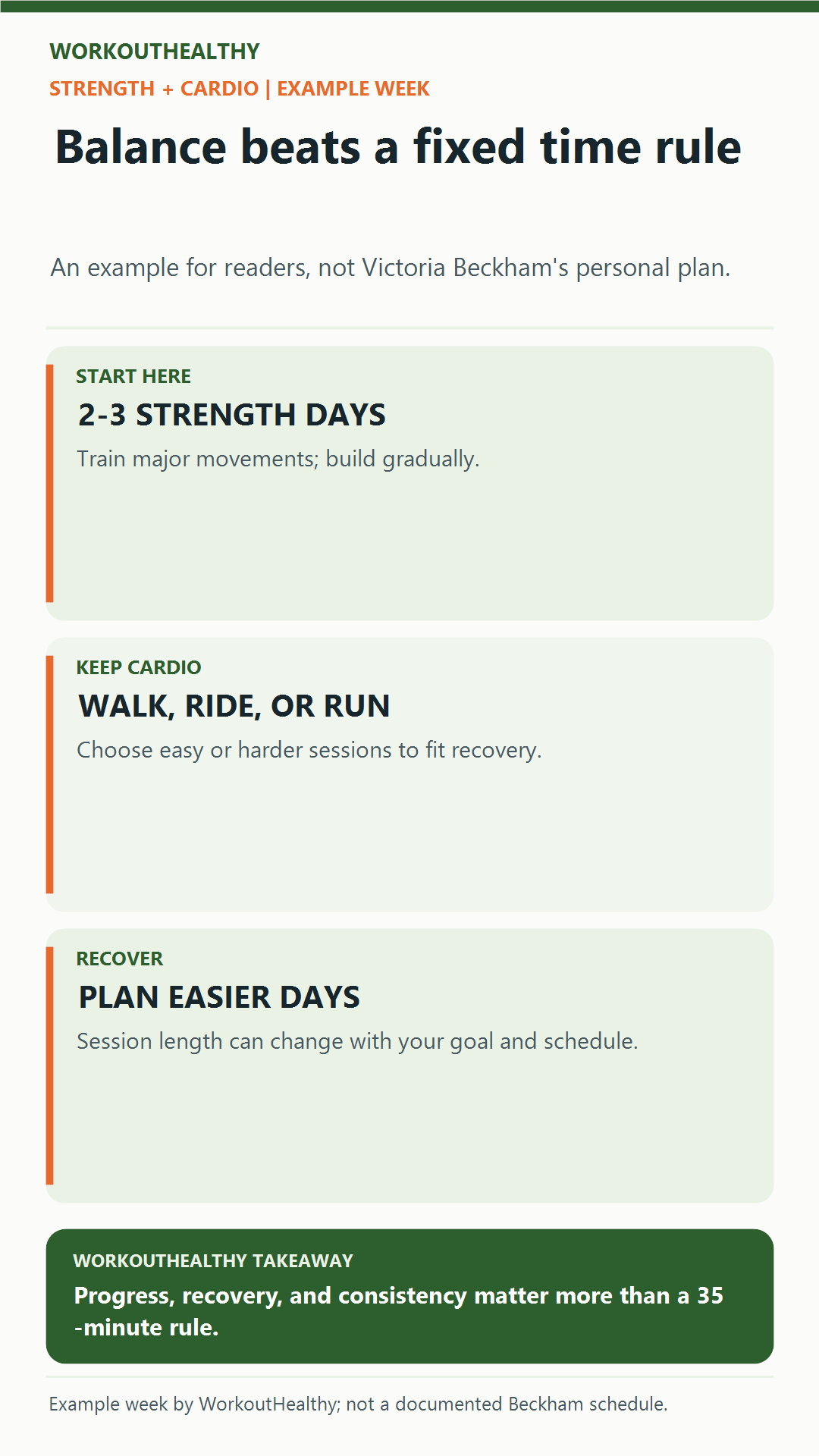
A strength session can include a squat or step, a hip hinge, a push, a pull, and a carry or trunk exercise. Two or three working sets per movement provide enough information to judge recovery before adding more.
Cardio intensity should vary rather than turning every day into a race. Easy work creates room for harder lifting and occasional intervals.
Strength Training After 40 Has Practical Value
Resistance training can help adults preserve or build strength and muscle as they age. It also loads bone, supports physical function, and makes everyday tasks easier when the exercises and dose are appropriate.
Those benefits do not require a celebrity schedule or fear-based claims about metabolism. A person can begin with machines, dumbbells, bands, or body weight and progress when the current dose feels repeatable.
Deadlifts and overhead squats appear in reports about Beckham, but neither is mandatory. A kettlebell hinge, leg press, goblet squat, landmine press, or supported row may better fit another person’s mobility and experience.
Posture and muscle definition also depend on more than one exercise. Strength can help a person hold and control positions, but no lift guarantees a particular silhouette or permanently corrects every variation in posture.
Adults who are returning after a long break can spend several weeks learning technique with moderate effort. Early consistency usually matters more than reproducing the exact load, exercise list, or training frequency of someone with years of coaching.
Persistent pain, pelvic-floor symptoms, dizziness, or a major medical condition deserves individualized advice. Strength training is adaptable, and modification is part of good programming.
The Real Shift Was From Burning to Building
Victoria Beckham’s story is useful because she changed the purpose of training after years of cardio-heavy work. She learned to value measurable strength and now uses a program that still includes cardiovascular exercise.
The evidence does not support a simple claim that heavy lifting fixed everything in 35 minutes. Her coach describes varied session lengths, changing blocks, adequate rest, and continued cardio.
The best takeaway is to stop judging a workout only by duration or calories. Build something measurable, keep enough aerobic work for health and endurance, and let the plan evolve when progress and recovery say it should.
Get the next evidence check.
Five practical fitness stories worth your time, every Friday.
One email a week. No product pitches. Unsubscribe in one click.
References
- Sprunk, C. (2017). Victoria Beckham’s earlier daily running and trainer routine. Women’s Health.
- Felbin, S. (2022). Bobby Rich on Victoria Beckham’s 35-to-90-minute sessions and measurable goals. Women’s Health.
- Conlon, S. (2023). Bobby Rich on Victoria Beckham’s strength, hypertrophy, power, endurance, and cardio blocks. Vogue.
- Woman & Home. (2025). Victoria Beckham on changing from a burn-focused cardio mindset.
- Currier, B. S., McLeod, J. C., Banfield, L., and colleagues. (2023). Resistance training prescription for strength and hypertrophy. British Journal of Sports Medicine.
- Schoenfeld, B. J., Ogborn, D., and Krieger, J. W. (2017). Weekly resistance-training volume and muscle growth. Journal of Sports Sciences.
- American College of Sports Medicine. (2026). Updated resistance-training guidelines.
Medical disclaimer: This article is for general information only and is not medical advice. If you have an injury, ongoing pain, or a medical condition, talk to a doctor or physical therapist before you change how you train or eat.