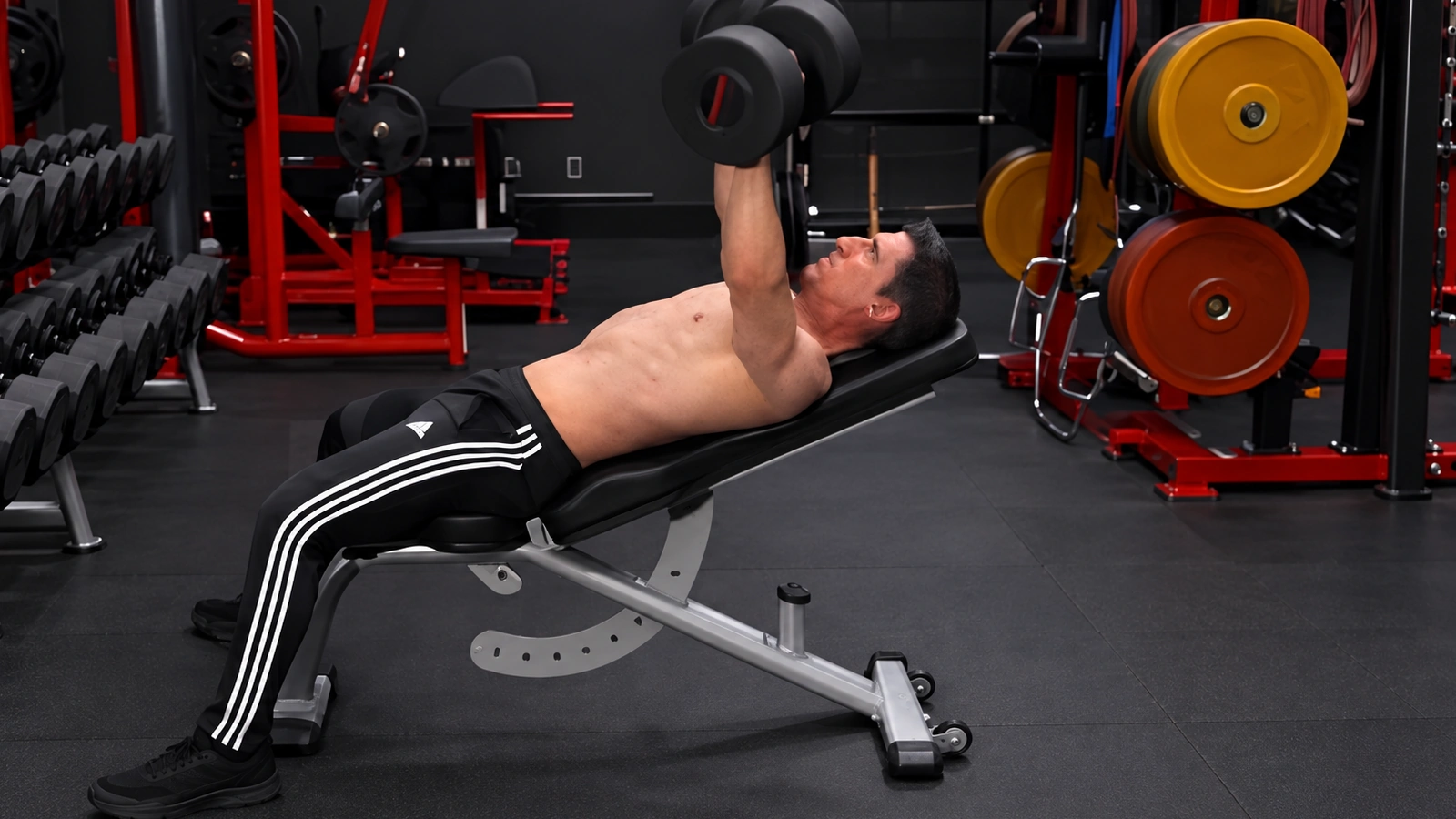

Illustration note: The featured image is illustrative. Use the original video at the end of this guide for the source’s movement demonstrations.
This two dumbbell chest workout is Jeff Cavaliere’s two-exercise combination: an incline dumbbell press and a floor-fly variation. His original presentation uses an adjustable bench and two dumbbell pairs, one heavier and one lighter.
The distinction matters: two base exercises does not mean an uninterrupted workout with only two fixed-weight dumbbells. Below is the actual sequence, its optional drop-set extensions and the limits of its safety and muscle-growth claims.
The source offers a demanding giant-set option, not a complete weekly training program. It suits readers who already understand these movements better than someone looking for a first workout or a shoulder-rehabilitation routine.
Check the equipment before you start
| Item | Role |
|---|---|
| Adjustable bench | A low incline, approximately 30 degrees in the source, for the press and incline squeeze press. |
| Heavier dumbbell pair | The original incline-press set. |
| Lighter dumbbell pair | The squeeze-press variation and floor work; also allows an immediate load drop. |
| Clear floor space | Room for the upper arms and weights, plus an unhurried transition off the bench. |
One adjustable pair can support separate sets if you stop to change its load. It cannot reproduce an immediate switch between two already prepared loads without that interruption.
A single fixed-weight pair may be suitable for one movement and unsuitable for another. Do not use your press load for a long-lever fly merely to keep the equipment list short.
If you have no bench, the incline portion is unavailable as shown. A floor-press alternative would be a different plan; this guide does not present it as the original incline routine.
The original sequence at a glance
The original source is ATHLEAN-X’s October 13, 2025 presentation, with the full public description and auto-generated captions identifying the sequence. Cavaliere first explains the two base movements, then shows ways to extend them.
| Movement | What the source specifies | Important distinction |
|---|---|---|
| Incline dumbbell press | Approximately 30-degree bench; a load allowing 8 to 10 repetitions to failure. | This is the source’s high-effort prescription, not a requirement for every reader. |
| Incline neutral-grip squeeze press | Use the lighter pair and press the dumbbells together. | Presented as a variation and an optional immediate follow-up to the heavier press. |
| Floor fly | Use the lighter pair; the floor limits the lowering depth. | The source’s optional drop-set example continues to failure before changing movement. |
| Neutral-grip floor press | Continue with the same pair after the fly becomes limiting. | A change in leverage, rather than a reduction in dumbbell weight. |
The optional giant set links heavier incline press, lighter incline squeeze press, floor fly and any remaining floor-press repetitions. It is one connected sequence, with the final extra repetitions conditional on what remains possible.
The presentation does not specify a number of rounds, rest between repeated rounds or weekly frequency. Treat it as a demonstration of one extended sequence, rather than a ready-made schedule for repeated rounds or a full week.
The load percentage also needs care: the opening captions and description say the lighter pair is 30 to 50 percent of the heavier pair, while later captions say 30 to 50 percent lighter. Those descriptions give different loads, so choose a manageable load for each movement rather than relying on either percentage.
Incline press and squeeze-press cues
Use a stable bench and a controlled setup, with the head and torso supported and the feet planted. Bring the dumbbells into position without rushing the transition or losing control of either weight.
Press and lower through a comfortable range while keeping the weights controlled. The source allows the hands and elbows to follow a less rigid path than a fixed bar, but that freedom does not make every position suitable for every shoulder.
For the squeeze variation, turn the palms toward each other and maintain contact between the dumbbells as you press. The inward squeeze adds voluntary adduction effort, while the triceps still contribute to extending the elbows.
Cavaliere presents that variation as an option for people who dislike the standard press. Pain is a reason to stop and assess the movement, rather than a signal to keep experimenting under fatigue.
Thirty degrees is the source’s chosen setting, not a proven ideal for all lifters. A bench-angle study in 14 trained men compared barbell conditions and acute electrical activity; it did not test long-term growth from this dumbbell routine.
Upper-pectoral activity did not differ across conditions over the complete lifting phase, although some differences appeared during a quarter of that phase. That is a narrower finding than declaring one angle the universal upper-chest winner.
Understand the floor-fly variation and its return
A conventional fly and an eccentric fly with a press return are not the same repetition. ATHLEAN-X’s written eccentric-floor-fly instructions describe lowering outward with a slight elbow bend, stopping when the upper arms touch the floor, then pressing back to the starting position.
That return changes the leverage instead of requiring a constant-angle fly back up. It should not be silently replaced by a cue to keep exactly the same elbow angle in both directions.
For the source’s eccentric variation, begin lying on the floor with the weights pressed above the chest. Lower outward under control with the described elbow bend, meet the floor gently with the upper arms, then use the press return.
Keep the load manageable and stop earlier if control or shoulder comfort is lost. The floor provides a depth boundary; it is not a surface to strike or a guarantee against an injury.
The source’s later fly-to-neutral-press drop changes the task again so that pressing can continue after the fly is limiting. Record the distinction between an eccentric fly with a press return and a separate squeeze-press continuation.
Using different leverage to return a load can emphasize the lowering phase even without changing the physical dumbbells. That explains the method more accurately than rejecting eccentric emphasis solely because the weight stays the same.
It still does not establish that the load exceeds your own fly-concentric maximum, that this is the best growth method or that your shoulders are protected from all risk. Those stronger conclusions need their own evidence.
What drop sets add, and what they do not prove
A 2026 systematic review and meta-analysis included 12 studies with 274 participants. It found no significant chronic hypertrophy or strength difference between drop-set and traditional training, alongside higher acute perceived effort and lactate with drop sets.
Those are general comparisons of studied protocols, not a trial of this exact incline-and-floor sequence. They support viewing drops as a possible time-efficient method with a fatigue cost, rather than a guaranteed growth upgrade.
The 2026 ACSM position stand also does not make training to failure obligatory. Do not confuse the source’s failure-based option with the only way these movements can be useful.
An extended sequence adds repetitions and demands that deserve their own log entry. There is no verified numerical rule here that turns one giant set into a particular number of ordinary sets.
Use the combination without inventing a new program
If you already have a suitable program, the two base movements can be discussed as exercise choices within it. Keep the program’s set allocation, recovery and other training visible when considering a substitution or optional drop.
| Situation | Useful decision |
|---|---|
| Learning the movements | Practice the setup and exit with manageable loads before considering the fatigue chain. |
| One adjustable pair | Pause to change loads and reset; acknowledge that this changes the immediate-drop format. |
| Considering the giant set | Review every transition and the existing weekly work; do not add unspecified rounds or treat it as mandatory. |
| Pain, instability or a rehabilitation restriction | Stop the affected movement and follow appropriate individual guidance. |
Log the bench setting, weight used for each movement, repetitions completed and whether a drop was included. Our training-log guide explains how to keep those comparisons useful.
Changing the angle, weight, movement and drop format together makes progress harder to interpret. Compare like with like before attributing a better session to a supposed activation trick.
This is a chest-focused combination, not a full-body training week. Our complete training-program guide covers the broader planning question.
The useful feature is a compact pair of movement choices with transparent equipment and effort requirements. The source’s stronger claims about perfect angles, risk removal and guaranteed growth are not necessary to understand or use those choices.
References
Lauver, J. D., Cayot, T. E., & Scheuermann, B. W. (2016). Influence of bench angle on upper extremity muscular activation during bench press exercise. European Journal of Sport Science, 16(3), 309 to 316. doi:10.1080/17461391.2015.1022605.
Havers, T., Micke, F., Geisler, S., & Held, S. (2026). Acute and chronic effects of drop-set training: A meta-analysis and systematic review. Sports Medicine – Open, 12, 38. doi:10.1186/s40798-026-01012-1.
Currier, B. S., et al. (2026). Resistance training prescription for muscle function, hypertrophy, and physical performance in healthy adults: An overview of reviews. Medicine & Science in Sports & Exercise, 58(4), 851 to 872. doi:10.1249/MSS.0000000000003897.
ATHLEAN-X. (2023, November 6). The best dumbbell exercises for chest. Related primary instructions for the eccentric floor fly, separate from the original 2025 combination.
ATHLEAN-X. (2026, January 16). Upper body dumbbell workout. Related primary written eccentric-floor-fly instructions, separate from the original combination.
Watch the original movement demonstrations
The original source is ATHLEAN-X’s The ONLY 2 Dumbbell Chest Exercises You Need (NO, SERIOUSLY!), published October 13, 2025. Useful chapter times are 0:33 for the incline press, 1:34 for the squeeze press, 2:31 for the floor fly and 4:32 for the final giant-set option.
Watch the original ATHLEAN-X video on YouTube if the embedded player does not load.
Medical disclaimer: This article is general fitness information, not medical advice. If you have an injury, ongoing pain or a medical condition, talk to a doctor or physical therapist before changing how you train.