

A popular fitness experiment claimed that training one muscle every day, instead of resting it, made that muscle grow up to four times faster.
The number is real, but it comes from three people, not a clinical trial.
That distinction matters.
Here is what the experiment actually tested, and what real research says about why the result happened.
What the 30 Day Experiment Actually Tested
Fitness coach Jeremy Ethier recruited three volunteers for a 30 day self experiment.
Each person trained one muscle daily on one side of their body while resting the other side 48 to 72 hours between sessions, the way most training programs recommend.
Brandon trained his chest, Max trained one leg, and Yolinda trained her biceps and triceps.
The everyday side did roughly 35 hard sets a week, compared to about 10 sets a week on the rested side.
All three volunteers had baseline and follow up MRI scans.
A muscle growth researcher analyzed the scans blind, without knowing which side was which, a real methodological strength for an informal project like this one.
Three people and a blinded MRI scan make a real case study, not proof that everyone should train a muscle every day.
Why More Volume, Not More Frequency, Likely Drove the Result
The MRI results were striking.
One volunteer’s daily trained side grew about 20 percent, compared to about 5 percent on his rested side.
The likely explanation is not that daily training has some special growth effect on its own.
It is that daily sessions let each person fit in far more total weekly hard sets than a normal twice a week routine allows.
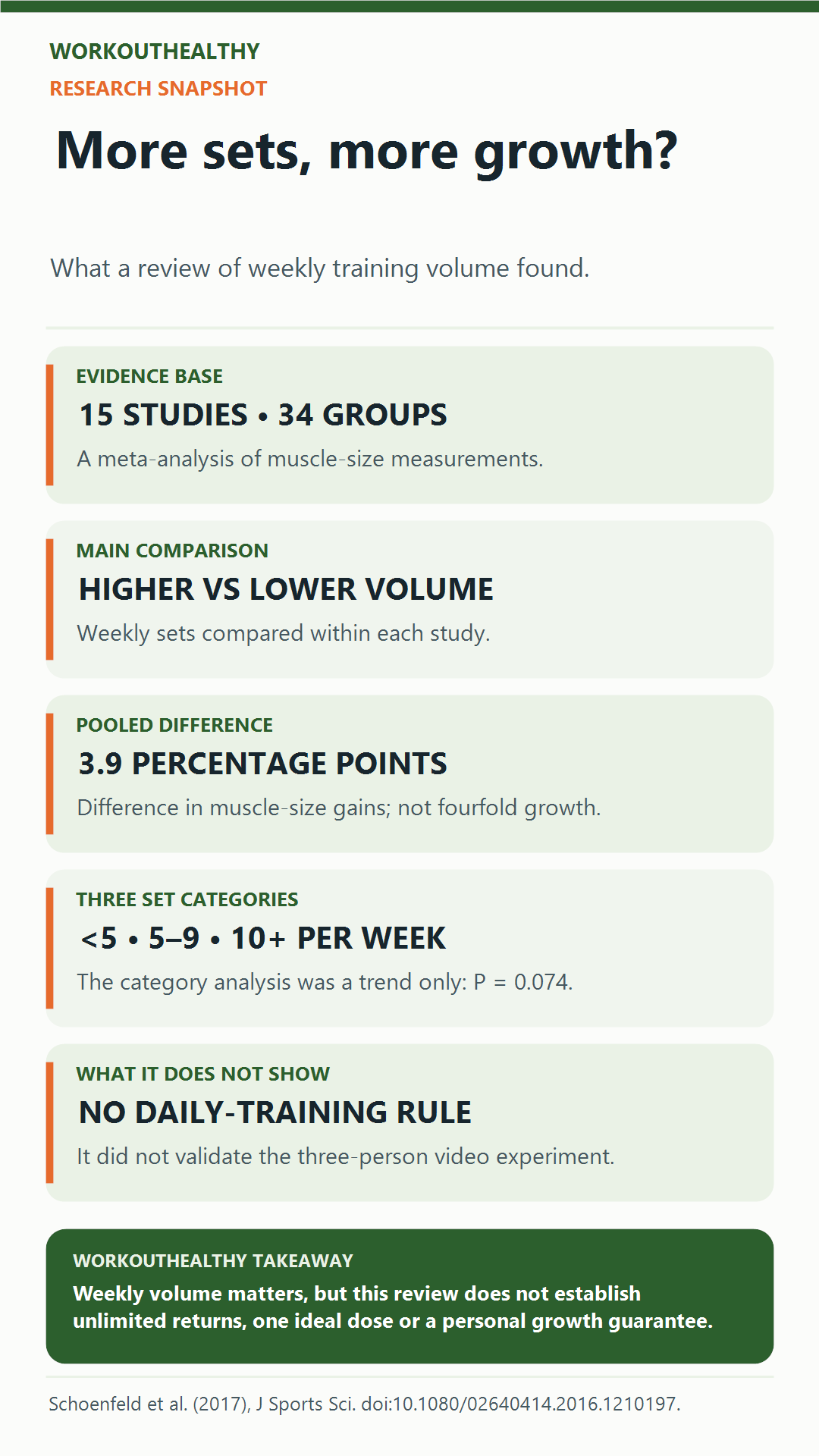
A systematic review and meta-analysis of resistance training studies found a clear dose response relationship between weekly sets and muscle growth, with more weekly volume producing more hypertrophy up to a point (Schoenfeld et al., 2017).
Daily training is one way to reach a high weekly volume. It is not the only way.
Why Frequency Itself May Also Play a Small Role
Volume is probably not the whole story, though.
A separate systematic review and meta-analysis looked specifically at training frequency, comparing muscle groups trained once a week against the same total volume spread across more sessions per week (Schoenfeld et al., 2016).
Training a muscle group twice a week produced more muscle growth than training it once a week, even when the total number of weekly sets was identical.
Going from twice a week to three times a week did not clearly add much more benefit, and the review found too few studies testing near daily frequencies to say what happens at that extreme.
Put together with the volume research, this points to two things happening in the daily training experiment at once.
More total sets very likely did most of the work.
But spreading those sets across more sessions each week may have added a small extra benefit on top of the volume itself, separate from it.
What This One Experiment Does Not Prove
Three people is not a sample size that supports a general training rule.
The volunteers were not randomly assigned, there was no true control group, and ordinary measurement error affects any single MRI comparison.
The everyday sides also came with real costs.
One volunteer’s daily trained leg became extremely sore early on, and joint and tendon strain was enough of a concern that everyone rotated exercises instead of repeating the same movement every session.
There is also no way to know from one before and after scan how much a recent hard session, hydration, or ordinary day to day fluid shifts affected the numbers.
None of that means the result is fake.
It means a single case study like this one raises a good question for researchers to test properly, rather than settling it.
It also helps to remember why this kind of video gets made in the first place.
A dramatic number like “four times faster” performs better than a modest one, so self experiments built for an audience have a built in reason to pick the most extreme comparison they can defend, not necessarily the most typical one.
How to Track Progress Without Access to an MRI
Almost nobody doing a specialization block has a lab willing to scan their muscle before and after, so progress has to be tracked with simpler tools instead.
A flexible tape measure around the same spot every two weeks, taken at the same time of day, gives a rough but useful trend line for a limb like an arm or a calf.
Strength on a main lift for that muscle is an even more reliable signal, since a muscle that is truly getting stronger and bigger will usually let you add weight or reps over time.
Progress photos in the same lighting and pose, taken every few weeks, catch shape changes that a tape measure and a strength number can each miss on their own.
Using two or three of these methods together gives a clearer picture than trusting any single one.
Common Mistakes People Make When Chasing High Frequency
The most common mistake is copying the extreme instead of the lesson.
Some lifters see “four times faster” and try to train every muscle daily, which usually wrecks recovery instead of speeding up growth.
A second mistake is adding a lot of volume without changing anything else about the week.
If you double or triple your weekly sets for a muscle but keep sleep, food, and stress the same, recovery becomes the limiting factor long before the extra sets can help.
A third mistake is picking one exercise and repeating it every session. That is exactly what caused joint strain in the original experiment.
Rotating exercises and angles spreads the mechanical stress across more tissue instead of loading one tendon or joint angle every single day.
A fourth mistake is stacking a new specialization block on top of an already full program instead of trading volume from somewhere else.
Adding daily direct arm work while also keeping every set of every other lift the same usually means total weekly training volume climbs past what the rest of the body can recover from, even if the arms themselves are fine.
Who Should Be Cautious With Very High Frequency Training
Beginners usually do not need this strategy at all.
A new lifter grows well on far less weekly volume than an experienced lifter needs, so adding daily sets mostly adds fatigue without adding much extra growth.
Anyone with a current joint, tendon, or ligament injury should treat daily direct work on that area as a bad idea until a doctor or physical therapist clears it.
The same caution applies to older lifters, since tendons and other connective tissue generally recover more slowly with age.
People dealing with a demanding job, poor sleep, or high life stress should also be careful.
Recovery is not just about the muscle itself.

It is about the whole body’s capacity to repair tissue, and chronic under sleeping or under eating shrinks that capacity no matter how advanced a lifter is.
Anyone managing a chronic health condition, particularly one that affects healing, inflammation, or blood flow, should check with a doctor before adding a lot of extra training volume for any single muscle, even if the movement itself feels manageable.
A Safer Way to Apply the Idea
You do not need to train a muscle every single day to capture most of the benefit.
A short specialization cycle works the same lever more safely.
Pick one or two lagging muscles, keep the rest of your program at its current volume, and add two or three focused sets to the priority muscle whenever you are already training.
Rotate between two exercises for that muscle so you are not stressing the same tendons every session.
A qualified coach can help you fit extra volume into a program without wrecking your recovery.
Consistency across weeks matters more than any single day’s session. Training with a reliable partner tends to make that consistency easier to sustain.
How to Progress a Specialization Block Step by Step
Start by moving your priority muscle from two sessions a week to three or four.
Keep each added session small, two to three sets of eight to twelve reps taken close to failure, so the extra work does not eat into recovery from the rest of your program.
Add roughly one more weekly set to that muscle every one to two weeks, as long as soreness fades within about 48 hours and your working weights are not sliding backward.
If a joint starts to ache during the movement itself, that is a signal to pull back the frequency or swap the exercise, not to push through it.
Run the specialization block for four to eight weeks, then bring that muscle back down to its normal volume for a few weeks before starting another block, either on the same muscle or a different one.
This on and off pattern gives connective tissue time to catch up between pushes.
You know it is working when your main lift for that muscle keeps getting stronger week to week and normal soreness starts settling down faster than it did in the first week.
If soreness keeps getting worse instead of better, or one specific joint angle starts to hurt, that is your cue to cut volume back before it turns into an overuse injury.
The real lesson from this experiment is about weekly volume, not about worshipping frequency for its own sake.
For a broader look at how consistent resistance work pays off later in life, see our review of what resistance training research shows about brain health, and our breakdown of what a real meta-analysis found about jump training and muscle growth.
Watch the Original Video
Get the next evidence check. Subscribe to WorkoutHealthy Insider for practical explanations behind popular fitness claims.
References
Schoenfeld, B. J., Ogborn, D., & Krieger, J. W. (2016). Effects of resistance training frequency on measures of muscle hypertrophy: A systematic review and meta-analysis. Sports Medicine, 46(11), 1689 to 1697. https://doi.org/10.1007/s40279-016-0543-8
Schoenfeld, B. J., Ogborn, D., & Krieger, J. W. (2017). Dose-response relationship between weekly resistance training volume and increases in muscle mass: A systematic review and meta-analysis. Journal of Sports Sciences, 35(11), 1073 to 1082. https://doi.org/10.1080/02640414.2016.1210197
This article is for general information only and is not medical advice. If you have an injury, ongoing pain, or a medical condition, talk to a doctor or physical therapist before you change how you train or eat.