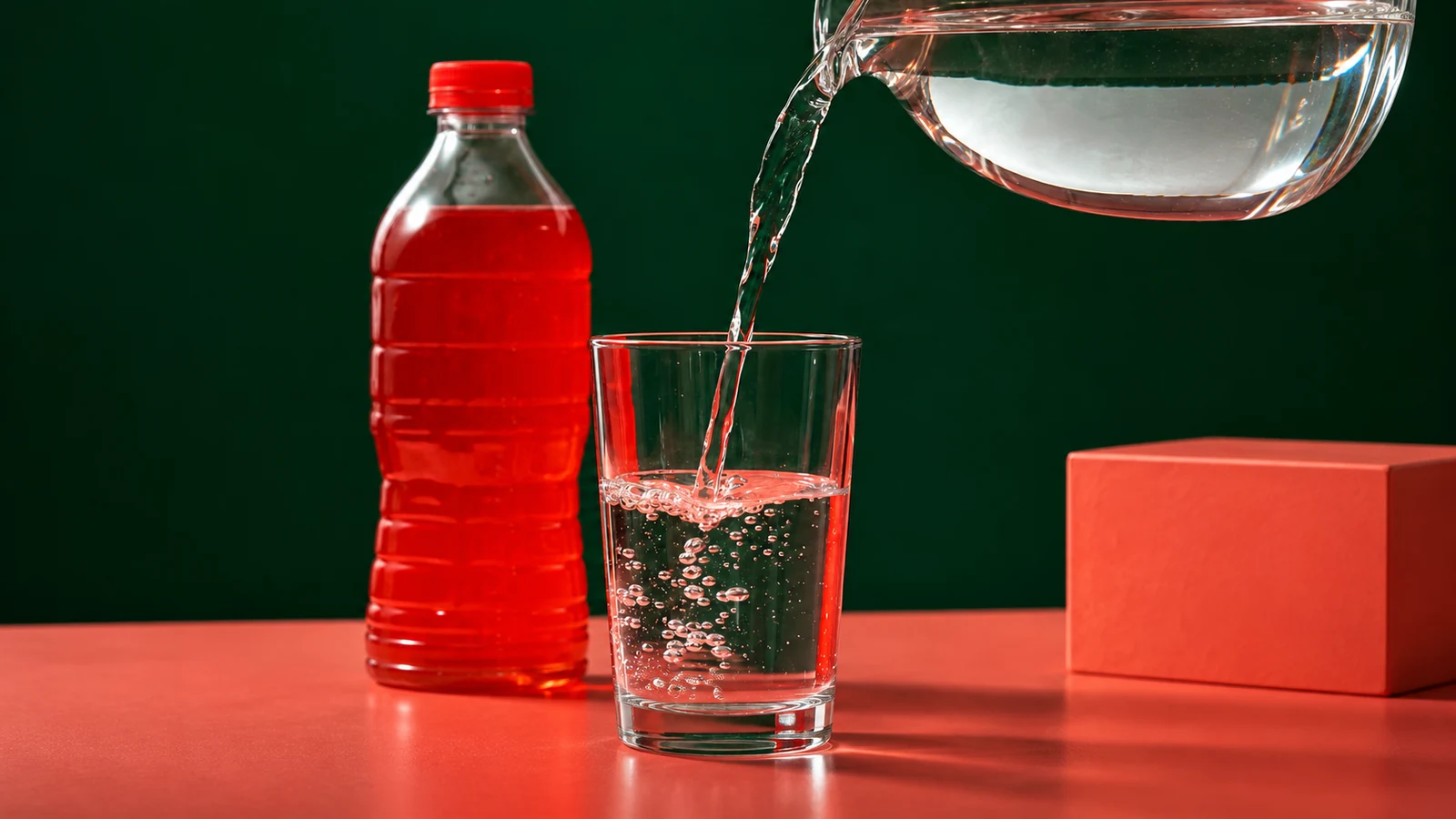

A drink can be an easy part of lunch to overlook. A 12-ounce regular soda contains roughly 155 calories and about 10 teaspoons of sugar in the example published by the Centers for Disease Control and Prevention (CDC). Sweet tea, lemonade, energy drinks, fruit drinks, and flavored coffee can add sugar too. Those numbers make a water swap worth considering, but they do not mean that one choice will automatically change your weight or blood glucose.
The useful question is more specific: Which drink are you replacing, how much of it do you usually pour, and what do you drink or eat afterward? A zero-calorie glass of water replaces the calories and added sugar in that particular serving. The longer-term effect depends on the rest of your day.
Which drinks count as sugar-sweetened beverages?
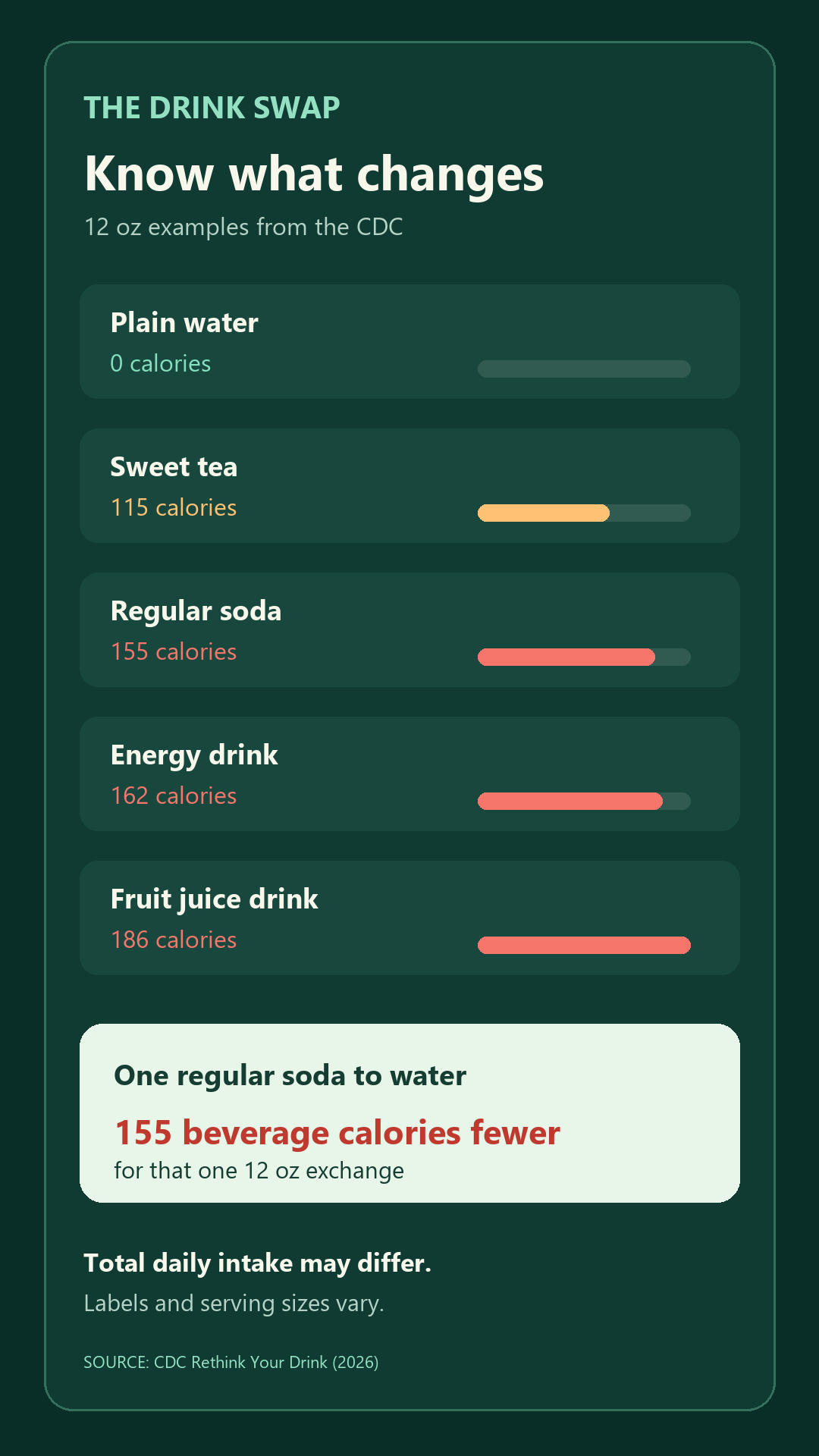
A sugar-sweetened beverage is a drink with sugar added during manufacturing or preparation. The CDC includes regular soda, fruit drinks, sports drinks, energy drinks, sweetened water, and coffee or tea with added sugar. A bottle labeled “fruit” or “natural” can still belong in this group. The ingredients and Nutrition Facts label are more useful than the front-of-package wording.
Serving size matters. A 20-ounce bottle is not the same as a 12-ounce can, and a coffee shop drink can combine sweetened syrup, sweetened cream, and a large serving. The CDC’s examples put a 12-ounce sweet tea at seven teaspoons of sugar and 115 calories, while a 12-ounce regular soda has about 10 teaspoons and 155 calories. These are examples, not universal values; recipes and products vary.
Juice needs a separate explanation. A drink made with added sugar is a sugar-sweetened beverage. Pure fruit juice may have no added sugar, but it still supplies free sugars and energy. The World Health Organization (WHO) includes sugars naturally present in fruit juice and juice concentrate in its “free sugars” guidance. Whole fruit has fiber and a different eating experience, so a glass of juice is not interchangeable with a piece of fruit.
Label check: Look first at the container size and servings per container, then at “Added Sugars.” A bottle with two servings doubles the per-serving sugar and calorie figures if you drink it all. For coffee or tea made to order, check the posted nutrition information or ask what is added.
What changes when you replace one drink with water?
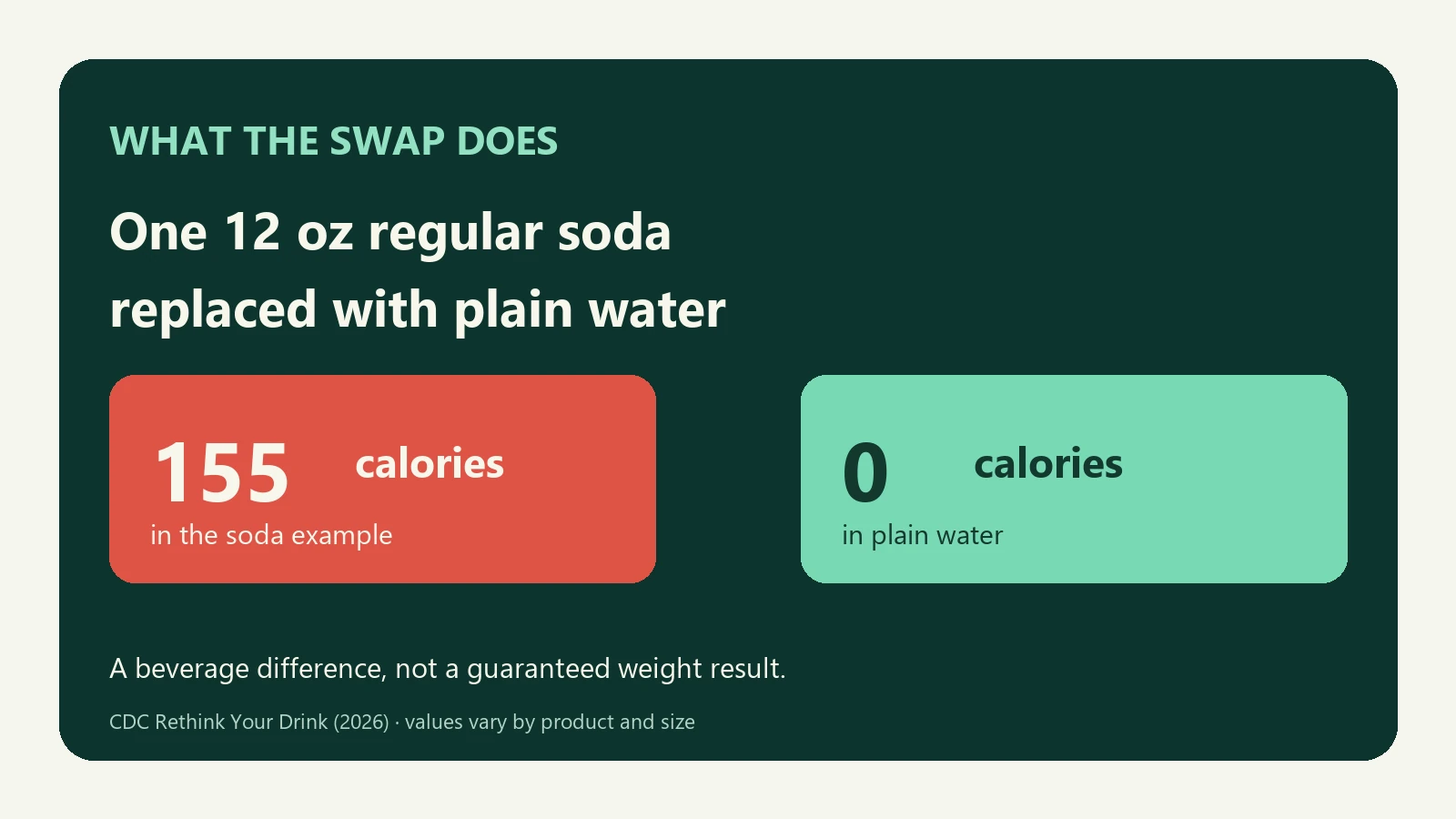
Water contains no added sugar and essentially no calories. If the drink it replaces has 155 calories, that specific exchange removes about 155 beverage calories from the occasion. It also avoids the sugar in that serving. This is straightforward substitution arithmetic, not a promise about the scale.
For example, replacing one 12-ounce regular soda each day would remove approximately 1,085 calories from those drinks over seven days, assuming the same soda, size, and frequency. A larger drink produces a larger beverage difference; a smaller drink produces a smaller one. The number is an accounting illustration. People may change what they eat later, and appetite, activity, medication, and metabolic needs all matter.
The useful win is the drink you actually replaced. Track that exchange before predicting a weight result.
This distinction prevents a common overstatement in social posts: “Every swap quietly cuts calories” is true only for the drink itself. Total daily calories fall if other intake does not fully replace them. The practical value remains real because a frequent drink is a repeatable choice, and repeating a manageable choice can make a dietary pattern easier to change.
If you are already tracking intake, avoid counting both the original drink and a hypothetical “saved” amount. Record the beverage you actually drank. For broader context on what tracking tools can and cannot measure, see our guide to calorie-tracking accuracy.
Why can beverage calories be easy to miss?
Liquid calories do not always produce an equal reduction in food eaten later. In a small randomized meal experiment with 29 adults, researchers offered a pizza meal with water, diet cola, regular cola, orange juice, or milk. Pizza intake was similar across conditions, while the energy-containing drinks raised total meal energy compared with water or diet cola. That finding supports a narrow point: at that meal, participants did not reduce pizza enough to offset the beverage calories.
Another controlled trial compared a sugar-sweetened soft drink, milk, a noncaloric soft drink, and water. The researchers found that energy from the drinks was not compensated by lower intake at the next meal in their study. But satiety is not identical for all liquids. Milk carries protein and other nutrients, a smoothie can include fiber, and meal timing changes the experience. The claim that “all liquids are never filling” goes beyond the evidence.
Context matters as well. A drink taken to quench thirst may register differently from a planned snack. None of these experiments proves that every person overeats after a sweet beverage. They explain why it is reasonable to inspect a habitual beverage when a person wants to reduce added sugar or calories without changing a main meal.
If the question is about a sweet craving rather than thirst, changing the drink alone may not solve it. Our sugar-cravings evidence check covers food, sleep, and flexible habits that may be more relevant.
What does the broader health evidence say?
Frequent sugar-sweetened beverage consumption is associated with weight gain, type 2 diabetes, heart disease, dental cavities, and other adverse outcomes in the CDC’s evidence summary. “Associated” is deliberate language: observational studies cannot prove that a given soda caused a specific person’s disease. They can still identify a dietary pattern worth changing, especially when combined with trials and the simple fact that these drinks provide added sugar and energy.
WHO recommends keeping free sugars below 10% of total energy intake and suggests a further reduction below 5%. That limit applies to an overall diet, not just drinks. For a person eating 2,000 calories a day, 10% is 200 calories from free sugars, or about 50 grams. A single large sweetened drink can take a substantial share of that amount. WHO’s guidance also reflects dental health, so the reason to limit sugar is not limited to body weight.
The effects of a drink on blood glucose depend on the person, beverage, serving size, meal context, and treatment. Replacing a sugary drink with water removes that drink’s sugar and can avoid its direct glucose load; it does not guarantee a specific glucose reading or make water a diabetes treatment. The original Facebook caption’s hydration reference is an exercise fluid-replacement position stand, which does not establish the sugar-swap claims. The beverage and nutrition sources below are the appropriate support for this article.
A water swap removes the sugar in the replaced drink. It does not promise weight loss, prevent diabetes, or replace a personal care plan.
Is a diet drink an acceptable alternative?
For a person who normally drinks regular soda, a zero-calorie or low-calorie sweetened version can reduce beverage sugar and calories. The CDC notes possible short-term calorie reductions while acknowledging uncertainty about long-term weight management. Water is a simple default because it has no sweetener, sugar, or calories, but insisting on water as the only useful substitution can make a realistic change harder for some people.
Longer studies also resist a simplistic “diet drinks are always worse” story. A 52-week randomized trial compared non-nutritive-sweetened beverages with water during a behavioral weight-management program. Its setting, participants, and intervention do not answer every question about lifelong use, but the trial is a reminder to distinguish a direct head-to-head comparison from speculation. The important first step for this article is replacing a drink with added sugar, whether the sustainable alternative is water, unsweetened tea, or a lower-sugar bridge.
Plain milk can supply protein and minerals but also supplies calories; it is a food choice as well as a drink. Unsweetened coffee and tea are low-calorie options for many adults, while caffeine tolerance and sleep still matter. Sparkling water can help someone who likes carbonation, provided the chosen product is unsweetened. Read the label rather than assuming every flavored seltzer is identical.
A practical one-drink plan that does not require perfection
Start with a repeatable moment: the soda with lunch, the sweet tea on the commute, or the afternoon energy drink. Note the usual size and how often you have it. Then choose an alternative you will actually have ready at that time. A visible bottle of cold water, unsweetened sparkling water, or tea can remove the extra decision when the habit cue arrives.
- Choose one drink. Do not try to overhaul every beverage at once.
- Check the serving. Compare the actual bottle or order, not an idealized 12-ounce example.
- Prepare the substitute. Put it where the old drink would normally be.
- Repeat for a week. Notice whether the swap is easy, inconvenient, or leaves you wanting a snack.
- Adjust. If water feels abrupt, try unsweetened flavored water, sparkling water, or a smaller sweetened serving while building the habit.
Flavor without much added sugar can be simple: citrus, cucumber, berries, mint, or a splash of juice in a larger glass of sparkling water. A splash of juice adds some sugar and calories, so it is a flavoring rather than a magic zero-calorie product. If you need a beverage during prolonged, intense exercise, your fluid and carbohydrate needs may differ from an ordinary desk-day lunch. Do not automatically substitute plain water for a prescribed sports nutrition plan.
Pay attention to the reason for the original drink. If you wanted caffeine, an unsweetened caffeinated option may fit better than plain water. If you wanted a dessert, a small planned sweet drink might be more satisfying than repeatedly replacing it and eating something else. A useful plan makes the tradeoff explicit rather than treating all sugar as a moral failure.
When should the advice be individualized?
People with diabetes may need to account for beverage carbohydrates, medication, glucose monitoring, and hypoglycemia treatment. Sugary drinks can be medically useful when treating low blood sugar according to a personal care plan; water cannot fill that role. Anyone using glucose-lowering medication should follow the clinician’s instructions rather than treating a general article as individualized advice.
Children, pregnant people, endurance athletes, people with fluid restrictions, and those with swallowing or kidney conditions may have different needs. “Drink more water” is not automatically safe at unlimited amounts. The focused advice here is to consider a reasonable replacement for a routine sweetened beverage, not to force large volumes of water.
Also watch the social context. Sharing a special drink occasionally is different from a daily large beverage. A plan that allows choice and enjoyment is more likely to last than a rule that treats one drink as a failure. If you have a history of disordered eating, a calorie tally may be unhelpful; discuss nutrition changes with an appropriate professional.
The takeaway
Replacing a regular sugary drink with water removes the sugar and calories in that particular drink. Research suggests beverage calories can add to meal energy without complete compensation, and public-health guidance supports reducing free sugars. Neither point guarantees weight loss from one swap. Pick a drink you have often, check its actual serving, prepare an alternative, and judge the habit by what you can repeat.
Sources
- CDC, Rethink Your Drink (2026), beverage examples and practical substitutions.
- CDC, Sugar-Sweetened Beverage Consumption (2026), definitions and health associations.
- WHO, Reducing Free Sugars Intake in Adults, guidance and definition of free sugars.
- Panahi and colleagues, 2013, randomized meal-time beverage experiment.
- Maersk and colleagues, 2012, controlled beverage satiety trial.
- Rogers and colleagues, 2023, 52-week water versus non-nutritive-sweetened beverage trial.