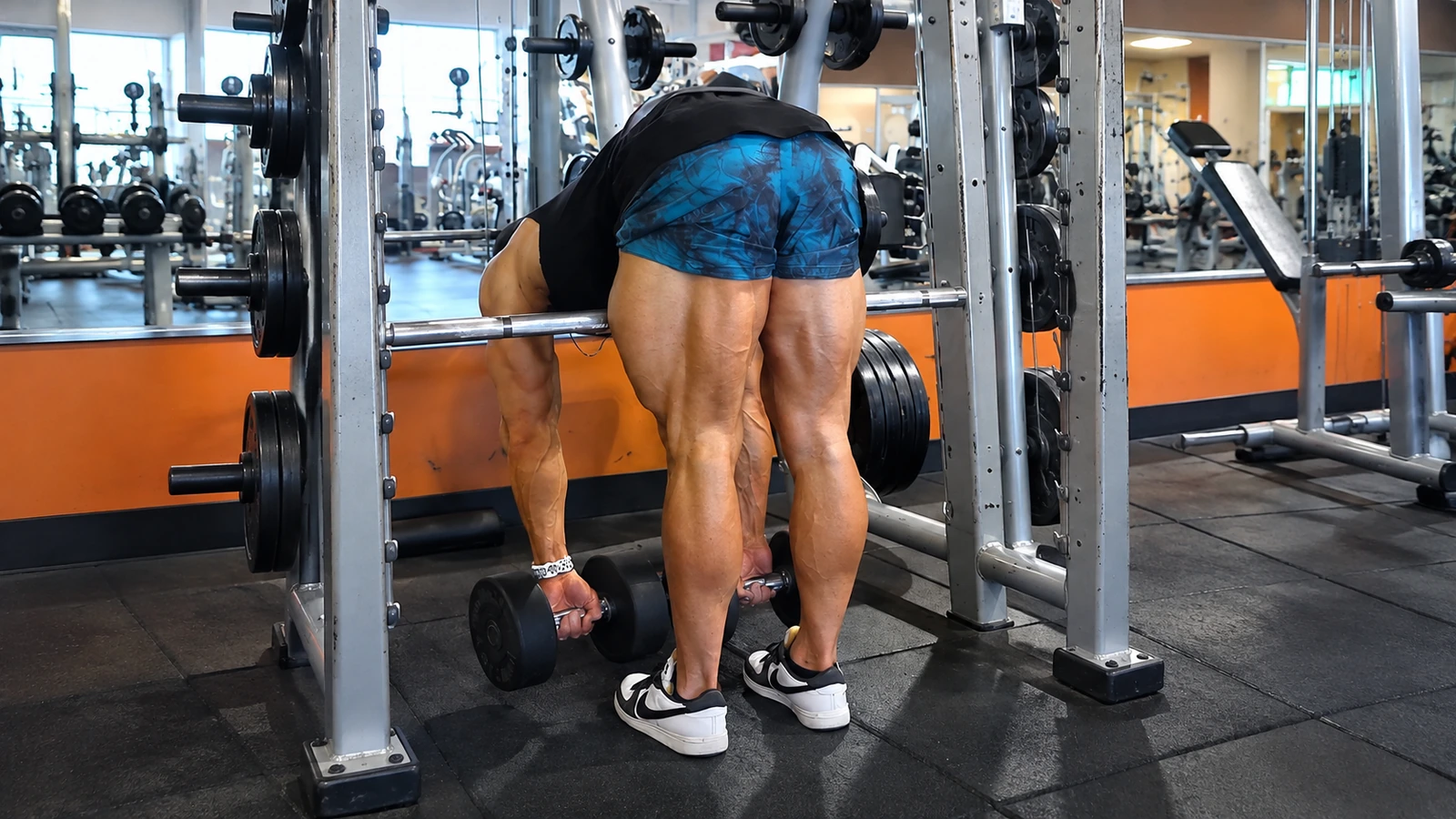

Image note: The lead still depicts a thigh-braced dumbbell hinge, but cannot establish bar locking, contact pressure or a complete repetition. The later dowel photograph is a general hinge illustration.
A supported dumbbell Romanian deadlift can mean several exercises, including a single-leg hinge with a hand on a rack. This guide examines the bilateral variation in which the fronts of the thighs meet a fixed Smith-machine bar while both hands hold dumbbells.
The brace may make the movement feel steadier, but a stronger stretch sensation does not establish greater muscle growth. The useful question is whether the setup helps you perform a controlled hip hinge without adding uncomfortable bar pressure or chasing unnecessary depth.
Which Supported Dumbbell RDL Is This?
Exercise names can hide important differences in support and loading. Identify what touches the support and what actually supplies resistance before borrowing instructions from another variation.
| Exercise | Support and load | What makes it different |
|---|---|---|
| Thigh-braced dumbbell RDL | Both feet stay down; thighs meet a fixed bar; dumbbells move. | The bar is a contact point, not the weight being lifted. |
| Hand-supported single-leg RDL | One hand holds a support while one leg performs the hinge. | The stance, balance task and available hand differ. |
| Wall-cued dumbbell RDL | The hips reach back toward a wall; hands hold dumbbells. | The wall supplies a target behind the hips, not a brace across the thighs. |
| Loaded Smith-machine RDL | The hands lift the Smith bar along its guides. | The moving bar supplies resistance; this is a different exercise. |
The thigh-braced version remains a hip hinge: the hips move back and then return toward standing. Bracing the legs against something does not turn a deeper forward bend into a better repetition.
What Albonetti’s Original Clip Actually Establishes
In his November 12, 2025 Instagram reel, Abel Albonetti demonstrates a two-dumbbell hinge with both feet grounded and his thighs against a Smith bar. His caption describes placing the quads against the machine and limiting the stretch to a comfortable range.
He also reports feeling a stronger hamstring stretch with less weight than in a plain dumbbell stiff-leg deadlift. That is his description of the experience, rather than a measured comparison of muscle force, activation or growth.
The support is an option, not permission for every lifter to push the hips farther back. The caption’s comfort limit does not establish a universal depth, bar height or amount of bodyweight to lean into the bar.
Muscle & Fitness subsequently covered the variation and embedded the reel, including comments about next-day soreness. A social demonstration and follower reactions cannot tell us how this setup performs against an ordinary RDL over months of training.
The original demonstration and caption are attributed to @abelalbonetti on Instagram, reel DQ9Lz0lgLOM. The clip is movement context, not a machine-specific safety inspection or a complete training program.
Stretch, Load and Growth Are Different Claims
A stable contact point can change the balance problem, but it also adds another force acting on the body. Without measuring that contact force and the lifter’s joint positions, the dumbbell labels alone cannot tell us how much demand reaches the hamstrings.
| Claim or observation | What it tells you | What it cannot establish |
|---|---|---|
| Albonetti reports needing less dumbbell weight. | He prefers a lighter load for the sensation he describes. | An equivalent hamstring training dose, a percentage reduction or lower spinal loading. |
| The stretch feels stronger. | A subjective sensation has changed. | Measured fascicle length, greater muscle tension or superior hypertrophy. |
| The brace feels steadier. | The support may reduce a balance distraction for that lifter. | That every machine or contact position is suitable, or that the brace prevents injury. |
| Someone is unusually sore afterward. | The session produced a noticeable response. | Which exercise will build more muscle or whether another hard session is appropriate. |
This also explains why matching the same dumbbell weight is not a laboratory comparison. Changing the brace pressure, knee bend, hip travel or tempo changes more than the exercise name.
What the Hamstring Studies Actually Tested
The research below helps explain hamstring training, but none of these studies compared this exact Smith-bar thigh brace with an unsupported dumbbell RDL. Results from leg curls, barbell RDLs and general deadlift recordings should keep their original labels.
| Study | Actual comparison and measurement | Relevant limit |
|---|---|---|
| Maeo and colleagues, 2021 | Twenty healthy adults trained seated curls with one leg and prone curls with the other for 12 weeks; MRI showed greater whole-hamstring volume gains in the seated condition. | A controlled leg-curl comparison supports studying muscle length; it does not validate a felt stretch or this bar brace. |
| Crawford and colleagues, 2025 | Thirty-two healthy young adults were assigned to eccentrically biased barbell RDLs or Nordic hamstring exercise for six weeks; ultrasound assessed architecture and cross-sectional area. | There was no Smith thigh brace and no unsupported-versus-supported dumbbell comparison. |
| Martín-Fuentes and colleagues, 2020 | A systematic review examined surface electrical recordings during deadlifts and their variants. | Electrical activity during an exercise is a different endpoint from muscle growth after training. |
The Crawford trial is especially easy to overread: its pooled hamstring cross-sectional area increased, while measured biceps femoris long-head thickness did not change. The groups did not differ significantly in those outcomes, so the study cannot rank the thigh-braced variation above a standard RDL.
The RDL group used a barbell, and the researchers matched repetitions, perceived effort and the length of the lowering phase across groups. That supervised protocol provides no conversion from an ordinary dumbbell load to a supported load.
These findings leave room to choose an exercise for a practical reason such as comfortable control. They do not establish that a novel support adds growth, nor that a specific lowering duration from a research protocol should become everyone’s routine.
Setup and Range: Keep the Hinge, Check the Support
This variation is most understandable if you already know how to perform an ordinary dumbbell RDL. If the hip hinge itself is unfamiliar, learning that movement first avoids combining a new technique with an unfamiliar contact point.
Before using a machine as a brace, have gym staff confirm that the bar is securely racked and the machine permits that use. The reel does not establish a universal hook position, safety-stop arrangement or contact height for other machines and bodies.
- Establish the contact without a working load. The demonstrated support is across the fronts of the thighs, not the knees or abdomen; abandon the setup if contact is painful or the bar moves.
- Start with both feet grounded and dumbbells under control. Use a load you can handle without needing to lurch into position or lean heavily onto the bar.
- Keep a small knee bend as you hinge back. Let the movement come from the hips rather than repeatedly bending the knees to sink lower.
- Keep the dumbbells close and the arms long. Avoid reaching them forward to create the appearance of more range.
- End the descent while you can control your trunk and pelvis. A comfortable hamstring stretch can accompany the hinge, but touching the floor or making the back parallel to it is not a required target.
- Return to standing under control. Finish the hip extension without leaning backward or using the brace to bounce out of the bottom.
The general hip-back, soft-knee and controlled-trunk principles are consistent with standard dumbbell RDL instruction from NASM. Adding a support does not make the source’s personal range a template for another lifter.
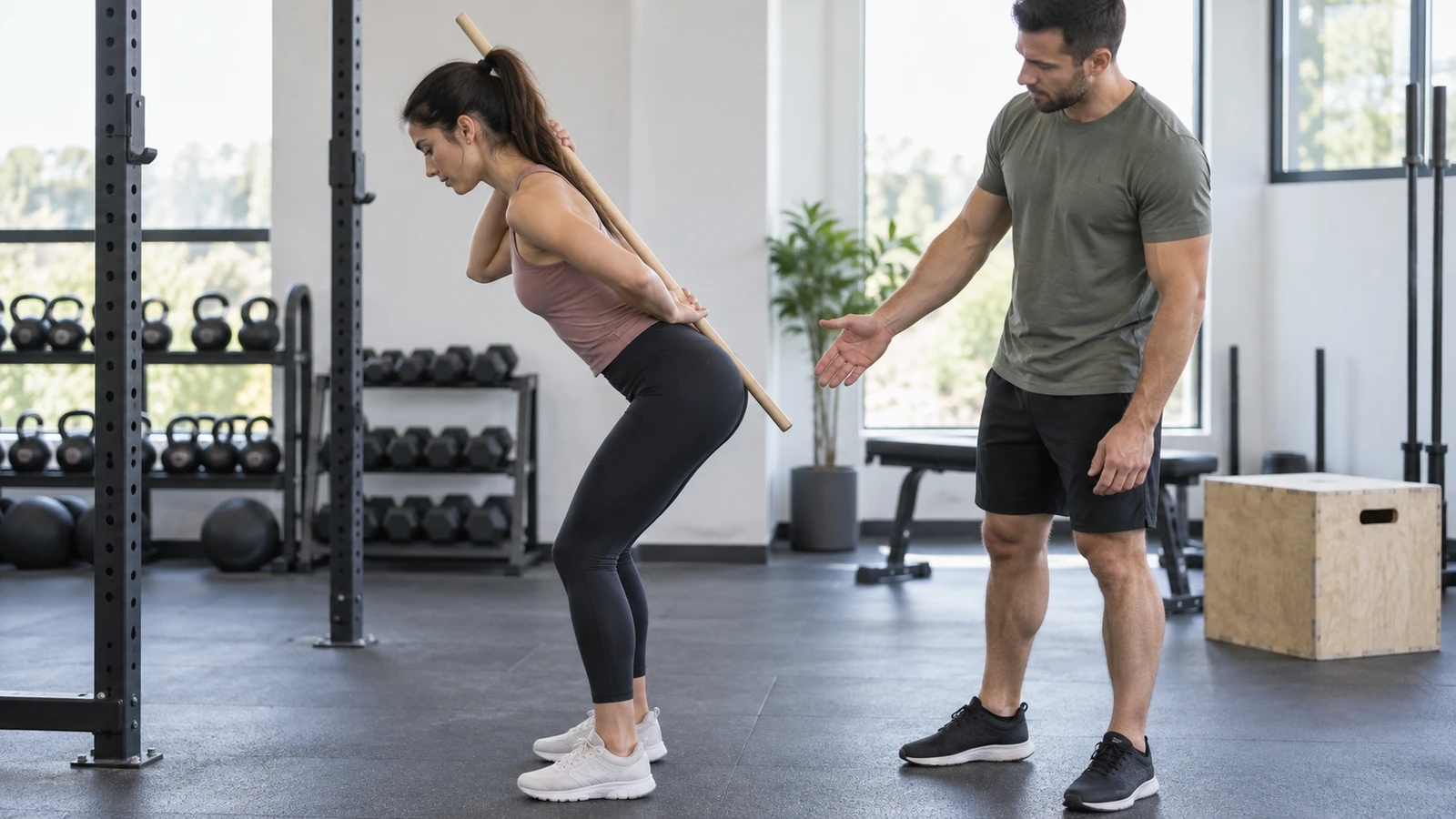
A side-view recording can help you notice changes in knee bend, dumbbell path and trunk position. It cannot measure internal muscle length, contact force or injury risk.
Sharp pain, numbness or radiating symptoms are reasons to stop and seek appropriate assessment. Do not use a stronger stretch or a supported position as a test of whether an existing back or hamstring problem is safe to train through.
Compare the Practical Fit Without Pretending to Test Growth
If you already have an appropriate RDL place in your training, record what changes when the support is introduced. This is an observation framework, not a new prescription for sets, repetitions, tempo or a return from injury.
| Record | Why it matters | Keep the interpretation modest |
|---|---|---|
| Variation, machine, bar contact and stance | Makes the setup identifiable when you repeat it. | A different contact position may be a different comparison. |
| Load in each hand and repetitions performed | Keeps the external work description clear. | Two lighter dumbbells do not prove equal muscle loading. |
| Balance distraction, bar comfort and control | Addresses the practical reason for adding support. | Feeling steadier is useful feedback, not proof of greater growth. |
| Range and visible changes in knee or trunk position | Helps identify whether extra depth came from the intended movement. | A deeper dumbbell endpoint is not a measurement of hamstring stretch. |
| Perceived effort and later symptoms or soreness | Adds context that the load number misses. | Do not turn soreness into a score or a signal to repeat a painful setup. |
For an arithmetic example only, two 12-kilogram dumbbells total 24 kilograms, while two 10-kilogram dumbbells total 20 kilograms. That is 4 kilograms less external dumbbell load; it does not mean hamstring tension fell by the same amount or that the training stimulus stayed equal.
Comparing your first unsupported session with one novel supported session cannot isolate the brace’s effect. Familiarity, effort, fatigue and the rest of the session may differ, so use the record to decide whether the movement fits your training rather than declaring a winner for hypertrophy.
When the Support Adds Value, and When It Adds Friction
The variation may be worth keeping when comfortable, stable contact removes a balance distraction and you can repeat a controlled hinge. It adds little when the standard RDL already feels controlled, the machine is unavailable or the contact makes setup awkward.
There is no requirement to find the deepest version or the one that causes the most soreness. In a small study of young men, Damas and colleagues measured muscle damage, protein synthesis and later quadriceps growth, illustrating that early damage responses and hypertrophy are not interchangeable outcomes.
That study did not test hamstring soreness after this variation. It should not be presented as a formula for deciding whether your next session is appropriate.
If another hinge is a better practical match, our guide to deadlift alternatives by goal explains distinct options. Changing an exercise is useful when it solves an identifiable training problem, not simply because the variation looks novel.
The supported dumbbell RDL is a legitimate variation to understand, with an unproven claim of superior growth. Keep the difference between a useful sensation, a repeatable movement and a measured adaptation clear.
Get the next evidence check.
Five practical fitness stories worth your time, every Friday.
One email a week. No product pitches. Unsubscribe in one click.
References
Albonetti, A. [@abelalbonetti]. (2025, November 12). Smith-machine-supported dumbbell RDL demonstration [Reel and caption]. Instagram, reel DQ9Lz0lgLOM.
National Academy of Sports Medicine. (n.d.). Dumbbell Romanian deadlift. Exercise library.
Maeo, S., Huang, M., Wu, Y., et al. (2021). Greater hamstrings muscle hypertrophy but similar damage protection after training at long versus short muscle lengths. Medicine & Science in Sports & Exercise, 53(4), 825 to 837. PubMed.
Crawford, S. K., Sandberg, C., Vlisides, J., et al. (2025). Hamstrings muscle architecture and morphology following 6 wk of an eccentrically biased Romanian deadlift or Nordic hamstring exercise intervention. Medicine & Science in Sports & Exercise, 57(8), 1799 to 1809. Full primary paper.
Martín-Fuentes, I., Oliva-Lozano, J. M., & Muyor, J. M. (2020). Electromyographic activity in deadlift exercise and its variants: A systematic review. PLOS ONE, 15(2), e0229507. PubMed.
Damas, F., Phillips, S. M., Libardi, C. A., et al. (2016). Resistance training-induced changes in integrated myofibrillar protein synthesis are related to hypertrophy only after attenuation of muscle damage. The Journal of Physiology, 594(18), 5209 to 5222. PubMed.
Fitness disclaimer: This article provides general fitness information, not personal medical advice or an individualized training plan. If you have an injury, ongoing pain or a medical condition, consult an appropriately qualified healthcare professional before changing your training.