

Running and junk food were tested together in a 2025 University College Cork study, but the viral conclusion runs farther than the evidence.
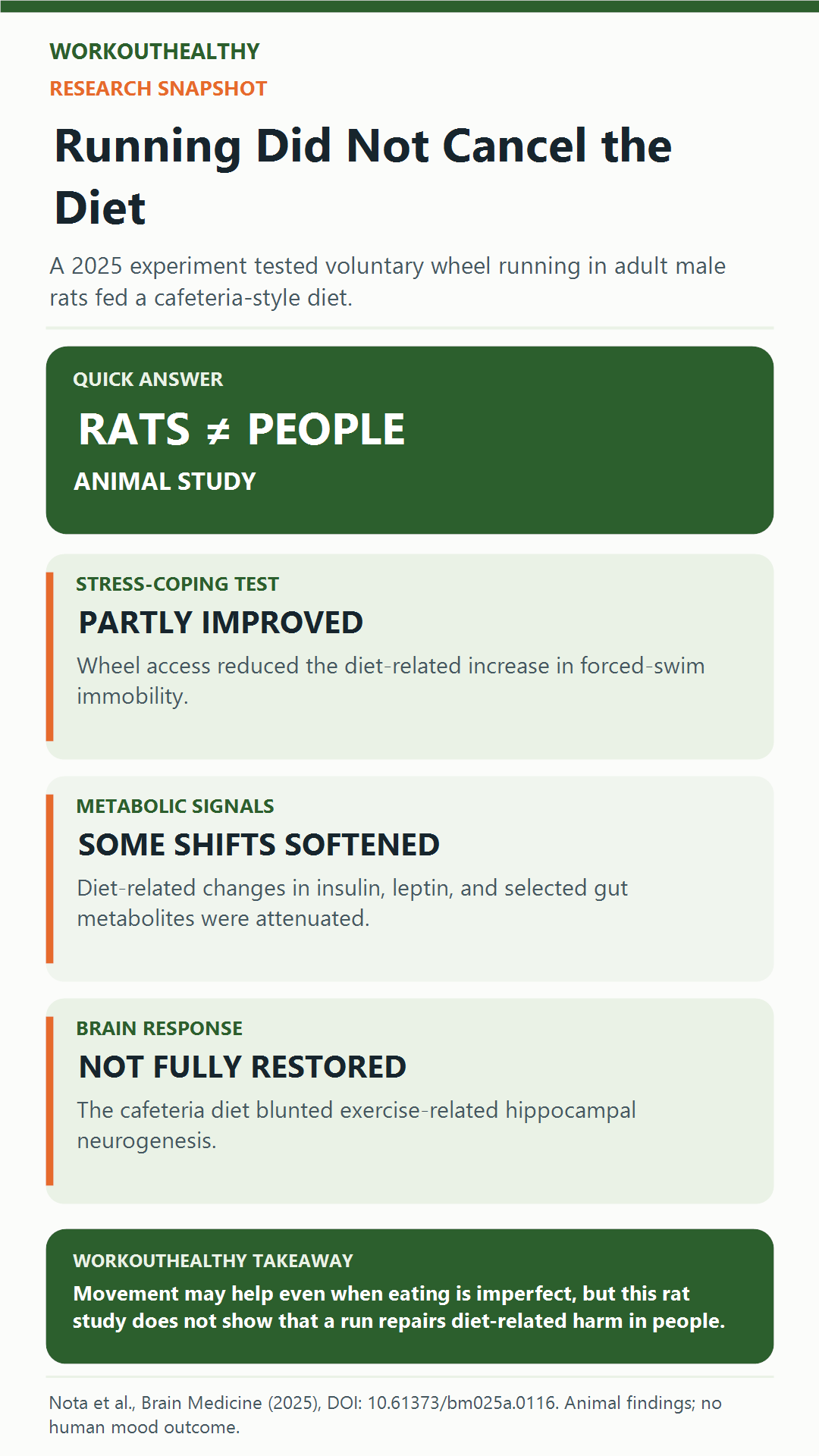
Voluntary wheel exercise helped male rats on a high-fat, high-sugar cafeteria diet in one stress-coping test and softened several metabolic changes.
The exercise did not erase every effect of the diet.
The cafeteria diet still blunted the increase in new hippocampal neurons seen with exercise, and the experiment did not test depression, happiness, or motivation in people.
The useful message is not that a run cancels dinner.
It is that movement can remain beneficial when a diet is imperfect, while food quality may still influence which exercise responses appear.
What the Researchers Actually Tested
The researchers used young adult male Sprague-Dawley rats, not human volunteers.
They assigned the animals to standard chow or a rotating cafeteria diet, then gave half of each diet group continuous access to running wheels.
Each experimental group contained 12 rats, and the intervention lasted seven and a half weeks. A second cohort assigned the same way completed several of the cognitive tests.
The cafeteria diet included standard chow plus changing high-fat and high-sugar foods offered freely.
That model is designed to create a highly palatable mixed diet, but it is not identical to one person’s usual meals or to a precise percentage of ultra-processed food.
The animals chose how much to use the wheel. Calling the intervention daily running suggests a prescribed distance and pace that the experiment did not impose.
Researchers measured weight and fat tissue, behavior, spatial learning, adult hippocampal neurogenesis, circulating hormones, and 175 compounds in material from the caecum.
The design can test biological differences between rat groups, not prove a treatment for a human mental-health condition.
What Changed in the Forced Swim Test
Rats eating the cafeteria diet while sedentary spent more time immobile during the forced swim test. Wheel access attenuated that increase, which the paper accurately described as an antidepressant-like effect.
That result is narrower than saying mood improved dramatically.
Researchers cannot ask a rat about sadness, pleasure, guilt, hopelessness, concentration, sleep, or suicidal thinking, which are central to evaluating depression in people.
The team also used tests of anxiety-like behavior, reward seeking, locomotion, and memory. Results across those tasks were not a simple story in which poor food damaged everything and exercise restored everything.
Exercise modestly improved spatial learning in the Morris water maze.
A modest cognitive effect in a rat maze is not proof that running repairs brain damage or improves motivation in a person who eats fast food.
Why This Was Not a Depression Diagnosis
In the forced swim test, a rodent initially moves actively and later may float with only the movements needed to keep its head above water.
Less immobility after an intervention has often been labeled antidepressant-like because many antidepressant drugs change the response.
That label does not make immobility a direct measure of depression or despair.
Reviews of the method argue that it reflects a coping strategy during an acute inescapable stressor and has limited face or construct validity for a human depressive disorder.
The distinction matters because the viral caption converts a laboratory readout into human feelings. The study supports saying exercise changed stress-coping behavior in rats, not that running restored happiness.
Animal models are useful for studying mechanisms that would be difficult or invasive to examine first in people. They are a starting point for translation, not a compressed clinical trial.
What Happened to Gut Metabolites
The cafeteria diet altered 62 of the 175 measured caecal metabolites.
Exercise changed far fewer metabolites, which is one reason the result should not be described as a full reset of the gut.
The paper highlighted anserine, indole-3-carboxylate, and deoxyinosine because exercise attenuated diet-related changes in their abundance. Attenuated means the changes were softened, not necessarily restored to a perfect control value.
Some metabolite levels correlated with behavior or cognition even after accounting for diet and exercise. A correlation can identify a plausible pathway, but it cannot show that one metabolite caused the behavioral result.
These compounds also should not be called mood and happiness chemicals.
Their concentrations in rat caecal contents are one piece of an emerging gut-brain question, not a validated emotional control panel.
A published WorkoutHealthy review of walking and the gut microbiome explains why human microbiome findings depend on diet, medication, training status, and the method used to analyze microbes.
What Insulin and Leptin Can Tell Us
The cafeteria diet increased weight gain and fat tissue and changed circulating insulin and leptin. Wheel exercise reduced weight gain in the cafeteria group and attenuated some of those hormonal changes.
Insulin helps regulate glucose, while leptin communicates information about stored energy and longer-term energy balance. Their concentrations can reflect metabolic state, but neither hormone provides a direct score for emotional stability.
The study also measured GLP-1, PYY, FGF-21, ghrelin, C-peptide, and glucagon. Exercise increased circulating GLP-1, yet the biological panel did not establish a single hormone pathway that caused the behavior.
Calling exercise metabolic medicine is a memorable metaphor. It should not turn a multivariable animal experiment into a medical prescription or imply that medication is unnecessary.
The Neurogenesis Catch
Exercise increased markers of adult hippocampal neurogenesis in rats eating standard chow. That expected increase was blunted in animals eating the cafeteria diet.
This is the clearest reason the study does not support a cancellation story.
Exercise improved one behavioral result in the poor-diet condition, but diet quality still changed the brain’s measured response to exercise.
Adult hippocampal neurogenesis refers to the formation and maturation of new neurons in a specific brain region. Counting doublecortin-positive cells in rat tissue does not reveal a person’s mood, memory, or future mental-health diagnosis.
The work is therefore mechanistic and hypothesis generating.
It suggests that diet can modify exercise-related plasticity, while leaving major questions about dose, sex, age, duration, and human relevance unanswered.
What Human Evidence Says
Human evidence supports physical activity as one useful part of depression care.
A 2024 network meta-analysis included 218 randomized studies and 14,170 participants, finding symptom reductions with walking or jogging, yoga, strength training, and mixed aerobic exercise.
Confidence was low for walking or jogging and very low for several other comparisons, and only one study met the review’s standard for low risk of bias.
Exercise can help without being a guaranteed response or a reason to stop psychotherapy or prescribed medication.
Diet also deserves attention on its own terms.
In the 12-week SMILES trial, 67 adults with major depression and poor diet quality received dietary support or social support, and the dietary group improved more.
Most SMILES participants were already using psychotherapy, antidepressants, or both. The dietary program was an adjunct to care, not evidence that eating differently replaces treatment.
A 2019 meta-analysis of 16 randomized trials found a small overall reduction in depressive symptoms after dietary improvement. Study populations and interventions varied, so the result does not turn one food group into an antidepressant.
Can Running Cancel Junk Food?
No study can calculate a universal exchange rate between miles and meals.
Exercise can improve fitness, insulin sensitivity, cardiovascular health, mood symptoms, and weight regulation while a low-quality diet continues to affect nutrient intake, dental health, blood lipids, blood pressure, and energy balance.
Energy expenditure is only one part of the question. Food supplies protein, fiber, fats, carbohydrates, vitamins, minerals, and other compounds that a workout cannot manufacture.
Trying to earn food through exercise can also turn movement into punishment.
A run is valuable even when it does not erase anything, and an occasional less nutritious meal does not require compensation.
The cafeteria-diet rats provide a more encouraging and precise point: beginning to move may produce benefits before every eating habit is optimized.
Waiting for a perfect diet is not necessary, and using exercise as permission to ignore diet is not supported.
Our guide to low-impact walking workouts offers a practical entry point for people who are not ready to run.
A Practical Both-and Plan
Start with movement you can repeat.
U.S. guidelines suggest building toward 150 to 300 minutes of moderate aerobic activity or 75 to 150 minutes of vigorous activity each week, plus muscle-strengthening work on two days.
A new runner can alternate short easy runs with walking and increase only one variable at a time. People with joint pain, a long break from exercise, or a medical condition may need a slower progression.
Improve diet by addition before aggressive restriction.
Add a fruit or vegetable, a protein source, a high-fiber carbohydrate, and water to meals that currently leave you hungry or low on energy.
Reduce highly processed snacks or sugary drinks gradually if they dominate the pattern, but do not treat one item as toxic.
Overall frequency, amount, nutritional context, and the rest of the week matter more than a single label.
If hunger cues are hard to read, WorkoutHealthy’s review of cravings and real hunger explains why timing tools work for some people and backfire for others.
When Mood Needs Clinical Care
Persistent sadness, loss of interest, major sleep or appetite changes, hopelessness, impaired function, or thoughts of death deserve professional attention.
Exercise and nutrition can support care, but neither should become a test of whether someone tried hard enough.
A clinician can also check for medical conditions, medication effects, substance use, sleep disorders, and nutritional deficiencies that can overlap with low mood or fatigue.
An internet article cannot make those distinctions.
If you may harm yourself or cannot stay safe, contact local emergency services or a crisis service now. In the United States and its territories, call or text 988 for the Suicide and Crisis Lifeline.
The Bottom Line
The 2025 study showed that voluntary wheel running attenuated one stress-coping change and several metabolic effects of a cafeteria diet in male rats.
It did not prove that running reverses brain damage, restores happiness chemicals, or cancels a poor diet in people.
The same experiment showed that the cafeteria diet blunted exercise-related hippocampal neurogenesis.
That finding makes the practical conclusion a partnership: keep moving even when eating is imperfect, and improve diet quality because exercise does not make nutrition irrelevant.
Get the next evidence check.
Five practical fitness stories worth your time, every Friday.
One email a week. No product pitches. Unsubscribe in one click.
References
- Nota MHC, Nicolas S, Dohm-Hansen S, et al. Exercise mitigates the effects of a cafeteria diet on antidepressant-like behavior associated with plasma and microbial metabolites in adult male rats. Brain Medicine. 2025;1(5):52-66. https://doi.org/10.61373/bm025a.0116
- University College Cork. Exercise mitigates the effects of a cafeteria diet on antidepressant-like behavior. https://research.ucc.ie/en/publications/exercise-mitigates-the-effects-of-a-cafeteria-diet-on-antidepress-2/
- Molendijk ML, de Kloet ER. Coping with the forced swim stressor: Current state-of-the-art. Behavioural Brain Research. 2019;364:1-10. https://pubmed.ncbi.nlm.nih.gov/30738104/
- Noetel M, Sanders T, Gallardo-Gomez D, et al. Effect of exercise for depression: systematic review and network meta-analysis of randomised controlled trials. BMJ. 2024;384:e075847. https://pubmed.ncbi.nlm.nih.gov/38355154/
- Jacka FN, O’Neil A, Opie R, et al. A randomised controlled trial of dietary improvement for adults with major depression. BMC Medicine. 2017;15:23. https://pubmed.ncbi.nlm.nih.gov/28137247/
- Firth J, Marx W, Dash S, et al. The effects of dietary improvement on symptoms of depression and anxiety: a meta-analysis of randomized controlled trials. Psychosomatic Medicine. 2019;81(3):265-280. https://pubmed.ncbi.nlm.nih.gov/30720698/
- Suárez-García S, del Bas JM, Caimari A, et al. Impact of a cafeteria diet and daily physical training on the rat serum metabolome. PLoS One. 2017;12(2):e0171970. https://journals.plos.org/plosone/article?id=10.1371/journal.pone.0171970
- U.S. Department of Health and Human Services. Physical Activity Guidelines for Americans. 2nd edition. https://health.gov/sites/default/files/2019-09/Physical_Activity_Guidelines_2nd_edition.pdf
Medical disclaimer: This article is for general information only and is not medical or individualized nutrition advice. If you have a medical condition or questions about eating and exercise, consult a qualified clinician or registered dietitian.