
Walking is often recommended for the heart, blood sugar, mood, and joints. A newer question is whether some benefits also involve the gut microbiome: the community of bacteria and other microorganisms living in the digestive tract.
That connection is biologically plausible, but it is easy to oversell. Exercise studies have found changes in microbial composition and function, yet the response varies with diet, body composition, intensity, and study design.
Quick answer: regular walking may influence the gut microbiome, but current human evidence does not justify calling it a microbiome treatment. The strongest practical plan is still simple: walk consistently, eat enough varied fiber, recover, and judge success by health and function rather than a commercial gut score.
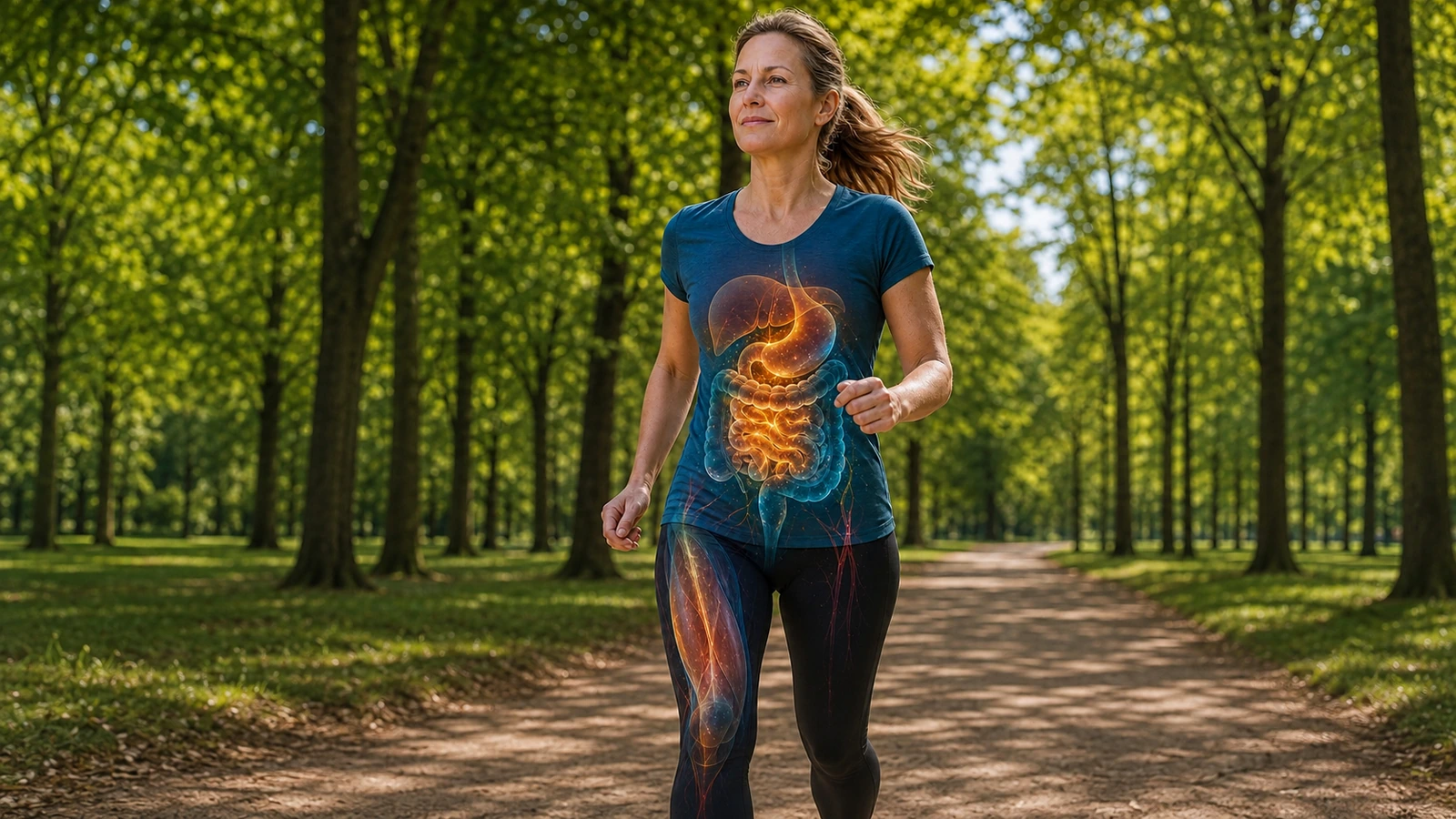
Walking may change the environment around gut microbes, but diet still supplies much of what they ferment.
What the gut microbiome actually means
The gut microbiota are the microorganisms living in the digestive tract. The microbiome can refer to those organisms together with their genes and surrounding environment.
Researchers study stool samples because they are practical to collect, but a stool sample does not represent every location or function inside the intestine.
Two people can have different microbial communities and both be healthy. There is no single universally accepted “perfect” microbiome profile.
Diversity is often discussed as if more is always better. In research, alpha diversity summarizes variety within a sample, while beta diversity compares communities between samples or groups.
Those measures are useful, but neither is a complete health score. A change can be statistically detectable without being clinically important, and an unchanged diversity value can hide shifts in specific organisms or metabolic functions.
Diet, medications, sleep, age, geography, illness, bowel transit, and recent antibiotic use can all influence results. Exercise is one input inside a much larger system.
What human exercise studies found
A six-week study of 32 previously sedentary adults used supervised endurance exercise three days per week. Sessions progressed from 30 to 60 minutes and from moderate toward vigorous intensity (Allen et al., 2018).
The microbial response differed between lean participants and participants with obesity. Fecal short-chain fatty acids increased in the lean group but not in the group with obesity.
After participants returned to sedentary behavior for six weeks, many exercise-related changes reversed. That result suggests that any microbial effect may depend on continued activity rather than one short training block.
The study was small and did not test walking alone. It shows that structured aerobic exercise can alter microbial composition and metabolic output in some people, not that everyone receives the same change.
A longer randomized trial assigned 88 adults with overweight or obesity to habitual living, active bicycle commuting, moderate exercise, or vigorous exercise. Changes were subtle and strongest in the vigorous group at three months; no individual bacterial genera changed significantly after correction (Kern et al., 2020).
Systematic reviews find the same mixed pattern. Some studies report greater diversity or more short-chain-fatty-acid-producing bacteria, while many human studies show no significant diversity change. Differences in exercise dose, sequencing method, diet control, and participant health make a single conclusion difficult.
The honest summary is not “exercise fixes the gut.” It is that exercise can influence microbial ecology, with modest and individual responses in humans.
The 2026 walking trial that complicated the story
A 2026 pilot randomized 77 sedentary adults with prediabetes and overweight or obesity to a home-based walking intervention or usual activity (Demmer et al., 2026).
The walking group was invited to complete moderate-intensity walking three times per week. Sessions lasted 30 minutes during the first four weeks and 45 minutes during weeks five through eight.
Compared with the control group, the intervention produced modest microbiome changes. Unexpectedly, several alpha-diversity measures decreased by week eight.
Circulating short-chain fatty acids did not change significantly between groups. That finding directly challenges the simple story that more walking must raise microbial diversity and short-chain fatty acids in every population.
A decrease in one diversity measure does not automatically mean the intervention harmed the gut. The trial was a pilot, the population had prediabetes, and diversity does not equal health by itself.
It does mean social-media explanations should be cautious. Walking has many established benefits even when a stool sample does not change in the expected direction.
The trial also gives a realistic exercise dose that people can understand: three moderate walks per week. It was not an extreme endurance program or an athlete comparison.
Where short-chain fatty acids fit
Short-chain fatty acids, including acetate, propionate, and butyrate, are produced when gut microbes ferment substrates that largely come from dietary fiber and resistant starch.
Butyrate can serve as fuel for cells lining the colon. Short-chain fatty acids also interact with immune signaling, metabolism, and the intestinal barrier.
These functions make them interesting candidates for explaining links between the microbiome and health. They do not turn a single food, supplement, or walking routine into a proven treatment.
Fecal concentration is also an imperfect window. It reflects production, absorption, transit, and use, so a higher or lower stool value does not map neatly to a better or worse health outcome.
Exercise may influence the microbial environment through changes in gut transit, blood flow, bile acids, immune signaling, and metabolites released during activity. The relative importance of each pathway remains under study.
Diet is inseparable from the practical plan. A walk cannot give microbes fermentable fiber that is absent from meals.
Can the microbiome explain lower inflammation?
Regular physical activity is associated with lower chronic disease risk and can improve inflammatory markers through several pathways. Better body composition, glucose control, sleep, cardiovascular function, and stress regulation may all contribute.
The gut microbiome could be one pathway among those many pathways. Short-chain fatty acids can affect immune and barrier function, which gives the hypothesis a plausible mechanism.
Human microbiome studies do not yet show that walking changes a specific organism, which then causes a meaningful reduction in disease or inflammation.
Most studies are too small or short to establish that chain. Observational studies are especially vulnerable to diet and lifestyle differences between active and inactive people.
Even randomized trials can struggle to separate exercise from changes in appetite, food choices, bowel habits, sleep, or weight. Microbial communities can also respond differently between individuals.
Use the microbiome as a developing explanation, not the main reason to walk. The established benefits of regular activity are already strong enough to justify the habit.
A three-part walking and fiber plan
WorkoutHealthy’s three-part plan focuses on actions that support both general health and the conditions in which beneficial microbial fermentation can occur.
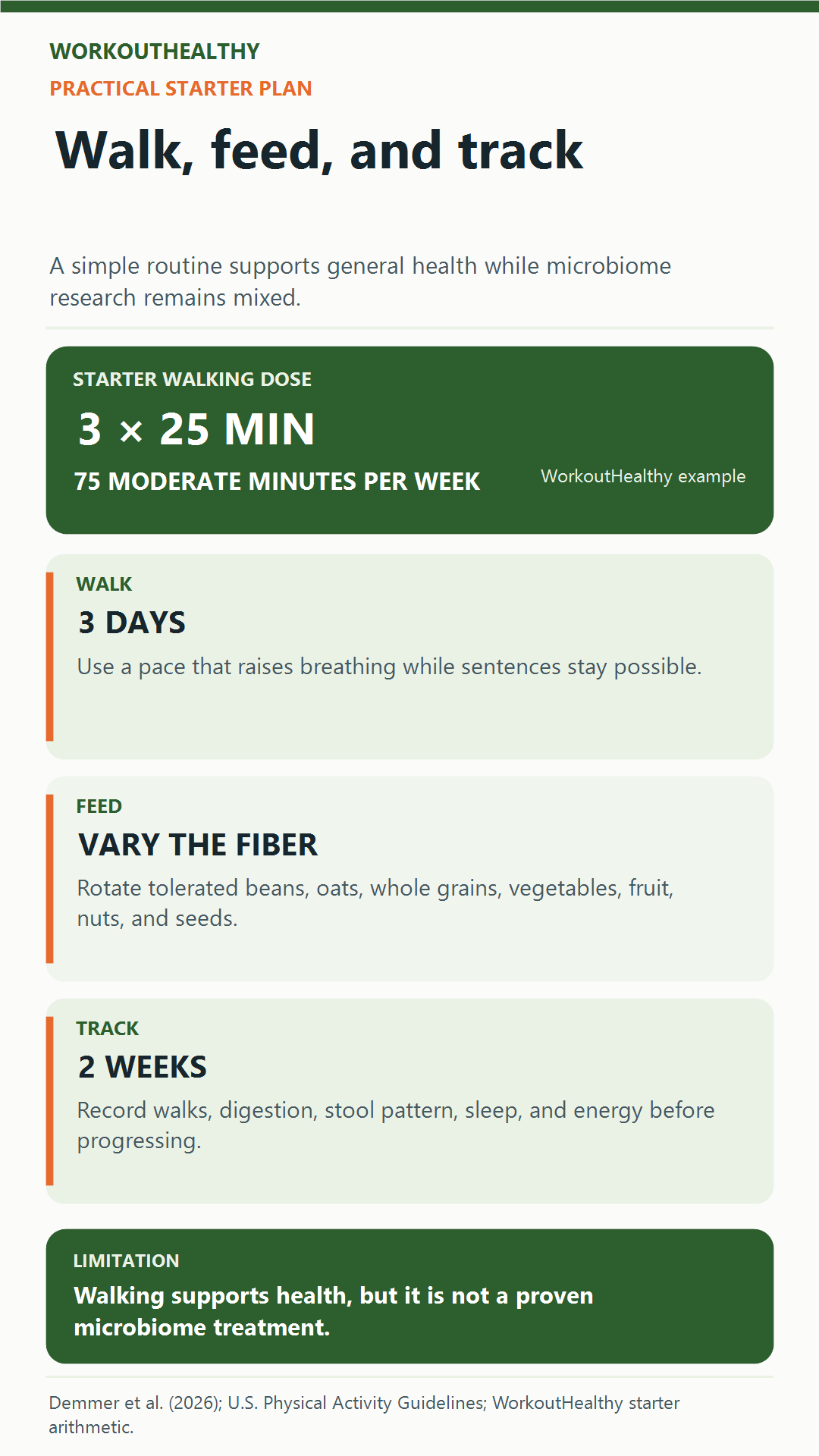
Part one, repeatable walking: begin with three moderate walks per week. Twenty to thirty minutes per session is a practical starting range for many adults. Use a pace that raises breathing while still allowing sentences.
Part two, varied fiber: include several types of plant food across the week, such as beans, oats, whole grains, vegetables, fruit, nuts, and seeds. Increase gradually if current intake is low.
Part three, recovery and tracking: record completed walks, digestive comfort, stool pattern, sleep, and energy for four weeks. Do not change several supplements at the same time.
A starter week could include a 25-minute walk on Monday, Wednesday, and Saturday. Add a bean-based meal twice, oats or another whole grain at breakfast, and vegetables or fruit at most meals.
That schedule totals 75 minutes of moderate activity. It sits below the general adult target of 150 to 300 weekly moderate-intensity minutes, but some activity is better than none and progression should match current capacity.
After two stable weeks, add five minutes to each walk or add a short fourth walk. Change one variable so digestive or recovery effects remain interpretable.
This is a WorkoutHealthy planning framework, not a microbiome therapy tested as a package. Its value is that it combines an achievable activity dose with the dietary substrate microbes actually use.
Walking also pairs well with strength work. The adult physical-activity guidelines include muscle-strengthening activity on at least two days each week, not aerobic exercise alone.
For a simple recovery framework, see our guide to rest days and training adaptation. If stress is the main barrier to consistency, our box-breathing guide offers a short practice that can sit beside, rather than replace, movement.
Common microbiome mistakes
Do not buy a supplement simply because it claims to feed “good bacteria.” Product formulas, strains, doses, and evidence vary, and a label may promise more precision than current science can deliver.
Do not treat gas after a sudden fiber increase as proof of detoxification. Increase fiber gradually, drink adequate fluid, and seek medical advice for persistent pain, bleeding, fever, unexplained weight loss, or major bowel changes.
Do not interpret a consumer microbiome test as a diagnosis. Results can vary with sampling, laboratory methods, and the reference database, while clinical standards remain limited for many claims.
Do not assume intense exercise is always better for the gut. Long, strenuous sessions can temporarily affect gastrointestinal symptoms and barrier function, especially with heat, dehydration, or inadequate fueling.
Do not ignore medications or medical conditions. Antibiotics, metformin, inflammatory bowel disease, infection, surgery, and other factors can dominate the microbial picture.
Finally, do not let microbiome optimization displace the basics. A regular walk that improves fitness, mood, blood pressure, or glucose control is worthwhile even when no stool test is performed.
The microbiome is one possible pathway; the walk is still useful when that pathway remains uncertain.
The bottom line
Exercise can change the human gut microbiome, but results are modest, variable, and shaped by the population and protocol. A recent walking trial found microbiome changes without the expected rise in diversity or circulating short-chain fatty acids.
Walk for the established whole-body benefits. Pair the habit with varied fiber, adequate recovery, and gradual progression. Treat gut-microbiome improvement as a research question, not a guaranteed outcome.
Start here: complete three 25-minute moderate walks this week and add one fiber-rich food you already tolerate. Repeat for two weeks before changing the dose.
References
Medical disclaimer: This article is general product information, not medical advice. The equipment described here is not a treatment for any condition. If you have an injury, ongoing pain, or a medical condition, talk to a doctor or physical therapist before using any of it.