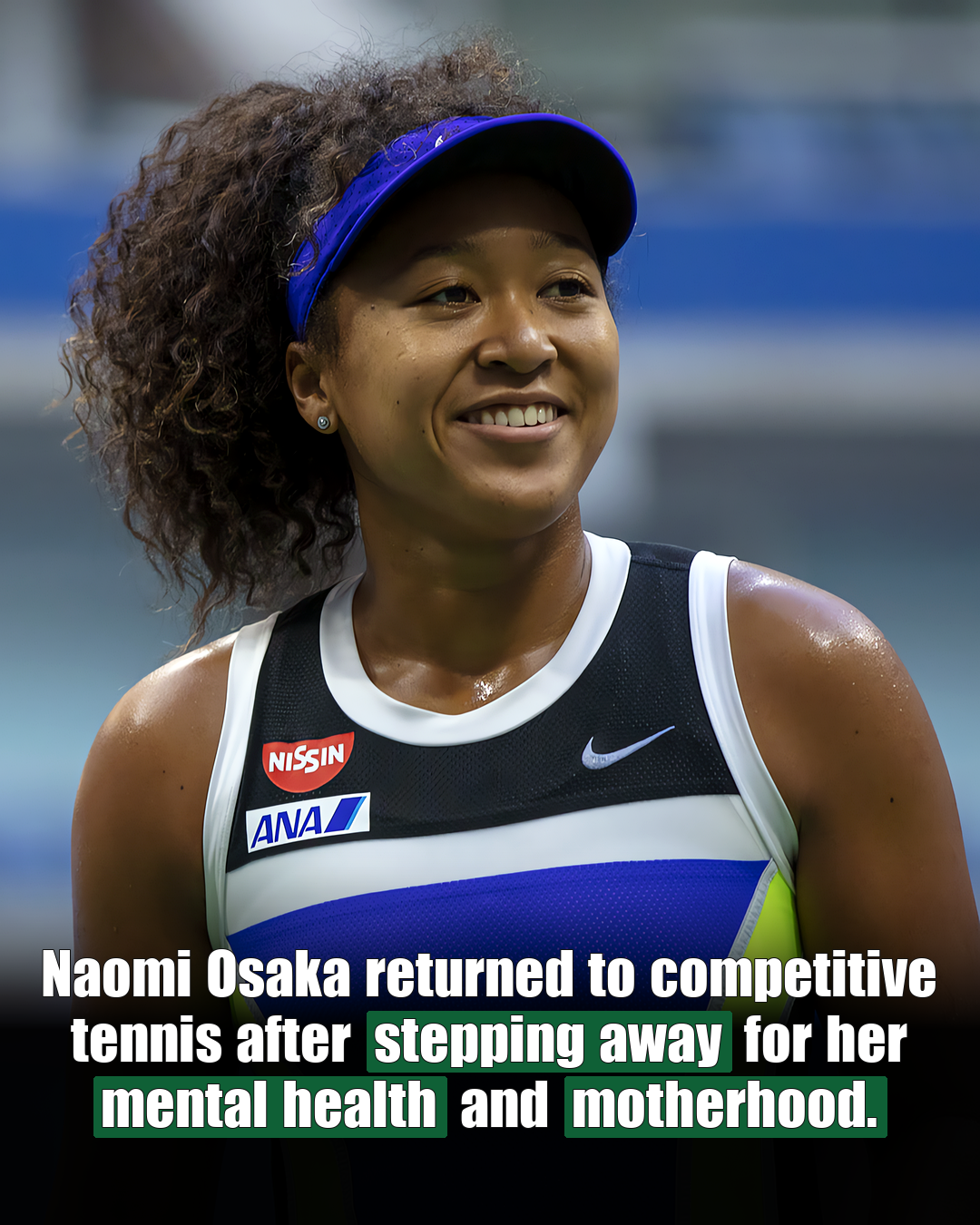

Naomi Osaka has won four Grand Slam singles titles.
She has also done something much harder to measure than a trophy count.
She stepped away from the sport at the height of her career to protect her mental health.
Then she became a mother.
Then she came back and started rebuilding, one match at a time.
Her story is not a straight line from struggle to triumph.
It is slower and more honest than that, and that is exactly why it matters to so many people who are not professional athletes at all.
A Break That Surprised the Tennis World
In May 2021, Osaka withdrew from the French Open.
She had already said she would skip the tournament’s mandatory post match press conferences, citing the toll they took on her mental health.
When she was fined for that decision, she chose to leave the tournament entirely rather than keep going under those terms.
In the days that followed, she disclosed something few fans knew.
She had been dealing with bouts of depression since winning her first US Open title back in 2018.
She also skipped Wimbledon that year and took an extended break from the tour.
At the time, a four time Grand Slam champion walking away from two majors in a single season was almost unheard of.
Osaka was ranked among the top players in the world, and she was still choosing to step back.
Becoming a Mother, Then Starting Over
In 2023, Osaka announced she was pregnant and would miss the season.
Her daughter was born that July.
Osaka has been private about many details of her daughter’s life, but she has spoken openly about how becoming a parent changed her relationship with tennis.
She returned to professional competition in January 2024 at the Brisbane International, more than a year after her last tour match.
The comeback did not arrive fully formed.
Osaka has talked about the rust that builds up after time away from top level competition, and about needing to rebuild both her game and her confidence at the same time.
Results came in stages rather than all at once.
In 2025, she won a smaller WTA 125 title at the Open de Saint-Malo and reached the final of the Canadian Open, a significant result against a deep field.
By early 2026 she had climbed back into the top 15 in the world rankings, with fourth round finishes at events including Indian Wells and Madrid.
That climb happened gradually, tournament by tournament, after starting from outside the rankings entirely when she returned.
In Her Own Words
Osaka has been unusually direct, for a top athlete, about what the 2021 decision cost her and what it gave her back.
She has described therapy as something that genuinely helped her manage the pressure of playing at the highest level.
In interviews since, she has said she feels settled and at peace with where her mental health stands today, a marked change from how she described herself around 2021.
She has also spoken about motherhood reshaping her priorities on tour.
Coming back on her own timeline, rather than rushing to match her old ranking, has mattered more to her than a fast return to the top.
Stepping away from a sport, even at the top level, does not have to be permanent. Coming back on your own terms can matter more than coming back quickly.
What the Research Says About Mental Health in Elite Sport
Osaka’s 2021 announcement landed in the middle of a growing body of research on athlete mental health, and it helped push the conversation into the mainstream.
In 2019, the International Olympic Committee published a consensus statement built by a panel of sports medicine and psychiatry experts.
The panel reviewed the existing science and concluded that mental health symptoms and disorders are common among elite athletes, not rare exceptions, and that they deserve the same structured screening and treatment that physical injuries receive (Reardon et al., 2019).
A separate systematic review and meta-analysis pooled data across dozens of studies of current and former elite athletes.
It found meaningful rates of anxiety, depression, and other mental health symptoms in both active competitors and retired athletes, sometimes at rates similar to or higher than the general population, depending on the specific condition studied (Gouttebarge et al., 2019).
That research runs against an old assumption in sports culture, the idea that elite success and psychological struggle rarely coexist.
Osaka’s case, and the research behind it, both point the other way.
Returning to Sport After Pregnancy: What the Evidence Shows
The postpartum side of Osaka’s comeback has its own body of evidence behind it.
A 2016 evidence summary from an International Olympic Committee expert group reviewed the research on exercise during and after pregnancy for competitive athletes.
It found that, for healthy pregnancies without complications, staying active through pregnancy and returning to training afterward is generally safe and does not carry the risks some older guidance assumed (Bø et al., 2016).
That same evidence summary was clear that the return timeline is not one size fits all.
Recovery from childbirth, changes in core and pelvic floor strength, and simple time away from competition all affect how quickly an athlete can safely rebuild toward peak performance.
That lines up with what Osaka has described in public: a comeback built in stages, not a single moment where she was suddenly back to her old form.
What This Evidence Does Not Prove
None of this research proves that stepping away from a career, on its own, cures depression or anxiety.
The IOC consensus statement is a summary of best available evidence and expert judgment, not a single controlled experiment, and it stops short of prescribing one specific treatment path for every athlete.
It also does not prove that Osaka’s specific outcome, a return to competitive tennis and a stated sense of peace with her mental health, will look the same for every athlete or every person managing similar struggles.
The postpartum research carries a similar limit.
The 2016 evidence summary describes what is generally safe for healthy pregnancies without complications, but it is not a guarantee, and it does not remove the need for individualized medical guidance based on a specific person’s delivery, recovery, and health history.
Public accounts of an athlete’s mental health and recovery, including interviews and social media posts, are also not the same thing as a clinical record.
They offer a real and useful window into her experience, but they are not a substitute for the kind of evaluation only a doctor or therapist can provide.
How This Compares to General Guidance
Most readers are not professional athletes managing a return to a Grand Slam schedule.
The underlying pattern still applies broadly.
Mental health struggles do not always look dramatic from the outside.
Someone can be winning, by every external measure, while still needing help.
Asking for that help, whether through therapy, a break from a stressful routine, or both, is not a sign of weakness.
It is closer to what the research actually recommends.
The same is true for returning to exercise after a major life change like childbirth, illness, or an extended break of any kind.
A gradual, staged return tends to work better than trying to jump straight back to a previous level of fitness or performance.
Who Should Talk to a Doctor First
Anyone experiencing ongoing sadness, loss of interest in things they used to enjoy, or persistent anxiety that interferes with daily life should talk to a doctor or licensed mental health professional.
This is especially true for new parents.
The postpartum period carries its own elevated risk for depression and anxiety, on top of whatever a person was already managing, and it is a well recognized time to check in with a doctor about mood and mental health specifically.
Anyone returning to exercise after pregnancy, surgery, or a long break should also get clearance from a doctor before restarting intense training, particularly if there were any complications during delivery or recovery.
People with a history of depression or anxiety who are considering a major life or career change, the way Osaka stepped back from a demanding tour schedule, may benefit from planning that change alongside a therapist rather than navigating it alone.
A Practical Look at Rebuilding After Time Away
Osaka’s comeback offers a useful template for anyone rebuilding a fitness or health routine after a long break, whether the break came from parenthood, illness, injury, or burnout.
Start with a real assessment.
Osaka and her team did not assume her old fitness level was still there.
They built a plan around where she actually was, not where she used to be.
Set stage based goals instead of a single finish line.
Her early 2024 goal was simply competing again, not winning a major, and later goals shifted as her results improved.
Expect setbacks without treating them as failure.
Early losses after a long layoff are normal, not proof that the comeback was a mistake.
Build in real recovery time, not just training time.
That includes sleep, mental health support, and time away from the sport or activity itself.
Lean on a support system.
Osaka has talked about the value of having people around her, including her family, during both the 2021 break and the return that followed.
A similar principle holds for anyone rebuilding a routine, since training with other people tends to make consistency easier to sustain.
Track wellbeing, not just performance.
The habits that helped Osaka manage stress during her break, including therapy, are worth carrying forward into the comeback itself rather than dropping once results start to improve, and they connect to a broader pattern of how chronic stress affects the body well beyond the tennis court.
References
Reardon, C. L., Hainline, B., Aron, C. M., et al. (2019). Mental health in elite athletes: International Olympic Committee consensus statement. British Journal of Sports Medicine, 53(11), 667-699.
Gouttebarge, V., Castaldelli-Maia, J. M., Gorczynski, P., Hainline, B., Hitchcock, M. E., Kerkhoffs, G. M., Rice, S. M., & Reardon, C. L. (2019). Occurrence of mental health symptoms and disorders in current and former elite athletes: A systematic review and meta-analysis. British Journal of Sports Medicine, 53(11), 700-706.
Bø, K., Artal, R., Barakat, R., et al. (2016). Exercise and pregnancy in recreational and elite athletes: 2016 evidence summary from the IOC expert group meeting, Lausanne. Part 1, exercise in women planning pregnancy and those who are pregnant. British Journal of Sports Medicine, 50(10), 571-589.
This article is for general educational purposes and is not a substitute for personalized medical or mental health advice. Anyone experiencing symptoms of depression, anxiety, or other mental health concerns, including in the postpartum period, should speak with a qualified doctor or mental health professional.