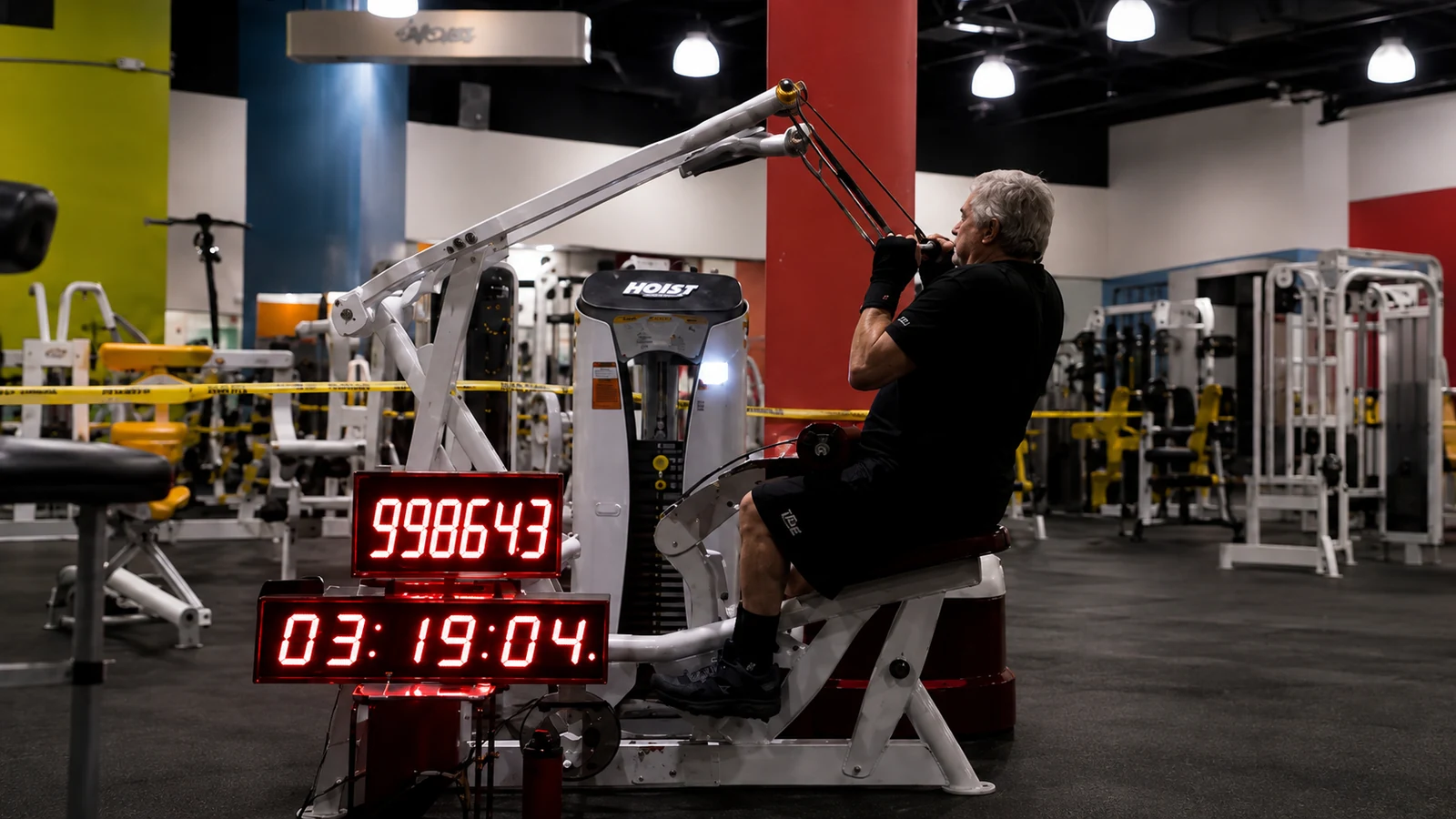

James Smith spent three hours and nineteen minutes pulling a cable bar down toward his chest.
He did that over and over, thousands of times, until the running total on a lat pulldown machine reached one million pounds.
That number is not a single lift.
It is a cumulative total, the sum of every repetition added together.
Smith, who goes by “The Geezer,” filmed the whole attempt and posted it to his own YouTube channel under the title “JIMMY THE GEEZER SETS THE 1,000,000 lb. LAT PULLDOWN WORLD RECORD.”
The feat is also listed by Record Holders Republic, a United Kingdom based organization that reviews and catalogs a wide range of unusual physical feats submitted by the public.
That distinction matters, and this article stays precise about it throughout.
Record Holders Republic is not Guinness World Records.
A listing there does not carry the same global name recognition, and it is not reviewed by the same kind of on-site, third-party adjudication process a Guinness attempt typically goes through.
Still, the numbers behind this record hold up under real scrutiny.
They say something genuinely useful about endurance training, not just about one unusual afternoon in a gym.
What Actually Happened
According to Smith’s Record Holders Republic profile, the one million pound total came from 4,888 total repetitions on a Hoist Fitness RS1201 lat pulldown machine.
The clock stopped at 3 hours, 19 minutes, and 53 seconds.
The video backs this up.
It shows Smith seated at the machine, pulling the bar down in a steady, repeated rhythm for the full attempt.
Visible fatigue sets in as the session wears on.
His profile also lists several shorter benchmarks logged on the same machine.
A 5 minute total of 42,878 pounds, a 10 minute total of 79,721.04 pounds, a 30 minute total of 214,174.08 pounds, and a 1 hour total of 330,313.84 pounds all appear on the same page.
A 500,000 pound checkpoint appears at 1 hour, 39 minutes, and 20 seconds, roughly halfway to the final total.
Whether every one of those numbers comes from the same continuous session, or from separate attempts on the same machine, is not fully documented on the page.
What is consistent across all of them is the pace.
Smith was not doing a handful of heavy singles.
He was doing thousands of moderate, repeatable pulls.
Who Is James “The Geezer” Smith?
Public information about Smith is limited outside of his own channel and his Record Holders Republic listing.
His profile notes that at the time of one of his shorter benchmark lifts, he was 63 years old and weighed 349.7 pounds.
Beyond that, there is no independent biography, no verified competitive lifting background, and no outside interview this article could confirm.
That is worth saying plainly rather than filling the gap with guesswork.
What can be verified is the video itself, the equipment used, and the numbers Record Holders Republic has published.
Record Holders Republic vs. Guinness World Records
Guinness World Records is the organization most people picture when they hear the phrase “world record.”
It runs a formal application and adjudication process.
That often includes a Guinness official present in person, or reviewing detailed video and witness evidence, before a title is confirmed.
Record Holders Republic operates differently.
It is a smaller, independent record tracking organization that reviews submissions from the public, including niche, self-defined categories a larger body like Guinness may never have created.
That structure is exactly why a category like “cumulative pounds pulled on a lat pulldown machine” can exist there at all.
It also means the verification standard is not identical to Guinness.
Record Holders Republic’s own page for this record notes that the rep count relied on light sensor activation, and that the machine’s mechanical advantage was factored into the weight calculation.
That is a reasonable way to track volume on a selectorized machine.
A pulldown’s cable and pulley system does not always move the weight stack one pound for every pound of resistance felt at the bar.
But it does mean the final number is a calculated figure tied to this specific machine and this specific counting method, not a simple stopwatch and a scale.
None of this makes the feat less real or less demanding.
It does mean readers should understand what kind of record this is before treating it the way they would a Guinness title.
The Real Math Behind a Million Pounds
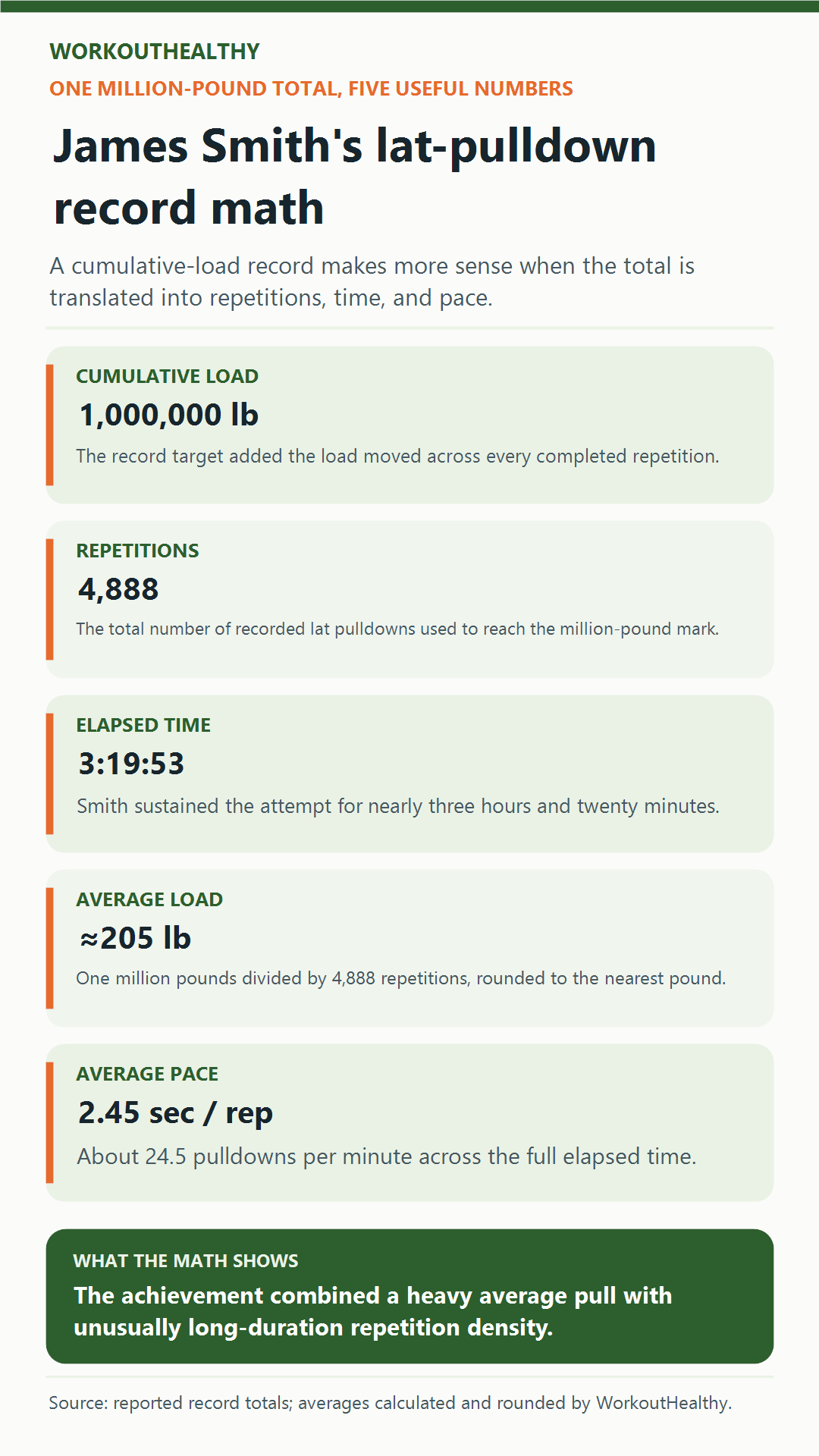
Divide one million pounds by 4,888 repetitions and the average load per pull comes out to about 205 pounds.
That is a genuinely useful number, because it reframes what this record actually demonstrates.
Two hundred and five pounds on a lat pulldown is a real, respectable working weight for a trained lifter.
It is not close to a maximal single effort for most people who train seriously.
The achievement is not that Smith moved an enormous weight once.
It is that he moved a moderate weight thousands of times without the pace collapsing.
Run the time math the same way. Divide the total session length, 11,993 seconds, by 4,888 repetitions.
That works out to roughly one repetition every 2.45 seconds, or about 24.5 pulls a minute, sustained on average for over three straight hours.
WorkoutHealthy covered a similar kind of pacing math in our breakdown of DonnaJean Wilde’s push-up world record.
In that record, a fast opening pace settled into a slower, survivable rhythm over the course of an hour.
The same pattern likely applies here.
A three hour effort cannot be paced like a two minute set.
The numbers suggest Smith found a rate his body could actually hold, rather than chasing a pace that looked impressive early and collapsed later.
Four thousand eight hundred eighty eight repetitions do not require heavy weight. They require a pace a person can survive for three hours.
The Muscles Doing the Pulling
The lat pulldown is built around the latissimus dorsi, the broad muscle that runs down the sides of the back.
It never works alone.
Research using surface electromyography, a method that measures the electrical activity a muscle produces during a contraction, has examined how hand position changes which muscles do the most work during a pulldown.
Signorile and colleagues compared several grip widths and hand orientations on the lat pulldown.
They found that the exact hand position shifts how much the biceps, the middle trapezius, and other back and arm muscles contribute alongside the lats (Signorile et al., 2002).
A later review by Leslie and Comfort reached a similar conclusion.
Grip width and orientation change the muscle activation pattern during both pull-ups and lat pulldowns, without one single grip being clearly superior for every muscle involved (Leslie & Comfort, 2013).
The practical takeaway is that a lat pulldown, done for thousands of reps, is really a full pulling-chain workout.
The lats provide most of the pulling force, but the biceps, forearms, rear shoulders, and upper back all share a meaningful part of the load over that many repetitions.
Why Grip Fails Before the Back Does
Anyone who has done high-rep pulling exercises knows the feeling.
The back can often keep working long after the hands start to give out.
That is not a coincidence.
Grip strength, and specifically how well a person can resist fatigue in a sustained or repeated grip, appears to be a meaningful limiting factor in tasks like this one.
A 2026 study in the International Journal of Exercise Science found that relative handgrip strength, meaning grip strength measured against a person’s own body mass, was the strongest predictor of how well someone resisted fatigue during sustained gripping tasks (Pérez et al., 2026).
In practice, that means two people with similar back strength can have very different experiences on a multi-hour pulling task.
The one with better grip endurance relative to their size is the one more likely to keep the bar moving once the back muscles are still willing but the hands are struggling to hold on.
For a record like Smith’s, grip endurance is not a side detail.
Over 4,888 repetitions, it may have been just as decisive as back strength itself.
Endurance Is Its Own Trainable Skill
It is tempting to assume that anyone strong enough to lift heavy weight could also grind out thousands of lighter reps if they simply chose to.
The research on training adaptations suggests otherwise.
A study comparing endurance-trained, power-trained, and untrained men during repeated, fatiguing submaximal contractions found that the endurance-trained group held each contraction significantly longer than the other two groups across ten straight trials (Pääsuke et al., 1999).
The researchers concluded that the fatigue these subjects experienced came largely from the muscle itself reaching contractile failure.
It did not come from the nervous system simply refusing to keep sending the signal to work.
That distinction matters.
It means muscular endurance, the specific ability to keep producing force across many submaximal repetitions, is its own trainable quality, separate from maximum strength or explosive power.
This sits at the opposite end of the training spectrum from an approach like Mike Mentzer’s Heavy Duty system, which we covered in detail here.
Heavy Duty is built around one all-out set taken to failure, rather than thousands of submaximal reps.
Both approaches can build a stronger, more capable body.
They simply train different qualities, and a record like this one is a demonstration of the high-volume end of that spectrum, not proof that one style beats the other.
Strength asks how much a person can move one time. Endurance asks how many times they can keep moving without stopping.
What This Record Does Not Prove
This record is not evidence of exceptional raw pulling strength.
An average load of about 205 pounds per rep is a working weight, not a maximal one.
It is also not verified the way a Guinness title would be.
No independent, on-site adjudicator is documented as having witnessed the attempt in person, at least not in any source this article could confirm.
The rep count and weight total both rely on the machine’s own sensor and resistance calculations.
That is a defensible method for tracking volume, but it is not the same as a manually witnessed, third-party audit.
No competing or newer claim for this exact category, cumulative weight pulled on a lat pulldown machine, could be found in the sources available for this article.
Smith’s profile presents the 1,000,000 pound mark as his own current best in this event.
This article cannot independently confirm whether anyone else has since attempted or exceeded it.
If You Want to Build This Kind of Endurance Yourself
Nobody needs to chase a million pounds to use the underlying lesson here.
Build volume gradually.
A safe way to explore high-rep pulling work is to add reps or sets slowly over weeks, not all at once.
A systematic review of resistance training research found that increasing weekly training volume tends to increase muscle growth up to a point (Schoenfeld et al., 2017).
The benefit comes from progressive increases over time, not from a single enormous session.
Train your grip on purpose.
Grip endurance can be a limiting factor before the back is actually finished working.
Dedicated grip work, such as timed dead hangs or farmer carries, can extend how long someone can sustain a high-rep pulling session.
Even a modest pulling goal counts as real progress.
Five controlled pull-ups, the kind Vanna White has described doing in her own routine, which we looked at here, is a genuinely strong benchmark for most adults.
That is a more realistic starting target than thousands of pulldown reps.
Watch your pace, not just your total.
Going out too fast on any long session tends to end in a hard stop rather than a controlled finish.
That is the same pacing lesson that showed up in Wilde’s push-up record.
Plan for a multi-hour effort like an endurance event, not a normal workout.
Fueling and hydrating before and during a long session matters.
Even something as simple as caffeine timing, which we cover in our guide to caffeine before a workout, can affect how focused and steady someone feels several hours into sustained, repetitive training.
Watch your form as fatigue builds.
The most common mistake in long, high-rep pulling sessions is letting momentum, body English, or a rounding lower back creep in as the target muscles tire.

That raises injury risk without actually making the set more productive.
Who Should Be Cautious Here
Anyone with a shoulder impingement history, an existing rotator cuff issue, or elbow or wrist tendon pain should get individualized guidance before attempting high-volume pulling work of any kind.
A multi-hour continuous effort also places real, sustained demand on the cardiovascular system.
Anyone with uncontrolled blood pressure or a diagnosed heart condition should talk to a doctor before attempting anything resembling this kind of session.
New lifters do not need to test their endurance limits to get real benefit from pulling exercises.
A far smaller, well-paced volume still builds strength, back health, and genuine muscular endurance over time.
Watch the Original Video
Curious about the training science behind viral feats like this one? Subscribe to WorkoutHealthy Insider for practical explanations behind popular fitness claims.
References
Leslie, K. L. M., & Comfort, P. (2013). The effect of grip width and hand orientation on muscle activity during pull-ups and the lat pull-down. Strength & Conditioning Journal, 35(1), 75 to 78. https://doi.org/10.1519/ssc.0b013e318282120e
Pääsuke, M., Ereline, J., & Gapeyeva, H. (1999). Neuromuscular fatigue during repeated exhaustive submaximal static contractions of knee extensor muscles in endurance-trained, power-trained and untrained men. Acta Physiologica Scandinavica, 166(4), 319 to 326. https://doi.org/10.1046/j.1365-201x.1999.00576.x
Pérez, M. Á., Martínez, M., Ursic, P., Hernández-Madrid, J., & Torres-Banduc, M. (2026). Relative handgrip strength as the primary determinant of fatigue resistance in young adults. International Journal of Exercise Science, 19(7). https://doi.org/10.70252/ijes2026703
Schoenfeld, B. J., Ogborn, D., & Krieger, J. W. (2017). Dose response relationship between weekly resistance training volume and increases in muscle mass: A systematic review and meta-analysis. Journal of Sports Sciences, 35(11), 1073 to 1082. https://doi.org/10.1080/02640414.2016.1210197
Signorile, J. E., Zink, A. J., & Szwed, S. P. (2002). A comparative electromyographical investigation of muscle utilization patterns using various hand positions during the lat pull-down. Journal of Strength and Conditioning Research, 16(4), 539 to 546. https://doi.org/10.1519/00124278-200211000-00008
This article is for general information only and is not medical advice. If you have an injury, ongoing pain, or a medical condition, talk to a doctor or physical therapist before you change how you train or eat.