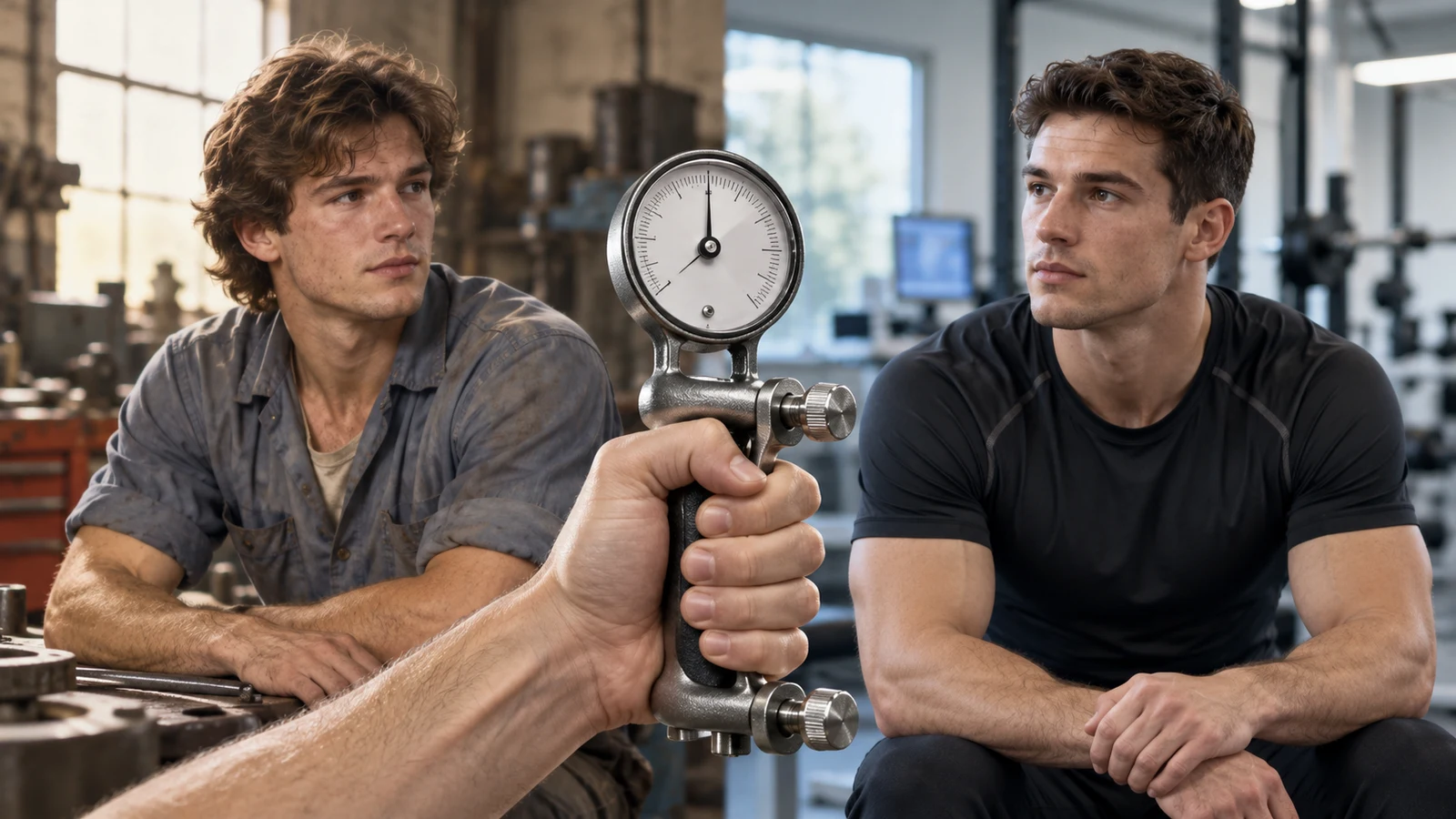

Millennial grip strength was lower than 1985 reference values in a 2016 study of 237 adults aged 20 to 34.
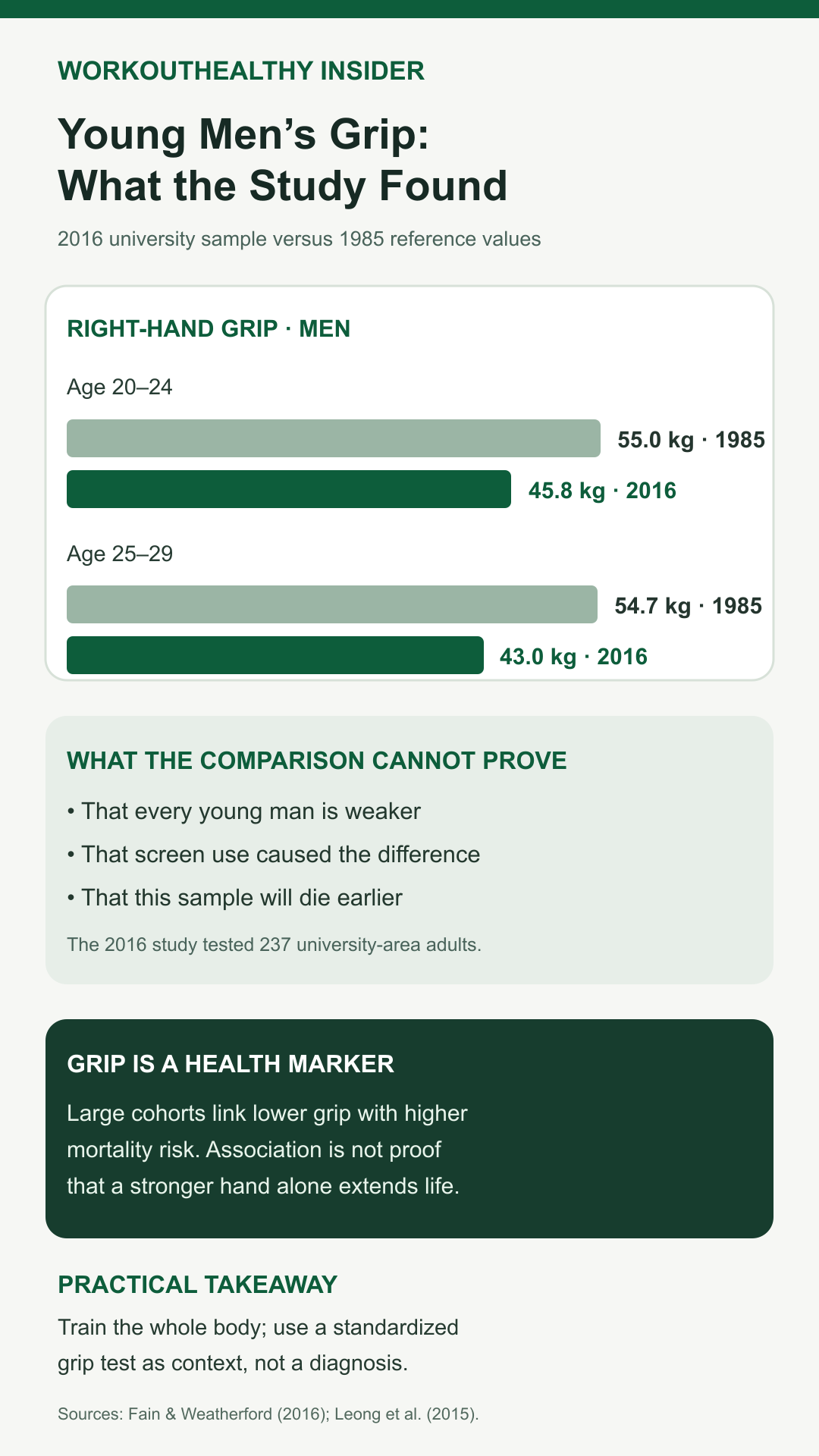
Among men aged 20 to 24, average right-hand grip was about 20 pounds lower than the older reference mean.
That result is real, but it does not show that today’s young men are uniformly weaker than their fathers.
The researchers tested a university-based convenience sample, compared it with a different sample measured decades earlier, and did not follow health or lifespan outcomes.
The viral version also joins separate bodies of evidence as if they came from one experiment.
Grip strength is associated with later health outcomes in large observational cohorts, but the 2016 study did not prove heart disease, diabetes, or early death in millennials.
What the Headline Gets Right
Researchers Elizabeth Fain and Cara Weatherford did find lower average grip scores than the commonly used 1985 norms. Every male age-and-hand comparison in their study was statistically lower.
The right-hand difference for men aged 20 to 24 was 9.1 kilograms, which is about 20 pounds. Men aged 25 to 29 differed by 11.7 kilograms on the right and 8.6 kilograms on the left.
Those are substantial average differences within the two samples. They also explain why a study designed to update clinical reference values became a generational headline.
The accurate statement is narrow: this group of young adults produced lower grip values than age- and sex-matched data collected for a 1985 paper.
The study did not directly test any participant’s father.
How the 2016 Study Worked
The researchers recruited 237 healthy adults aged 20 to 34 during one semester. Participants were full-time students, and recruitment occurred in university areas that young adults frequently used.
Each person sat with the shoulder close to the body, elbow bent to 90 degrees, forearm neutral, and wrist within the standardized testing range.
A Jamar dynamometer measured grip, while a pinch gauge measured lateral pinch.
Grip and pinch were tested three times on each side, then averaged. That protocol matched the older reference study closely enough to support a clinical comparison.
This was a cross-sectional study, not an experiment.
Nobody was assigned more screen time, less manual work, or a training program, so the design cannot identify why the samples differed.
What the Numbers Showed
Men aged 20 to 24 averaged 45.8 kilograms with the right hand, compared with 55.0 kilograms in the 1985 reference sample.
Their left-hand difference was much smaller at 2.6 kilograms.
Men aged 25 to 29 averaged 43.0 kilograms on the right versus 54.7 kilograms in the reference data. The left side averaged 41.5 kilograms versus 50.1 kilograms.
The current sample contained only four men aged 30 to 34.
Although their right-hand mean was 10.5 kilograms lower, four people cannot support a stable estimate for millions of men in that age band.
Women did not show one uniform decline.
The youngest women had lower grip values, while women aged 30 to 34 were stronger than the older reference means in both hands.
Lateral pinch strength was also far less dramatic than grip strength.
Male pinch differences were small and not statistically significant, which argues against describing the result as a universal collapse in hand function.
Why This Is Not a National Trend Estimate
The authors identified the central limitation themselves. University recruitment may have selected people with more education, computer use, and sedentary daily roles than the general population.
Occupational roles were not measured or controlled.
The explanation about grandfathers doing more manual work is plausible, but this study did not compare job demands, daily movement, or screen time with grip results.
The two samples also came from different places and eras.
The modern group was recruited around a North Carolina university, while the 1985 norms came from volunteers in the Milwaukee area.
A later United States reference study used 1,232 participants from the 2011 NIH Toolbox normative project.
Men aged 25 to 29 averaged 49.7 kilograms with the dominant hand, between the older mean and the small university sample.
That does not erase Fain and Weatherford’s finding.
It shows why the responsible conclusion is that reference values needed updating, not that one paper proved an entire generation lost its health reserve.
What Grip Strength Says About Health
Grip strength is useful because it is quick, inexpensive, and connected with broader physical function. It can reflect muscle strength, body size, nutrition, activity, neurologic function, illness burden, and social conditions.
In the PURE study, researchers followed 139,691 adults aged 35 to 70 across 17 countries.
Each 5-kilogram lower grip value was associated with 16 percent higher all-cause mortality and 17 percent higher cardiovascular mortality during a median four-year follow-up.
A 2022 dose-response review combined 48 prospective studies and more than 3.1 million participants.
Lower grip was consistently associated with higher all-cause and cardiovascular mortality, although most included ages started well above the millennial study’s youngest participants.
These large studies make grip a valuable risk marker. They do not turn a young adult’s dynamometer score into a personal expiration date.
For a broader look at how resistance and aerobic exercise relate to cardiovascular risk, see our evidence review on cardio, strength training, and heart health.
The Diabetes Claim Is Not Supported
The 2016 millennial comparison did not measure blood glucose, insulin sensitivity, diabetes incidence, or cardiovascular events. It cannot support the caption’s claim that the observed grip difference directly signals diabetes risk.
The much larger PURE cohort found no significant association between grip strength and incident diabetes.
Other studies may link low muscle function with metabolic health, but that is different from saying this grip comparison proved future diabetes.
Blood pressure, glucose, lipids, smoking, sleep, body composition, family history, and overall activity remain clinically meaningful. Grip can add context, but it does not replace standard risk assessment.
Strength Marker or Cause?
Observational research cannot cleanly separate cause from marker. Chronic illness can reduce strength, while inactivity and lower strength may also contribute to worse function.
Income, education, occupation, nutrition, medical care, and physical activity can influence both grip and long-term health. Statistical adjustment helps, but it cannot remove every shared cause.
The PURE investigators explicitly called for trials to determine whether improving strength reduces mortality and cardiovascular disease. That caveat prevents us from treating every kilogram added to a grip test as a quantified extension of life.
Resistance-training cohorts are encouraging, with regular participation associated with lower mortality.
Those studies still do not prove that hand grippers alone prevent disease or that grip is the only strength measure that matters.
Can Strength Be Rebuilt?
Yes, muscular strength is highly trainable, but a whole-body program is more useful than chasing one grip number. A 2023 network meta-analysis included 178 strength studies and found every tested resistance-training prescription superior to no training.
Higher loads ranked best for maximal strength, while many load and frequency combinations still worked. Beginners therefore do not need a perfect split or advanced system to start improving.
The United States Physical Activity Guidelines recommend strengthening all major muscle groups on at least two days each week. That includes the legs, hips, chest, back, abdomen, shoulders, and arms.
If rep ranges feel confusing, our guide to low reps, high reps, strength, and muscle size explains what changes as load and effort change.
A Practical Two-Day Plan
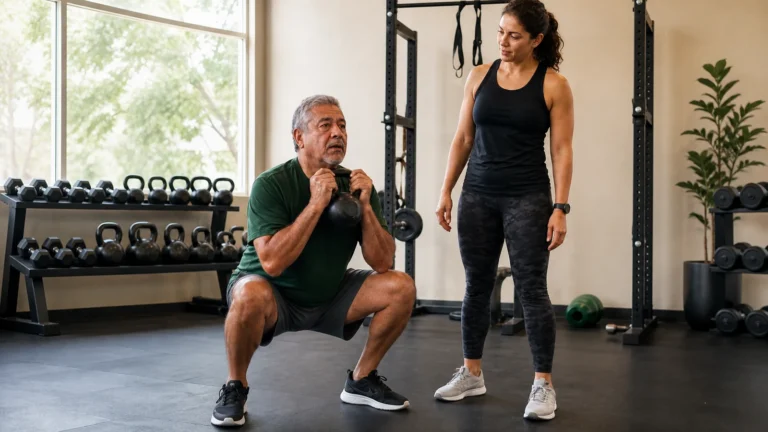
On two nonconsecutive days, choose one squat or split-squat movement, one hip hinge, one push, one pull, and one carry.
Do one to three challenging sets of each exercise after a short warmup.
Use a load that allows controlled repetitions with roughly two or three good reps left before failure.
When every set reaches the top of your chosen range with clean technique, add a small amount of weight or a harder variation.
Rows, pull-ups, deadlifts, and loaded carries train grip while also developing larger muscle groups. A hand gripper can be an accessory, but it should not replace pulling, carrying, and whole-body strength work.
Record the exercise, load, repetitions, and how hard the last set felt. Our training-log guide shows how to track enough detail to progress without turning the process into paperwork.
How to Interpret a Grip Test
Published norms depend on the device, handle setting, body position, hand dominance, age, sex, height, weight, and testing instructions. A store-bought gripper or bathroom-scale trick cannot be compared directly with a standardized dynamometer result.
Fatigue, pain, motivation, recent training, and unfamiliarity can change a single score. Clinicians usually interpret repeated standardized measurements alongside the person’s history and function.
Sudden weakness, a large side-to-side change, numbness, pain, or loss of daily function deserves medical assessment. Those signs are more important than whether someone matches an internet average.
The Bottom Line
The 2016 study found lower grip strength in a university sample of young adults than in 1985 reference data, especially among men.
It raised a legitimate question about changing norms and work patterns.
It did not compare fathers with sons, represent every American, establish screen use as the cause, or show that millennials will die earlier.
The wider literature supports grip as a health marker, not a stand-alone diagnosis or causal forecast.
The constructive response is not generational panic.
Train the whole body consistently, progress the work, maintain aerobic activity, and use clinical risk factors rather than a viral grip headline to judge health.
Get the next evidence check.
Five practical fitness stories worth your time, every Friday.
One email a week. No product pitches. Unsubscribe in one click.
References
- Fain E, Weatherford C. Comparative study of millennials’ (age 20-34 years) grip and lateral pinch with the norms. Journal of Hand Therapy. 2016;29(4):483-488. https://pubmed.ncbi.nlm.nih.gov/26869476/
- Mathiowetz V, Kashman N, Volland G, Weber K, Dowe M, Rogers S. Grip and pinch strength: normative data for adults. Archives of Physical Medicine and Rehabilitation. 1985;66(2):69-74.
- Wang YC, Bohannon RW, Li X, Sindhu B, Kapellusch J. Hand-Grip Strength: Normative Reference Values and Equations for Individuals 18 to 85 Years of Age Residing in the United States. Journal of Orthopaedic & Sports Physical Therapy. 2018;48(9):685-693. https://pubmed.ncbi.nlm.nih.gov/29792107/
- Leong DP, et al. Prognostic value of grip strength: findings from the Prospective Urban Rural Epidemiology study. Lancet. 2015;386(9990):266-273. https://pubmed.ncbi.nlm.nih.gov/25982160/
- López-Bueno R, et al. Thresholds of handgrip strength for all-cause, cancer, and cardiovascular mortality: A systematic review with dose-response meta-analysis. Ageing Research Reviews. 2022;82:101778. https://pubmed.ncbi.nlm.nih.gov/36332759/
- Wu Y, Wang W, Liu T, Zhang D. Association of Grip Strength With Risk of All-Cause Mortality, Cardiovascular Diseases, and Cancer in Community-Dwelling Populations: A Meta-analysis of Prospective Cohort Studies. Journal of the American Medical Directors Association. 2017;18(6):551.e17 to 551.e35. https://pubmed.ncbi.nlm.nih.gov/28549705/
- Currier BS, et al. Resistance training prescription for muscle strength and hypertrophy in healthy adults: a systematic review and Bayesian network meta-analysis. British Journal of Sports Medicine. 2023;57(18):1211-1220. https://pubmed.ncbi.nlm.nih.gov/37414459/
- Shailendra P, Baldock KL, Li LSK, Bennie JA, Boyle T. Resistance Training and Mortality Risk: A Systematic Review and Meta-Analysis. American Journal of Preventive Medicine. 2022;63(2):277-285. https://pubmed.ncbi.nlm.nih.gov/35599175/
- US Department of Health and Human Services. Physical Activity Guidelines for Americans. 2nd ed. 2018. https://health.gov/sites/default/files/2019-09/Physical_Activity_Guidelines_2nd_edition.pdf
Medical disclaimer: This article is for general information only and is not medical advice. Sudden or one-sided weakness, numbness, or pain warrants clinical assessment rather than self-diagnosis from a grip test.