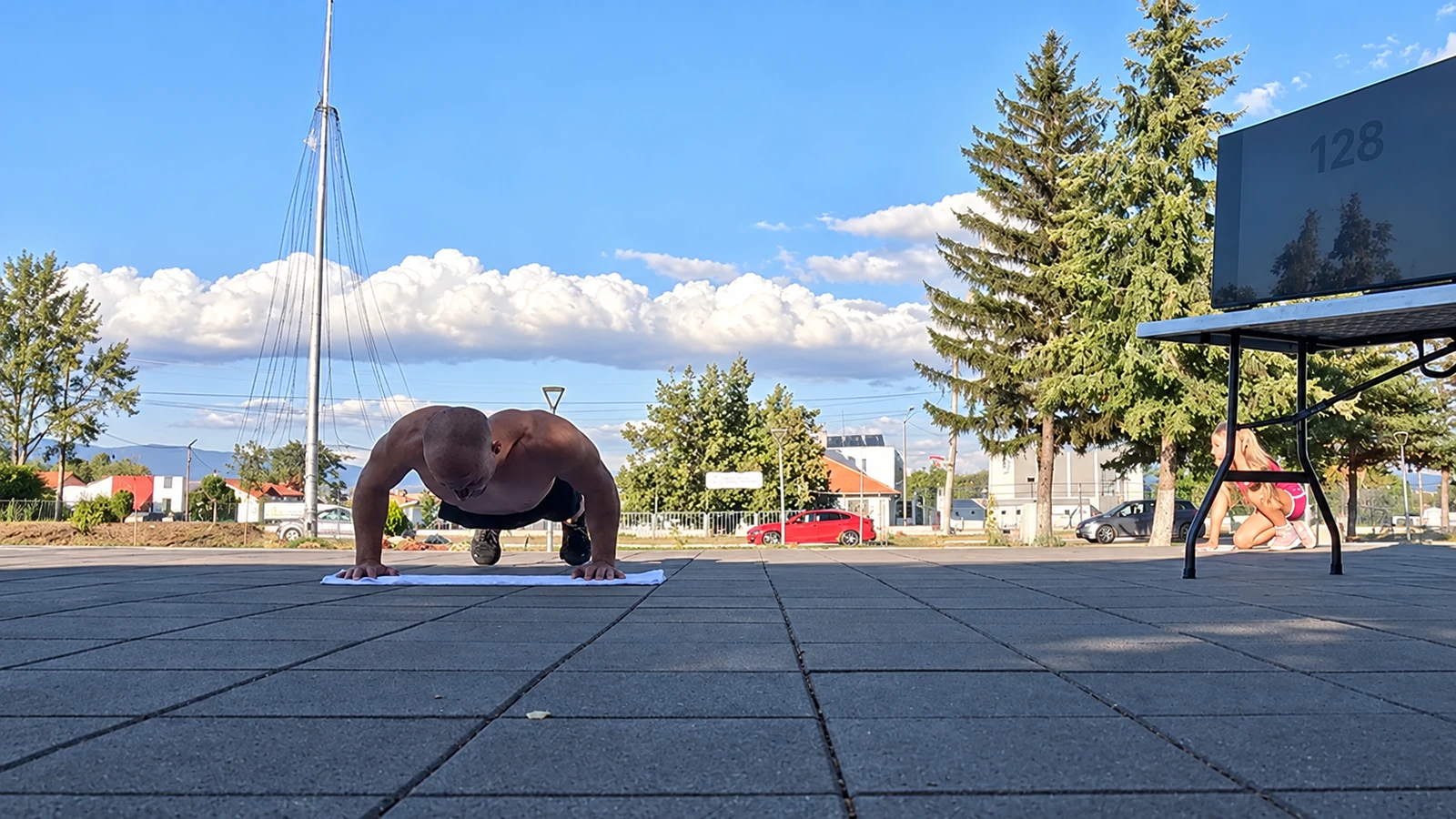

Michael Donchev completed 240 push-ups in three minutes in Novi Khan, Bulgaria, on September 13, 2026, according to Guinness World Records (n.d.-b).
The category is specifically most push-ups in three minutes for men, which makes the time limit and the category part of the result.
The headline is impressive, but the useful questions sit behind it: what was verified, what the pace means, and what ordinary training can reasonably borrow.
A short social clip can start that conversation, while the official record entry provides the clearest starting point for the claim.
A record becomes meaningful when its category and evidence stay attached to the number.
Consistent technique gives a training goal something useful to measure.
What Guinness actually confirmed
The official Guinness entry names Donchev, gives the Bulgarian location, and records the total and date for this particular title (Guinness World Records, n.d.-b).
That is a narrower and more useful statement than calling someone the best at push-ups in every possible setting.
A one-minute attempt, a three-minute attempt, and an endurance challenge ask different questions, even when the exercise name looks the same.
Keep the complete title attached when sharing the result, so readers can tell what performance is actually being compared.
Our coverage of Jake Rintoul’s weighted ring-dip record follows the same principle: the load, movement, and time window define the feat.
How the three-minute title is judged
Guinness explains that approved record attempts receive title-specific guidelines covering the rules, measurement, eligibility, and evidence requirements (Guinness World Records, n.d.-a).
Those instructions matter more than a viewer’s preferred version of an exercise or an informal challenge at a local gym.
The public record listing does not reproduce Donchev’s complete application pack, so it would be misleading to invent its exact judging language.
Guinness also requires complete video evidence of an attempt, rather than only a highlight, to support its review (Guinness World Records, n.d.-c).
A photograph can show a position, but it cannot reveal the entire counted sequence, the timing, or everything the reviewers considered.
What the preparation story adds
Guinness’s October 22 feature describes unsuccessful attempts in 2024 and 2025 before Donchev achieved the title in 2026 (Selbie, 2026).
His account includes work on strength, endurance, technique, recovery, and maintaining form under fatigue, along with setbacks and injuries.
Those details put the final three minutes inside a much longer preparation process, rather than making the outcome look like a spontaneous challenge.
His personal workload is not a ready-made prescription for another person, because the story does not establish their starting ability or recovery needs.
The practical point is to identify what failed in an attempt, then give the next training block a specific problem to address.
The pace behind 240 repetitions
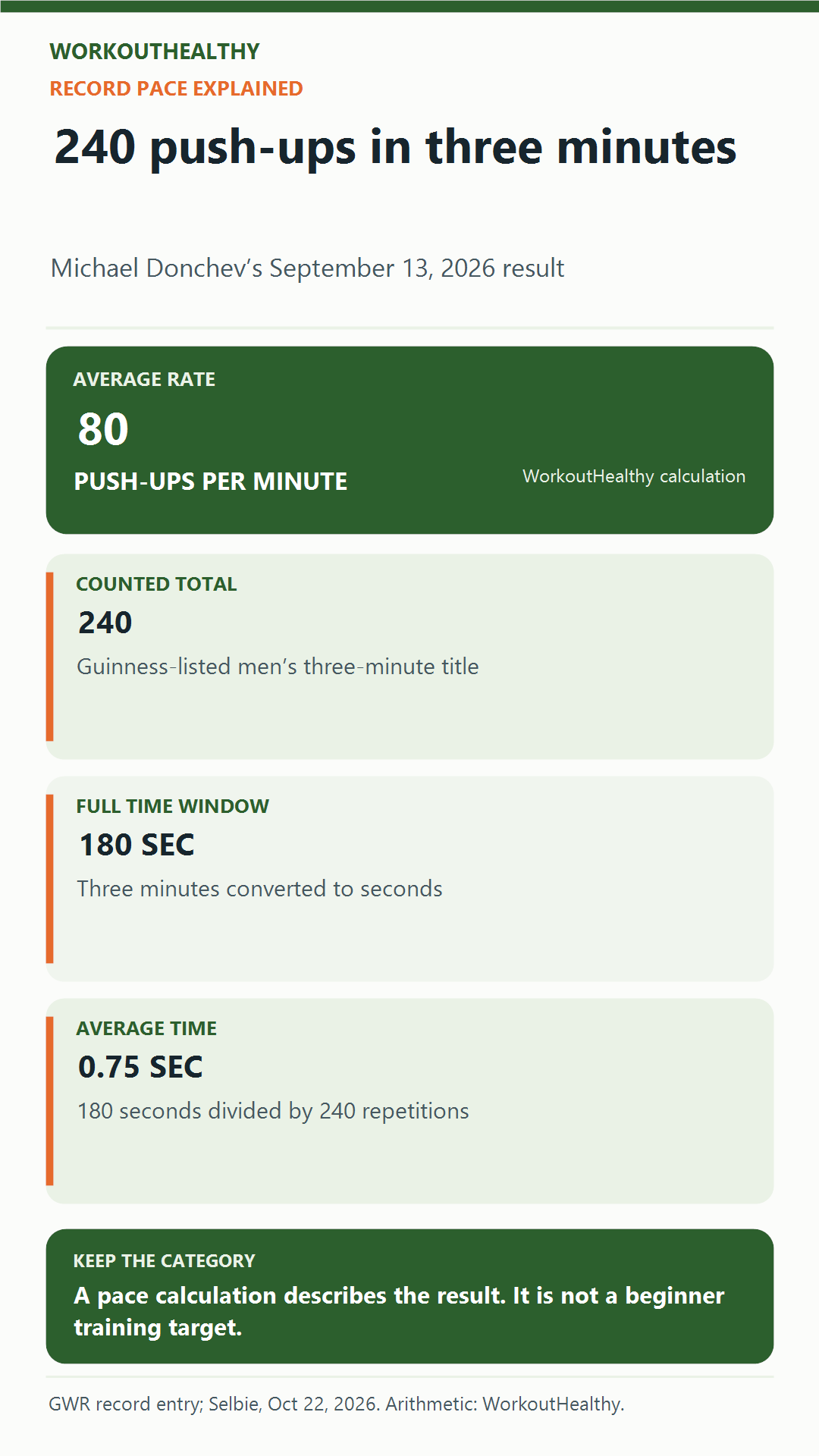
WorkoutHealthy’s calculation starts with two reported inputs: 240 counted repetitions and a three-minute window of 180 seconds.
Dividing 240 by 3 gives an average of 80 repetitions per minute, while dividing 180 by 240 gives 0.75 seconds per repetition.
That average includes the entire window; it does not prove that every repetition took exactly the same amount of time.
Using the previous mark of 231 reported in the Guinness feature, the increase was 9 repetitions, or approximately 3.9 percent (Selbie, 2026).
The percentage formula is (240 − 231) ÷ 231 × 100.
These are arithmetic descriptions of the reported result, not an estimate of Donchev’s second-by-second rhythm or a pace for beginners to copy.
If the credited total or time window changed, the averages would change too, which is why the inputs should remain visible beside the result.
Why a training clip cannot settle every form question
The related reel in the Guinness story shows Donchev training in a different outdoor setting from the photographed record attempt.
It is useful context for his public training, and it is labeled as a training clip in the video section below.
It should not be presented as the complete three-minute evidence submitted for the certified result.
Before judging a record from a fragment, ask whether the footage shows the same event, the whole attempt, and the applicable standard.
That approach leaves room to discuss technique without pretending that a short promotional reel supplies information it does not contain.
A more useful push-up starting point
For ordinary exercise, Mayo Clinic describes controlled modified push-ups and wall push-ups, with a straight body and engaged abdominal muscles (Mayo Clinic, 2025).
The relevant starting point is a variation you can control, rather than matching an elite repetition count.
Choose one version and keep the setup consistent when comparing your own sessions, so a change in technique does not masquerade as progress.
Notice whether you can maintain the same body position through the movement and continue breathing normally.
Our push-up progression guide separates different training goals, which is more useful than treating every extra repetition as the same kind of improvement.
If pain or an existing injury complicates the movement, seek qualified guidance instead of using a record story as rehabilitation advice.
What to take from the record
Donchev’s result is a verified achievement in a defined category, while the surrounding training story describes an individual path toward it.
You can appreciate the speed without turning it into a deadline for your own body.
A more practical next step is to choose a clear movement standard, record your own starting point, and review what changes across comparable sessions.
Keep the distinction between official evidence, personal experience, and editorial calculation intact when you share the story.
Save the pace comparison as context, then use a manageable, clearly defined goal for your own training.
Donchev’s related training reel
This is Donchev’s public training reel featured by Guinness, not the complete certified three-minute attempt (Selbie, 2026).
References
Guinness World Records. (n.d.-a). How are records measured? Guinness World Records.
Guinness World Records. (n.d.-b). Most push ups in three minutes (male). Retrieved October 25, 2026, from Guinness World Records.
Guinness World Records. (n.d.-c). Video evidence. Guinness World Records.
Mayo Clinic. (2025, November 21). Video: Modified pushup. Mayo Clinic.
Selbie, J. (2026, October 22). Failed attempts to 240 push-ups in a matter of minutes: Michael’s record-breaking journey. Guinness World Records.
Medical disclaimer: This article is general product information, not medical advice. The equipment described here is not a treatment for any condition. If you have an injury, ongoing pain, or a medical condition, talk to a doctor or physical therapist before using any of it.