
Method Man has made heavy lifts part of his public image, but a recent workout report puts the spotlight on a different challenge: repeating moderate bench press sets until the reps add up.
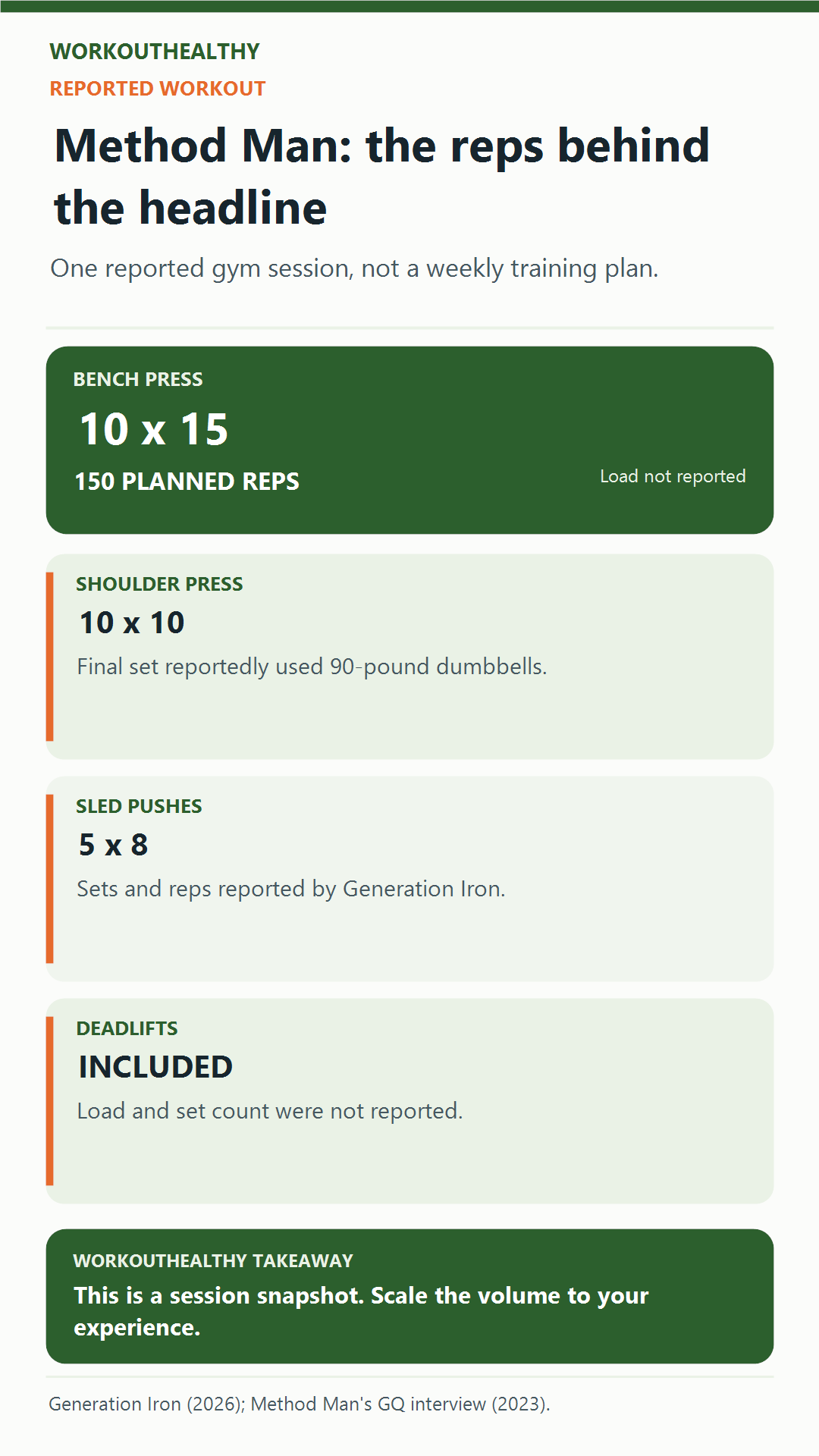
Generation Iron describes 10 sets of 15 bench press reps, along with shoulder presses, sled pushes, and deadlifts; the rapper had also described that same high-rep bench format in a 2023 GQ interview.
The useful question is what that session actually shows about his training, and what an ordinary lifter can take from it without trying to copy an advanced athlete’s workload.
What the reported workout actually includes
Generation Iron says the session began with dumbbell shoulder presses for 10 sets of 10 reps, and it reports that his final set used 90-pound dumbbells.
The report then describes five sets of eight sled pushes, followed by deadlifts and the bench press sequence of 10 sets of 15 reps with a lighter load.
Those details come from the outlet’s account of Tical Athletics posts, so they describe a visible workout rather than a complete training log.
The report does not give the bench weight, rest periods, exact deadlift sets, or a measured outcome from the workout.
That matters because a rep count alone cannot tell you how hard each set was or how much recovery the full session demanded.
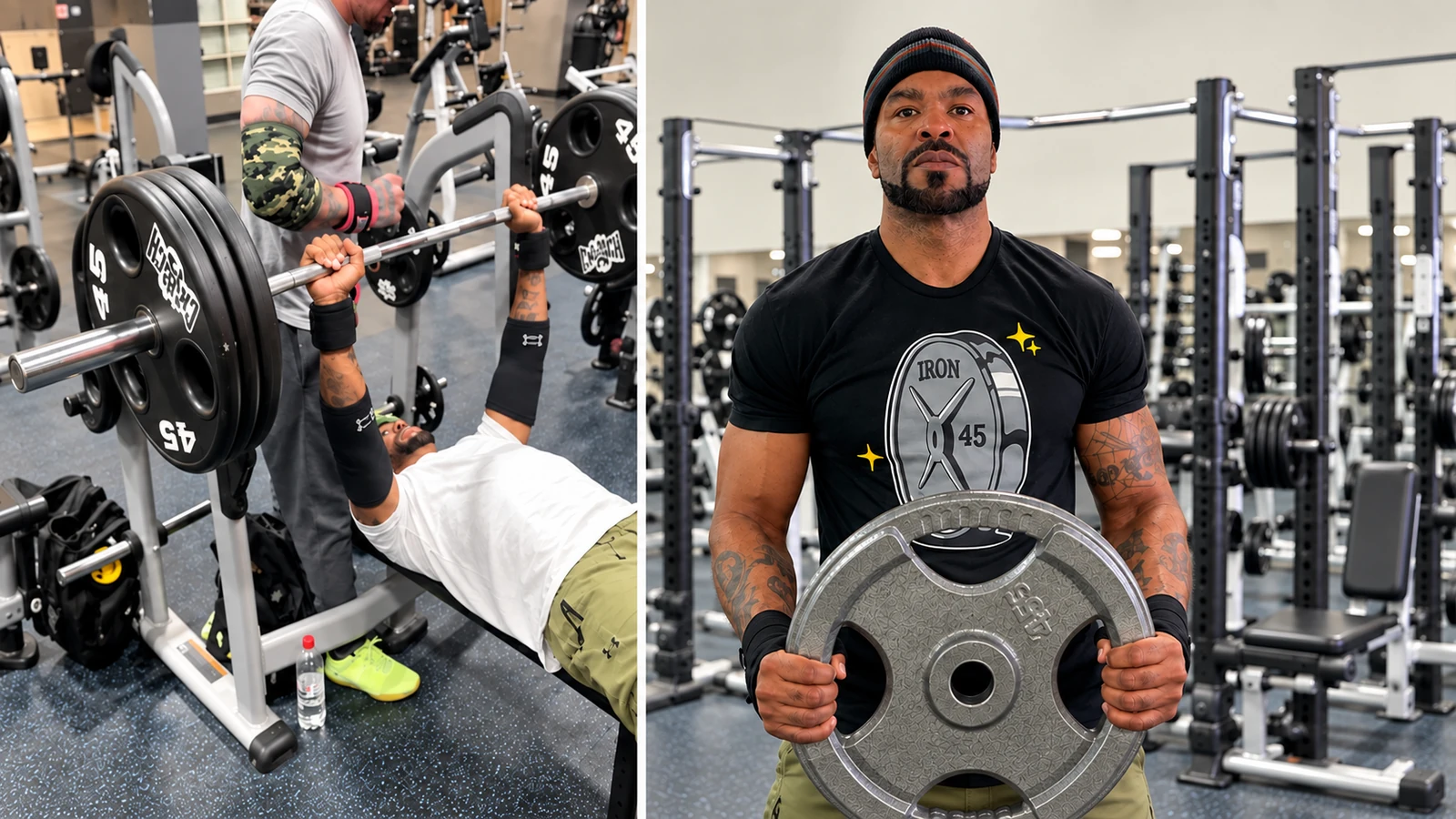
The Facebook creative pairs a bench scene with a portrait of Method Man, but it does not identify the weight on the high-rep bench sets.
A plate visible in an image is not a reliable way to calculate the load across a different set or video clip.
The safest summary is specific: the published account describes a high-volume bench challenge inside a broader gym session.
For the programming context behind a high-set workout, see how training volume and frequency interact.
Why 10 sets of 15 feels different from a heavy single
Ten sets of 15 equals 150 planned bench repetitions, which is a lot of practice on one movement even when the weight is lighter.
A heavy single asks for a brief peak effort, while a long sequence asks you to repeat a technically sound press as fatigue grows.
Neither number tells the whole story unless you also know load, range of motion, rest time, and how close each set came to failure.
Fifteen reps with a weight that leaves several repetitions in reserve can feel very different from 15 reps that nearly stop the lifter.
Technique can also change late in a session, when shoulders, chest, and triceps have already done many sets of work.
That is why the appealing headline is not a ready-made program for everyone who sees it.
Method Man’s total is interesting because it exposes the endurance side of resistance training, not because 150 is a magic target.
For a reader, the useful lesson is to decide whether the goal is a stronger maximal press, more work capacity, muscle growth, or simply consistent training.
Method Man had described this approach before
In his 2023 GQ interview, Method Man described a body-part schedule that included heavy five-rep work and a switch toward higher repetition sessions.
He said chest day could start with five sets of five on the bench, while the higher-rep version involved 10 sets of 15.
He also described shoulder presses for 10 sets of 10 and explained that the repeated chest work felt especially hard.
That interview is useful because it makes the newer report less surprising: high-rep bench work was already part of his stated training mix.
It does not prove he used the exact same load, recovery schedule, or weekly plan in 2026.
Nor does a single published clip establish that the workout is his current everyday routine or the cause of his physique.
Fitness stories often compress years of training into one striking session, but a session is only a snapshot.
The older interview and the newer report agree on the central bench format, while leaving plenty of important programming details unknown.
What research says about load and muscle growth
A 2021 systematic review and network meta-analysis compared resistance training with lower, moderate, and higher loads when sets were taken to voluntary failure.
It found that a range of loads can support muscle hypertrophy, while heavier loads generally favored gains in one-repetition maximum strength.
That does not mean all rep schemes work identically for every person or that failure is required on every set.
It also does not mean Method Man’s reported workout caused any particular change in muscle size.
The study groups followed organized programs over time, whereas the public workout report provides no before-and-after measurements.
Another review found no clear muscle-growth advantage for taking every set to momentary failure compared with stopping short.
Taken together, the research supports choosing a load and rep range you can perform well and progress, instead of treating one celebrity set count as uniquely effective.
Our separate guide to low reps versus high reps goes deeper into the strength and size tradeoffs.
The rest of the session changes the picture
The bench numbers make a memorable headline, but the report places them beside shoulder presses, sled work, and deadlifts.
That combination spreads the effort across pressing muscles, legs, trunk, and the work of moving a loaded sled.
The report does not specify how hard every exercise was, so there is no sound basis for calculating a total workload or ranking the hardest part.
Ten shoulder-press sets before bench work could make later pressing feel different from a bench session done when fresh.
Sled pushes can be demanding without looking like a classic barbell lift, and deadlift effort depends heavily on load and reps.
One session can therefore contain several kinds of stress, from technical repetition to muscular endurance to heavy lifting.
The practical insight is to consider the whole workout when judging whether a number is reasonable, rather than isolating one exercise from its context.
A plan that looks manageable on paper may become too much when multiple large movements are stacked together.
Why copying all 10 bench sets is a poor starting point
Method Man has discussed years of lifting, training with friends, and using both heavy and high-rep work.
A person new to pressing has a different starting point and no reason to jump straight to 150 bench reps.
More sets can provide more practice, but they also consume time and can make it harder to keep the same technique from first rep to last.
Start with the amount of work you can recover from and repeat next week, then add only when you have a reason to do so.
If your setup changes, your range of motion shortens, or every rep turns into a grind, the session is giving feedback.
You can reduce the load, stop the set, or choose a less demanding variation rather than chase the full headline number.
Our floor press versus bench press guide explains how a different pressing variation changes the movement, though it is not an automatic substitute for everyone.
The goal is consistent work you can track, not a one-day imitation of someone else’s highlight.
A practical way to test a higher-rep day
If you already know how to bench press comfortably, you can explore a higher-rep day with a manageable load and a small number of sets.
Choose a weight that lets you keep your normal setup, controlled lowering, and a steady press without a spotter having to rescue the bar.
Two or three sets give you enough information about how 12 to 15 reps feel without committing to ten rounds.
Record the weight, completed reps, rest periods, and how many clean reps you think remained at the end of each set.
Keep the first week modest enough that you can compare it with another session rather than simply survive it.
If you later add a set, make one change at a time so you can tell whether the extra work helped or just increased fatigue.
A lifter whose main goal is a stronger single will still need practice with heavier loads, while someone seeking general fitness may prefer a simpler full-body routine.
These are training options, not a claim that a particular rep count will reproduce Method Man’s results.
Heavy sets and high-rep sets answer different questions
A heavy set tests how much force you can apply to a familiar lift under a short effort.
A high-rep set tests how long you can sustain useful effort with a lighter load before technique or speed falls away.
Most people do not have to choose one identity forever, because programs can include both kinds of work at different times.
Method Man’s GQ comments about five-rep bench work and 15-rep bench work illustrate that he has used both approaches.
What you do next should depend on your goal, your experience, and the quality of repetitions you can keep producing.
A higher rep target can be motivating, but a visible rep total is not a score for health, skill, or personal worth.
If you train with a partner, discuss the target before the set and agree on when the set ends if the lift becomes inconsistent.
The best comparison is against your own previous training under similar conditions, not a clip with unknown loads and rest periods.
What the Method Man workout shows
The striking detail is real enough to discuss: Generation Iron reports 10 sets of 15 bench reps, and Method Man described that format himself in GQ.
The same sources do not establish the bench load in the reported 2026 session or prove a special benefit from that exact volume.
The session is a useful reminder that resistance training can challenge strength, repetition quality, and endurance in different ways.
For most readers, the sensible takeaway is to borrow the idea of purposeful variety while scaling the work to a level they can perform and repeat.
We explain our sourcing and visual standards for public figures on the How We Cover Celebrity Fitness page.
References
- Generation Iron, “Method Man Goes Through Low-Weight, High-Rep Workout,” September 21, 2026.
- GQ, “The Real-Life Diet of Method Man,” July 20, 2023.
- Lopez et al., “Resistance Training Load Effects on Muscle Hypertrophy and Strength Gain,” Medicine & Science in Sports & Exercise, 2021.
- Refalo et al., “Influence of Resistance Training Proximity-to-Failure on Skeletal Muscle Hypertrophy,” Sports Medicine, 2023.