

Merle Dandridge spends most of her working nights under stage lights or in front of a camera.
This fall she chased a goal that had nothing to do with acting at all.
Dandridge ran the 2025 TCS New York City Marathon, according to Runner’s World, and called finishing it a lifelong bucket list item.
She raised money for Broadway Cares, a nonprofit that supports theater workers facing serious illness and financial hardship.
For an actor known for playing intense, high stakes characters, this was a challenge with no script and no second take.
Who Is Merle Dandridge
Dandridge was born in 1975 in Okinawa, Japan, and grew up at Offutt Air Force Base in Nebraska.
She trained at Roosevelt University’s Theatre Conservatory in Chicago before building a career that spans Broadway, television, and video games.
She originated roles in Rent and Jesus Christ Superstar on Broadway and later starred as Grace Greenleaf in the drama series Greenleaf.
Fans of The Last of Us know her as Marlene, a role she voiced and performed through motion capture in the original 2013 video game and reprised in the 2023 HBO adaptation.
Her video game work also includes voicing Alyx Vance in the Half Life series, and she won a BAFTA Award in 2015 for her performance in Everybody’s Gone to the Rapture.
More recently, she has played Fire Chief Natasha Ross on the drama series Station 19, adding a network television procedural to a resume that already spanned theater, streaming, and gaming.
Across all of it, she has built a reputation as a performer who moves comfortably between mediums rather than staying in one lane.
Running for Broadway Cares
Broadway Cares, formally known as Broadway Cares/Equity Fights AIDS, is a well established nonprofit that provides financial and social service support to theater industry workers dealing with illness, aging, and financial crisis.
Dandridge’s marathon run raised funds for that mission, joining a long tradition of theater performers using the New York City Marathon to support causes tied to their industry.
The race itself is one of the largest marathons in the world, with tens of thousands of finishers each November.
What makes her story stand out is the framing.
She has described the marathon as something she wanted to complete for herself, not for a role or a press tour, a genuinely personal goal fit into an already demanding career.
Why Charity Marathon Fundraising Works So Well
Broadway Cares has supported the theater community since the height of the AIDS crisis in the 1980s, and it has since broadened its mission to cover a wider range of health and financial emergencies affecting people who work in theater.
A marathon fundraiser gives a cause like this something a simple donation drive rarely offers: months of visible, trackable effort building toward a single public day.
Sponsors and followers can watch training progress unfold in real time, which tends to build more sustained engagement than a one time appeal.
It also works because the New York City Marathon itself carries enormous public visibility.
Running under a charity’s name in a race watched by millions gives that cause exposure it could not easily buy through advertising alone.
Fitting Marathon Training Around a Working Actor’s Schedule
Actors juggling rehearsals, filming days, and travel rarely get the luxury of a predictable training block.
Most marathon plans assume a fairly stable weekly schedule, which is not always available to someone whose calendar changes by the production.
That makes the achievement more impressive, not less.
Fitting long runs around irregular hours takes real planning, not just motivation on race morning.
It also mirrors a challenge a lot of working adults face outside the entertainment industry.
Shift workers, parents, and anyone with an unpredictable schedule deal with the same basic problem: fitting consistent training into a week that refuses to be consistent.
What the Research Says About Running and Long Term Health
Running is one of the most studied forms of aerobic exercise, and the evidence on its long term benefits is strong.
A large scale analysis published in the Journal of the American College of Cardiology, known as the Copenhagen City Heart Study, tracked joggers over several decades and compared their mortality risk to non joggers (Schnohr et al., 2015).
The researchers found that light to moderate joggers had a notably lower risk of death over the follow up period than sedentary non joggers, though the benefit leveled off and even reversed slightly at the very highest, most strenuous training volumes.
That finding matters for anyone training for a single event like a marathon.
The goal is not to train as hard and as often as possible.
It is to train enough to finish safely, then return to a more moderate, sustainable routine afterward.
More running is not automatically better running. The dose that helps a long term health outcome is usually smaller than the dose runners assume they need.
What This Evidence Does Not Prove
The Copenhagen study followed people who jogged regularly over years, not people training for a single marathon on a compressed schedule, so it cannot be read as direct proof about marathon training specifically.
It also cannot say anything about Dandridge’s personal training approach, since the specifics of her plan have not been publicly detailed.
What the study does support is a broader, well replicated pattern: moderate, consistent aerobic activity tracks with better long term health outcomes than either no exercise or extreme, unrelenting volume.
A single marathon, especially a first one, is a short term spike in training load rather than a permanent lifestyle change, and the research on habitual joggers should be read with that distinction in mind.
Common Mistakes When Training Around a Busy Schedule
Trying to make up missed training days by doubling up runs is a common mistake.
Back to back hard efforts without recovery raise injury risk far more than they add fitness.
Skipping warm ups to save time is another frequent shortcut.
A rushed five minute warm up before a hard effort leaves muscles and tendons less prepared for the load.
Ignoring sleep in favor of an early run is a mistake that catches up with people.
Recovery, not the workout itself, is when the body actually adapts to training.
Treating every available window as a training opportunity, without any planned rest days, is a fourth common trap.
Even a packed schedule needs at least one or two lower intensity days built in each week.
Who Should Talk to a Doctor First
Marathon training asks a lot of the cardiovascular system, and that is true regardless of how fit someone looks or how demanding their career already is.
Research published in the New England Journal of Medicine examined cardiac arrests during long distance running races across more than a decade of race data (Kim et al., 2012).
The researchers found these events are rare overall, but they occur more often in participants with an underlying, often previously undiagnosed heart condition.
Anyone starting marathon training after a long period without regular exercise should talk to a doctor first, particularly if they are over 40, have a family history of heart disease, or notice unusual chest discomfort or breathlessness during exertion.
This is true whether the person training is a working actor, an office worker, or a retiree.
People managing asthma, joint pain, or any chronic condition should also check in with a doctor or physical therapist before committing to a training block that includes long runs on hard pavement.
How to Build a Marathon Training Plan Around a Busy Life
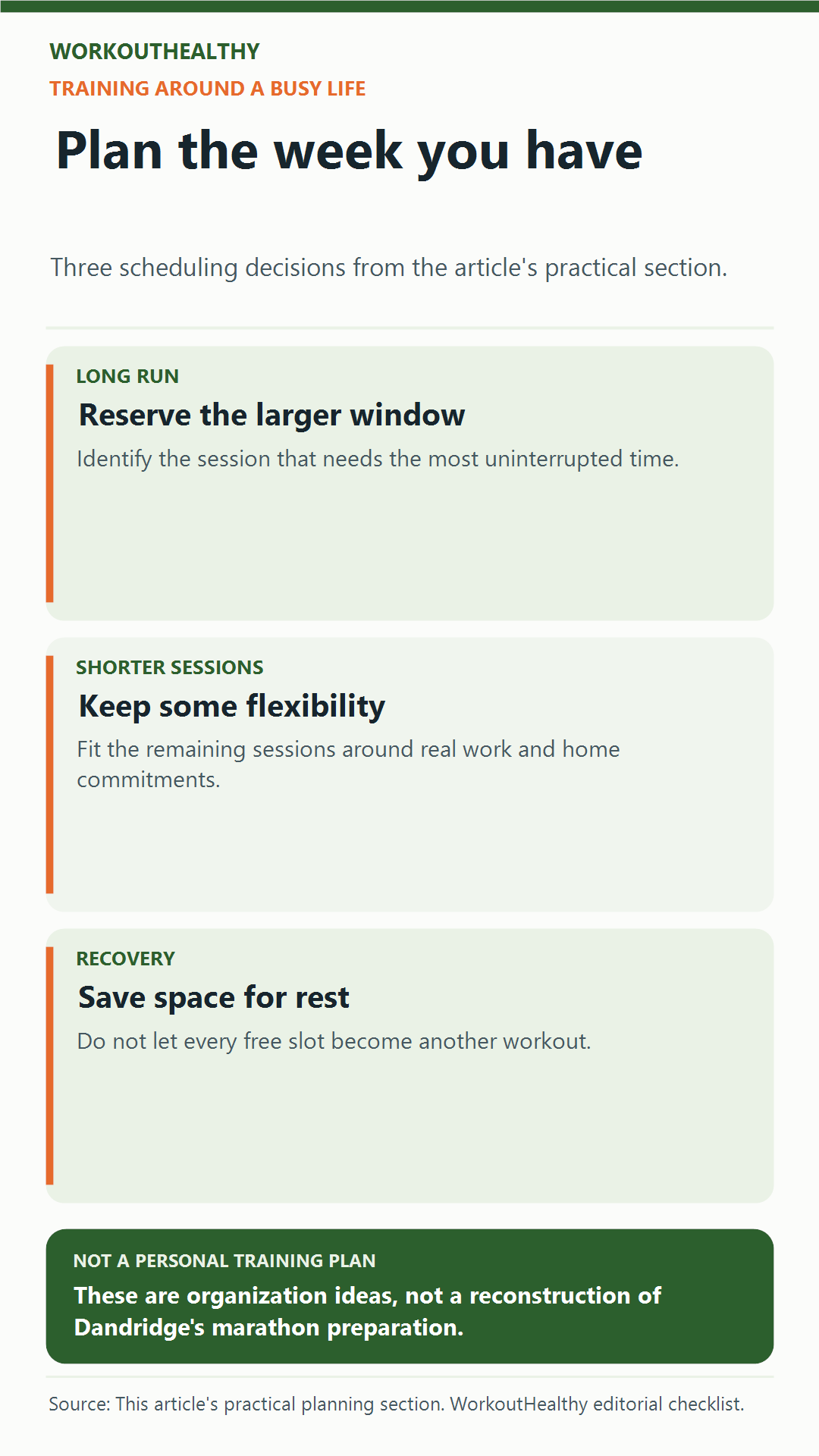
Block out your long run day first, before anything else gets scheduled.
This is the one session in a marathon plan that is hardest to reschedule once the week fills up.
Keep shorter runs flexible and short enough to fit into a lunch break or an early morning window.
Twenty to thirty minutes of easy running still counts toward weekly volume.
Use a training plan with built in flexibility, such as a three week rotation instead of a rigid seven day cycle.
This makes it easier to shift a missed run without abandoning the whole week.
Treat sleep as part of training, not separate from it.
Aim for a consistent bedtime on the nights before your hardest sessions.
Fuel and hydrate on a schedule you can actually repeat during a busy week, not an ideal one that only works on your days off.
Build in at least one full rest day, even during your highest volume training weeks.
Rest days are not wasted time, they are part of how the body absorbs training stress.
Consider training with a friend, castmate, or running group for accountability.
A training partner can make the difference between a missed session and a completed one, especially on weeks when the schedule fights back.

If your schedule makes it hard to build a plan on your own, a personal trainer or run coach can help design a program around your actual calendar rather than an idealized one, and can flag warning signs your own instincts might miss.
References
- Schnohr, P., O’Keefe, J. H., Marott, J. L., Lange, P., & Jensen, G. B. (2015). Dose of jogging and long-term mortality: The Copenhagen City Heart Study. Journal of the American College of Cardiology, 65(5), 411-419. https://doi.org/10.1016/j.jacc.2014.11.023
- Kim, J. H., Malhotra, R., Chiampas, G., d’Hemecourt, P., Troyanos, C., Cianca, J., Smith, R. N., Wang, T. J., Roberts, W. O., Thompson, P. D., & Baggish, A. L. (2012). Cardiac arrest during long-distance running races. New England Journal of Medicine, 366(2), 130-140. https://doi.org/10.1056/NEJMoa1106468
- Runner’s World. (2025). Celebrities running the 2025 New York City Marathon.
- Broadway Cares/Equity Fights AIDS. About our mission.
This article is for general educational purposes and is not medical advice. Talk to a doctor or qualified health professional before starting a new exercise program, especially if you have an existing health condition or have not exercised regularly in the past year.