

Megan Fox did say in 2011 that she had followed a strict vegan diet based on raw fruits and vegetables with no bread, sugar, or coffee. In the same account, she said she lost too much weight, stopped the approach, and began eating a wider variety of foods.
That makes the viral low-sugar, no-refined-carbohydrate story incomplete. It mixes a temporary diet Fox abandoned with trainer Harley Pasternak’s Five Factor system, which explicitly includes carbohydrates such as whole grains, fruit, and vegetables.
The Strict Diet Quote Came With a Warning
Fox told Amica magazine that she had spent about a year and a half on the raw vegan pattern. Us Weekly reported her full context in September 2011, including her statement that the diet caused more weight loss than she wanted.
She said she had returned to eating a bit of everything and continued training with Pasternak three times a week. That is the opposite of evidence that eliminating bread and other carbohydrates remained the permanent secret to her appearance.
Pasternak also said Fox had a fast metabolism and that his concern was making sure she ate enough of the right foods. The viral caption rejects a metabolism explanation and replaces it with strict discipline, while the trainer’s own account described both genetics and adequate intake as relevant.
Old celebrity quotes often survive longer than the behaviors they describe. A restrictive phase from age 25 should not be presented as a current plan for a person now in a different stage of life.
The Five Factor Diet Is Not a No-Carb Diet
Pasternak has described his Five Factor eating pattern as five meals or eating occasions containing lean protein, a carbohydrate source, fiber, a healthy fat, and a sugar-free drink. His examples include whole grains, fruit, vegetables, fish, eggs, yogurt, and oils.
Contemporary reports even listed Five Factor French toast, oatmeal pancakes, and pizza among foods associated with Fox’s version of the plan. Those examples do not fit the idea that she permanently removed every traditional carbohydrate.
The word refined also needs precision. A grain can be refined without being identical to a sugary dessert, and bread can vary widely in fiber, sodium, ingredients, portion, and how it fits the rest of a meal.
Dietary guidance generally recommends choosing nutrient-dense foods and making at least half of grain choices whole grains rather than eliminating the entire grain category. Added sugar is worth limiting, but naturally occurring sugar in fruit or plain dairy arrives with a different nutrient package.
Stable Energy Is Not Guaranteed by Removing Bread
Meals that combine protein, fiber, fat, and minimally processed carbohydrates can slow digestion and support fullness. That basic structure may help some people maintain steadier appetite, but it does not mean bread or a single food automatically causes an energy crash.
Blood glucose responses differ with portion, meal composition, activity, sleep, medications, and individual health. A person with diabetes needs personalized guidance rather than a celebrity rule about salmon and avocado.
A highly restrictive food list can also make it harder to meet energy needs, enjoy social meals, or sustain training. Fox’s own report that she lost too much weight is a reminder that a plan can sound disciplined while failing the person’s actual goal.
Organic labeling does not solve the larger question either. Organic and conventional foods can both contribute to a nutritious diet, while protein, fiber, portions, preparation, access, and the overall pattern matter more than using the label as proof of purity.
Healthy fats such as avocado, nuts, seeds, and olive oil are energy dense and can support satisfying meals, yet they do not cancel calories or guarantee focus. Salmon supplies protein and omega-3 fats, but a diet does not become balanced merely because two fashionable foods appear on the plate.
People who feel tired after meals should consider sleep, meal size, hydration, stress, medical conditions, and medication effects instead of assuming refined carbohydrate is the sole cause. Persistent fatigue, dizziness, or unexplained weight change deserves clinical attention.
Our review of walking after meals and blood sugar explains a behavior with direct research behind it. That evidence is more useful than labeling every carbohydrate as a problem.
The Five Factor Workout Has Five Phases
Pasternak described Fox’s sessions as a minimum five-minute cardio warm-up, a lower-body strength exercise, an upper-body exercise, an abdominal exercise, and a five-minute cool-down. He said the middle exercises could be cycled for repeated rounds.
That is a compact full-body circuit, not a program focused only on abdominal sculpting. It can raise heart rate and train several movement patterns within a limited appointment.
The label Five Factor has also been used across different versions of Pasternak’s books and media appearances, so an exact session cannot be reconstructed from the name alone. Exercise choice, load, rounds, repetitions, and rest determine whether the workout feels gentle, moderate, or intense.
Calling every circuit high-intensity training is also inaccurate. High intensity can refer to heavy resistance, near-maximal cardiovascular work, or simply subjective difficulty, and those are not interchangeable doses.
Circuit Training Can Work Without Being Magical
A systematic review covering 45 studies found that resistance circuit training improved strength, cardiorespiratory fitness, muscle mass, and fat mass on average. The results support circuits as a valid format, but they do not show that five phases are uniquely superior.
Short rest periods make a session efficient and cardiovascularly demanding, while longer rests can preserve strength and technique. A person seeking maximal strength may need heavier sets with more recovery than a nonstop circuit allows.
Low-volume interval training can improve aerobic fitness, yet meta-analyses have not consistently found superior changes in fat mass compared with continuous exercise. Time efficiency is valuable, but no short workout bypasses nutrition, recovery, and long-term consistency.
Readers can compare formats in our article on circuit training benefits and limits. The best format is one that matches the goal and can be repeated safely.
Ab Exercises Strengthen Muscle, Not a Celebrity Outline
Pasternak said he trained Fox’s trunk through forward and backward movement, side-to-side movement, and rotation rather than through crunches alone. That is a reasonable way to expose the trunk to several functions.
Core training can improve strength, endurance, and control in the exercises practiced. It cannot choose a person’s bone structure, fat distribution, waist length, lighting, or camera angle.
Research on localized fat loss remains limited and mixed, and one small newer trial does not turn abdominal circuits into a guaranteed spot-reduction tool. Total energy balance, genetics, and whole-body activity still dominate visible body composition.
The phrase toned abs combines muscle and appearance as though one exercise controls both. A stronger trunk is a useful goal even when it does not produce the look of a professionally styled photograph.
A More Balanced Five-Part Plan

- Warm up for five minutes. Use walking, cycling, or easy versions of the planned movements.
- Train the lower body. Choose a squat, hinge, step, or lunge that can be loaded gradually.
- Train the upper body. Alternate pushing and pulling across the week instead of forcing both into one move.
- Train the trunk. Use a carry, plank, controlled rotation, or flexion exercise that feels stable.
- Cool down and record the dose. Note the load and repetitions so the next session has a clear starting point.
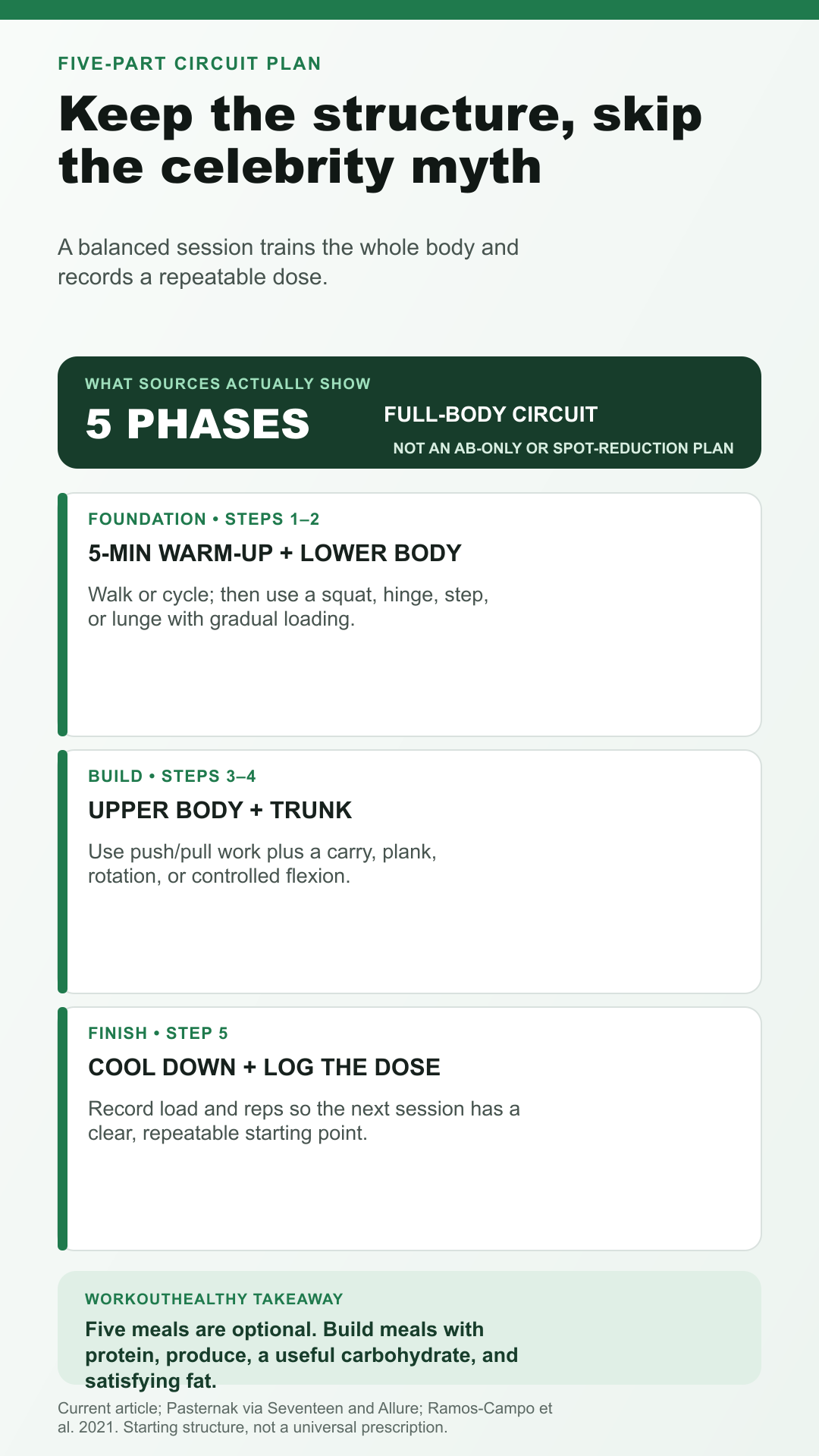
A beginner can complete two rounds with comfortable loads, while an experienced lifter can use harder variations and more recovery. The plan does not need to promise maximum metabolic impact to be worthwhile.
Meals can follow a similarly flexible structure by pairing a protein source, produce, a carbohydrate that supports energy needs, and a satisfying fat. Five meals are optional, not a metabolic requirement.
The Corrected Story Is Less Restrictive
Megan Fox’s documented history includes a strict vegan experiment, dissatisfaction with excessive weight loss, a return to broader eating, and training with a coach who used short full-body circuits. The sources do not establish a permanent organic, salmon-and-avocado diet with all bread removed.
They also do not prove that discipline alone created a famous body. Genetics, resources, professional coaching, work demands, age, pregnancy history, and image production all sit outside the neat caption.
The safer lesson is to keep useful structure and discard the mythology. Eat enough, include foods you can sustain, train the whole body, and let health goals be more important than reproducing someone else’s appearance.
Get the next evidence check.
Five practical fitness stories worth your time, every Friday.
One email a week. No product pitches. Unsubscribe in one click.
Medical disclaimer: This article is for general information only and is not medical advice. If you have an injury, ongoing pain, or a medical condition, talk to a doctor or physical therapist before you change how you train or eat.