

Brian Johnson built the Liver King persona around raw organs, heavy training, and a message that modern people should return to “ancestral” habits. That history makes his later criticism of strict carnivore eating more than celebrity-diet trivia.
It is a useful case study in what happens when a dramatic nutrition identity meets evidence, changing goals, and public accountability.
Quick answer: Johnson has publicly backed away from presenting an all-meat diet as the answer for everyone. That change does not prove a plant-only diet is best, and it does not erase earlier misleading claims. It does reinforce a better rule: judge a diet by nutritional adequacy, sustainability, health markers, and evidence, not by the confidence of its loudest promoter.
A nutrition plan should be able to survive new evidence without becoming a new identity crisis.
What actually changed
Johnson became famous by eating raw liver and other animal foods on camera while selling an “ancestral” lifestyle. The image was intentionally extreme because extreme images travel well online.
In Netflix’s 2025 documentary profile, Johnson criticized the carnivore diet and acknowledged that he had promoted ideas he no longer defended in the same way. Public reporting since then has described a broader diet that includes fruit and other plant foods.
That is a pivot, but it needs careful wording. It does not establish that he is vegan, that he has abandoned all animal foods, or that one documentary confession settles every health question.
The reliable conclusion is narrower: the best-known promoter of a rigid meat-centered identity no longer presents strict carnivore eating as the universal answer he once implied.
Johnson’s credibility also changed after he admitted using performance-enhancing drugs while marketing an “all-natural” physique. A muscular body was part of the evidence viewers were invited to trust, even though the picture was incomplete.
That history matters because nutrition claims often borrow authority from appearance. A physique can show that someone built muscle; it cannot reveal blood lipids, long-term cardiovascular risk, micronutrient status, drug use, genetics, or whether a diet caused the result.
Why the persona mattered
Online nutrition rewards certainty. “Eat a varied pattern that fits your needs” is less memorable than “plants are poison” or “meat fixes everything.”
A persona compresses a complicated decision into a character. Followers do not merely copy a menu; they join a story about toughness, purity, or rebellion.
That can make ordinary course correction feel like betrayal. If food choices become proof of who you are, adding beans or berries is no longer a small nutrition change. It becomes an admission that the tribe may have been wrong.
The healthier model treats eating as adjustable. Goals change, labs change, budgets change, training changes, and evidence improves. A good plan has room for all of that.
This same distinction appears in celebrity schedules. Our review of Mark Wahlberg’s changing breakfast routine shows why one person’s current timing is not a universal rule.
There is also a commercial layer. When a personality sells supplements, subscriptions, or products connected to the diet, dramatic certainty can benefit the business.
A financial interest does not automatically make a claim false. It does mean the claim deserves more independent verification, not less.
What carnivore evidence can and cannot show
A carnivore diet usually means eating only or almost only animal foods. Definitions vary, which already makes outcomes difficult to compare.
Some people report short-term weight loss, steadier appetite, or fewer digestive symptoms. Those experiences can be real without proving that eliminating all plants caused the improvement.
Restrictive diets often remove alcohol, refined snacks, sugary drinks, and many highly palatable foods at the same time. They may also increase protein and reduce total calorie intake without deliberate counting.
That creates multiple plausible explanations. An elimination period can identify a trigger, but it can also make someone credit “no plants” for benefits caused by eating fewer calories or fewer ultra-processed foods.
Long-term evidence for strict carnivore eating remains thin. Large randomized trials comparing years of carnivore eating with well-designed omnivorous or plant-forward diets do not exist.
Known concerns include very low fiber intake, limited variety, high saturated-fat exposure in some versions, and possible gaps in vitamin C, folate, potassium, magnesium, and other nutrients depending on food selection.
Responses also differ. One person may see LDL cholesterol rise sharply, while another shows a smaller change. That variation is a reason to measure, not a reason to assume risk disappears.
Blood pressure, LDL cholesterol, triglycerides, glucose control, bowel habits, kidney function when relevant, and overall dietary adequacy are more useful than a before-and-after mirror photo.
What plant foods add
Plant foods are not interchangeable. Lentils, berries, oats, olive oil, broccoli, and candy made with refined plant ingredients do not have the same nutritional profile.
A plant-forward pattern emphasizes minimally processed vegetables, fruit, legumes, whole grains, nuts, seeds, and unsaturated fats. It can still include fish, eggs, dairy, or meat if that matches the person’s preferences.
Fiber is one major difference. It supports stool bulk and helps feed intestinal microbes that produce short-chain fatty acids.
Plant foods also add potassium and a wide range of phytochemicals. Those compounds do not make a food magical, but variety helps cover nutritional bases that a narrow menu can miss.
Whole-diet research consistently favors patterns rich in vegetables, fruit, legumes, whole grains, and unsaturated fats for cardiovascular health. That is a pattern-level finding, not a command to avoid every animal product.
Even foods with promising compounds need proportion. The evidence behind cocoa flavanols and blood-vessel function is more specific than “chocolate is healthy.”
The useful question is not whether a food belongs to Team Plant or Team Animal. It is what the food contributes, what it displaces, and how it fits the person’s health needs.
You can keep protein without keeping the ideology
Leaving a strict carnivore framework does not require abandoning protein. It requires separating a legitimate training need from an all-or-nothing story.
Adults who strength train can distribute protein across meals using meat, fish, eggs, dairy, soy, beans, lentils, or combinations. Total intake, training quality, and recovery matter more than attaching virtue to one source.
Plant proteins can support muscle growth when total protein and essential amino acids are adequate. Some people may use slightly larger portions or combine sources across the day.
A mixed plate can include a clear protein anchor, high-fiber carbohydrate, vegetables, and a source of unsaturated fat. That structure is flexible enough for performance and ordinary life.
Recovery still requires more than protein. Sleep, training load, calories, stress, and rest all influence adaptation.
Our guide to rest days and muscle growth explains why more effort is not always more progress.
You do not need a nutritional tribe to build a high-protein plate.
The four-part diet-claim filter
A simple filter can keep a dramatic testimonial from becoming an expensive or risky experiment.
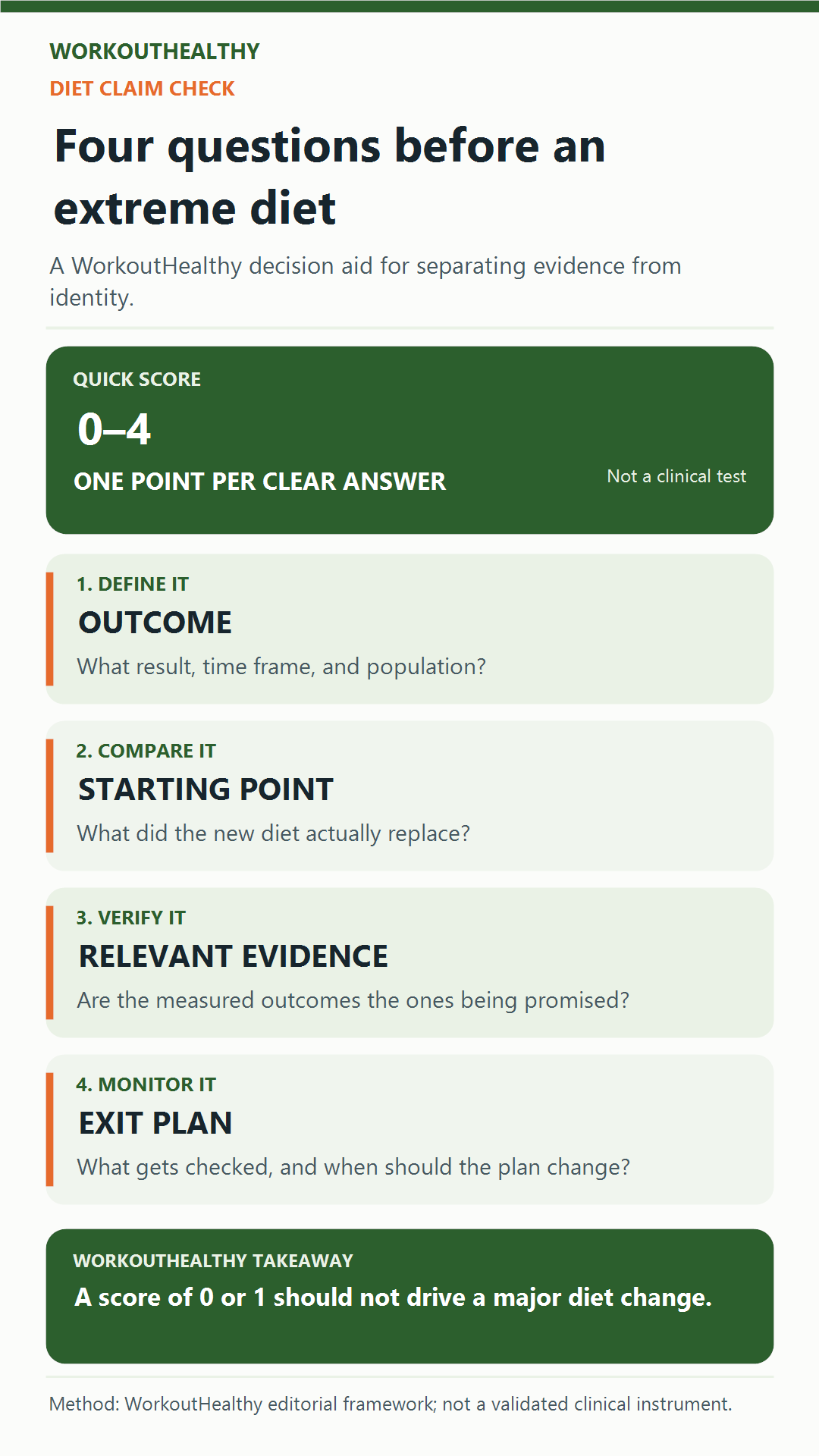
First, define the claim. “I feel better” is not the same as “this diet prevents heart disease.” Ask what outcome, time frame, and population are actually being discussed.
Second, identify the comparison. Did the person replace fast food with steak and eggs, or replace a balanced high-fiber diet with only meat? The starting point changes the meaning.
Third, separate direct evidence from proxies. Weight, LDL cholesterol, bowel symptoms, gym performance, and mortality are different outcomes. Improvement in one does not guarantee improvement in all.
Fourth, look for exit ramps. A credible plan explains what to monitor, who should avoid it, and when to change course. A belief system treats every bad result as failure to commit.
WorkoutHealthy’s practical scoring rule gives one point for each answer that is clear: defined outcome, fair comparison, relevant evidence, and monitoring plan. A claim scoring zero or one should not drive a major diet change.
Two points means the idea needs more investigation. Three or four points makes it testable, but still not universally correct.
This framework is a site-created decision aid, not a validated medical instrument. Its purpose is to slow the leap from charismatic story to personal prescription.
A practical way to broaden a restrictive diet
Someone moving away from a very narrow diet does not need to rebuild every meal overnight. A gradual approach makes symptoms and preferences easier to interpret.
Start with one familiar plant food in a modest portion. Fruit, cooked vegetables, oats, rice, potatoes, or a small serving of legumes may be easier than a giant raw salad.
Keep the rest of the meal stable for several days. That reduces the number of variables changing at once.
Add variety progressively if tolerance is good. Track bowel symptoms, appetite, energy, training, and any clinician-directed markers rather than relying on fear or excitement.
People with diagnosed gastrointestinal disease, food allergy, kidney disease, diabetes medication, or a history of disordered eating should get individualized help before making a major restriction or reintroduction.
Do not use social-media discomfort rules as diagnosis. Temporary gas after rapidly increasing fiber can happen, but persistent pain, vomiting, blood in stool, or unintended weight loss needs medical evaluation.
Keep the change boring enough to evaluate. A modest swap repeated for two weeks teaches more than alternating between extreme challenges.
The bottom line
Liver King’s pivot is not proof that one opposing diet wins. It is evidence that even the most confident nutrition identity can change when reality becomes harder to compress into a slogan.
The lasting lesson is to demand clear outcomes, fair comparisons, independent evidence, and a monitoring plan. Build meals that cover protein, fiber, micronutrients, and enjoyment without asking food to prove your membership in a tribe.
Keep the practical takeaway: replace one extreme rule with one measurable habit. Add a fiber-rich food, keep a protein anchor, and check whether your health and training actually improve.
Medical disclaimer: This article is general product information, not medical advice. The equipment described here is not a treatment for any condition. If you have an injury, ongoing pain, or a medical condition, talk to a doctor or physical therapist before using any of it.