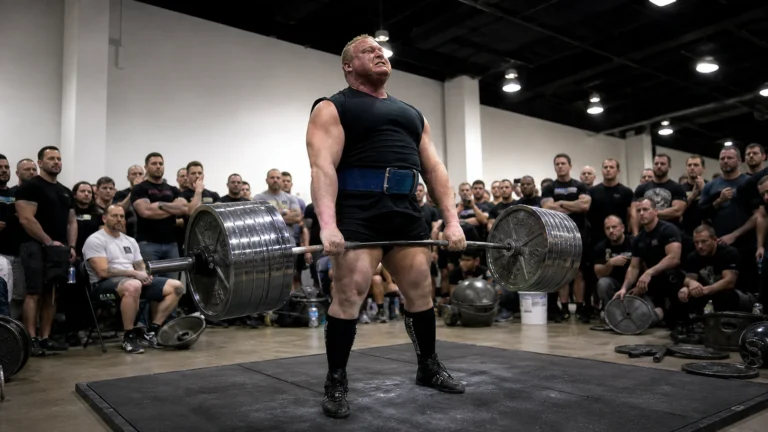

Lee Haney did not try to be huge and razor lean at the same time.
Like most top bodybuilders of his era, he split his year into an off season and a contest phase.
In the off season, the focus was on building. In the contest phase, the focus shifted to sharpening what he had built.
That kind of planning helped him win eight Mr. Olympia titles in a row.
It is also a useful model for regular lifters who keep chasing every goal at once.
Who Lee Haney Is
Lee Haney was born in 1959 in Spartanburg, South Carolina.
He won the Mr. Olympia contest every year from 1984 through 1991.
His eight titles are still tied for the most ever, a record he shares with Ronnie Coleman.
He later chaired the President’s Council on Physical Fitness and Sports and hosted a faith and fitness TV show.
What We Know About His Yearly Plan
We did not find a detailed written log of Haney’s year during his winning streak.
What we do have are his own later comments about how he handled prep.
In a 2023 Fitness Volt report on his advice, Haney shared a blunt rule for the off season.
“If you can’t flex it, don’t carry it.”
He explained that the point is to keep body fat under control, so you do not have to fix it later.
The same report says he recommended staying within about 15 pounds of stage weight in the off season.
For an October Mr. Olympia, he said he would start prep around the first of the year.
So his phases were long and planned well ahead, not a quick crash before the show.
Why Bodybuilders Split the Year
Building muscle and getting very lean pull in different directions.
Muscle growth is easier when you eat enough and recover well.
Getting stage lean requires eating less for months, which makes hard training feel harder.
Trying to do both at full speed usually means doing neither one well.
Separate phases let you give each goal your full attention for a while.
What Changes Between the Phases
The exercises in each phase can look fairly similar. The priorities are what change.
- Building phase. Food intake supports growth, training volume tends to be higher, and the goal is to add muscle and strength.
- Prep phase. Food intake comes down slowly, training aims to hold on to muscle, and conditioning work often goes up.
- Recovery phase. After a show, food and training volume return toward normal so the body and mind can reset.
That third phase is easy to forget, but research suggests it may be one of the most important.
What Research Says About Contest Prep
In 2014, Eric Helms, Alan Aragon, and Peter Fitschen reviewed the research on natural bodybuilding prep.
Their review in the Journal of the International Society of Sports Nutrition drew on more than 200 references.
It favored a gradual approach to fat loss, with enough protein, so lifters keep as much muscle as possible.
That matches Haney’s view. A long, steady prep is kinder to muscle than a rushed one.
The review also focused on drug free competitors, which matters when reading older bodybuilding stories.
The Real Cost of Getting Stage Lean
A 2013 case study by Lindy Rossow and colleagues followed one natural bodybuilder for a full year.
The researchers tracked him for six months before his contest and six months after it.
During prep, his body fat dropped from 14.8 percent to 4.5 percent.
His testosterone fell from 9.22 to 2.27 ng/mL, and his mood scores got much worse.
His strength dropped too.
After the show, his mood returned to normal. His strength had only partly come back six months later.
That is one person, so it cannot speak for everyone.
Still, it shows why stage condition is a short peak, not a way to live all year.
What This Does Not Mean for You
Most people never need a contest phase at all.
The extreme leanness bodybuilders reach is not a health goal, and it is hard on the body.
Haney himself has warned against dangerous dehydration before shows. He has said you do not need to stop drinking water.
The useful lesson is the planning, not the extreme end point.
How to Plan Phases in Your Own Year
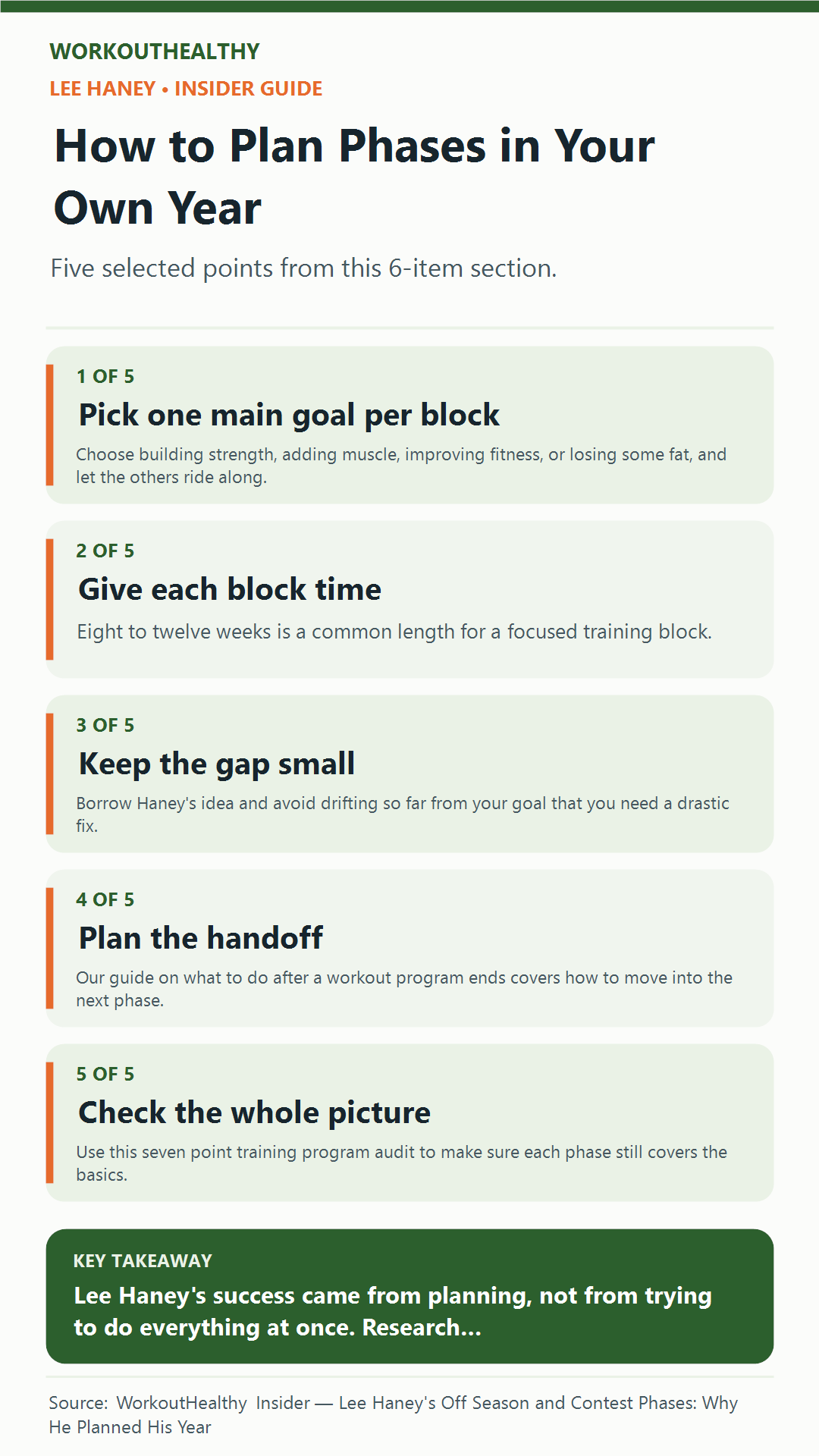
- Pick one main goal per block. Choose building strength, adding muscle, improving fitness, or losing some fat, and let the others ride along.
- Give each block time. Eight to twelve weeks is a common length for a focused training block.
- Keep the gap small. Borrow Haney’s idea and avoid drifting so far from your goal that you need a drastic fix.
- Plan the handoff. Our guide on what to do after a workout program ends covers how to move into the next phase.
- Check the whole picture. Use this seven point training program audit to make sure each phase still covers the basics.
- Get help with big diet changes. A registered dietitian can build an eating plan that fits your body and health.
Common Mistakes With Training Phases
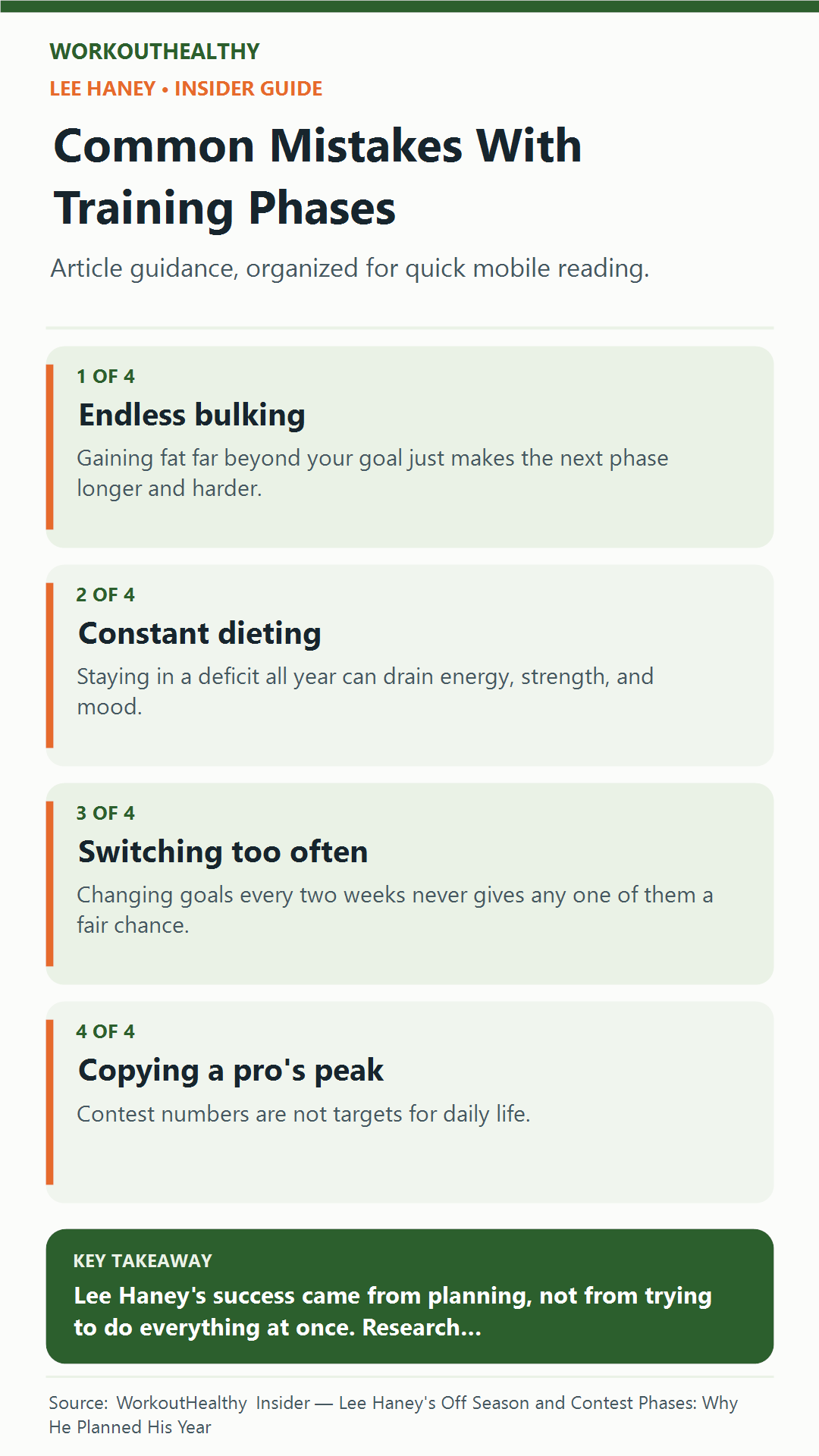
- Endless bulking. Gaining fat far beyond your goal just makes the next phase longer and harder.
- Constant dieting. Staying in a deficit all year can drain energy, strength, and mood.
- Switching too often. Changing goals every two weeks never gives any one of them a fair chance.
- Copying a pro’s peak. Contest numbers are not targets for daily life.
For a look at how another champion’s eating changed once competition was behind him, read about Arnold Schwarzenegger’s plant forward diet.
The Bottom Line
Lee Haney’s success came from planning, not from trying to do everything at once.
Research supports slow, steady prep and shows how costly extreme leanness can be.
For most lifters, the takeaway is simple.
Focus on one goal at a time, and stay close enough to your target that you never need a crash fix.
Want more stories like this? Subscribe to WorkoutHealthy Insider for practical explanations behind popular fitness claims.
References
- Fitness Volt. (2023, February 5). Lee Haney cautions bodybuilders against dehydration and unqualified coaches, shares tips for safe contest prep.
- Helms, E. R., Aragon, A. A., & Fitschen, P. J. (2014). Evidence-based recommendations for natural bodybuilding contest preparation: Nutrition and supplementation. Journal of the International Society of Sports Nutrition, 11, 20. https://doi.org/10.1186/1550-2783-11-20
- Rossow, L. M., Fukuda, D. H., Fahs, C. A., Loenneke, J. P., & Stout, J. R. (2013). Natural bodybuilding competition preparation and recovery: A 12-month case study. International Journal of Sports Physiology and Performance, 8(5), 582 to 592. https://doi.org/10.1123/ijspp.8.5.582
This article is for general information only and is not medical advice. If you have an injury, ongoing pain, or a medical condition, talk to a doctor or physical therapist before you change how you train or eat.