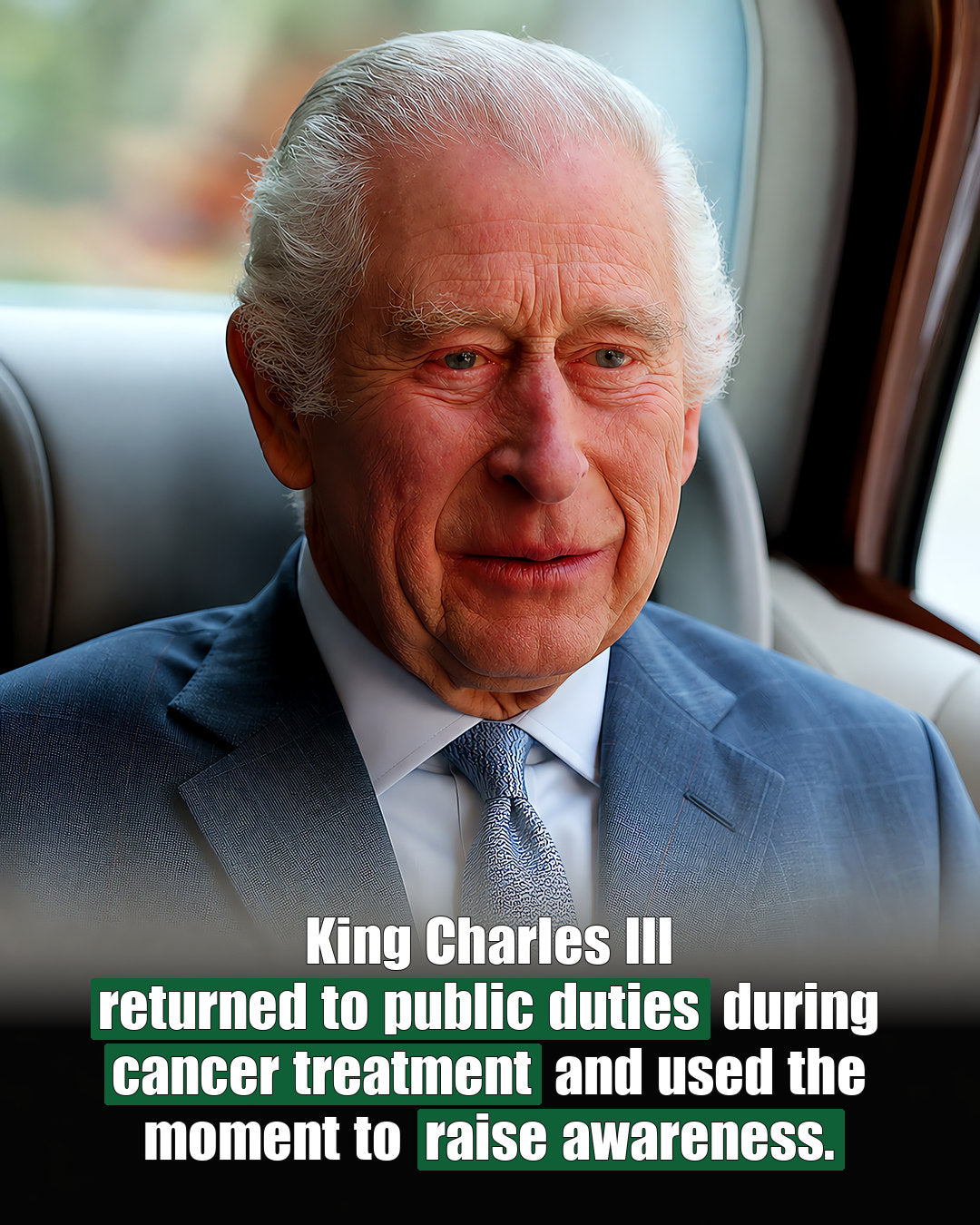

King Charles III is 77 years old, and he remains, by any measure, one of the most visible people in the world with an active cancer diagnosis.
He was diagnosed with cancer in February 2024. The diagnosis came during an unrelated procedure for a benign, enlarged prostate.
Buckingham Palace has never named the specific type of cancer. That decision was itself unusual for a family long known for keeping health matters private.
A WorkoutHealthy Facebook post described his approach this way. King Charles kept working through cancer treatment and used it to raise health awareness.
That framing is accurate, and it captures something genuinely notable about how he has handled a difficult diagnosis in public view.
What Has Actually Happened Since the Diagnosis
Charles began treatment shortly after his February 2024 diagnosis. He paused some public duties briefly at first, on the advice of his medical team.
He returned to a reduced schedule of engagements within weeks.
He continued treatment alongside that schedule for well over a year. As of late 2025, palace officials confirmed something significant.
His treatment would be reduced in 2026. Buckingham Palace described this as a move into what it called a precautionary phase, not a declaration of remission.
Royal biographers who cover the palace closely have reported that Charles remains under some form of ongoing treatment or monitoring into 2026.
No public statement has confirmed remission.
Despite that, Charles has kept an unusually full schedule. He has hosted multiple state visits, kept a heavy daily load of engagements and meetings, and continued working on official paperwork late into the evening, according to people who work closely with him.
Queen Camilla has spoken publicly about the experience as well. In comments reported in August 2026, she described how difficult it was to keep the diagnosis private in the earliest days, before the palace made it public.
In His Own Words
Charles has spoken about his treatment schedule directly, confirming that his own medical team gave the go ahead to ease it in 2026.
“My own schedule of cancer treatment can be reduced in the New Year,” he said, describing the update as a welcome one.
Buckingham Palace has echoed that cautious optimism in its own statements. “His Majesty has responded exceptionally well to treatment,” the palace said, “and his doctors advise that ongoing measures will now move into a precautionary phase.”
Those are careful words. They describe a positive trend without claiming the situation is fully resolved, which matches how palace communications have handled this diagnosis from the start.
Royal biographer Robert Hardman, who has covered Charles closely, has described him as approaching his duties with genuine purpose and energy despite the diagnosis.
Hardman has said Charles keeps a schedule that would exhaust people half his age.
He often handles ten to twelve engagements and meetings in a single day. He reportedly continues working through paperwork well into the early hours of the morning.
That pace has not gone unnoticed by people close to him. Queen Camilla has reportedly accepted the relentless schedule as central to how her husband finds a sense of purpose, even during treatment.
Why His Openness Matters, According to Research
Charles’s choice to be public about a cancer diagnosis is not just a personal decision.
It has real, measurable effects on public health behavior, and there is solid research showing why that happens.
The clearest example on record is what researchers now call the Katie Couric effect. In March 2000, television host Katie Couric had her own colonoscopy filmed and aired on national television, following her husband’s death from colon cancer.
A study published in the Archives of Internal Medicine in 2003 measured what happened next.
Colonoscopy rates rose by roughly 20 percent in the months following the broadcast. That figure came from national colonoscopy registry data, not just anecdotal reports.
That increase held for at least nine months after the segment aired. A single public health moment, built around one person’s openness about a health procedure, moved a real, national screening statistic.
A similar pattern followed actress Angelina Jolie’s public 2013 announcement that she had undergone a preventive double mastectomy after learning she carried a high risk gene for breast cancer.
Researchers at a major UK cancer prevention center tracked genetic counseling referrals before and after her announcement.
Referrals for genetic counseling more than doubled in the two months following her disclosure. That finding came from a study published in the journal Breast Cancer Research in 2014.
Referrals remained 32 percent higher than the prior year’s baseline several months later, showing the effect was not just a brief spike of curiosity.
These two examples share a pattern with King Charles’s situation. A public figure’s willingness to discuss a health diagnosis openly appears to give ordinary people permission, and sometimes urgency, to book a screening or checkup they had been putting off.
Charles’s own case is different from Couric’s and Jolie’s in one important way. He has not disclosed the specific type of cancer he has, which limits how directly his openness can point people toward one particular screening test.
Even without that detail, public health researchers generally view visible, high profile cancer disclosures as a net positive for awareness.
The mechanism appears to be less about the specific medical facts. It seems to be more about normalizing the idea that seeking care, and talking about it, is not something to hide.
What This Means for the Average Reader
Most people will never have a royal family’s platform or a movie star’s media reach.
But the underlying message behind both the research and Charles’s own choice is available to everyone, regardless of platform.
Cancer outcomes generally improve the earlier a cancer is found. That is one of the most consistent findings across nearly every type of cancer that has been studied, regardless of how famous the person receiving the diagnosis happens to be.
A diagnosis found during a routine or unrelated procedure, the way Charles’s cancer was found, is not unusual.
Screenings and checkups scheduled for one reason sometimes catch something else entirely. That is part of why regular checkups matter even when nothing feels wrong.
Charles’s continued public schedule through treatment also reflects something increasingly common in modern cancer care.
Many people continue working, and continue many normal daily activities, throughout treatment. That depends heavily on the type of cancer, the treatment plan, and guidance from their own medical team.
Who Should Talk to a Doctor First
Anyone who has noticed a new, persistent symptom, whether it is unexplained fatigue, unusual pain, unexpected weight change, or anything else that feels out of the ordinary for more than a couple of weeks, should talk to a doctor rather than waiting.
A tool like the four flights of stairs self check can be a useful nudge to book that appointment, though it is not a substitute for one.
People with a family history of cancer should ask their doctor about what screening schedule makes sense for their own risk level.
Family history can shift recommended screening ages earlier than the general population guidelines suggest.
Anyone overdue for an age appropriate cancer screening, such as a colonoscopy, mammogram, or prostate exam, should treat this as a reminder to schedule it, not as something to read and set aside.
People currently in cancer treatment who are considering changes to their activity level, work schedule, or exercise routine should coordinate that decision with their oncology team specifically, since the right amount of activity varies significantly by cancer type, treatment stage, and individual health status.
How to Turn This Story Into an Action, Not Just an Article
Write down which screenings apply to you based on your age, sex, and family history.
The list is different for everyone, and a primary care doctor can confirm it in a single conversation.
Book the appointment you have been putting off. If a specific screening or checkup has been sitting on a mental to do list for months, this is a reasonable moment to actually schedule it.
Ask your doctor directly what your family history means for your own risk. Many people never have this conversation explicitly, even when a parent or sibling has had cancer.
If you or someone you love is currently in treatment, ask the care team directly about safe activity levels.
Movement guidance during cancer treatment is highly individual. A real answer from an oncology team beats general advice from an article every time.
Talk about this openly with family members if it feels comfortable to do so. Part of why the Katie Couric and Angelina Jolie effects worked was simply that people started talking about screenings they might otherwise have avoided discussing.
Do not wait for a celebrity story to be the only reason you take action.
Charles’s diagnosis, and the public conversation that followed it, is a reminder rather than a requirement.
The same screenings, the same conversations with a doctor, and the same attention to new symptoms are worth taking seriously.
That is true whether or not a public figure happens to be in the news that week.
Coverage of the announcement described it as a personal blessing for Charles and his family, a small reminder of how much relief even modest medical progress can bring after nearly two years of treatment.
References
- HELLO! Magazine, “King Charles set to reduce cancer treatment in 2026 after go-ahead from doctors,” hellomagazine.com
- CNN, “Queen Camilla says it was ‘difficult’ to keep the King’s cancer diagnosis secret,” cnn.com, August 2026
- IBTimes UK, “Is King Charles Still in Cancer Treatment in 2026?,” ibtimes.co.uk
- Cram, P., Fendrick, A.M., et al. (2003). The impact of a celebrity promotional campaign on the use of colon cancer screening: the Katie Couric effect. Archives of Internal Medicine, 163(13), 1601-1605.
- Evans, D.G., Barwell, J., et al. (2014). The Angelina Jolie effect: how high celebrity profile can have a major impact on provision of cancer related services. Breast Cancer Research, 16(5), 442.
This article is for general information only and is not personal medical advice. It describes King Charles III’s cancer diagnosis and treatment based on public reporting and official palace statements as of this writing, and it does not disclose or speculate about medical details the palace has not made public. Anyone with concerns about their own cancer risk, symptoms, or screening schedule should talk with a doctor rather than relying on this or any general health article.