
Karlie Kloss has spent two decades building one of the most recognizable careers in fashion.
She has also spent years running a nonprofit that teaches coding to teens.
Neither of those things left much obvious room for marathon training.
She trained for and completed a New York City Marathon debut anyway, while both of those commitments were still running at full speed.
That timing is worth sitting with for a moment. Most people assume they need a quieter stretch of life before taking on something as demanding as 26.2 miles.
Kloss’s story pushes back on that assumption.
What Actually Happened
Kloss was discovered at a local runway show in 2005 and rose quickly through the modeling industry.
By New York Fashion Week 2008, she was walking 31 shows in a single season.
She went on to become a Victoria’s Secret Angel from 2013 to 2015 and has appeared on dozens of international Vogue covers over the course of her career.
In April 2015, Kloss launched Kode With Klossy, a nonprofit that provides free coding education to girls and non-binary teens.
The program partners with organizations like Flatiron School and Code.org to run summer camps teaching programming languages including Ruby, JavaScript, and Swift.
By 2025, Kode With Klossy had reached nearly 11,000 young people across more than 100 countries.
Running a nonprofit at that scale, alongside a full modeling career, is a demanding schedule by any measure.
It was during that stretch of her career that Kloss trained for and completed her first New York City Marathon, one of the most physically demanding endurance events most people ever attempt.
Finishing 26.2 miles is a serious undertaking under any circumstances. Doing it during a period when her schedule was already full in multiple directions adds a layer most casual descriptions of marathon training tend to skip over.
What Her Story Represents
Kloss’s marathon debut is a useful example of how marathon training rarely happens under ideal, uncluttered conditions.
Most first-time marathon finishers are not professional athletes with unlimited free time.
They are people training around jobs, families, and packed calendars, not instead of them.
A demanding career and a big physical goal are often treated as if they cannot coexist.
Kloss’s debut is one example among many showing that a full schedule does not automatically rule out chasing something like a marathon.
What it usually comes down to instead is priority, not available free time in the abstract.
The Science Behind Marathon Training, Even for Beginners
Marathon training produces real, measurable changes in the body, and those changes are not limited to elite or lifelong runners.
A 2020 study published in the Journal of the American College of Cardiology followed 138 first-time marathon runners preparing for the London Marathon (Bhuva et al., 2020).
None of the participants had a history of serious heart disease before the study began.
Researchers measured blood pressure and the stiffness of participants’ aortas, the body’s largest artery, both before and after roughly 17 weeks of beginner-level training.
After training, participants showed lower blood pressure on average, with drops of about 4 points systolic and 3 points diastolic.
Their aortas had also become noticeably more flexible, an improvement the researchers estimated was equal to reversing about four years of natural, age-related arterial stiffening.
Interestingly, the biggest improvements showed up in older runners, slower runners, and men, not necessarily the fastest or youngest participants in the study.
That detail matters for anyone assuming marathon training only benefits people who are already fit or fast.
The study specifically recruited beginners, and they still saw real cardiovascular improvements in under five months.

The Science Behind Building a New Habit Around a Busy Schedule
Fitting marathon training into an already full schedule is less about finding extra hours and more about building a habit that survives a busy week.
A widely cited 2010 study published in the European Journal of Social Psychology tracked how new habits actually form in real life, not in a lab (Lally et al., 2010).
Participants who successfully built a new daily habit, like exercise, took an average of 66 days before the behavior started to feel automatic rather than effortful.
That number varied quite a bit person to person, ranging from about 18 days on the low end to nearly 254 days for some participants and behaviors.
The researchers also found that missing a single day here and there did not meaningfully disrupt the habit-forming process, as long as the behavior resumed soon after.
That finding matters for anyone training for a marathon around a demanding job or travel schedule.
A missed run does not erase the progress already made, as long as training gets back on track.
Why Kode With Klossy Makes This Story More Interesting
Running a nonprofit is not a passive commitment squeezed in around a main career.
Kode With Klossy involves curriculum design, partnerships with schools and companies, fundraising, and running in-person summer camps across dozens of countries.
That kind of organizational work comes with its own unpredictable schedule, closer to running a small company than a side project.
Layering marathon training on top of a modeling career and a nonprofit leadership role is a real test of time management, not just physical endurance.
It also reflects a pattern seen across a lot of high-achieving people. The busiest periods of life are often when people reach for a big, structured physical goal, rather than waiting for things to calm down first.
A marathon plan gives a person a clear, external structure at a time when everything else on the calendar might feel unpredictable.
How This Compares to General Training Guidance
Most marathon coaches recommend beginner training plans that run 16 to 20 weeks, with a gradual buildup in weekly mileage.
A common guideline caps weekly mileage increases at around 10 percent from one week to the next, to reduce the risk of overuse injuries like stress fractures.
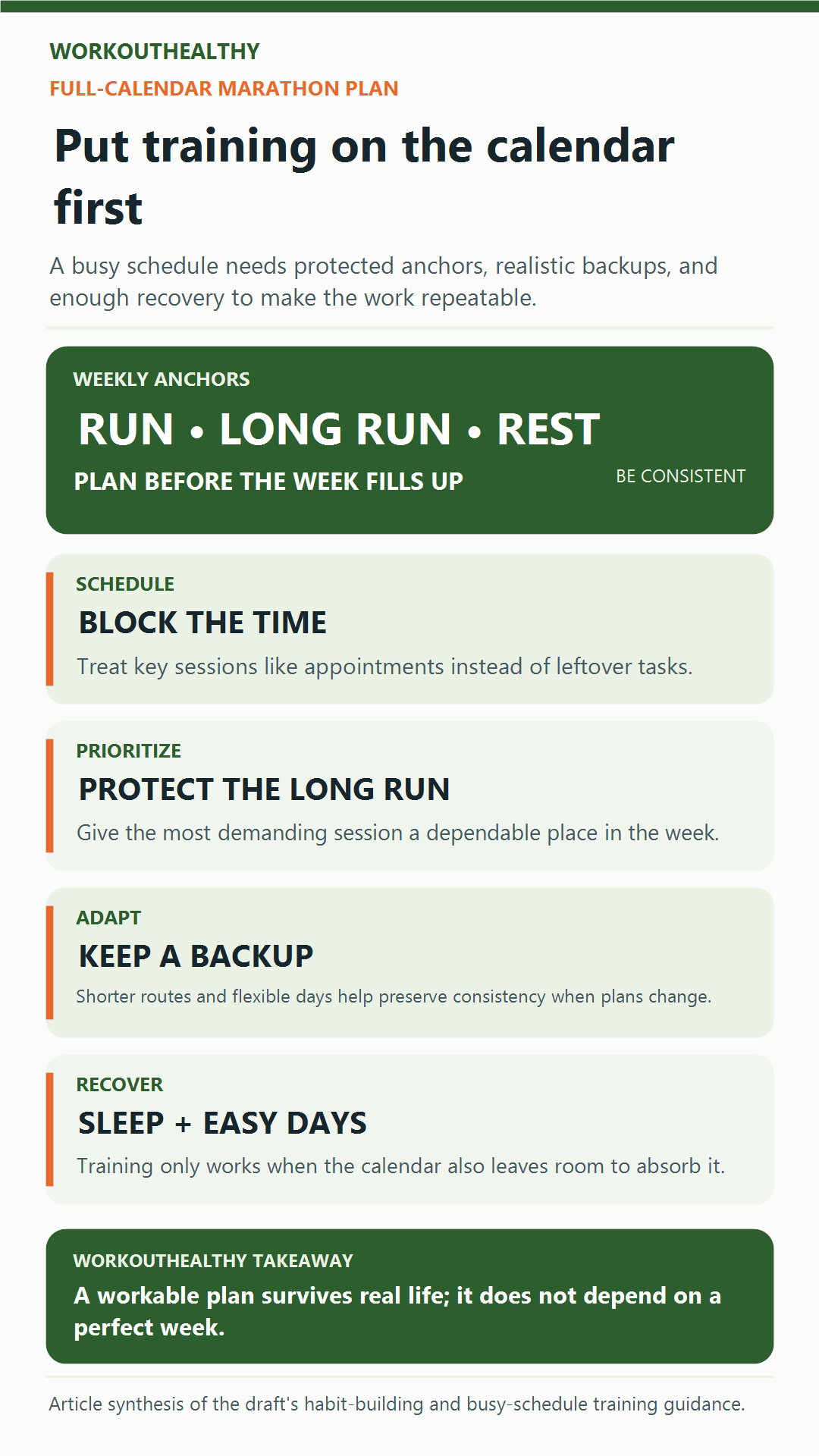
Coaches working with busy professionals often build extra flexibility into a training plan from the start, rather than assuming every planned run will happen exactly as scheduled.
That might mean combining a missed weekday run with the weekend’s long run, or accepting a slightly shorter run rather than skipping the day entirely.
The overall training volume matters more than any single session, which gives a busy schedule some real room to breathe.
Many coaches also recommend anchoring the week around two or three non-negotiable sessions, usually the long run and one or two key workouts, while treating the remaining easy runs as flexible.
That structure protects the sessions that matter most for race day, while leaving room for a schedule to shift around everything else.
Common Mistakes People Make Training Around a Busy Schedule
One common mistake is trying to make up for a missed week by dramatically increasing mileage the following week.
That kind of catch-up jump is one of the more common causes of overuse injury in beginner runners.
Another mistake is skipping rest days entirely because free time feels scarce.
Rest days are part of the training itself, not time stolen from it. Skipping them regularly tends to backfire through fatigue or injury rather than faster progress.
Some people also try to squeeze in every planned run at the original planned distance, rather than adjusting a single session when the day gets unexpectedly short.
A shorter run completed is usually more valuable than a full run skipped entirely.
Finally, people sometimes treat travel or work trips as an automatic excuse to pause training completely, when a lighter, modified plan during travel weeks often keeps momentum intact.
How to Train for a Big Goal With a Full Calendar
Pick a training plan with built-in flexibility, rather than one that assumes a perfectly open schedule every week.
Protect your long run first when planning a busy week, since it is the single most important session for marathon preparation.
Our guide on how many miles to walk a day is a useful, low pressure way to build a base of activity around a demanding schedule.
Stack habits where you can, like using a work trip’s hotel gym for an easy run instead of skipping it entirely.
Give yourself permission to shorten, not skip, a session when the day runs long.
Consider a coach or structured plan if you are juggling a demanding job with training.
Our piece on deciding whether you need a personal trainer walks through how to find the right kind of support.
Track consistency over weeks and months, not perfection in any single week. The habit research above shows that occasional missed days do not undo the process, as long as you get back to it.
Respect the taper in the final weeks before race day, even if your schedule tempts you to squeeze in one more hard session.
Reassess after your first big race, not during it. It is easy to compare a busy training cycle unfavorably to an imagined ideal one while you are still in the middle of it.
Give yourself real credit for finishing something demanding during a demanding stretch of life, rather than discounting the achievement because conditions were not perfect.
References
Bhuva, A. N., Charidimou, A., et al. (2020). Training for a first-time marathon reverses age-related aortic stiffening. Journal of the American College of Cardiology, 75(1), 60-71.
Lally, P., van Jaarsveld, C. H. M., Potts, H. W. W., & Wardle, J. (2010). How are habits formed: Modelling habit formation in the real world. European Journal of Social Psychology, 40(6), 998-1009.
This article is for general information only and is not personal medical or fitness advice.
Details of any individual’s personal training history are drawn from public reporting and have not been independently verified in every particular.
Talk with a qualified healthcare provider before starting a new endurance training program, especially if you have an existing health condition.