
Jonah Hill’s public conversation about surfing, therapy, and body image offers a more interesting fitness lesson than a transformation photo. The activities themselves matter, but so does the reason a person feels able to return to them. That is a useful place to begin—with careful attention to what Hill actually said and what others have inferred.
The Facebook post combines his surfing, reports of boxing, and mental-health remarks into one short story. This article separates those threads and looks at the evidence for choosing enjoyable movement without presenting a celebrity’s private life as a prescription.
A person’s visible fitness change is not a medical record of their mental health.
What Hill actually said about surfing
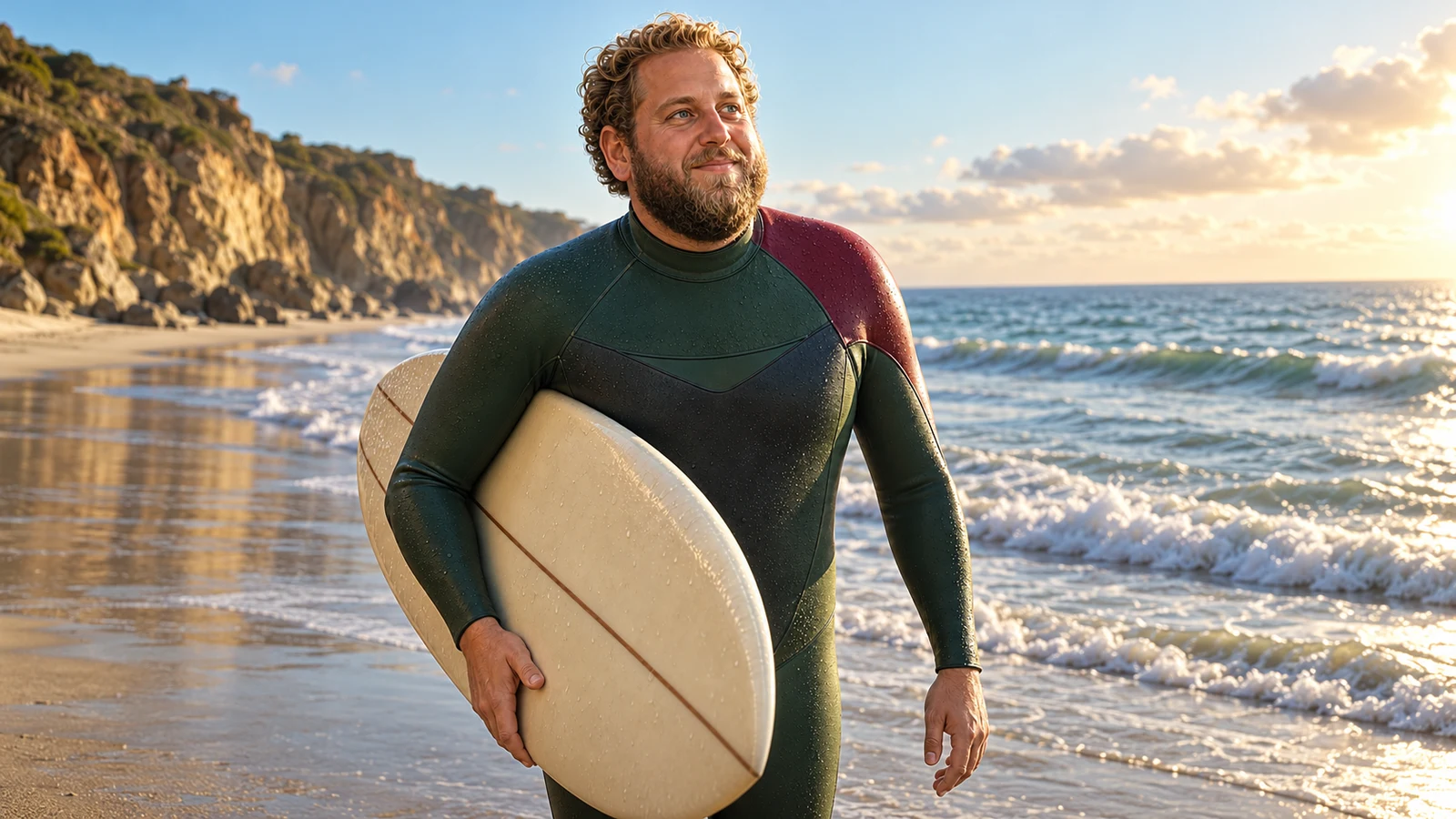
In a 2021 GQ conversation with Adam McKay, Jonah Hill described surfing as part of his everyday life. He spoke about a quieter routine that balanced work and time in the water, sometimes surfing in the morning and again later if conditions were good. That is firsthand evidence that the activity mattered to him. It is not a controlled measure of how much surfing changed his mood, body, or health.
Many celebrity-fitness summaries skip that distinction. A public interview can tell us what a person says they do and why it feels meaningful. It cannot isolate one variable from therapy, work changes, relationships, sleep, and everything else in a life. Hill did not publish a standardized “surf this many minutes” program for readers to copy.
The social image accompanying this story is an editorial illustration adapted from the Facebook creative. It is not a documentary photograph of Hill on a specific surf outing. Readers deserve to know that before treating the picture as evidence.
Why mental health is part of this story
Hill has publicly discussed therapy and mental health, including through his documentary Stutz and remarks surrounding its release. In a 2022 public letter reported by major outlets, he explained that anxiety had led him to step back from certain promotional appearances. These statements support a broader account of someone taking mental health seriously. They do not authorize strangers to diagnose him or reduce his choices to one neat transformation narrative.
Exercise can be a valuable part of a mental-health plan, but it is not therapy in disguise. The two can coexist. A 2024 network meta-analysis of randomized trials found that several forms of exercise can help reduce depressive symptoms in studied populations. The evidence is about groups and interventions, not about proving what happened in Hill’s private care.
People dealing with depression, anxiety, trauma, or body-image distress may need professional support even when they are active. The right exercise can offer structure, social contact, enjoyment, and a sense of agency; none of those benefits means a person should replace prescribed care or blame themselves when activity alone is not enough.
Surfing, boxing, and the limits of a caption
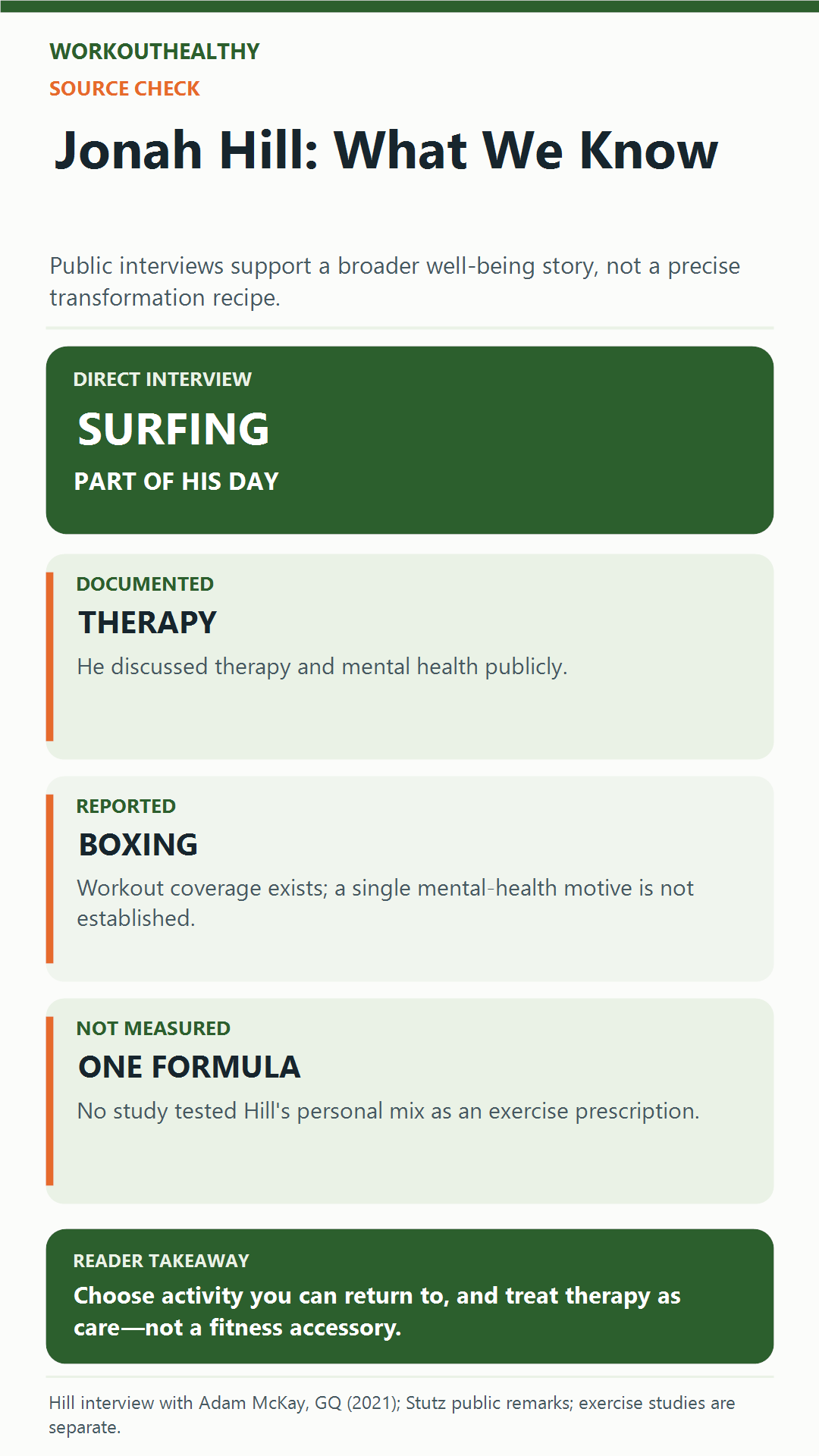
There is public coverage of Hill boxing in a gym, and his surfing is directly described in the GQ interview. But those two facts do not prove that he selected both activities for the exact same mental-health reason or used them in a documented program. The Facebook caption compresses separate observations into a single motive. The safer reading is narrower: surfing is part of his self-described routine, boxing has appeared in workout coverage, and he has spoken separately about therapy and mental health.
This may sound fussy, but motive claims matter when a celebrity’s body and personal history are involved. The claim “he boxed” is not the same as “boxing was his primary mental-health treatment.” Nor does a photo or video reveal enjoyment, stress relief, or clinical benefit. We can draw a practical lesson without assigning a private reason to every workout.
That lesson is to ask what kinds of movement a person wants to return to. Surfing and boxing are examples, not prescriptions. Walking, dancing, cycling, swimming, lifting, or team sports can also fit. Access, safety, cost, culture, and physical capacity should shape the choice.
Why enjoyment can support consistency
The Facebook post claims people are more likely to stick with activities they enjoy. That direction is broadly consistent with motivation research, but it is not a guarantee. A systematic review of self-determination theory and physical activity found that more autonomous forms of motivation were positively related to exercise. Intrinsic motivation—the experience of interest or satisfaction in the activity itself—appeared especially relevant to longer-term adherence.
Enjoyment can reduce the friction of starting. It can also make the activity itself feel rewarding rather than postponing all reward until a mirror or scale changes. But even an enjoyable activity becomes hard to maintain if the schedule is impossible, the cost is high, the environment feels unsafe, or the intensity is too much. Treat enjoyment as one design criterion among several.
A good activity is one you can do repeatedly and recover from, with enough challenge to meet your goals. Someone might love swimming but need a cheaper winter alternative; someone else may enjoy boxing classes but need modifications for a wrist injury. The ability to choose and adapt is part of making activity sustainable.
Body-image pressure changes the context
Hill has pushed back publicly against comments about his body, even complimentary ones. It is possible to appreciate a person’s training without turning their appearance into public property. A wellness article should not imply that a smaller or more muscular body is proof of better mental health, nor that an actor owes the audience a detailed account of weight changes.
Appearance goals are not inherently wrong, but they are a fragile sole measure of success. Bodies change for many reasons, and visible changes do not tell us whether a person sleeps better, feels safer, has adequate nutrition, or receives needed care. A steadier set of measures includes energy for daily life, skill, strength, endurance, mood during or after activity, and the ability to keep showing up.
For someone with a history of body criticism, tracking every mirror change can make exercise feel like punishment. Shifting attention toward what the activity lets you do may be healthier. That shift is a reader takeaway, not a claim that we know exactly how Hill manages his own self-image today.
A three-check framework for choosing movement
First, check interest: would you still consider this activity if no one saw a before-and-after picture? An answer of “maybe” is enough to try it. You do not need to feel thrilled every session. Curiosity and a modest positive feeling are useful signals.
Second, check feasibility: can you access it at a realistic time and cost, and do you have a safe beginner version? A favorite activity that requires two hours of travel may need a convenient companion option. A walking route, inexpensive class, or simple home routine can reduce barriers. The best plan is not necessarily the most dramatic one.
Third, check recovery and support: does the dose leave you able to repeat it, and do you have help when symptoms or motivation become difficult? Start below the level that produces dread or prolonged pain, then build. If the activity is tied to mental-health concerns, professional care and supportive relationships remain important. This three-check framework is WorkoutHealthy’s practical synthesis, not a protocol published by Hill or a clinical treatment.
The sustainable activity is the one that fits a life, not the one that looks most impressive in a reel.
What to do when enjoyment is not enough
People sometimes hear “find something you love” as a promise that every workout will feel fun. Even meaningful activities include inconvenient days, slow progress, and logistical trouble. Consistency can come from flexible routines, social plans, low-friction equipment, and realistic minimums, not only from enthusiasm.
Try setting two levels: a full session for ordinary days and a ten-minute version for crowded ones. The short version can preserve the habit without pretending it produces the same training stimulus. If you miss several sessions, return at a manageable level rather than punishing yourself with a maximal restart. Review what actually blocked participation and change the plan accordingly.
If distress, compulsive exercise, eating concerns, or severe body dissatisfaction are driving the routine, the solution is not simply a more enjoyable sport. A clinician or mental-health professional can help address the underlying issue. Movement can support well-being, but it should not become another way to measure personal worth.
The evidence is broader than one celebrity
Hill’s interviews are personal accounts. Exercise studies are separate evidence about people in trials. Combining them can make a thoughtful article, but the two kinds of evidence must not be blurred. Research on motivation supports giving people autonomy and choices. Research on depressive symptoms supports exercise as one possible care component. Neither proves that Hill’s surfing schedule is the optimal dose or that boxing specifically treated his stress.
Similarly, enjoyment is not the only reason to exercise. Some people value function, community, health, skill, or simply time outdoors. A person may choose a less enjoyable strength exercise to build capacity for a sport they love. The aim is not constant pleasure; it is a personally meaningful routine with enough support to last.
Our consistency and moderation guide explores that long view, while our circuit-training evidence check shows how a different workout choice can fit someone who prefers gym sessions to the ocean.
Bottom line
Jonah Hill has directly described surfing as part of his life and has spoken publicly about therapy and mental health. There is coverage of boxing workouts, but the exact motive the social caption assigns to boxing is not firmly established. His story should not be turned into a universal fitness formula or a weight-loss before-and-after.
The reader-facing lesson is still useful: choose movement that fits your life and gives you a reason to return, then adjust the dose and seek appropriate support. Exercise can be part of mental well-being. It is not a substitute for mental-health care, and no one’s appearance can tell us whether they are well.
Get the next evidence check.
Five practical fitness stories worth your time, every Friday.
One email a week. No product pitches. Unsubscribe in one click.
References
- McKay, A. (2021, August 24). Jonah Hill is supergood. GQ. Interview with Hill about surfing and therapy.
- Hill, J. (2022). Public statement on Stutz and anxiety surrounding promotional appearances, reported by the Los Angeles Times.
- Teixeira, P. J., et al. (2012). Exercise, physical activity, and self-determination theory: A systematic review. International Journal of Behavioral Nutrition and Physical Activity.
- Noetel, M., et al. (2024). Effect of exercise for depression: Systematic review and network meta-analysis of randomised controlled trials. BMJ.
- Men’s Health. (2018). Coverage of Hill training at a boxing gym. This establishes gym activity, not his precise motive.
Mental-health disclaimer: This article is general information, not diagnosis or treatment advice. Exercise can support well-being but is not a substitute for professional care when needed. If you are in immediate danger or considering self-harm, contact local emergency services or a crisis line.