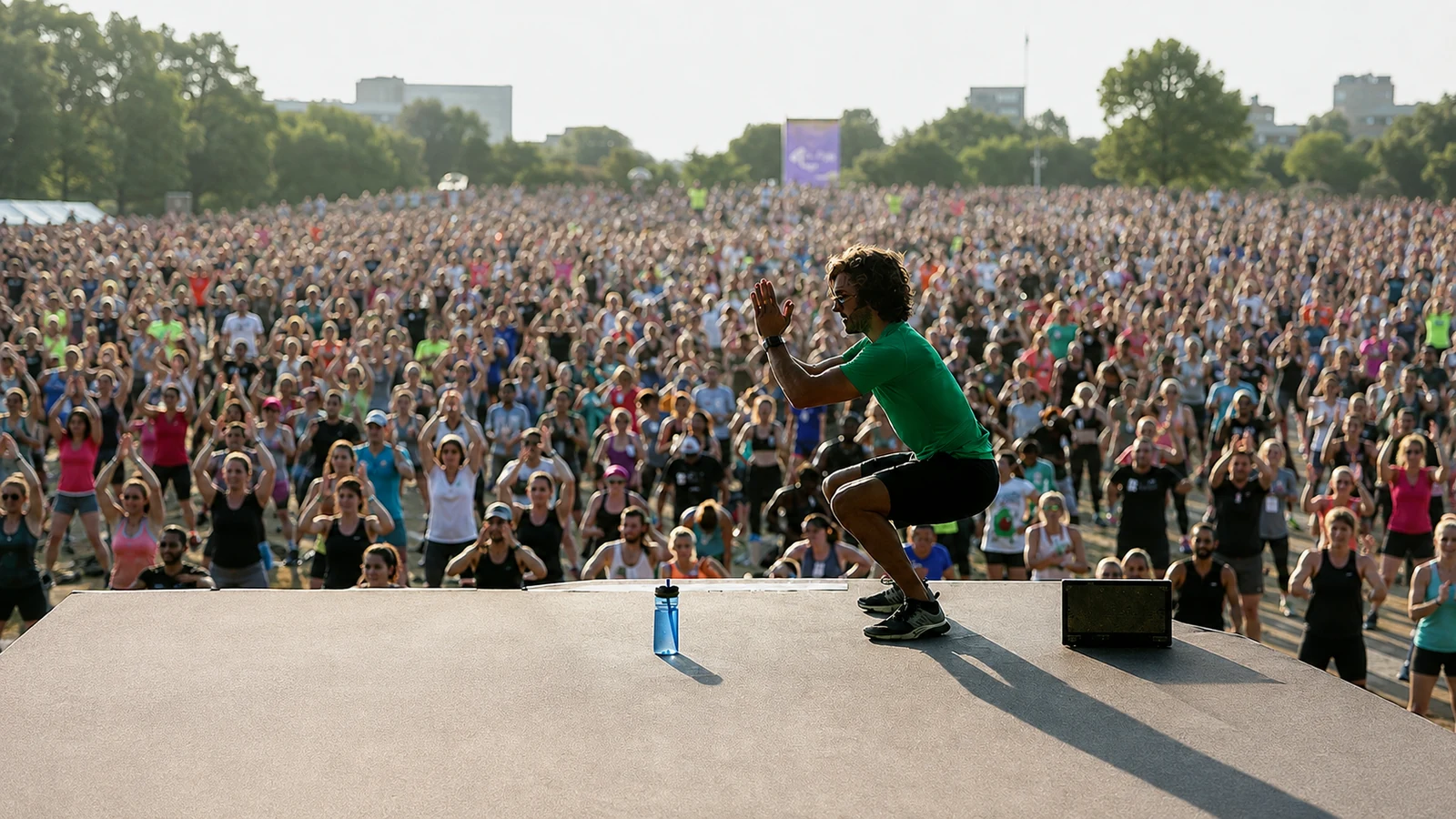

On July 5, 2017, a crowd gathered in Hyde Park, London, for something other than a headline band.
Thousands of people faced a fitness coach named Joe Wicks instead.
For 30 minutes they moved together through short bursts of hard effort and brief recovery, the pattern known as high intensity interval training, or HIIT.
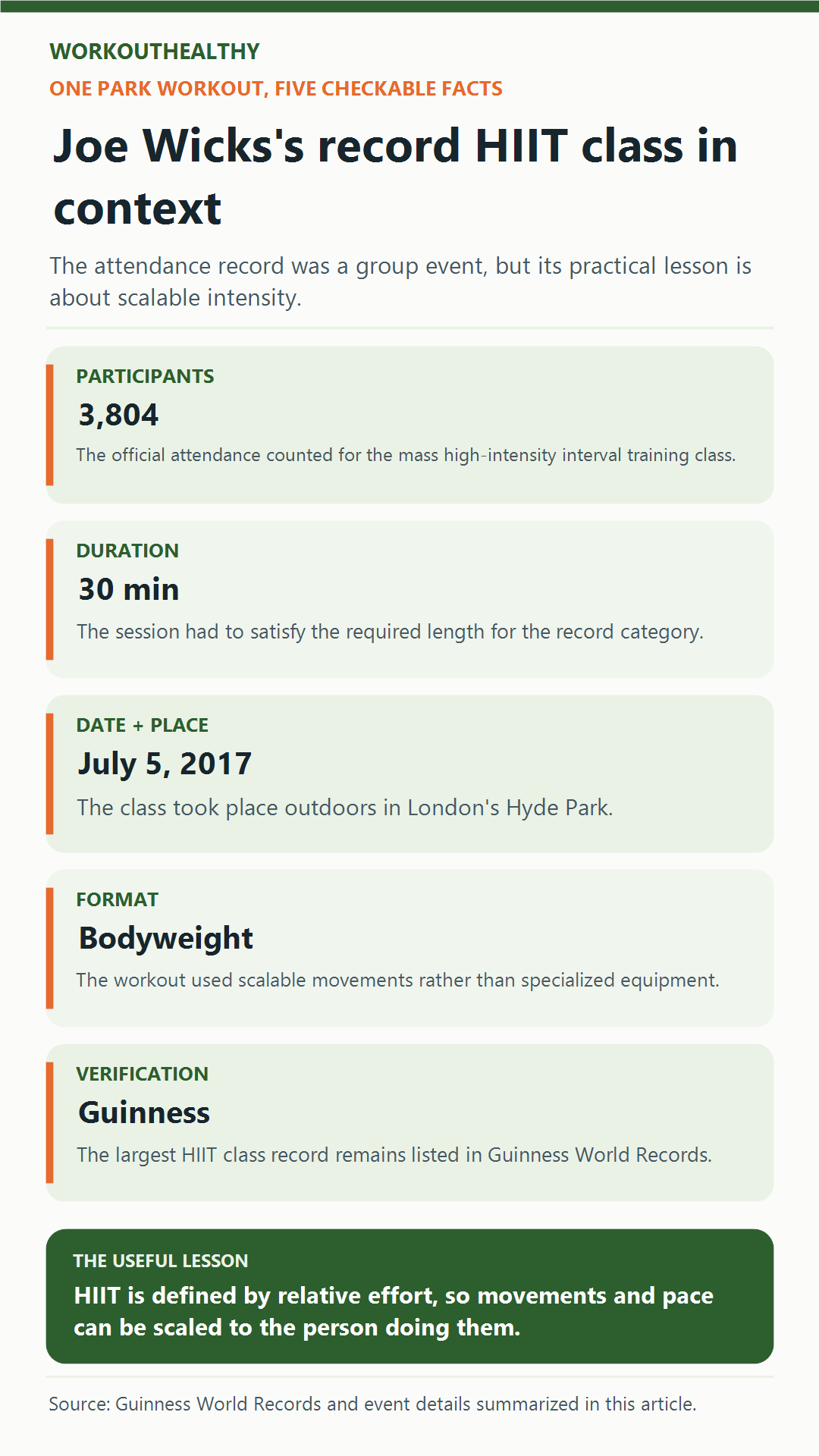
When the session ended, the number of participants was verified at 3,804 people.
Guinness World Records confirmed it as the largest HIIT class ever recorded, a title the record still holds today.
This is what actually happened that day, what the science behind HIIT really shows, and what a claim like “20 minutes of honest HIIT can rival far longer easy sessions” does and does not support.
What Actually Happened in Hyde Park
The session took place at Barclaycard presents British Summer Time, a concert festival held annually in Hyde Park.
Joe Wicks, known online as The Body Coach, led the class on July 5, 2017.
According to the official Guinness World Records listing, 3,804 people completed the 30 minute workout together.
Tickets to the session raised money for the Teenage Cancer Trust, and Wicks has said the goal was to get more people moving and eating better, not just to set a record.
No equipment was involved.
Participants used their own body weight for the entire class, the same approach Wicks built his early YouTube and Instagram following on.
Joe Wicks built his brand on quick, home friendly workouts for busy people. In Hyde Park he proved the same style scales to thousands of people at once, with no machines and no treadmills, just bodyweight and willpower.
Why Guinness World Records Recognized the Class
A Guinness World Records title is not awarded on a headcount alone.
An event like this needs an official rule set agreed in advance, a method for counting and confirming who actually completed the workout, and an independent adjudicator present to verify the attempt met those rules on the day.
That process is why the record carries more weight than a viral estimate from a festival crowd.
We checked the official Guinness World Records page for this listing directly.
As of this writing, Guinness still lists Joe Wicks and the 3,804 person class as the record holder, with no newer, larger HIIT class listed as having broken it.
That makes this one of the more straightforward claims in this line of fitness content to verify, because it traces back to an organization with a public, checkable database rather than a number that only exists inside a caption.
It is not the only Guinness certified fitness feat worth checking this way.
We used the same source verification approach on DonnaJean Wilde’s push-up world record and on Edith Connor’s Guinness record as the oldest female bodybuilder.
Both held up against the official listings.
What Makes HIIT Different From a Normal Workout
HIIT alternates short bursts of intense effort with brief periods of rest or lower effort movement.
A researcher review published in The Journal of Physiology describes this pattern as a way to pack a large physiological stimulus into a short amount of total exercise time (Gibala et al., 2012).
During the hard bursts, your heart rate climbs quickly and your muscles rely more on stored energy for fast fuel.
During the short recovery windows, your heart rate drops only partway before the next burst starts.
Repeating that cycle is what makes a 20 or 30 minute HIIT class feel far harder than a jog of the same length.
It is also why HIIT classes like the one in Hyde Park can meaningfully challenge thousands of people with completely different fitness levels using nothing but body weight.
The Afterburn Effect: A Real but Limited Bonus
The caption behind this record makes a specific claim: that intensity, not time, is often the real currency of a good workout.
There is a real mechanism behind that idea, and it has a name.
It is called excess post exercise oxygen consumption, or EPOC, sometimes shortened to the afterburn effect.
After a hard interval session, your body keeps burning extra oxygen and energy for a period after you stop moving, as it works to restore itself to a resting state.
A widely cited review in the Journal of Sports Sciences found that both the intensity and the duration of exercise affect how large and how long that afterburn window is, with higher intensity effort producing a bigger effect than the same amount of time spent at an easy pace (Laforgia et al., 2006).
EPOC is a real physiological response, but it is usually a modest part of total daily energy expenditure. It does not by itself show that a short interval workout burns more energy or delivers better long-term health outcomes than a longer moderate session.
The more useful comparison is outcome-specific: research can compare fitness or cardiometabolic changes over weeks, while an individual can choose a format they can recover from and repeat.
Does HIIT Really Match Longer, Easy Cardio?
This is where a caption can drift ahead of what a single study can prove, so it is worth being precise.
A frequently cited trial had a group train using very short sprint intervals, totaling about one minute of hard effort spread across a 10 minute session, three times a week for 12 weeks.
Researchers compared their cardiometabolic health improvements to a separate group doing 50 minutes of traditional moderate cycling per session, also three times a week (Gillen et al., 2016).
Both groups improved on similar measures of health, despite the sprint interval group training for roughly five times less total exercise volume and time.
A broader systematic review and meta-analysis of HIIT studies found consistent improvements in cardiometabolic health markers like blood pressure, blood sugar control, and cardiorespiratory fitness across many trials (Batacan et al., 2017).
Together, that is real evidence that intense intervals can produce health benefits similar to much longer, easier sessions, at least on the specific markers those studies measured.
For a sense of scale, one hour of jump rope burns roughly 600 to 1,000 calories depending on body weight and pace, which sits in the same general intensity territory as a sustained HIIT circuit.
What This Evidence Does Not Prove
None of this means HIIT is automatically better than every other form of exercise, or that a single 30 minute class in Hyde Park proves something scientific on its own.
Most of the controlled research behind HIIT comes from small groups training under supervision, often for a period of weeks, not a single session at a festival.
A single class, even one attended by thousands of people, is a participation event, not a clinical trial.
It says something about how many people can be motivated to try something hard together.
It does not, by itself, prove long term health outcomes for any one of those 3,804 participants.
The research on HIIT is also strongest for cardiometabolic markers like blood pressure and blood sugar control, and weaker or more mixed for outcomes like long term fat loss, where total diet and daily activity usually matter more than any single workout format.
Common Mistakes People Make With HIIT
The biggest mistake is treating every single interval like an all out sprint from the first session.
HIIT is demanding by design, and going too hard too soon is a fast way to burn out or get hurt before your body has adapted.
A second common mistake is skipping the recovery windows, or cutting them short to feel more productive.
The recovery period is not wasted time. It is part of what makes the next hard burst possible.
A third mistake is letting form break down once fatigue sets in, especially on movements like squats, lunges, or push ups that get sloppy under fatigue.
Slower, cleaner reps at high effort still count as intensity.
Sloppy, fast reps mostly just raise injury risk.
If you enjoy training with others, the accountability of a group or a training partner can help you actually hold your pace instead of quietly easing off when a session gets hard.
That is one reason group HIIT classes like Wicks’ Hyde Park session tend to push people further than a solo workout does.
Who Should Check With a Doctor First
HIIT is intense by definition, and that intensity is not the right starting point for everyone.
Anyone with a diagnosed heart condition, uncontrolled high blood pressure, or a history of chest pain during exertion should talk to a doctor before attempting an interval style workout.
The same goes for anyone who is new to exercise entirely, pregnant, recovering from a recent injury or surgery, or managing a condition like diabetes that affects how the body responds to intense effort.
None of that means HIIT is off limits for those groups forever.
It means the intensity should be introduced gradually and, in many cases, with medical guidance first.
How to Try a Body Coach Style HIIT Session at Home
You do not need 3,803 other people or a festival stage to try a version of what happened in Hyde Park.
Pick four to six bodyweight movements that use different muscle groups, such as squats, push ups, mountain climbers, and high knees.
Work each movement hard for 30 to 40 seconds, then rest for 15 to 20 seconds before moving to the next one.
Cycle through the full list two to four times, depending on your fitness level and how the session feels.
Warm up for five minutes first with easy movement like marching in place or light jogging, since jumping straight into maximum effort raises injury risk.
Keep total session time, including warm up and cool down, in the 20 to 30 minute range, in line with the Hyde Park session and the research studies cited above.
If a movement causes joint pain rather than muscle fatigue, swap it for a lower impact version, like a step back lunge instead of a jump lunge, or an incline push up instead of a standard one.

Progress by adding a round or shortening your rest slightly over several weeks, not by adding more sessions per week before your body has adapted to the ones you already have.
Two to three HIIT sessions a week, spaced with easier days between them, is a reasonable starting cadence for most healthy adults.
Watch the Original Video
Want more claims like this checked before you believe them? Subscribe to WorkoutHealthy Insider for practical explanations behind popular fitness claims.
References
Batacan, R. B., Duncan, M. J., Dalbo, V. J., Tucker, P. S., & Fenning, A. S. (2017). Effects of high-intensity interval training on cardiometabolic health: A systematic review and meta-analysis of intervention studies. British Journal of Sports Medicine, 51(6), 494–503. https://doi.org/10.1136/bjsports-2015-095841
Gibala, M. J., Little, J. P., MacDonald, M. J., & Hawley, J. A. (2012). Physiological adaptations to low-volume, high-intensity interval training in health and disease. The Journal of Physiology, 590(5), 1077–1084. https://doi.org/10.1113/jphysiol.2011.224725
Gillen, J. B., Martin, B. J., MacInnis, M. J., Skelly, L. E., Tarnopolsky, M. A., & Gibala, M. J. (2016). Twelve weeks of sprint interval training improves indices of cardiometabolic health similar to traditional endurance training despite a five-fold lower exercise volume and time commitment. PLOS ONE, 11(4), e0154075. https://doi.org/10.1371/journal.pone.0154075
Guinness World Records. (n.d.). Largest high-intensity interval training lesson. Retrieved September 2026, from https://www.guinnessworldrecords.com/world-records/114112-largest-high-intensity-interval-training-class
Laforgia, J., Withers, R. T., & Gore, C. J. (2006). Effects of exercise intensity and duration on the excess post-exercise oxygen consumption. Journal of Sports Sciences, 24(12), 1247–1264. https://doi.org/10.1080/02640410600552064
This article is for general information only and is not medical advice. If you have an injury, ongoing pain, or a medical condition, talk to a doctor or physical therapist before you change how you train or eat.