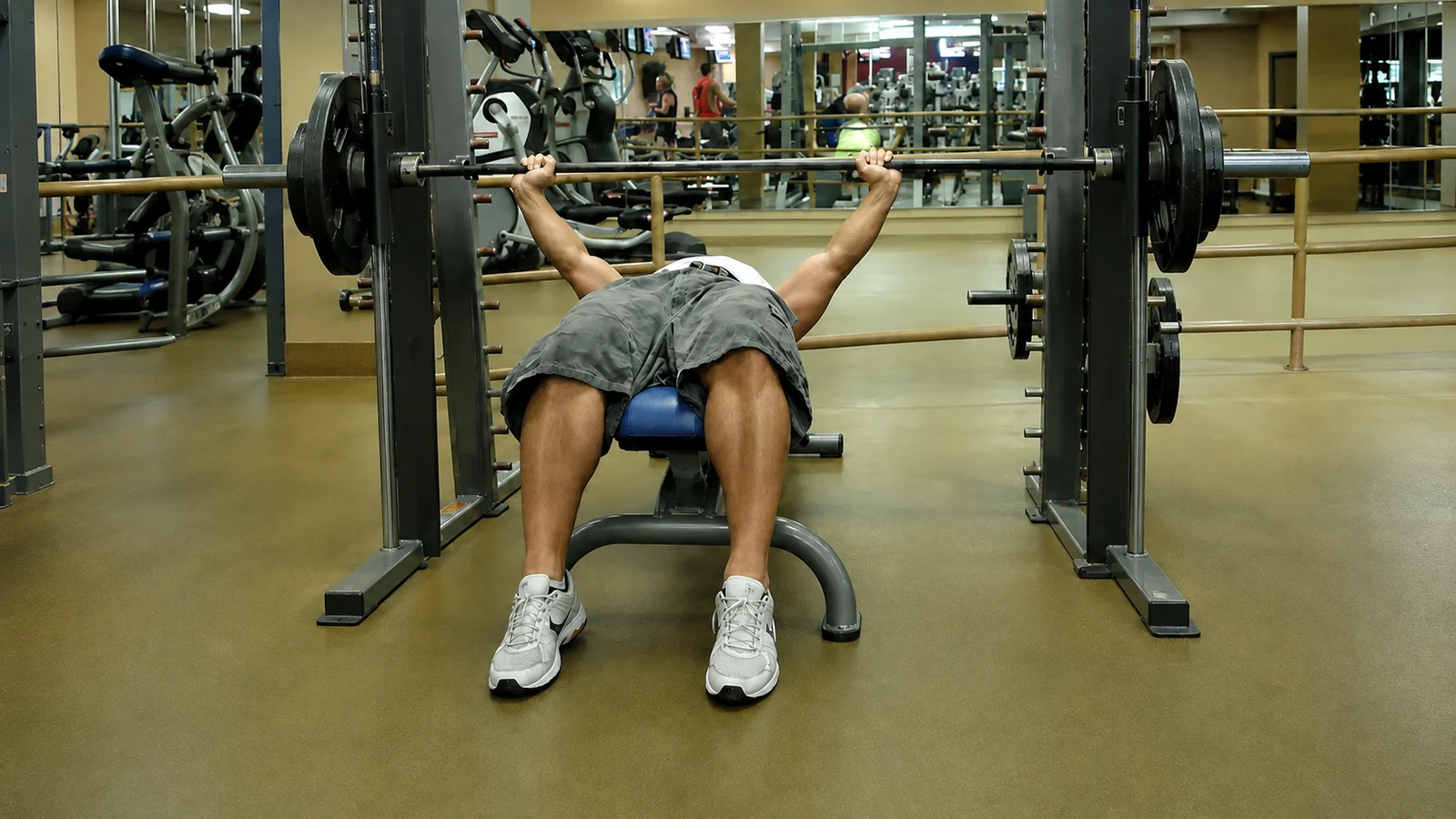

Jason Faulkner loaded a barbell to 225 pounds on the carriage of a Smith machine, angled the bench into a decline, and started pressing.
He did not stop until he had done it 107 times.
The date was September 5, 2013, in a home gym setup in Saint Joseph, Missouri.
Faulkner filmed the entire set for submission to RecordSetter, an online platform built around exactly this kind of narrowly defined, self-submitted feat.
That detail about the platform matters as much as the number itself.
RecordSetter is not Guinness World Records, and understanding the difference between the two is the first thing worth doing before looking at what Faulkner actually did.
What Actually Happened on September 5, 2013
Faulkner’s own submission history on RecordSetter shows this was not his first attempt at the category.
He originally set the mark at 102 reps on July 3, 2013, then came back two months later and pushed it to 107.
The category rules, as RecordSetter lists them, required the bar to touch Faulkner’s lower chest on every single rep and banned both wrist wraps and chalk.
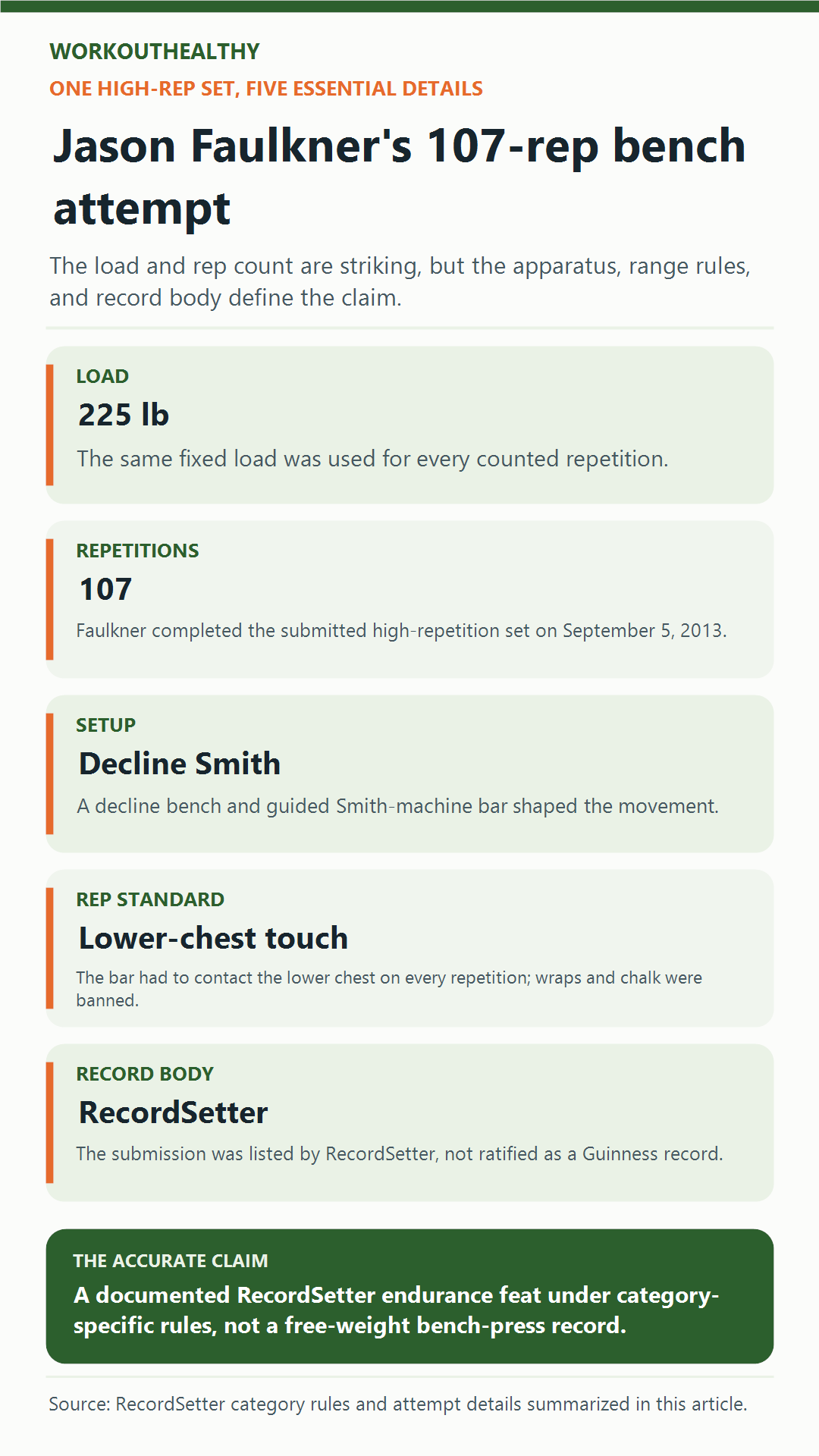
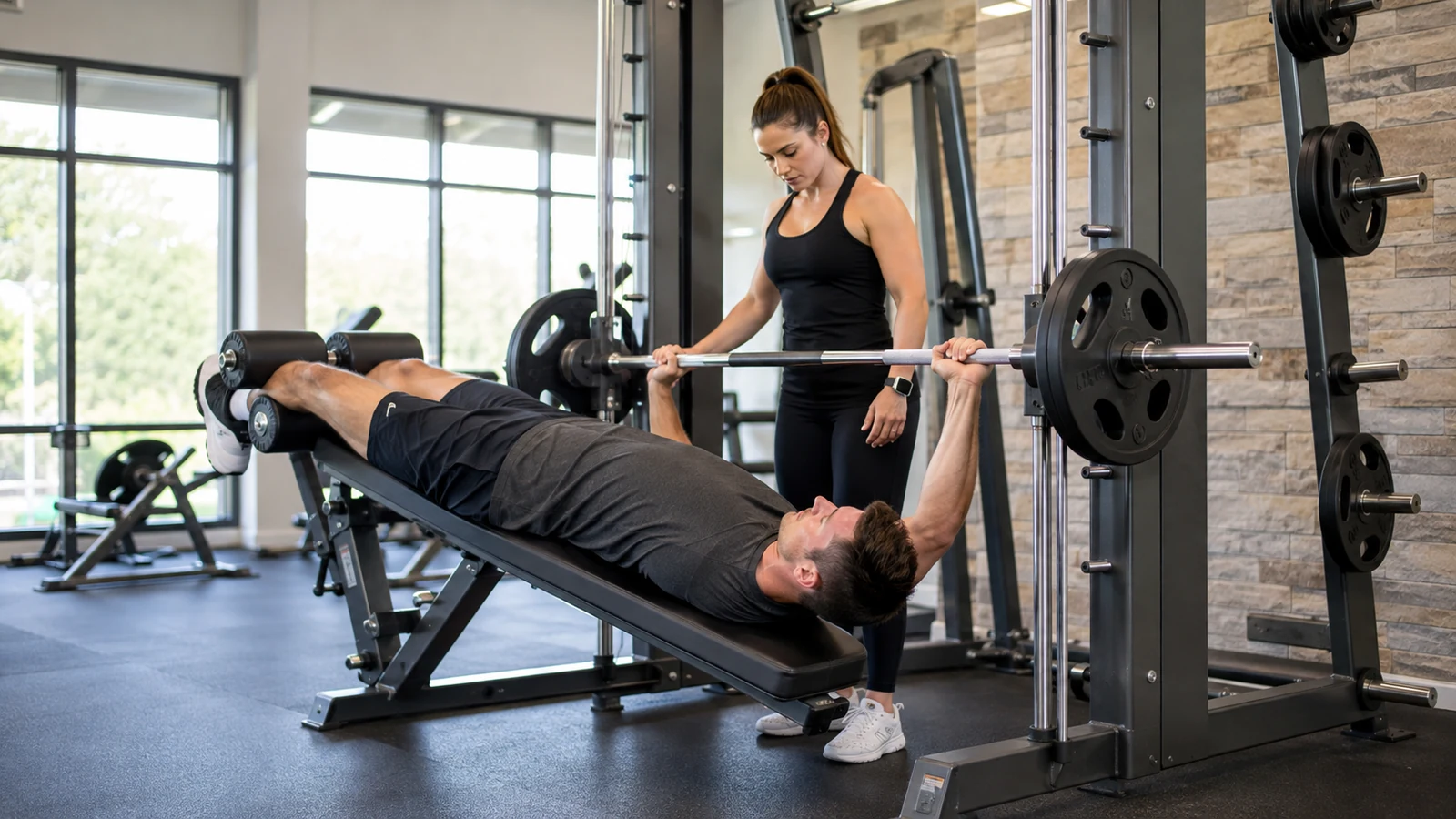
Both attempts used the same setup, a Smith machine loaded to 225 pounds, with the bench angled into a decline position rather than flat or inclined.
A Smith machine fixes the bar to a vertical track, so the bar can only travel straight up and down.
That single design choice removes an entire category of physical skill from the lift, and it is the first thing worth understanding about why 107 reps at 225 pounds on a Smith machine is not directly comparable to 107 reps of the same weight on a free barbell.
What RecordSetter Actually Is, and Why That Matters Here
RecordSetter describes itself as an online service that lets anyone submit video of an attempt at an existing record category, or propose an entirely new one.
There is no equivalent to Guinness’s adjudication process here, no on-site witness requirement, and no independent panel reviewing footage against a written rulebook before a claim goes live.
A submitter records an attempt, uploads the video, and RecordSetter posts it as the current holder in that category.
Categories themselves are often extremely specific, sometimes created by the same person attempting the record, which is part of how a title like “Most Decline Bench Press Reps With A 225-Pound Weight On A Smith Machine” comes to exist as its own named category in the first place.
RecordSetter works more like a video verified attempt log than a certified record book. Anyone can submit a category, and anyone can challenge it.
None of this means Faulkner’s set did not happen.
The video exists, RecordSetter’s own page still lists his 107-rep attempt as the current record in that specific category as of this writing, and the feat itself, moving a 225-pound barbell through a full decline pressing range of motion 107 times without a rest, is genuinely demanding.
It means something different than a Guinness World Record, though, and this article treats it that way throughout rather than borrowing Guinness’s institutional weight for a claim Guinness never reviewed at all.
Has Anyone Broken This Specific Record Since 2013?
RecordSetter’s own page for this category shows only two entries, Faulkner’s original 102-rep attempt from July 2013 and his improved 107-rep attempt from September 2013, with the second one still labeled the current record.
No newer submission challenging the mark appears on the record’s own page.
That is a meaningfully different situation than most of the Guinness-certified feats covered elsewhere in this site’s World Records category, several of which have been broken multiple times since their original claim was first written down.
It is worth being precise about what “still current” means on a platform like RecordSetter, though.
A record standing unchallenged for over a decade on a low-traffic, self-service platform is not the same claim as a record independently confirmed to still be the best mark anyone has ever set.
It most likely reflects that few people have both attempted this exact narrow category and bothered to submit video proof, rather than confirming nobody has ever done more reps at 225 pounds on a Smith machine in a decline position.
Why a Fixed Bar Path Changes What the Lift Is Actually Testing
A Smith machine’s defining feature is that the bar cannot drift forward, backward, or sideways.
It travels on a fixed vertical track, and many Smith machines add a slight counterbalance that reduces the bar’s effective starting weight before a single plate is added.
A 2005 study directly compared force production between the Smith machine and free weights for the bench press and the squat, and found the two versions of the same nominal weight produce meaningfully different demands at different points in the lift, largely because the machine removes the need to stabilize the bar path (Cotterman, Darby, & Skelly, 2005).
A separate study using electromyography on the squat found the free-weight version recruited stabilizing muscles significantly more than the Smith machine version of the same lift, because a lifter pressing against a fixed track does not have to actively balance the load (Schwanbeck, Chilibeck, & Binsted, 2009).
The same logic carries over to pressing.
On a flat bench, or in a decline position with a free bar like the one compared in our own breakdown of the floor press versus the bench press, part of every rep’s effort goes into keeping the bar traveling in a straight line over the chest.
On a Smith machine, the track already does that job, which frees the prime movers, the chest, shoulders, and triceps, to work closer to their fatigue limit without also fighting instability.
That tradeoff is exactly what makes a Smith machine a reasonable tool for a pure muscular endurance test like Faulkner’s, and exactly why the number 107 does not translate directly into what someone could do pressing a free barbell.
What the Decline Angle Adds to the Picture
Bench angle changes which part of the chest does the most work.
A 2010 study measured muscle activity with electromyography during chest press variations performed at several bench angles, including decline, flat, and multiple incline positions (Trebs, Brandenburg, & Pitney, 2010).
That research found the decline position shifted more of the working load onto the lower, sternocostal portion of the pectoralis major compared with the flat and incline versions, while the incline positions shifted more work toward the clavicular, upper portion of the chest and the front of the shoulder.
Faulkner’s category specifically required a decline setup, not a flat or incline one.
That detail is not incidental to the rep count.
It means the 107-rep total reflects fatigue accumulating specifically in the lower chest fibers, repeated over and over, rather than a load spread more evenly across the whole chest and shoulder girdle.
The Real Difference Between Chasing Strength and Chasing Muscular Endurance
Lifting 225 pounds for a single maximum rep and lifting 225 pounds for 107 reps in a row train two different qualities, even though the weight on the bar is identical.
A well known 2002 study split trained lifters into three groups, each following a different rep range for months of structured training, a heavy low-rep group, a moderate-rep group, and a light high-rep group (Campos et al., 2002).
The high-rep group built the largest gains in local muscular endurance, the low-rep group built the largest gains in maximum strength, and the moderate-rep group produced the largest muscle growth of the three, each adaptation following the specific demand placed on the muscle.
Same bar. Same 225 pounds. Completely different physical skill.
Faulkner’s own submission history reflects that specificity playing out over time.
He did not jump straight to 107 reps.
His first submission in July 2013 topped out at 102, and only after continuing to train the same movement did he add five more reps two months later.
Our look at DonnaJean Wilde’s push-up world record covers the same underlying idea from a bodyweight angle, since pacing a fatigue-limited set for a full hour is a skill built through repeated practice, not a lucky single attempt.
Building the kind of fatigue resistance needed to press 225 pounds more than a hundred times takes sustained, rep-focused training, not one attempt out of nowhere.
What This Evidence Does Not Prove
None of the research cited above was conducted on Faulkner himself, and none of it directly measured a 107-rep decline Smith machine set.
The Cotterman and Schwanbeck studies compared Smith machines with free weights in controlled lab settings, using different populations, different exercises, and far lower rep counts than Faulkner’s set.
The Trebs study on bench angle used moderate loads and standard rep ranges, not a fatigue test anywhere close to 107 continuous reps.
None of this research can confirm exactly how many of Faulkner’s 107 reps met a strict, judged depth and pace standard, since RecordSetter’s review process is not the same as an in-person judged competition with instant video replay for every rep.
The research explains the biomechanics that made a feat like this possible on this specific equipment.
It does not independently verify the exact number 107, and readers should treat that number the way this article has throughout, as RecordSetter’s own recorded claim rather than an independently adjudicated result.
Common Mistakes People Make Chasing High-Rep Bench Numbers
A lot of lifters try to copy a high-rep record by simply doing more reps at whatever weight they already bench, and that usually backfires fast.
Fatigue changes technique long before it stops a lift entirely, and a bar path that looked clean on rep 10 often drifts and shortens by rep 60, especially on a free bar without a Smith machine’s guidance.
Chasing rep count on a decline angle specifically adds risk many lifters do not plan for, since a fatigued decline press is harder to bail out of safely than a flat or incline one.
Skipping a real warm-up before a long, high-rep set is another common mistake, since a set like this asks connective tissue and stabilizing muscles to hold up under load far longer than a typical strength-focused session.
Reaching for wrist wraps or straps to compensate for grip fatigue, which is exactly what RecordSetter’s own rules for this category prohibited, defeats the point of testing raw muscular endurance in the first place.
Who Should Check With a Doctor Before Attempting Something Like This
Anyone with a history of shoulder impingement, a rotator cuff injury, or chronic wrist or elbow pain should talk to a doctor or physical therapist before attempting a long, high-rep pressing set at a meaningful percentage of their max.
The same caution applies to anyone with uncontrolled high blood pressure, since sustained high-repetition resistance work under load raises blood pressure more than most people expect, and holding strain through many consecutive reps compounds that effect.
People newer to structured strength training should build up rep tolerance gradually rather than testing a maximal rep count cold, since connective tissue adapts more slowly than muscle does and often lags behind strength gains for months.
Anyone recovering from a recent chest, shoulder, or arm injury should get clearance from a medical professional before loading a decline press for high reps, since the position places sustained tension on the front of the shoulder joint throughout the entire set.
How to Actually Build Toward a High-Rep Smith Machine Press
Start with a weight closer to half of your true one-rep max on the exercise, and build total rep volume gradually across weeks rather than testing a maximal set early.
Practice the exact standard the category requires, in this case touching the lower chest on every single rep, since sloppy range of motion late in a fatigued set is where most form breakdowns start.
Add sets of 15 to 25 reps to a regular training week for several weeks before attempting anything close to 50 or more reps in one continuous set.
Track how many reps you complete with clean form and log it week to week, since visible progress is a better guide to readiness than guessing.
Rest at least 48 hours between high-rep pressing sessions on the same movement pattern, since fatigue from a genuinely maximal rep test clears more slowly than fatigue from a normal strength session.
Some lifters chase this kind of volume with shorter, harder sessions instead of longer ones, an approach closer to the philosophy behind Mike Mentzer’s Heavy Duty training system, though building toward a true maximal rep test still requires deliberately practicing the higher rep ranges themselves, not just training harder in a lower one.
Have a plan for the final stretch of reps before starting, including exactly where you would stop if you were not on a self-catching machine, since form usually breaks down fastest in the last quarter of a maximal attempt.
Time your last meal and caffeine intake the same way you would before any demanding training session, and our guide to caffeine timing before a workout covers how to avoid overdoing the stimulant side of that prep.
Film the attempt from an angle that clearly shows full range of motion on every rep, the same standard RecordSetter requires, since it forces honest self-assessment of whether reps are actually meeting the depth requirement.
Watch the Original Video
Want more record feats explained instead of just repeated? Subscribe to WorkoutHealthy Insider for practical explanations behind popular fitness claims.
References
Campos, G. E., Luecke, T. J., Wendeln, H. K., Toma, K., Hagerman, F. C., Murray, T. F., Ragg, K. E., Ratamess, N. A., Kraemer, W. J., & Staron, R. S. (2002). Muscular adaptations in response to three different resistance-training regimens: Specificity of repetition maximum training zones. European Journal of Applied Physiology, 88(1-2), 50 to 60. https://doi.org/10.1007/s00421-002-0681-6
Cotterman, M. L., Darby, L. A., & Skelly, W. A. (2005). Comparison of muscle force production using the Smith machine and free weights for bench press and squat exercises. Journal of Strength and Conditioning Research, 19(1), 169 to 176. https://doi.org/10.1519/00124278-200502000-00029
Schwanbeck, S., Chilibeck, P. D., & Binsted, G. (2009). A comparison of free weight squat to Smith machine squat using electromyography. Journal of Strength and Conditioning Research, 23(9), 2588 to 2591. https://doi.org/10.1519/JSC.0b013e3181b1b181
Trebs, A. A., Brandenburg, J. P., & Pitney, W. A. (2010). An electromyography analysis of 3 muscles surrounding the shoulder joint during the performance of a chest press exercise at several angles. Journal of Strength and Conditioning Research, 24(7), 1925 to 1930. https://doi.org/10.1519/JSC.0b013e3181ddfae7
This article is for general information only and is not medical advice. If you have an injury, ongoing pain, or a medical condition, talk to a doctor or physical therapist before you change how you train or eat.