
Ask a room full of lifters about cardio and fat loss, and you will hear some strong opinions.
Some will tell you the treadmill is a waste of time.
Others will say muscle is the real fat burner, and cardio just makes you hungry.
These arguments are popular for a reason, because a few of them hold up well.
But a few of them fall apart once you look at the actual studies.
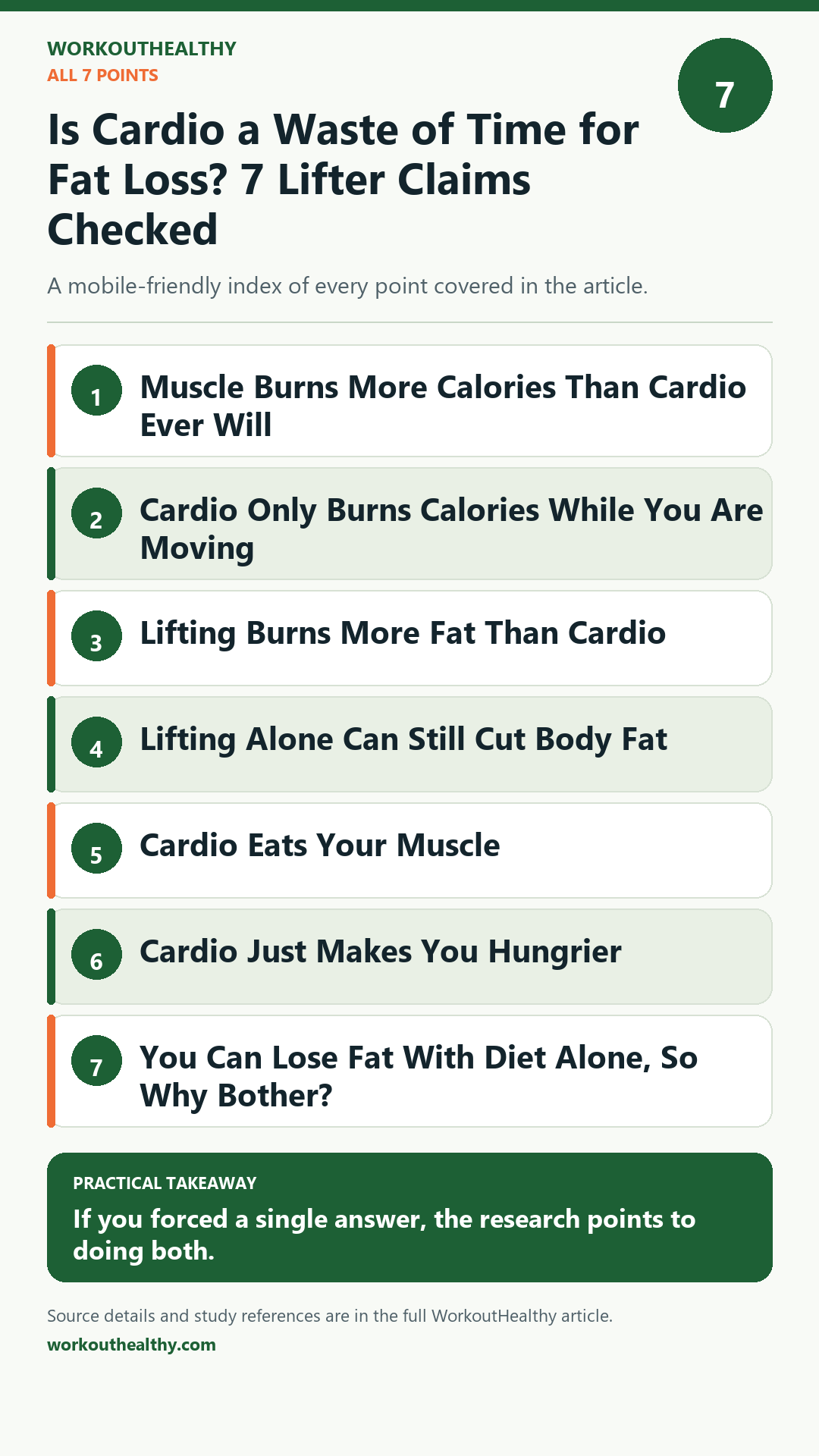
Below are the seven arguments lifters make most often, each one checked against the research.
By the end, you will know which type of training really deserves the most of your gym time if losing fat is the goal.
Spoiler: the best answer is not one or the other.
1. “Muscle Burns More Calories Than Cardio Ever Will”
This is the most common argument, and it is only partly true.
Muscle is active tissue, so it does burn calories even while you sit on the couch.
The catch is the size of that effect.
A widely cited model of resting energy use puts skeletal muscle at about 13 calories per kilogram per day.
That works out to roughly 6 calories per pound of muscle.
So if you add 4 pounds of muscle, you might burn around 24 extra calories a day at rest.
That is real, but it is about the same as a few bites of a granola bar.
A 30 minute brisk walk burns far more than that in one session.
Muscle helps your metabolism, but it is a slow drip, not a fire hose.
Verdict: true in direction, badly overstated in size.
2. “Cardio Only Burns Calories While You Are Moving”
Mostly true.
Most of the energy cost of a cardio session happens during the session itself.
There is a small afterburn effect after hard exercise, but for steady cardio it is modest.
The same is true for lifting, though.
A normal strength workout does not burn a huge number of calories either, during or after.
So this argument cuts both ways.
Verdict: true, but it applies to weights too.
3. “Lifting Burns More Fat Than Cardio”

This is where the best research pushes back.
A well known trial from Duke University, published in 2012, compared three groups of overweight and obese adults over 8 months.
One group did aerobic training, one did resistance training, and one did both.
The aerobic group and the combined group lost more total body weight and more fat mass than the lifting only group.
The lifting group and the combined group gained more lean mass than the aerobic group.
In plain terms, cardio was better for dropping fat, and lifting was better for building muscle.
The combined group got a good share of both benefits.
Verdict: not supported when you compare them head to head.
4. “Lifting Alone Can Still Cut Body Fat”
This one is true, and it matters.
A 2022 review in Sports Medicine pooled 54 studies of healthy adults who did full body strength training for at least 4 weeks.
Compared with people who did no exercise, the lifters lowered their body fat percentage by about 1.5 points.
They also lost about half a kilogram of fat mass and reduced visceral fat, the deeper fat around the organs.
Those changes are modest, but they happened without any cardio added.
So lifting is not useless for fat loss.
It just is not a magic shortcut.
Verdict: true, with realistic expectations.
5. “Cardio Eats Your Muscle”
You will hear this a lot, especially from people who are trying to bulk.
The fear is that cardio “burns muscle” and ruins your gains.
In the Duke trial above, the combined group still gained lean mass while doing both types of training.
The bigger issue is when cardio volume gets very high, or when recovery and food intake are poor.
If you want a deeper look at how the two styles interact, our guide to lifting and cardio in the same week covers the interference effect in detail.
Verdict: mostly a myth at normal amounts of cardio.
6. “Cardio Just Makes You Hungrier”
There is some truth here, and it is worth taking seriously.
Some people eat back a large share of the calories they burn, often without noticing.
That can make cardio feel useless on the scale.
But that is a food problem, not a cardio problem.
The same thing can happen after a hard lifting session.
Tracking what you eat for a few weeks is the simplest way to see whether this is happening to you.
Verdict: a real risk for some people, not a reason to skip cardio.
7. “You Can Lose Fat With Diet Alone, So Why Bother?”
Technically, yes.
Fat loss is driven by eating fewer calories than you burn over time.
But exercise makes that deficit easier to create and easier to keep.
The American College of Sports Medicine reviewed the evidence in a 2009 position stand.
It found that about 150 to 250 minutes of moderate activity a week gives only modest weight loss by itself.
More than 250 minutes a week was linked with larger losses and better protection against regaining weight.
The same position stand noted that strength training does not add much to weight loss on its own.
But it can help you keep lean mass while the fat comes off.
Verdict: diet leads, but exercise helps you keep the weight off.
So Which Type of Training Wins?
If you forced a single answer, the research points to doing both.
Cardio tends to drive more fat loss per week.
Lifting protects and builds muscle, which helps you look leaner at the same body weight.
Together, they cover each other’s weak spots.
That is not a dodge.
It is simply what the head to head studies found.
We also covered a real world version of this idea in our look at whether one dumbbell workout can build muscle and burn fat at once.
What This Evidence Does Not Prove
The Duke trial studied sedentary adults who were overweight or obese.
Lean, experienced lifters may respond differently.
Most of these studies did not tightly control diet either.
That means some of the differences could come from how people ate, not only how they trained.
The 2022 review also found that how body fat was measured changed the size of the result.
Scan based measurements and simpler methods did not always agree.
Finally, a few months of training cannot tell us much about the next 10 years.
Long term results depend mostly on what you can keep doing.
Common Mistakes People Make
Here are the mistakes that stall fat loss most often, no matter which side of the debate you are on.
- Doing only light, easy cardio and never pushing the pace.
- Lifting with the same weights for months with no progress.
- Rewarding every workout with a large snack or drink.
- Ignoring daily steps outside the gym.
- Quitting after two weeks because the scale did not move.
Daily movement matters more than most people think.
Our breakdown of daily steps and mortality shows why walking counts for more than calories alone.
How to Tell What Is Working for You
The scale alone will not give you the full picture.
If you are lifting and eating well, you may gain a little muscle while losing fat.
That can make your weight look stuck even while your body is changing.
Track a few simple markers every two to four weeks instead.
- Your waist measurement at the belly button.
- How your clothes fit.
- The weights you use on your main lifts.
- How long it takes you to walk or run a set distance.
- A weekly average of your morning weight, not a single day.
If your waist is shrinking and your lifts are climbing, the plan is working.
If nothing has moved after six to eight weeks, adjust one thing at a time.
Add a cardio session, tighten up portions, or push your lifts a bit harder.
Changing everything at once makes it hard to know what helped.
A simple training log makes these patterns much easier to spot.
Who Should Check With a Doctor First
Most healthy adults can start light cardio and basic lifting without a problem.
Talk to a doctor before you begin if any of these apply to you.
- You have heart disease, high blood pressure, or diabetes.
- You get chest pain, dizziness, or unusual shortness of breath with effort.
- You are pregnant or recently gave birth.
- You have joint pain or a recent injury.
- You have been fully inactive for a long time and have other health conditions.
A Simple Weekly Plan That Uses Both
Here is a practical starting point for most adults.
Strength, 2 to 3 days a week.
Pick 5 to 6 exercises that cover your whole body, such as a squat, a hinge, a push, a pull, and a carry.
Do 2 to 3 sets of 8 to 12 reps.
Add a little weight or a rep or two when the last set starts to feel easier.
Cardio, 3 to 5 days a week.
Aim for 150 minutes or more of moderate effort across the week.
Moderate means you can talk, but you would not want to sing.
Once that feels normal, swap one session for a harder interval workout.
Daily movement.
Walk more on non training days.
Take the stairs, park farther away, and take short walking breaks during long sitting.
Food.
Eat enough protein, keep portions steady, and watch the extras that sneak in after workouts.
Rest.
Give each muscle group at least a day between hard sessions.
Sleep 7 or more hours when you can.
The best fat loss plan is the one you are still following six months from now.
Watch the Original Video
Want more fitness debates settled with real studies? Subscribe to WorkoutHealthy Insider for practical explanations behind popular fitness claims.
References
Donnelly, J. E., Blair, S. N., Jakicic, J. M., Manore, M. M., Rankin, J. W., & Smith, B. K. (2009). Appropriate physical activity intervention strategies for weight loss and prevention of weight regain for adults. Medicine & Science in Sports & Exercise, 41(2), 459 to 471. https://doi.org/10.1249/MSS.0b013e3181949333
Wang, Z., Ying, Z., Bosy-Westphal, A., Zhang, J., Schautz, B., Later, W., Heymsfield, S. B., & Müller, M. J. (2010). Specific metabolic rates of major organs and tissues across adulthood: Evaluation by mechanistic model of resting energy expenditure. The American Journal of Clinical Nutrition, 92(6), 1369 to 1377. https://doi.org/10.3945/ajcn.2010.29749
Wewege, M. A., Desai, I., Honey, C., Coorie, B., Jones, M. D., Clifford, B. K., Leake, H. B., & Hagstrom, A. D. (2022). The effect of resistance training in healthy adults on body fat percentage, fat mass and visceral fat: A systematic review and meta-analysis. Sports Medicine, 52(2), 287 to 300. https://doi.org/10.1007/s40279-021-01562-2
Willis, L. H., Slentz, C. A., Bateman, L. A., Shields, A. T., Piner, L. W., Bales, C. W., Houmard, J. A., & Kraus, W. E. (2012). Effects of aerobic and/or resistance training on body mass and fat mass in overweight or obese adults. Journal of Applied Physiology, 113(12), 1831 to 1837. https://doi.org/10.1152/japplphysiol.01370.2011
This article is for general information only and is not medical advice. If you have an injury, ongoing pain, or a medical condition, talk to a doctor or physical therapist before you change how you train or eat.