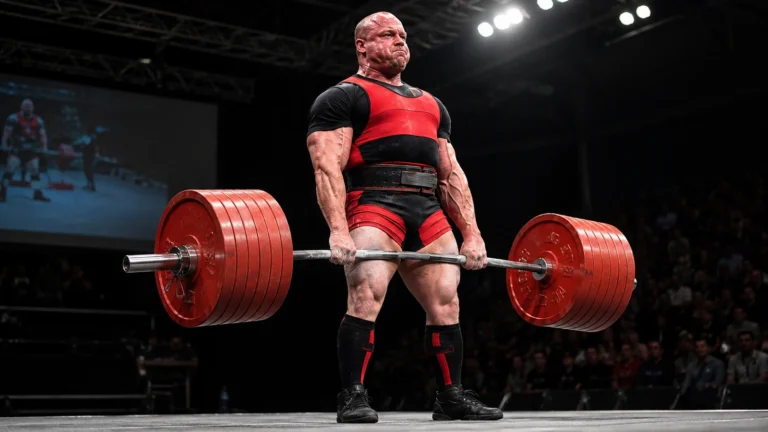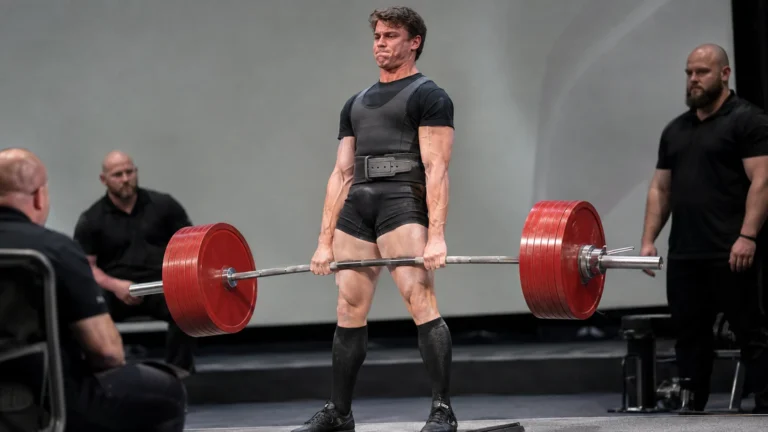

Cardio vs strength training: which should you prioritize? If you want endurance, make aerobic work the main event; if you want maximal strength or muscle, prioritize progressive resistance training.
For general health, do both, because each trains a different capacity.
The argument often goes wrong when a study about fat mass is used to predict muscle growth, or a study about explosive power is used to say cardio destroys all gains. Here are nine familiar claims, what the measured outcomes actually show, and two ways to fit both methods into a short week.

Cardio vs strength training: choose by goal
“Better” depends on the outcome you are testing. This goal guide is a practical interpretation of exercise guidelines and the studies below, not a claim that one activity works only for one outcome.
| Your primary goal | Give first priority to | Keep the other method because |
|---|---|---|
| General health | A sustainable mix | US guidelines recommend both aerobic activity and muscle strengthening. |
| Running, cycling or other endurance performance | Practice the aerobic activity you want to improve | Strength work develops muscle function that endurance practice alone may not train well. |
| Maximal strength or muscle size | Progressive resistance training | Cardio builds aerobic capacity; a 43-study review did not find a meaningful group-average loss of maximal-strength or whole-muscle growth from combining them. |
| Explosive power | Power-focused strength sessions while fresh | Aerobic training still has value, but the review found less explosive-strength gain when both modes occurred in the same session. |
| Reducing fat mass | A workable nutrition and activity plan | Aerobic or combined training averaged more absolute fat-mass loss than resistance alone in longer studies, but matched workloads showed no statistically clear difference. |
For adult health, the CDC recommends at least 150 minutes of moderate aerobic activity or 75 minutes of vigorous activity each week, plus muscle-strengthening work on at least two days. Some activity is beneficial even before you reach those totals.
Nine cardio vs weights claims, checked against outcomes
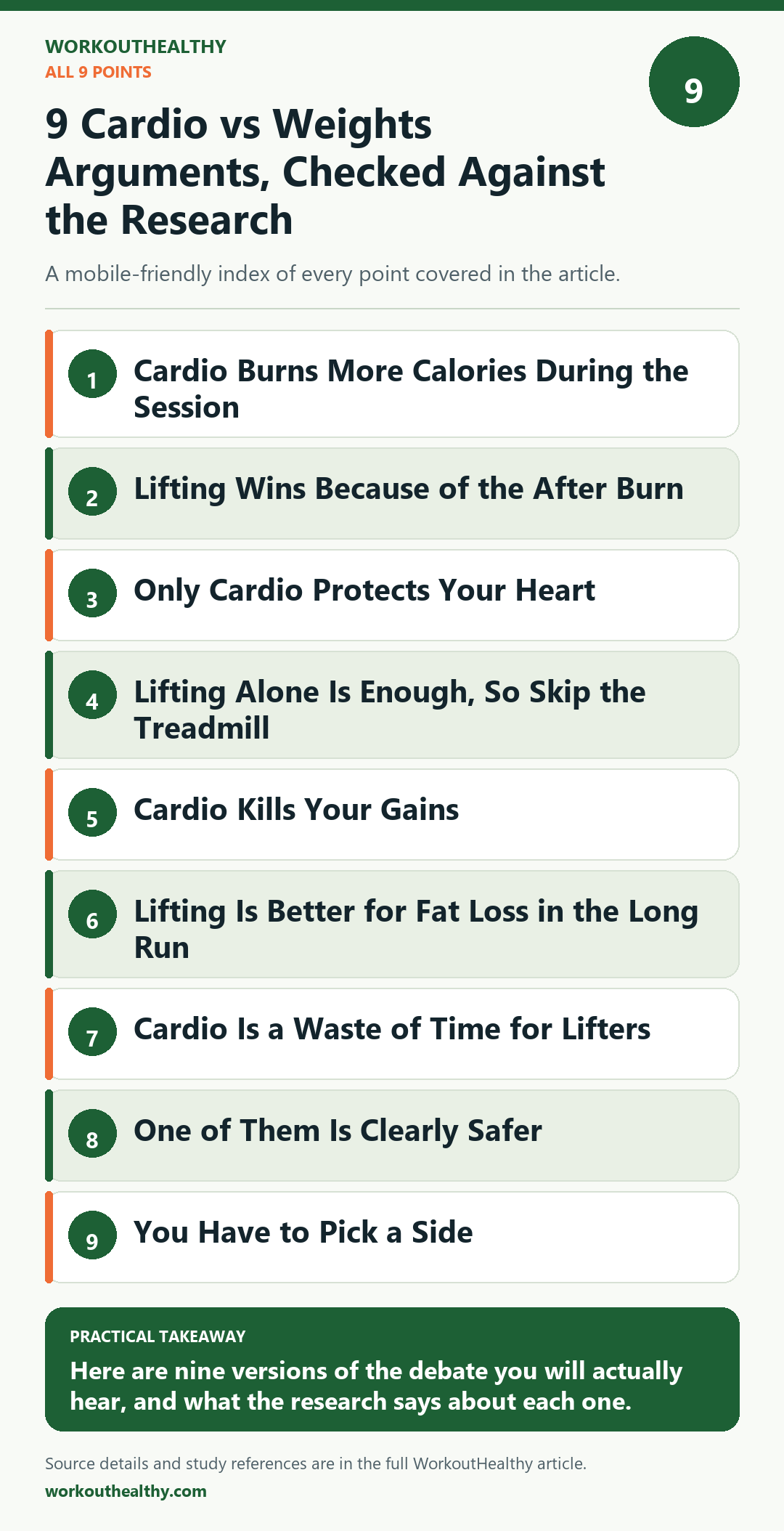
1. “Cardio always burns more calories during a workout”
Energy used during a session depends on its length and intensity, so “always” is too strong. Sustained running or cycling often uses more energy per hour than a lifting session with rests, but that is not an equal-effort comparison.
In an eight-month trial, 196 sedentary adults with overweight or obesity were randomized to aerobic, resistance or combined programs; 119 had comparable body-composition data for this analysis. Aerobic and combined groups reduced body and fat mass more than the resistance-only group, but the study did not measure a universal calorie count for every possible workout.
2. “The lifting afterburn settles the debate”
Excess post-exercise oxygen consumption is real, but a review of resistance-exercise energy measurements found widely varying estimates. A temporary increase after lifting does not establish that lifting causes more fat loss over months.
Lift because you want strength and muscle, not because an afterburn slogan guarantees fat loss. Track the outcomes you care about over time instead of trying to estimate a small, variable recovery effect.
3. “Only cardio helps your heart”
Aerobic activity directly trains sustained cardiorespiratory work, but strength training is also associated with health benefits. A 2022 review of 16 prospective cohort studies found muscle-strengthening activity associated with lower all-cause mortality and cardiovascular-disease risk.
Those cohort links cannot prove that lifting caused the lower risk, and they do not make aerobic activity optional. The joint evidence and the US guidelines support doing both.
4. “If I lift, I can skip aerobic work”
A good squat does not tell you how comfortably you can sustain a brisk climb or a long ride. Add walking, cycling, swimming or another aerobic activity you can repeat, then progress its duration or effort gradually.
You can count activity outside the gym. A commute walk or neighborhood loop may be easier to maintain than adding another machine session.
5. “Cardio kills muscle gains”
A 2012 review raised concern about interference when endurance work and lifting were combined. An updated 2022 review of 43 studies found no statistically significant group-average interference with muscle hypertrophy or maximal-strength gains compared with the same strength program alone.
The newer review did find a smaller gain in explosive strength, especially when aerobic and strength work occurred in the same session. Our guide to cardio and muscle growth examines that scheduling question in more detail.
For a power athlete, separating demanding sessions may be worth trying. The average result is not a reason for everyone who lifts to avoid cardio.
6. “Lifting always beats cardio for fat loss later”
The eight-month trial does not support that universal claim: the resistance-only group did not show a significant mean reduction in fat mass, while the aerobic and combined groups did. The combined program required more total training time, so its results should not be described as a time-matched win over aerobic training.
A 2025 review of 36 trials found more absolute fat-mass loss with aerobic or combined training than resistance alone in longer programs. When studies matched training workload, the differences between methods were not statistically clear.
Strength work still matters when the goal includes muscle and function. Body weight, fat mass, and lean mass answer different questions, and a single scale reading cannot show all three.
7. “Cardio is wasted time for lifters”
If your goal is a stronger squat, lifting is the direct practice. Aerobic work can address a separate endurance goal and the health-guideline target without assuming it will make every lifting set better.
Start with an amount that fits recovery and schedule, such as comfortable walks or easy cycling. If hard intervals noticeably reduce the quality of your priority strength session, move them farther apart or reduce the load rather than rejecting aerobic training altogether.
8. “One option is clearly safer”
Injury risk depends on the person, exercise, environment and increase in workload. Neither a treadmill nor a barbell comes with a universal safety guarantee.
Learn the movement, choose a manageable starting dose, and increase one training demand at a time. A coach or clinician can help adapt either mode when pain, limited mobility or a medical condition changes the decision.
9. “You have to choose a side”
Most people have more than one goal. A plan can make one method the priority while still giving the other a consistent place in the week.
Do not call the two methods interchangeable: a walk does not replace progressive lifting for maximal strength, and two lifting days do not automatically meet the aerobic guideline. They can coexist without requiring equal time.
Two ways to combine them with limited gym time
These are illustrative calendars for an adult who can exercise without a condition-specific restriction. They show how two or three gym visits can coexist with walks outside the gym; they are not a clinical prescription or a claim that this exact schedule is optimal.
Two gym days
| Day | Example activity |
|---|---|
| Monday | Full-body strength session, then 20 minutes of moderate walking |
| Tuesday | 30 minutes of moderate walking |
| Wednesday | 20 minutes of moderate walking |
| Thursday | Full-body strength session, then 20 minutes of moderate walking |
| Friday | 30 minutes of moderate walking |
| Saturday | 30 minutes of moderate walking |
| Sunday | Rest or easy movement by choice |
The example totals 150 minutes of moderate walking and two strength days. “Moderate” means the effort meets your own guideline-level intensity, so a casual stroll may not count the same way.
Three gym days
| Day | Example activity |
|---|---|
| Monday | Full-body strength session, then 20 minutes of moderate cardio |
| Tuesday | 25 minutes of moderate walking |
| Wednesday | 40 minutes of moderate aerobic activity at the gym |
| Thursday | 25 minutes of moderate walking |
| Friday | Full-body strength session, then 20 minutes of moderate cardio |
| Saturday | 25 minutes of moderate walking |
| Sunday | Rest or easy movement by choice |
This example totals 155 minutes of moderate aerobic work and two strength days. If endurance or explosive power is your main sport goal, change the schedule around the sessions that need your freshest effort.
What this evidence cannot say
The eight-month body-composition trial studied a specific sedentary population and compared programs with different total training demands. Only 119 of the 196 randomized participants had comparable body-composition data for the analysis, so its averages do not forecast an individual’s response or replace a food-intake plan.
The 2022 concurrent-training review compares group averages across different supervised programs. “No significant average interference” does not mean that no individual will struggle when hard running and heavy leg work are crowded together.
The muscle-strengthening and mortality review combines observational cohorts. It supports an association, not a proof that a given number of lifting minutes prevents a heart event.
When to adjust the week or get advice
If your priority sessions repeatedly deteriorate, reduce competing hard sessions, separate them when practical, or make one mode easier for a few weeks. Track performance, recovery and adherence rather than changing the plan after one unusually hard workout.
If exercise brings on chest pressure, lightheadedness or unusual shortness of breath, stop and seek medical evaluation, as the American Heart Association advises. For an existing condition, injury, pregnancy or activity limit, ask a qualified clinician how to adapt these examples.
References
- Centers for Disease Control and Prevention. Adult Activity: An Overview.
- Willis LH, Slentz CA, Bateman LA, et al. Effects of aerobic and/or resistance training on body mass and fat mass in overweight or obese adults. Journal of Applied Physiology. 2012;113(12):1831 to 1837. doi:10.1152/japplphysiol.01370.2011.
- Momma H, Kawakami R, Honda T, Sawada SS. Muscle-strengthening activities are associated with lower risk and mortality in major non-communicable diseases: a systematic review and meta-analysis of cohort studies. British Journal of Sports Medicine. 2022;56(13):755 to 763. doi:10.1136/bjsports-2021-105061.
- Schumann M, Feuerbacher JF, Sünkeler M, et al. Compatibility of concurrent aerobic and strength training for skeletal muscle size and function: an updated systematic review and meta-analysis. Sports Medicine. 2022;52:601 to 612. doi:10.1007/s40279-021-01587-7.
- Wilson JM, Marin PJ, Rhea MR, et al. Concurrent training: a meta-analysis examining interference of aerobic and resistance exercises. Journal of Strength and Conditioning Research. 2012;26(8):2293 to 2307. doi:10.1519/JSC.0b013e31823a3e2d.
- Lafontant K, Rukstela A, Hanson A, et al. Comparison of concurrent, resistance, or aerobic training on body fat loss: a systematic review and meta-analysis. Journal of the International Society of Sports Nutrition. 2025;22(1):2507949. doi:10.1080/15502783.2025.2507949.
- Mitchell L, Wilson L, Duthie G, et al. Methods to assess energy expenditure of resistance exercise: a systematic scoping review. Sports Medicine. 2024;54:2357 to 2372. doi:10.1007/s40279-024-02047-8.
- American Heart Association. Slow, steady increase in exercise intensity is best for heart health. 2020.
This article is for general information and is not medical advice. Ask a healthcare professional about exercise limits related to your health or symptoms.