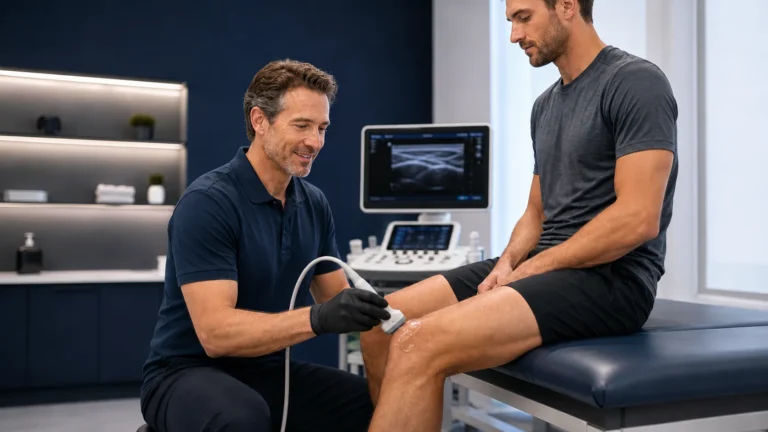

A video from the University of Arkansas shows a college dean sitting in on an exercise science class for a day.
The program description behind it says something worth taking seriously: these degrees train the coaches, trainers, and clinical rehabilitation professionals who will run tomorrow’s gyms, sports medicine clinics, and training rooms.
That raises a fair question for anyone who has ever had a coach yell “fix your knees” without explaining how.
What do exercise scientists actually do once they get past the classroom and into a real lab?
A large part of the answer is movement analysis, which means measuring exactly how a body moves instead of guessing from the sideline.
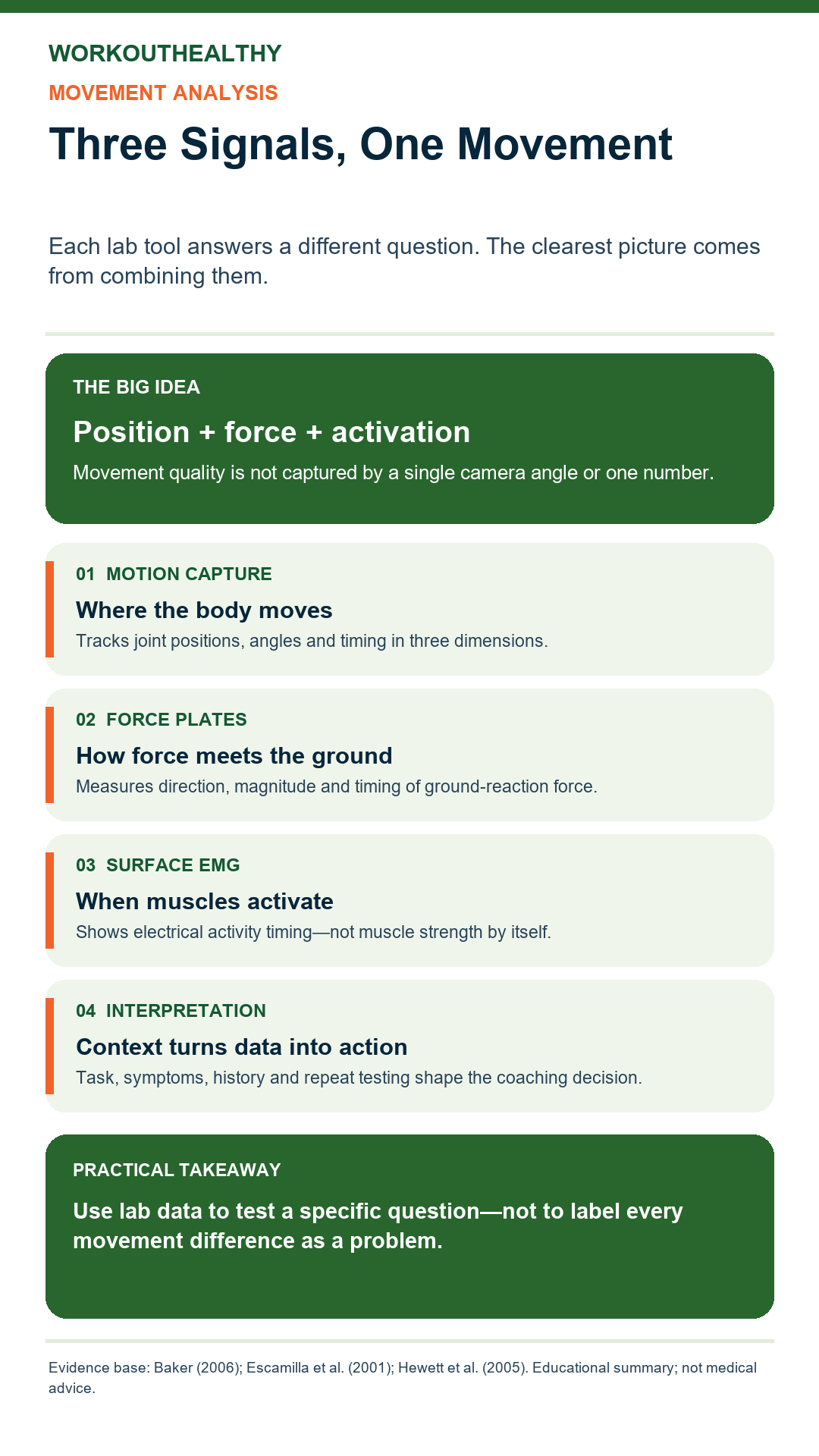
Three tools sit at the center of that work: three-dimensional motion capture, force plates, and surface electromyography, usually shortened to EMG.
Each one answers a different question about how a human body performs an action, and together they turn coaching from opinion into measurement.
What Exercise Scientists Actually Study When They Study Movement
Sport biomechanics is the branch of exercise science that studies the forces and motions involved in human movement.
It sits at the intersection of physics, anatomy, and coaching practice.
A biomechanist watching an athlete run, jump, or squat is not just watching for style.
They are trying to quantify joint angles, timing, force, and muscle activity in ways a human eye simply cannot do on its own.
That distinction matters because coaching has historically relied on visual judgment.
A coach watches a landing look “off” and flags it, which is useful but limited by what the eye can catch at normal speed.
Motion capture, force plates, and EMG exist because certain movement problems happen too fast, or are too subtle, for even a trained eye to catch reliably.
Inside a Motion Capture Lab: How 3D Systems Track the Body
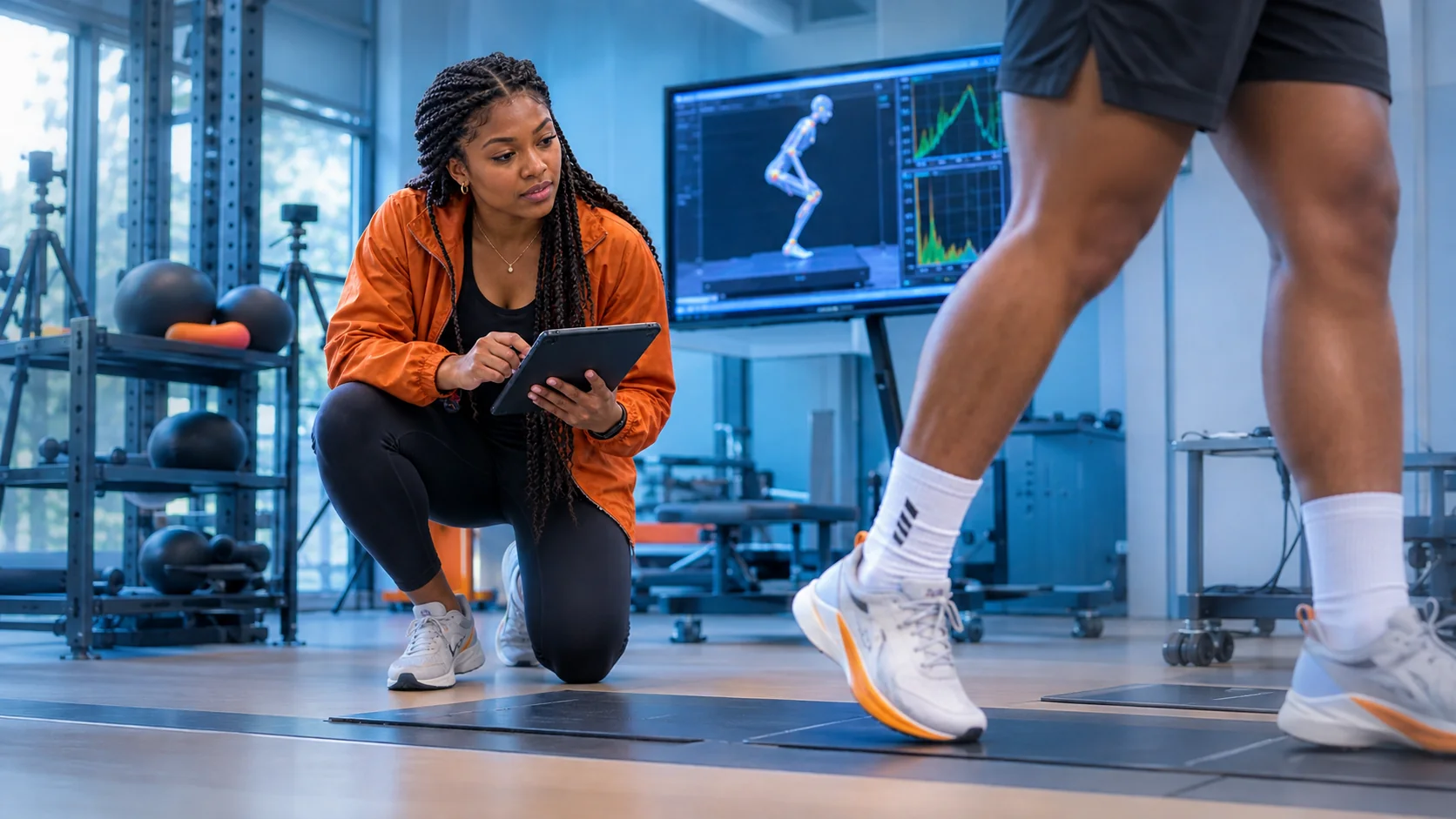
A three-dimensional motion capture system typically uses a ring of infrared cameras placed around a room, paired with small reflective markers taped to specific bony landmarks on a person’s body.
As someone walks, runs, or jumps through the space, the cameras track each marker dozens or hundreds of times per second.
Specialized software then reconstructs those marker positions into a three-dimensional skeleton, calculating joint angles at the hip, knee, and ankle throughout the movement.
This is the same basic technology used in some video game and film animation studios, just applied to clinical and athletic questions instead of entertainment.
In rehabilitation medicine, this approach is usually called clinical gait analysis.
A widely cited review in the Journal of NeuroEngineering and Rehabilitation lays out how gait analysis methods are used to guide treatment decisions for conditions like cerebral palsy, stroke recovery, and joint replacement, by giving clinicians objective joint angle and timing data instead of relying on visual impression alone (Baker, 2006).
The same underlying idea applies in sport.
A distance runner’s stride, a pitcher’s arm path, or a sprinter’s hip extension can all be broken down frame by frame, angle by angle, instead of described in adjectives.
What Force Plates Reveal That the Eye Cannot See
A force plate looks unremarkable, usually just a flat metal platform built into a floor or placed on top of one.
Underneath that plain surface sit sensors that measure the force a person exerts against the ground in three directions, many times per second.
This measurement is called ground reaction force, and it is one of the most information-dense signals in all of sport science.
When someone jumps, a force plate can show exactly how much force they generate during the crouch, how quickly that force builds, and how the landing absorbs it on the way back down.
This is part of why researchers looking at whether box jumps can build muscle lean on force plate data rather than just counting reps, since the forces produced during a jump are not the same as the forces produced during a slow, controlled lift.
None of that is visible to a stopwatch or a naked eye watching from the sideline.
Two athletes can jump to the exact same height and land in ways that look similar on video, while a force plate shows one of them absorbing the landing far more abruptly than the other.
That abruptness, often described as a high loading rate, is one of the signals sport scientists watch closely when they assess landing mechanics.
Two athletes can look identical landing from a jump on video, yet a force plate can show one of them absorbing that same landing in a way that loads the knee joint far more abruptly than the other.
Combining Motion Capture and Force Plates to Flag Injury Risk
The real power of these tools shows up when labs combine them.
One of the most cited examples in sport biomechanics comes from a research team led by Timothy Hewett, who used synchronized 3D motion capture and force plates to study female high school and college athletes performing a standardized jump landing task (Hewett et al., 2005).
The researchers measured each athlete’s knee motion and the forces acting on the knee joint during that landing, then followed those athletes through a full season of competition.
Athletes who showed greater inward knee collapse, a pattern called dynamic knee valgus, combined with higher rotational force at the knee, were significantly more likely to go on to suffer an ACL tear later that season.
This was a prospective study, meaning the movement measurements came first and the injuries were tracked afterward, which is a much stronger design than looking backward at injured athletes and guessing what went wrong.
That single study is a large part of why ACL injury-risk screening protocols exist in college and professional athletic programs today.
It demonstrated that a measurable movement pattern, not just an opinion about “bad form,” could statistically predict a serious injury before it happened.
Surface EMG: Reading Which Muscles Actually Fire, and When
Motion capture and force plates describe what a joint does and how much force crosses it.
Neither one directly answers a different question: which specific muscles are doing the work, and in what order?
That is the job of surface electromyography, or EMG, which uses electrodes placed on the skin over a muscle to detect the tiny electrical signal the muscle produces when it contracts.
A classic study by Rafael Escamilla and colleagues used EMG alongside motion analysis to compare knee biomechanics during the squat and the leg press, two exercises coaches often treat as interchangeable (Escamilla et al., 2001).
The study found real differences in muscle activation patterns and knee joint loading between the two exercises, depending on stance width, foot position, and how deep the movement went.
The same logic applies to exercises that look like simple substitutes for each other, the way a floor press changes the mechanics of a bench press just by removing the leg drive and shortening the range of motion.
That kind of finding is exactly why EMG matters to a coach designing a rehabilitation program after knee surgery.
Two exercises that look similar to the eye can load a healing joint very differently, and EMG combined with motion analysis is one of the few ways to actually confirm that difference rather than assume it.
How Labs Turn Raw Data Into Coaching Decisions
None of this technology matters much if the data just sits in a spreadsheet.
In practice, sport scientists translate motion capture, force plate, and EMG data into specific coaching cues.
A knee valgus pattern flagged in a lab might turn into a hip strengthening program and a verbal cue to “push your knees out” during a squat or landing drill.
A force plate reading showing an abrupt, high-impact landing might turn into coaching on how to land more softly, absorbing force over a longer time window instead of all at once.
An EMG reading showing one muscle group firing far later than expected might point a physical therapist toward a specific strengthening or activation exercise.
This is the practical bridge between a research lab and a practice field, and it is exactly the kind of translational work exercise science degree programs are built to teach.
It is also, in a much lower-tech form, the same reason training with a partner or a coach who gives real-time feedback on bar path, depth, and posture can catch a form problem sooner than training alone in front of a mirror.
What This Evidence Does Not Prove
It is worth being honest about the limits of this research.
A single jump landing test in a lab is a controlled, artificial task, and it does not perfectly replicate the chaos of a real game.
Movement screening tools like the ones described here are genuinely useful for identifying group-level risk patterns, but they are much weaker at predicting whether any one specific individual will get injured.
Most published screening protocols carry real predictive value at the population level while still producing both false positives and false negatives for individual athletes.
Access is another limit worth naming directly.
Full 3D motion capture systems, multi-axis force plates, and multi-channel EMG setups are expensive and usually only available at universities, professional sports organizations, and larger sports medicine clinics.
Most weekend athletes and even most high school teams will never sit inside one of these labs.
Common Mistakes People Make Reading Movement-Analysis Data
The most common mistake is treating a single number as a verdict rather than one piece of evidence.
A knee valgus angle, a ground reaction force value, or an EMG reading in isolation rarely tells the whole story on its own.
Context matters just as much as the number, including the athlete’s sport, training history, prior injuries, and how fatigued they were during testing.
A second mistake is assuming lab findings automatically transfer to every sport and every movement pattern.
A landing pattern measured during a standardized vertical jump test does not automatically describe how that same athlete lands while cutting on a soccer field.
A third mistake, common among casual fitness content online, is citing these tools as proof of a dramatic claim without naming the actual study behind it.
Real biomechanics research is nuanced, probabilistic, and full of caveats, which does not always make for a punchy headline.
Who Actually Benefits From a Formal Movement Assessment
Not everyone needs a trip to a motion capture lab, and that is fine.
Athletes recovering from a significant injury, especially an ACL reconstruction, are a group where formal movement assessment has the clearest evidence behind it.
Return-to-sport testing after ACL surgery increasingly uses force plates and motion analysis to check whether an athlete has regained symmetrical strength and landing mechanics before clearing them to compete again.
Athletes with a history of repeated overuse injuries, like stress fractures or chronic tendon pain, are another group where a formal gait or movement analysis can sometimes catch a mechanical contributor that basic observation missed.
Competitive athletes at the college level and above, where teams often have access to a sports medicine department, are more likely to have this kind of testing available to them already.
For most recreational lifters and runners, this level of testing is not necessary to train safely or effectively.
A Practical Starting Point Without a Lab
The good news is that some of these principles scale down to ordinary gym and training settings.
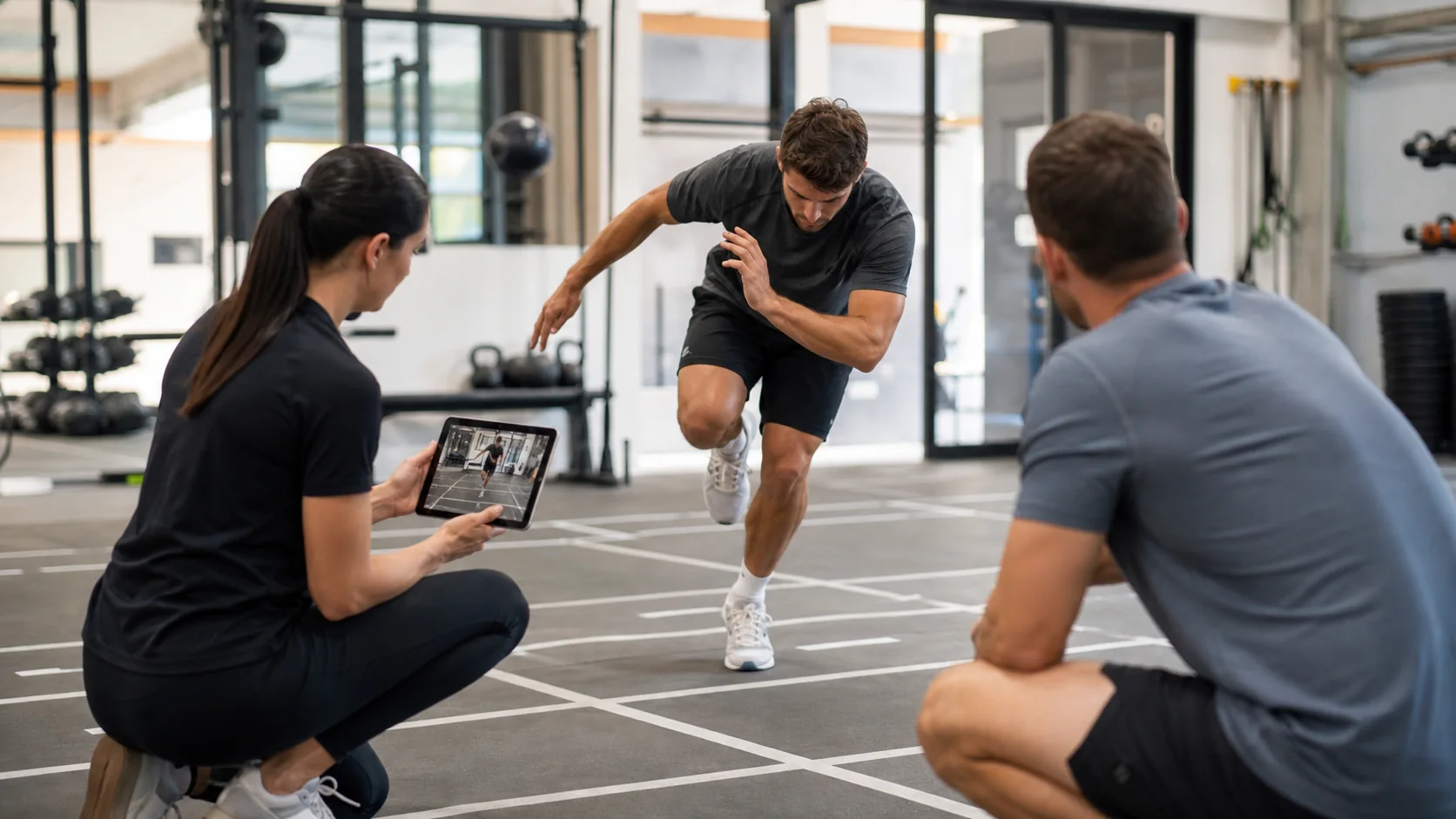
A simple smartphone video, filmed from the front and the side during a squat, landing, or running stride, can reveal a surprising amount about joint alignment even without any specialized equipment.
Slowing that video down frame by frame is a rough, low-cost version of what a motion capture system does at far higher resolution.
Working with a certified strength and conditioning coach or physical therapist adds a trained eye that knows what patterns actually matter clinically, rather than what simply looks unusual.
For anyone weighing whether that kind of guidance is worth it, the bigger decision of whether you need a personal trainer and how to hire one is a reasonable place to start before investing in any specialized testing.
Progressing load and volume gradually, rather than jumping into high-impact jump training or heavy lifting too quickly, reduces the number of repetitions a potentially flawed movement pattern gets reinforced under real load.
None of that replaces a lab, but it borrows the same underlying logic: measure and observe before assuming a movement is safe.
Watch the Original Video
Want more research explained in plain language? Subscribe to WorkoutHealthy Insider for practical explanations behind popular fitness claims.
References
Baker, R. (2006). Gait analysis methods in rehabilitation. Journal of NeuroEngineering and Rehabilitation, 3, 4. https://doi.org/10.1186/1743-0003-3-4
Escamilla, R. F., Fleisig, G. S., Zheng, N., Lander, J. E., Barrentine, S. W., Andrews, J. R., Bergemann, B. W., & Moorman, C. T., III. (2001). Effects of technique variations on knee biomechanics during the squat and leg press. Medicine & Science in Sports & Exercise, 33(9), 1552 to 1566. https://doi.org/10.1097/00005768-200109000-00020
Hewett, T. E., Myer, G. D., Ford, K. R., Heidt, R. S., Jr., Colosimo, A. J., McLean, S. G., van den Bogert, A. J., Paterno, M. V., & Succop, P. (2005). Biomechanical measures of neuromuscular control and valgus loading of the knee predict anterior cruciate ligament injury risk in female athletes: A prospective study. American Journal of Sports Medicine, 33(4), 492 to 501. https://doi.org/10.1177/0363546504269591
This article is for general information only and is not medical advice. If you have an injury, ongoing pain, or a medical condition, talk to a doctor or physical therapist before you change how you train or eat.