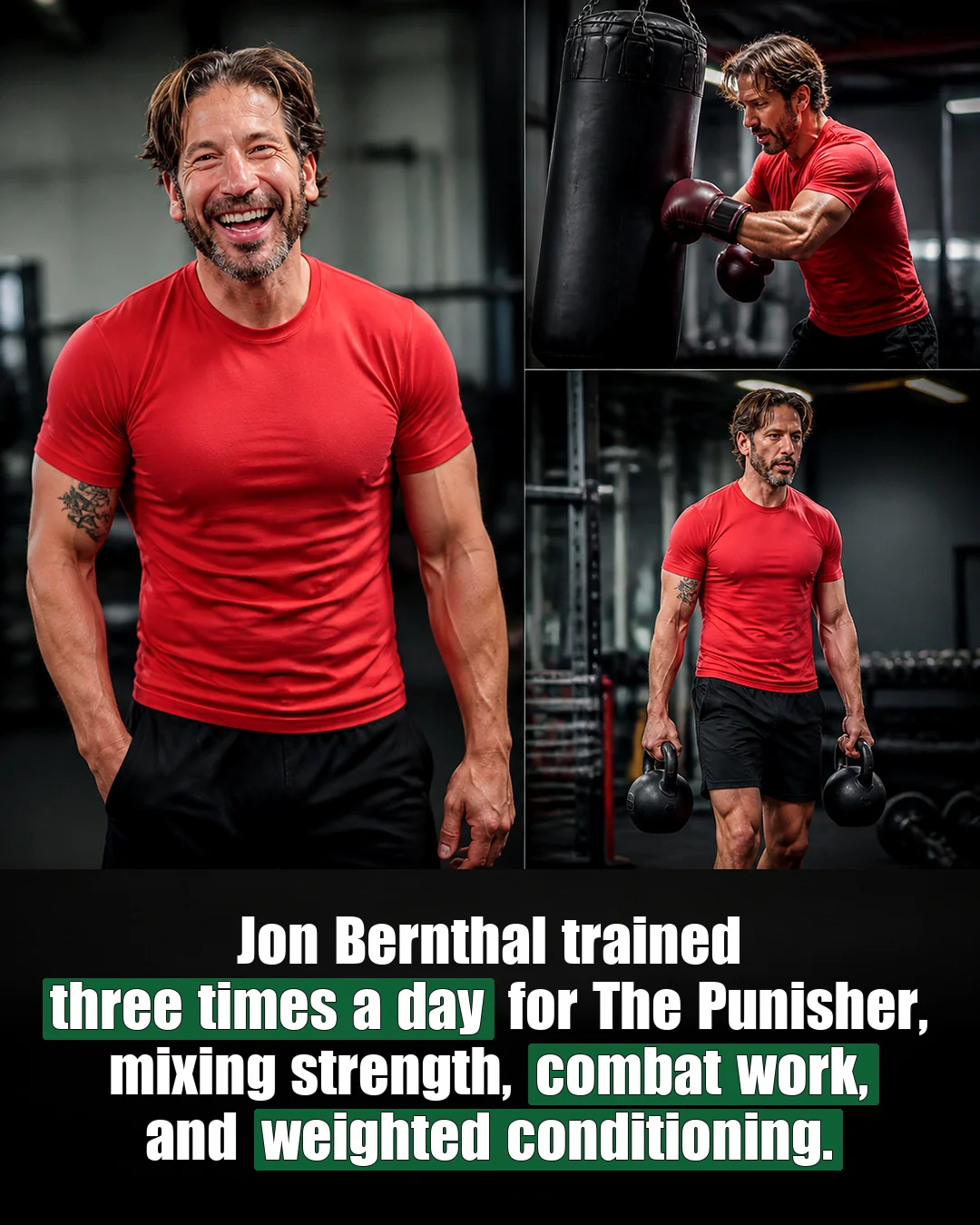

Jon Bernthal built a reputation in Hollywood for training as hard as the characters he plays.
He first drew wide attention as Shane Walsh on The Walking Dead, but it was a different role that turned his physical transformation into a talking point of its own.
In 2016, Bernthal began playing Frank Castle, also known as the Punisher, first in the Marvel series Daredevil and later in his own Netflix show.
Critics praised the performance for its intensity, and much of that intensity came from a body clearly built for the part.
Bernthal is known as a method actor who does much of his own stunt work, which meant the training behind the Punisher was not just for looks.
Before that, he built a reputation for physically committed performances in films like Fury and Ford v Ferrari, and he later won a Primetime Emmy Award for his role in The Bear.
Across that range of work, one thread stays consistent. Bernthal shows up to roles looking like he has actually trained for them, not just dieted for them.
That distinction matters, since a lean physique and a genuinely conditioned, capable body are not the same thing, even if they can look similar on camera.
What Bernthal’s Training Reportedly Looked Like
According to reporting on his preparation for the role, Bernthal trained multiple times a day.
His routine reportedly mixed heavy strength work with boxing and functional conditioning drills, rather than sticking to one training style.
That kind of schedule is demanding by design. Multiple daily sessions push both the muscular and cardiovascular systems in different ways within the same day.
Bernthal has been open about how physically taxing that preparation was, both on his body and on his ability to recover between sessions.
A schedule like his is not something most trainers would recommend for the general public, and it is worth saying plainly that this kind of volume carries real injury and burnout risk without careful, professional oversight.
Still, the underlying training style, mixing strength work with boxing and conditioning, is something regular lifters and athletes can learn from, even at a much lower volume.
Bernthal’s Own Approach to Character and Training
Bernthal has talked in interviews about immersing himself fully in a role, sometimes staying in character or in a training mindset for extended periods during production.
For the film Pilgrimage, he reportedly stayed silent on set during the early weeks of filming as part of that process.
That level of commitment extends to his physical preparation as well. He has described training for a role as something closer to preparing for a fight than preparing for a photo shoot.
He has also spoken about boxing specifically as something he trains in regularly, not just something he picked up for one particular part.
That detail matters, because it suggests the Punisher training was less about creating a temporary look and more about drawing on skills and conditioning he had already built over time.
What the Research Says About Combining Strength and Conditioning
Bernthal’s approach, mixing heavy strength training with boxing style conditioning, sits inside a well studied area of exercise science.
Researchers refer to combining aerobic or conditioning work with resistance training as concurrent training.
A widely cited meta-analysis in the Journal of Strength and Conditioning Research reviewed the evidence on how combining aerobic and resistance exercise affects strength and muscle gains (Wilson et al., 2012).
The researchers found that aerobic exercise can, in some cases, blunt strength and size gains compared to resistance training alone.
That effect, sometimes called the interference effect, tends to be smaller and more manageable when the aerobic work is not excessive and when total training volume is programmed carefully.
Combining strength and conditioning work does not have to come at the expense of either quality, as long as the overall training load is managed.
Boxing specifically has its own body of research on physiological demand.
A study measuring heart rate, oxygen use, and blood lactate during amateur boxing training found that boxing drills push the body into genuinely high intensity ranges, comparable to other forms of interval based conditioning (Ghosh, 2010).
A more recent study measured the physiological demands of full boxing bouts among highly trained amateur boxers, tracking heart rate and metabolic responses across three minute rounds (Bruzas et al., 2023).
That research confirmed that competitive boxing rounds place a heavy demand on both the aerobic and anaerobic energy systems, which explains why boxing is often used as a conditioning tool even by athletes who do not compete in the sport.
This combination of demands is part of why boxing style conditioning has become popular well beyond the sport itself.
A single round can blend short bursts of maximum effort punching with the sustained lower intensity work of footwork and defense, which trains more than one energy system in the same few minutes.
That variety is one reason coaches often use boxing drills as a conditioning tool for athletes in entirely different sports, not just for boxers themselves.
What This Research Does Not Prove
The concurrent training research shows a general pattern across many people, not a guarantee for any one individual.
Genetics, training history, nutrition, and recovery all affect how much interference someone actually experiences between strength and conditioning work.
The boxing research measured trained boxers, not actors preparing for a role or general fitness enthusiasts adding boxing to their week.
None of this research can speak directly to Bernthal’s specific results, since his exact training log and outcomes were never published in a way that could be independently verified.
What the research does support is the broader idea that combining these training styles is physically demanding and requires real planning to do safely and effectively.
How This Compares to General Training Guidance
Most strength coaches recommend limiting high intensity conditioning work on the same days as heavy strength training, or at least sequencing them carefully within a session.
Training multiple times in a single day, the way Bernthal reportedly did, is a pattern more common among professional athletes and performers with access to structured recovery support than among everyday gym goers.
For most people, two to four total strength sessions a week, combined with two to three conditioning sessions, is a far more sustainable structure than a daily double session schedule.
The core lesson from Bernthal’s training is not the volume. It is the idea that strength and conditioning work well together when they are balanced deliberately, rather than treating one as more important than the other.
Common Mistakes People Make With This Kind of Training
The most common mistake is copying the volume without copying the recovery support behind it.
Actors preparing intensely for a role often have access to trainers, physical therapists, chefs, and sleep schedules built entirely around the production.
Most people trying to replicate that kind of training do not have those resources, which raises the real risk of overtraining and injury.
Another mistake is treating boxing purely as cardio and ignoring the technical skill involved.
Poor punching mechanics and footwork increase injury risk to the wrists, shoulders, and lower back, so learning basic technique matters even in a fitness focused boxing class.
People also tend to underestimate how much heavy strength training and high intensity conditioning compete for the same recovery resources.
Stacking maximum effort lifting and hard conditioning on back to back days, week after week, is a common way people stall out or get hurt rather than progress.
Finally, many people skip a real warm up before combat style conditioning, treating it as optional the way it sometimes is before a simple cardio session.
Boxing and functional conditioning drills involve fast, rotational movement that puts real stress on joints that are not warmed up.
How to Build This Kind of Training Safely
Start with a foundation in basic strength training before adding boxing or high intensity conditioning work.
A body that already handles squats, presses, and rows well is better prepared for the added demand of combat style conditioning.
Separate your hardest strength days from your hardest conditioning days where possible.
Even two days of separation between a heavy leg day and an intense boxing session can meaningfully reduce interference and injury risk.
Learn boxing fundamentals from a qualified coach before training at high intensity.
Proper stance, hand position, and punching mechanics protect your joints and make the conditioning benefit more effective.
Build conditioning volume gradually over weeks, not days.
Jumping from no boxing experience to daily rounds is a common way people end up sidelined with an overuse injury before they see any real benefit.
Prioritize sleep and recovery as seriously as the training itself.
Our guide on George Foreman’s comeback training covers how one of boxing’s most famous athletes approached conditioning at a stage of life when recovery mattered more than ever.
Track how you feel across a full week rather than judging each individual session.
Persistent soreness, poor sleep, or dropping performance in your lifts are signs that the balance between strength and conditioning needs adjusting, not signs to push harder.
If you are new to structured training altogether, working with a qualified coach can help you build this kind of program correctly from the start.
Our guide on how to decide whether you need a personal trainer walks through what to look for.
References
Wilson, J. M., Marin, P. J., Rhea, M. R., Wilson, S. M. C., Loenneke, J. P., & Anderson, J. C. (2012). Concurrent training: A meta-analysis examining interference of aerobic and resistance exercises. Journal of Strength and Conditioning Research, 26(8), 2293-2307.
Ghosh, A. K. (2010). Heart rate, oxygen consumption and blood lactate responses during specific training in amateur boxing. International Journal of Applied Sports Sciences, 22(1), 1-12.
Bruzas, V., Venckunas, T., Kamandulis, S., Snieckus, A., Mockus, P., & Stasiulis, A. (2023). Metabolic and physiological demands of 3×3 min round boxing fights in highly trained amateur boxers. The Journal of Sports Medicine and Physical Fitness, 63(5).
This article is for general educational purposes and is not a substitute for personalized advice from a qualified fitness or medical professional.
Combat style conditioning carries real injury risk, so anyone new to boxing or high intensity training should start gradually and consider working with a qualified coach.