
If a baby, a night shift, or chronic insomnia controls when you sleep, you already know you can’t just “sleep more.” Researchers wanted to know if there’s anything you can do to protect your body from what broken sleep does to your blood sugar, and it turns out there is.
What Broken Sleep Does to Your Blood Sugar
Even a few nights of short or poor sleep push your body into a stressed state that keeps blood sugar elevated.
This is one of the most consistent findings in sleep research, which is part of why shift workers and people with chronic insomnia carry a higher long term risk of insulin resistance and type 2 diabetes.
What the Research Actually Shows
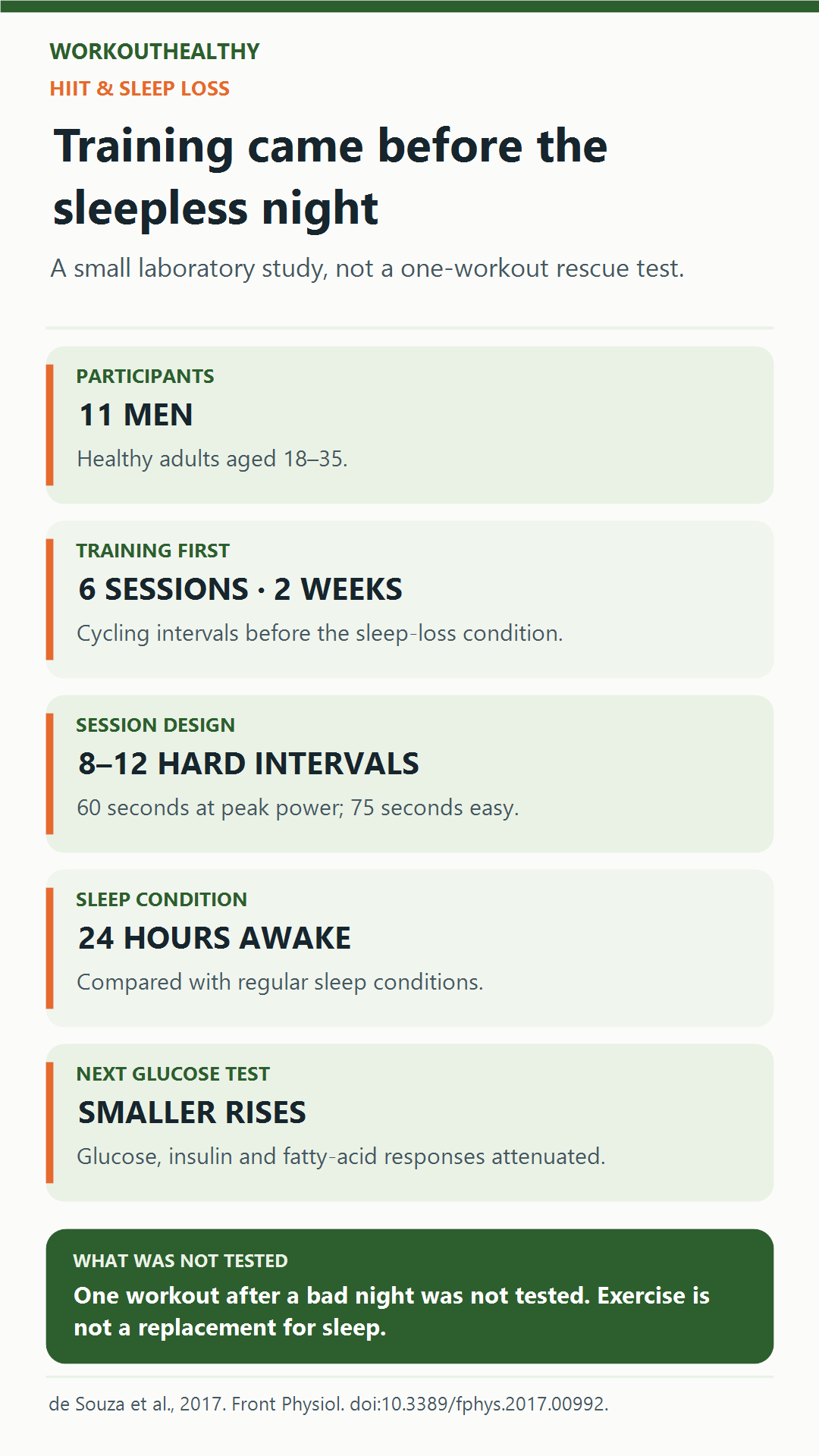
A 2017 study in Frontiers in Physiology put 11 healthy young men through a night of total sleep deprivation and measured how their bodies handled blood sugar the next morning (de Souza et al., 2017).
Sleep deprivation alone made their bodies noticeably less sensitive to insulin, the usual sign of blood sugar trouble.
But when the same men had completed two weeks of high intensity interval training right before that sleepless night, the rise in blood sugar, insulin, and free fatty acids the next morning was significantly smaller compared to sleep deprivation with no recent training at all.
The reason likely comes down to how muscles get sugar out of the bloodstream.
Hard exercise lets your muscles pull glucose in through a pathway that doesn’t depend on insulin, which sidesteps the exact system that a bad night’s sleep disrupts.
A hard workout can’t replace a good night’s sleep. But it can pull sugar out of your blood through a door that insulin resistance doesn’t block.
The Mechanism: How Muscle Contraction Moves Sugar Without Insulin
The reason hard exercise can blunt insulin resistance comes down to how muscle cells actually pull sugar out of the blood.
A detailed review in Nature Reviews Endocrinology laid out how exercise triggers glucose uptake through a pathway separate from the one insulin normally uses (Sylow, Kleinert, Richter, & Jensen, 2017).
Normally, insulin binds to a receptor on the muscle cell, which sets off a chain of signals that moves a glucose transporter called GLUT4 to the cell’s surface so sugar can get inside.
Sleep deprivation is thought to interfere with steps in that chain, which is part of why a sleepless night can leave cells responding poorly to insulin.
Muscle contraction opens a second, largely separate route to that same GLUT4 transporter.
Repeated hard effort activates a fuel sensing enzyme called AMPK, along with a mechanical stress pathway, and both can move GLUT4 to the cell surface without needing insulin’s signal to work properly at all.
This is why the timing lines up so well with the sleep research.
The workout doesn’t need the insulin pathway to be working normally, because it doesn’t rely on it.
It gives muscle a way to clear sugar from the blood even on a morning when insulin signaling isn’t doing its job the way it should.
Why This Matters More Over Months Than One Night
A single sleepless night is one thing, but the real world risk shift workers and people with insomnia face is a chronic one.
A large systematic review and meta-analysis in Diabetes Care pooled multiple long term studies tracking sleep habits and the later development of type 2 diabetes (Cappuccio, D’Elia, Strazzullo, & Miller, 2010).
People who regularly slept 5 to 6 hours a night or less had about a 28 percent higher relative risk of developing type 2 diabetes over time compared with people sleeping a more typical amount.
Poor sleep quality carried its own added risk, separate from how many hours a person actually slept.
This is the backdrop that makes the HIIT finding practically useful.
A single workout after one bad night will not undo years of accumulated risk from chronic short sleep.
But for someone who cannot fix their sleep schedule right away, having a tool that blunts the damage on the worst nights is still meaningfully better than doing nothing at all.
Who This Matters Most For
Shift workers, nurses, new parents, and anyone with chronic insomnia lose sleep for reasons they often cannot simply fix.
For this group, a short bout of hard exercise is a form of damage control, not a replacement for rest.
It doesn’t undo years of broken sleep, but it gives the body a real tool to fight back on the nights sleep doesn’t come.
What This Study Does Not Show
It helps to be precise about what the 2017 study actually tested.
Eleven healthy men between 18 and 35 years old took part, all of them regular sleepers with no history of heart disease, diabetes, or sleep disorders to begin with.
The exercise portion was not a single workout squeezed in after a bad night.
Participants completed six HIIT sessions over two weeks, and the night of total sleep deprivation came immediately after that training block ended, with blood sugar testing the following morning.
That detail matters.
This study shows that having recently trained with HIIT can blunt the blood sugar disruption from a sleepless night that follows.
It does not directly test whether a single HIIT session performed the morning after a bad night, with no recent training behind it, produces the same protection.
The study also measured insulin sensitivity using an oral glucose tolerance test rather than a more direct laboratory method, and the small, all male sample means the results may not automatically extend to women, older adults, or people who already have blood sugar problems.
The workout doesn’t fix the sleep. It opens a side door for sugar to leave the blood, on exactly the morning when the front door isn’t working right.
Common Mistakes People Make
One common mistake is treating a hard HIIT session as a substitute for sleep itself, rather than as backup for the mornings sleep doesn’t happen.
Exercise can blunt some of the blood sugar damage, but it does not restore the other things sleep does for the brain and body.

Another mistake is going all out on intervals with no base fitness or warm up, especially while already sleep deprived.
Reaction time, coordination, and pain perception are all worse after a sleepless night, which raises the odds of a strain, a fall, or poor form during a maximal effort interval.
Skipping fuel and fluids compounds the problem.
Sleep deprivation alone can affect blood pressure regulation, and pairing that with a hard workout on an empty stomach and low fluid intake raises the risk of feeling lightheaded or faint during the session.
A final mistake is scheduling this kind of workout right before an attempt to sleep.
Vigorous exercise close to bedtime can raise heart rate and body temperature enough to delay falling asleep for some people, which defeats the purpose on a night when sleep is finally possible.
Who Should Check With a Doctor First
Anyone with a heart condition, high blood pressure that isn’t well controlled, or a history of chest pain during exertion should talk to a doctor before trying high intensity intervals, sleep deprived or not.
People on medications that affect heart rate or blood pressure, including some blood pressure medications and stimulants, should also check first, since these can change how the body responds to sudden hard effort.
Pregnant women, people with diagnosed diabetes who already manage their blood sugar with medication, and anyone new to structured exercise should start with lower intensity intervals and build up gradually rather than jumping straight into an all out protocol.
If a sleepless night already comes with dizziness, a pounding heartbeat at rest, or trouble with balance, that’s a sign to skip the intense version entirely for that day and choose a walk or light movement instead.
How to Fit It In
The exercise style studied here doesn’t require a gym.
A short warm up followed by several rounds of near maximal effort for 20 to 30 seconds, with rest in between, is enough to trigger this response, and the whole session can fit in 15 to 20 minutes.
A More Detailed, Step by Step Protocol
The training protocol researchers used built up gradually over two weeks: 8 rounds of 60 second maximal effort cycling in the first two sessions, 10 rounds in the next two, and 12 rounds in the final two sessions, with 75 seconds of easy pedaling between each round.
A simplified version of that structure works with almost any cardio equipment or bodyweight movement, not just a stationary bike.
Cycling, rowing, running in place, or fast step ups on a sturdy stair all work, as long as the hard interval is genuinely difficult to sustain.
Start with a 5 minute easy warm up that gradually raises breathing rate and loosens the joints.
Jumping straight into a maximal interval without this raises injury risk, especially on a sleep deprived morning when coordination is already a little off.
For the work intervals, aim for an effort that feels like an 8 or 9 out of 10, hard enough that talking is not possible, but controlled enough that form doesn’t fall apart.
Begin with 6 to 8 rounds of 20 to 30 seconds if this style of training is new, then build toward 8 to 12 rounds of 30 to 60 seconds over a couple of weeks, similar to the structure the study used.
Recovery between rounds should be active, not a complete stop.
Slow pedaling, an easy walk, or light marching in place for 60 to 75 seconds lets heart rate come down partway without cutting off the body’s fuel use completely.
A good sign the session is dosed correctly is that heart rate visibly drops during each recovery period, and by the final round, effort still feels hard but form hasn’t broken down.
If heart rate stays pinned near maximum through the rest periods, or technique falls apart by round 4 or 5, that’s a sign to shorten the work intervals or lengthen the rest until conditioning catches up.
Finish with 3 to 5 minutes of easy movement to bring heart rate down gradually, rather than stopping abruptly.
The entire session, warm up included, fits inside 20 minutes for most people once the higher round counts are reached.
For more on sleep and recovery, see our article on how late is too late for caffeine before bed, our piece on what daily step counts show about mortality risk, and our look at what the research says about sauna use and heart health.
Watch the Original Video
Get the next evidence check. Subscribe to WorkoutHealthy Insider for practical explanations behind popular fitness claims.
References
Cappuccio, F. P., D’Elia, L., Strazzullo, P., & Miller, M. A. (2010). Quantity and quality of sleep and incidence of type 2 diabetes: A systematic review and meta-analysis. Diabetes Care, 33(2), 414 to 420. https://doi.org/10.2337/dc09-1124
de Souza, J. F. T., Dáttilo, M., de Mello, M. T., Tufik, S., & Antunes, H. K. M. (2017). High-intensity interval training attenuates insulin resistance induced by sleep deprivation in healthy males. Frontiers in Physiology, 8, Article 992. https://doi.org/10.3389/fphys.2017.00992
Sylow, L., Kleinert, M., Richter, E. A., & Jensen, T. E. (2017). Exercise-stimulated glucose uptake—regulation and implications for glycaemic control. Nature Reviews Endocrinology, 13(3), 133 to 148. https://doi.org/10.1038/nrendo.2016.162
This article is for general information only and is not medical advice. If you have an injury, ongoing pain, or a medical condition, talk to a doctor or physical therapist before you change how you train or eat.