
Hip thrusts can build strength, but a heavier hip thrust does not guarantee a faster sprint. The research suggests a possible small sprint benefit, with considerable uncertainty about how much comes from the lift itself.
One eight-week trial found a large hip-thrust strength gain without a detectable sprint improvement. A 2026 review found a small average sprint benefit across several studies, which became smaller when programs combining hip thrusts with other exercises were removed (Jarvis et al., 2019; Lin et al., 2026).
If speed is your goal, the useful question is whether your running improves alongside your lifting. Here is how to read those apparently conflicting results and judge what they mean for your training.
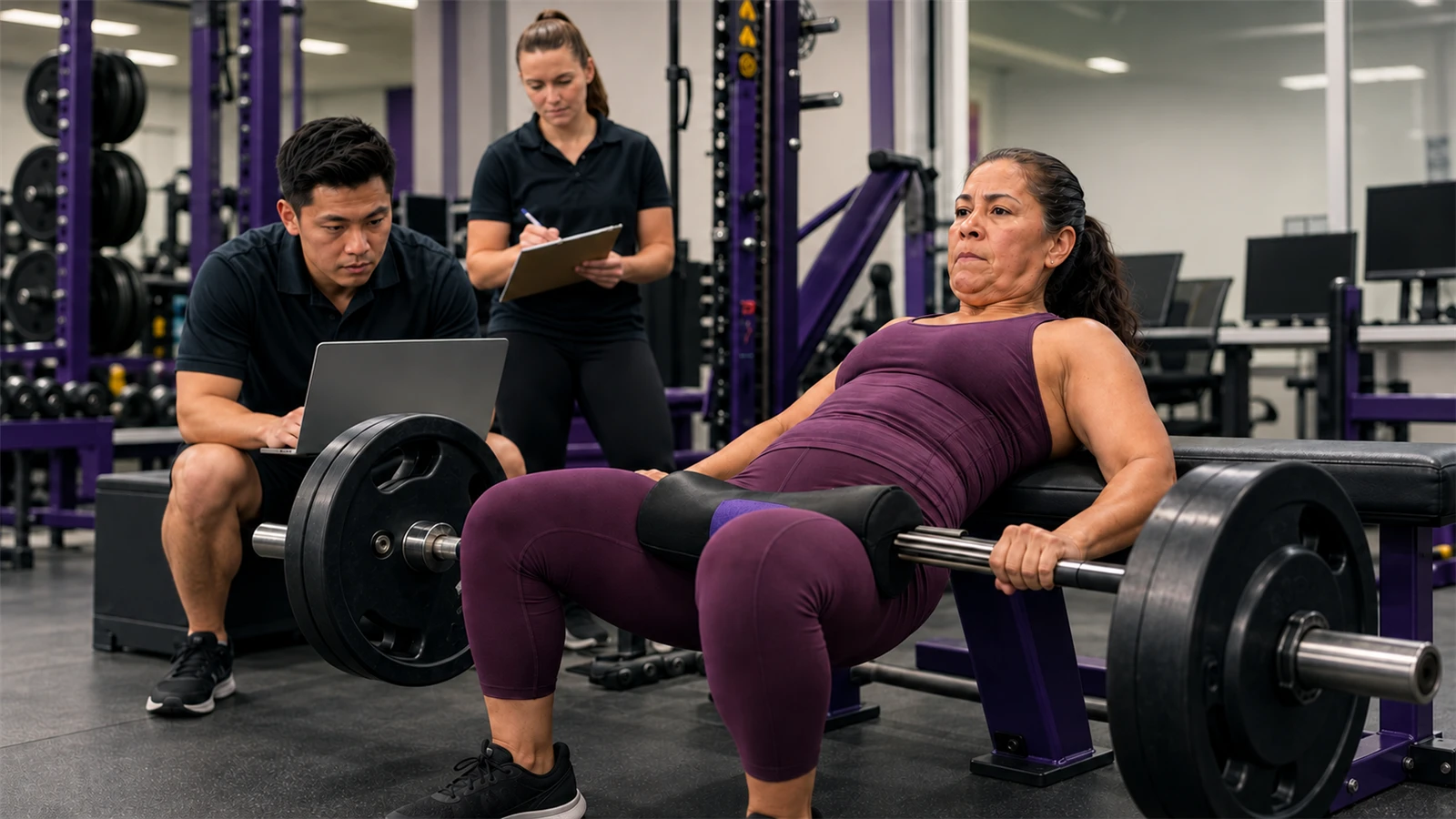
Image context: The featured image illustrates a gym testing scene; it is not a photograph of the study participants.
Hip Thrusts and Sprint Speed: Compare the Actual Tests
Studies can disagree because they test different athletes, training plans and sprint distances. Start with the comparison rather than treating every result as the same experiment.
| Source and population | What was compared | Sprint measurement | What it supports |
|---|---|---|---|
| Jarvis et al. (2019): 21 collegiate athletes, including 15 men and six women | Eight weeks of heavy barbell hip-thrust training versus a control group | 40 meters and each 10-meter segment | Hip-thrust strength increased, but the researchers did not detect a significant sprint improvement under this protocol. |
| Contreras et al. (2017): adolescent males | Six weeks of hip-thrust training versus front-squat training | 10 meters and 20 meters | Effect estimates suggested a possible advantage for hip thrusts over that active comparator; this was not a comparison with doing no strength training. |
| Lin et al. (2026): systematic review of healthy participants with varied training backgrounds | Multiple hip-thrust protocols and control conditions | Several short sprint tests; acute and longer-term outcomes analyzed separately | The longer-term sprint estimate was small and reduced further when combined training programs were excluded; evidence certainty was low to very low. |
The review included 22 eligible studies, with 20 contributing to its quantitative analyses across several outcomes. Its longer-term sprint analysis used nine studies involving 192 participants, not 20 separate sprint trials (Lin et al., 2026).
Also keep the units straight: a 40-meter sprint is not a 40-yard dash. An improvement over 10 meters does not establish an improvement over an entire race or a different distance.
What Happened in the Eight-Week Trial?
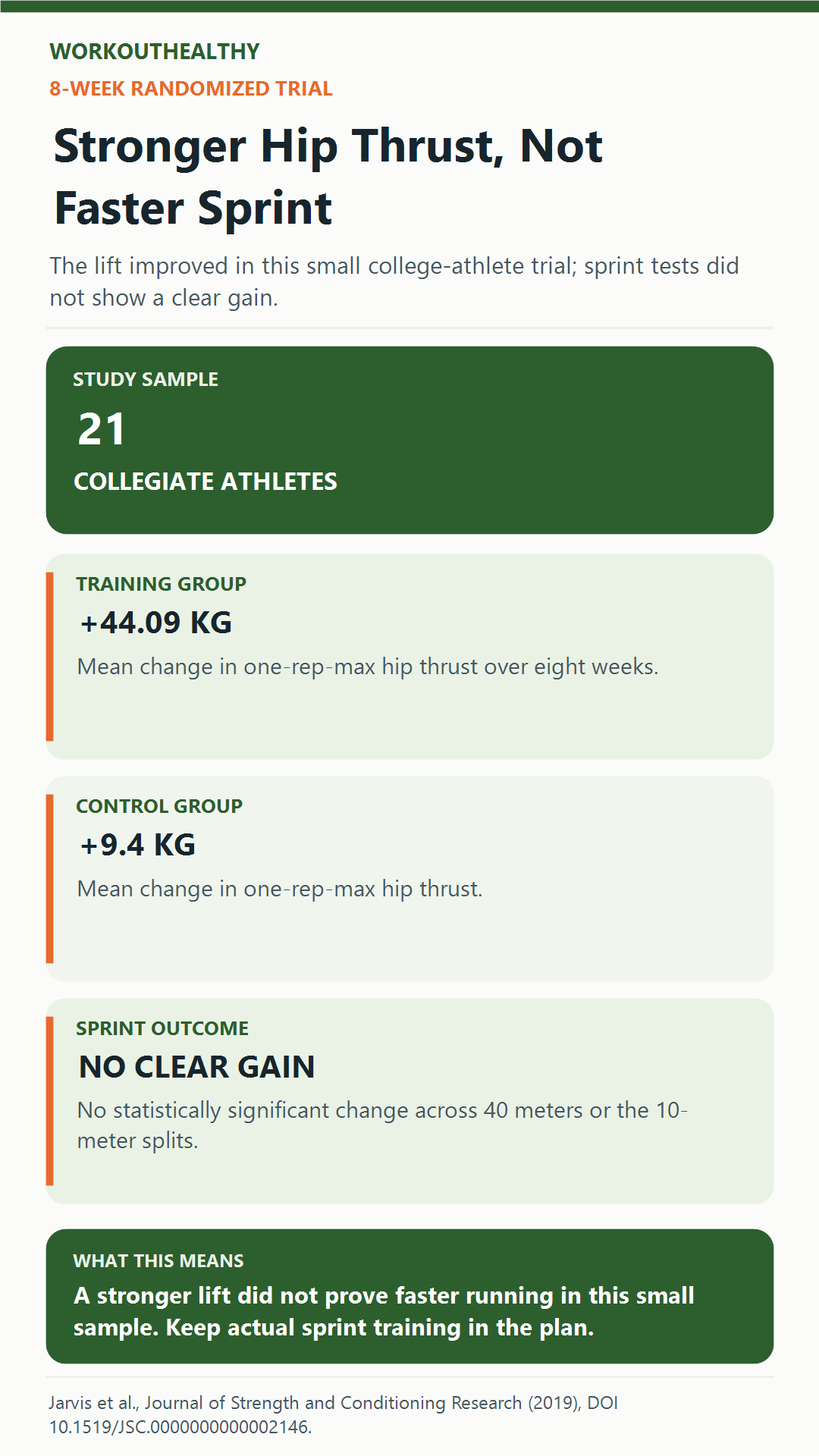
Jarvis and colleagues assigned 11 athletes to hip-thrust training and 10 to a control group. Before and after the intervention, the researchers measured hip-thrust one-repetition maximum, 40-meter sprint time and the four 10-meter segments of that sprint (Jarvis et al., 2019).
The training group’s mean increase in hip-thrust maximum was 44.09 kilograms, compared with 9.4 kilograms in controls. These are average changes in lifting performance, not the amount every athlete gained.
The investigators did not detect statistically significant improvements in the full sprint or its 10-meter segments. That is useful evidence against assuming that a large increase in this lift must carry over to faster running.
It does not establish that the true effect is exactly zero for every athlete. A small sample followed for eight weeks cannot settle every population, training duration or way of combining lifting with sprint practice.
Why the 2026 Review Gives Two Sprint Estimates
The newer synthesis helps explain why one trial should not become a universal verdict. Its main longer-term sprint analysis pooled 24 comparisons from nine studies and found a small effect favoring hip-thrust interventions (Lin et al., 2026).
Some interventions also included other exercises or performance drills. When the authors excluded combined programs, the estimated sprint effect fell from 0.31 to 0.22 and was reported as borderline significant at p = 0.05.
| Analysis in Lin et al. (2026) | Reported result | Interpretation boundary |
|---|---|---|
| Longer-term sprint analysis, including combined programs | Hedges’ g = 0.31; 95% confidence interval 0.12 to 0.51 | A small pooled advantage; the whole result cannot be assigned to hip thrusts alone. |
| Longer-term sprint analysis after excluding combined programs | Hedges’ g = 0.22; p = 0.05 | A smaller, borderline result; the independent benefit remains uncertain. |
| Immediate sprint performance after a conditioning activity | Hedges’ g = 0.55; 95% confidence interval 0.31 to 0.78 | A different question about a short-term response within a session, not lasting speed development. |
Hedges’ g is a standardized effect size. A value of 0.31 does not mean a 31% improvement, 0.31 seconds saved or a particular change in your sprint time.
The separate comparisons also do not represent 24 independent groups of athletes. Studies can contribute more than one distance or comparison, so the number of comparisons should not be confused with the number of studies.
The review’s certainty ratings were low to very low, with concerns about bias, small samples and measurement reliability. Its sensitivity analysis narrows what can be attributed to hip thrusts, but it does not reveal an exact benefit for a particular athlete.
Nor can separate meta-analyses of different exercises establish which lift is best for you. Differences in participants, comparators and testing make simple rankings of effect sizes misleading.
Why the Adolescent Front-Squat Study Matters
The six-week adolescent study asked whether hip-thrust training produced different outcomes from front-squat training. Its magnitude-based estimates suggested potentially beneficial 10-meter and 20-meter effects favoring hip thrusts (Contreras et al., 2017).
That result belongs alongside the Jarvis trial, with its population and comparator visible. It does not show that hip thrusts outperform every strength exercise, work equally well in adults or guarantee a faster time.
This is also why “the control group” needs a description. Comparing two strength programs answers a different question from comparing added hip-thrust training with a control condition.
For related exercise-selection questions, our squat-versus-hip-thrust evidence review separates findings about muscle and lifting performance from broader athletic claims.
A Stronger Lift and a Faster Sprint Are Different Outcomes
A lifting maximum measures performance in a particular exercise. Sprint times measure how quickly an athlete covers a distance under specified starting and timing conditions.
A muscle-activation result, a plausible force-direction explanation or a heavier training load does not substitute for a timed sprint outcome. Those observations can motivate research without proving that a training program improves running.
The practical implication is to give each result its own place in the training record. An athlete can improve the lift without improving the sprint, improve both, or improve neither during a particular block.
The 2026 review also separated immediate conditioning responses from weeks of training. Its acute sprint results varied substantially between studies, so a pooled positive result is not a reason to add unfamiliar heavy lifting immediately before a race (Lin et al., 2026).
Use a Training Record That Keeps the Two Results Separate
If you already train and measure sprint performance, use the record below to discuss an existing training block. This is an editorial tracking tool, not a new sprint workout, a maximal-lift testing prescription or a validated test of cause and effect.
| Record | What to write down | Why it helps |
|---|---|---|
| Actual performance target | Exact sprint distance, units and whether the start is standing, flying or another established format | Keeps a 10-meter acceleration test separate from a 40-yard dash or another task. |
| Sprint measurement | Times from the same established procedure, including timing equipment and how the recorded result is selected | A hand-timed result and an electronic result are not interchangeable. |
| Testing context | Surface, footwear, wind where relevant, warm-up and recent training fatigue | A different context can help explain a changed time without implying a new training effect. |
| Hip-thrust performance | The programmed load, repetitions and consistent exercise setup from your current sessions | Shows progress in the lift without requiring an extra one-repetition-maximum test. |
| Other training changes | Sprint practice, other strength exercises, overall workload and missed sessions | Prevents assigning the whole outcome to one exercise in a combined program. |
Interpret patterns over repeated comparable observations rather than treating one personal best as proof. The review noted that test-retest reliability was often missing from the underlying studies, so there is no universal tiny time change that this evidence proves meaningful.
If the lift improves while sprint times remain unchanged, you have evidence of lifting progress during that block. If both improve, you still cannot isolate the hip thrust’s contribution when several parts of training changed together.
For a separate look at organizing running sessions, see our sprint-workout guide. Keep any session’s purpose and demands distinct from the question of whether a particular lift transfers to speed.
Should You Keep Hip Thrusts in a Speed Program?
A hip thrust can have a clear strength-training purpose without carrying a promise about sprint times. The available studies support treating it as one possible component of training, while measuring the running outcome that matters to you.
The Jarvis trial shows why a large strength increase is insufficient proof of sprint improvement. The broader review leaves room for a small benefit, while showing how much the interpretation depends on combined training and uncertain evidence.
Choose the exercise for a stated purpose, keep the relevant performance measure visible and review the whole program when progress stalls. A higher hip-thrust number can be a worthwhile result; a speed claim still needs running evidence.
Subscribe to WorkoutHealthy Insider for more clear explanations of training research.
References
Contreras, B., Vigotsky, A. D., Schoenfeld, B. J., Beardsley, C., McMaster, D. T., Reyneke, J. H. T., & Cronin, J. B. (2017). Effects of a six-week hip thrust vs. front squat resistance training program on performance in adolescent males: A randomized controlled trial. Journal of Strength and Conditioning Research, 31(4), 999 to 1008. https://pubmed.ncbi.nlm.nih.gov/27253835/
Jarvis, P., Cassone, N., Turner, A., Chavda, S., Edwards, M., & Bishop, C. (2019). Heavy barbell hip thrusts do not effect sprint performance: An 8-week randomized controlled study. Journal of Strength and Conditioning Research, 33(7S), S78 to S84. https://doi.org/10.1519/JSC.0000000000002146
Lin, S., Cheng, M., Yi, X., Li, Y., & Liu, R. (2026). Acute and long-term effects of hip thrust training on athletic performance: A systematic review and meta-analysis. PeerJ, 14, e20785. https://doi.org/10.7717/peerj.20785
Medical disclaimer: This article is general fitness information, not medical advice. If you have an injury, ongoing pain or a medical condition, talk to a doctor or physical therapist before changing how you train.