
François Arnaud has been a working actor since 2007, long before Heated Rivalry made hockey training part of his job.
He is a French Canadian actor from Montreal, trained at the Conservatoire d’art dramatique de Montreal.
His breakout English language role came on Showtime’s The Borgias, where he played Cesare Borgia from 2011 to 2013.
He later starred in NBC’s Midnight, Texas and appeared in Blindspot and Schitt’s Creek.
In Heated Rivalry, Arnaud plays Scott Hunter, an American ice hockey player and captain of the fictional New York Admirals.
The role, alongside co-stars Hudson Williams and Connor Storrie, required more than acting range.
It required Arnaud to look and move like an athlete built for one of the most physically demanding sports in professional competition.
Heated Rivalry premiered on Crave in Canada in November 2025, with a simultaneous release on HBO Max internationally.
The series follows two rival hockey players who secretly maintain a relationship while playing for competing teams, and it received widespread critical acclaim after release.
It became the most watched original series in Crave’s history, a rare crossover success for a sports drama built around three separate athletic lead roles.
Arnaud came out as bisexual in 2020, and his role in a series built around a same sex hockey relationship added a layer of personal significance to the project beyond the physical training it required.
An Actor Who Trained Like the Athletes He Was Playing
Arnaud did not just study his character’s dialogue and backstory.
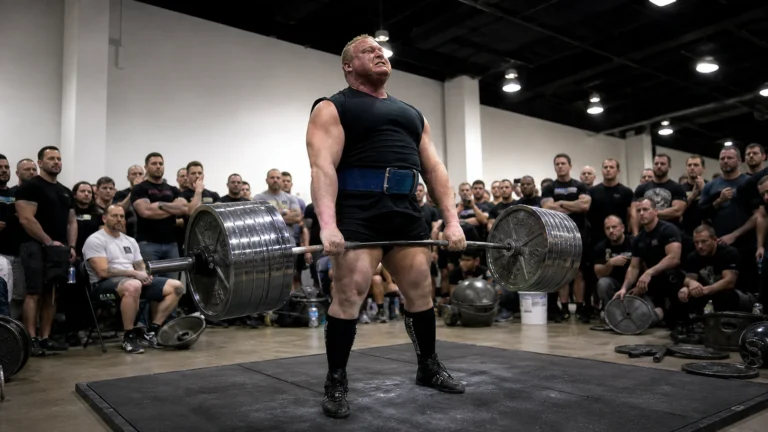
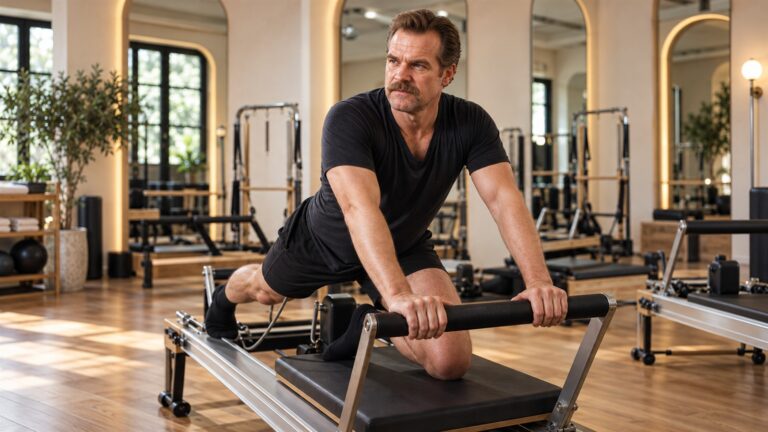
He has said he trained for the physical demands of the role, building a routine designed around the explosive strength and skating specific power that ice hockey requires.
His full body workout leaned on compound lifts and conditioning work rather than isolated, appearance focused exercises.
Publicly available detail on the exact program Arnaud followed is limited, since his fitness routine was covered mainly through general entertainment reporting rather than a detailed training log.
This article treats the described approach, compound lifts and conditioning built around hockey specific movement, as the verified core of what he trained for.
Why That Training Approach Makes Sense for Hockey
Ice hockey rewards a specific combination of physical qualities that few other sports demand at the same time.
Players need total body power for shooting and checking, quick direction changes for skating, and a strong lower body base for balance on ice.
Building a screen ready physique and building genuine athletic performance for hockey end up requiring a lot of the same underlying work.
Training for a role convincingly usually means training the way the real athletes do.
That overlap is part of why Arnaud’s approach, built around compound movements instead of isolated vanity lifts, tracks so closely with how real hockey players actually train off the ice.
It is also a useful lesson for anyone chasing an athletic look without a specific sport in mind.
Training the way a real athlete trains tends to build a more functional, capable body than training purely for appearance.
What the Research Says About Hockey Specific Training
A 2007 study published in the Journal of Strength and Conditioning Research looked directly at what predicts skating performance in competitive hockey players.
Researchers Chris Farlinger, Darren Kruisselbrink, and Jonathon Fowles led the study.
They found that off ice measures of leg power and strength, including vertical jump and certain sprint tests, correlated closely with on ice skating speed and acceleration.
That finding supports building explosive lower body strength in the gym as a legitimate way to improve how a player, or an actor playing one, actually moves on the ice, the same explosive quality examined in this piece on whether box jumps can build muscle.
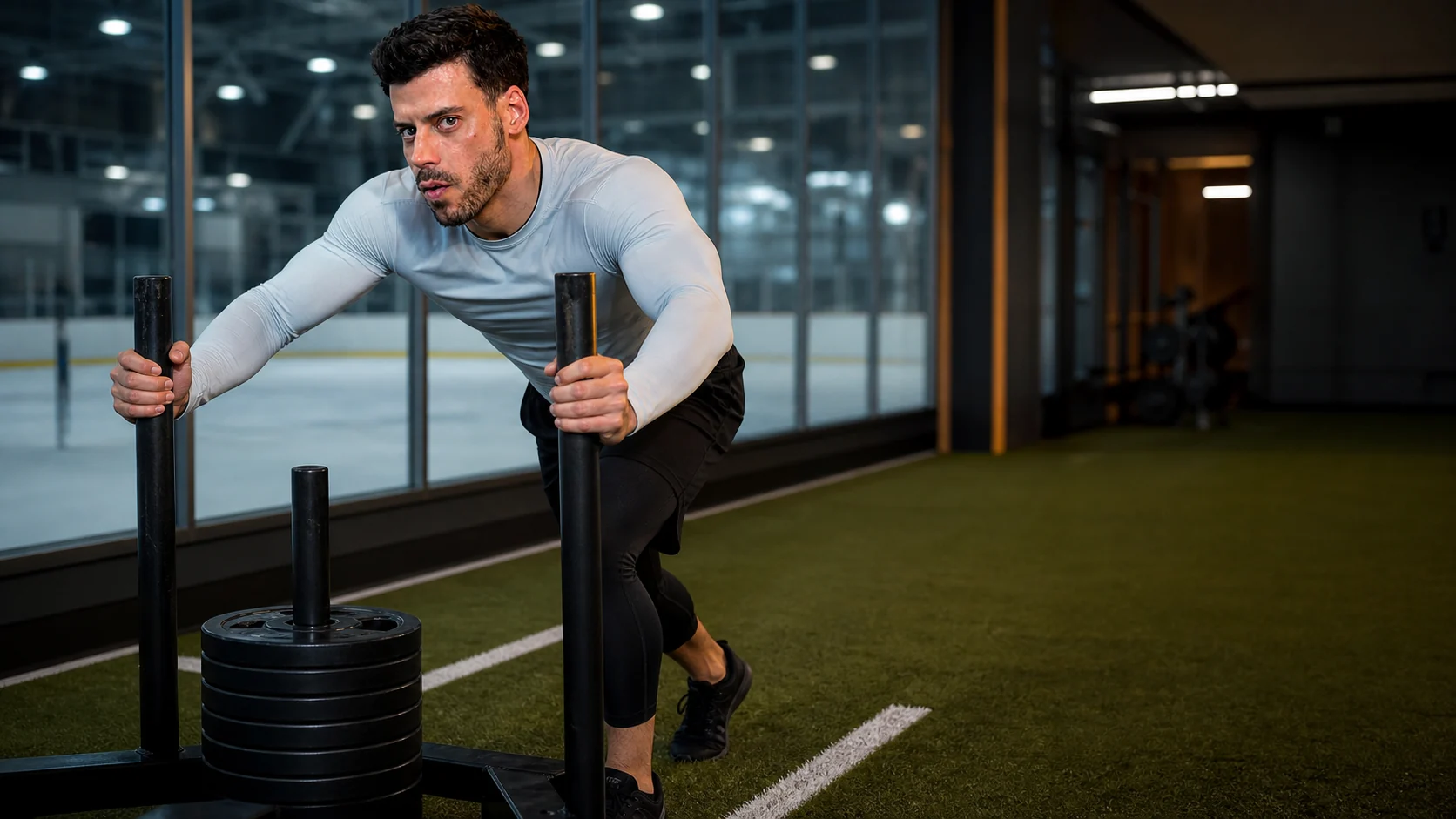
Sled and resisted sprint work, a common tool in hockey specific conditioning, also has research support.
A 2016 systematic review in Sports Medicine examined resisted sled sprint training across many studies.
Researchers George Petrakos, Jean-Benoit Morin, and Brendan Egan led that review.
They found that resisted sprint training, done with an appropriate load, can improve both acceleration and top end sprint speed.
The review noted that lighter loads tend to preserve normal sprint mechanics better than very heavy sled loads, which is a useful detail for anyone building a similar conditioning routine.
Together, these two studies help explain why a routine built around explosive lower body work and resisted conditioning, rather than slow isolated lifts, produces the kind of athletic look and function that a hockey role demands.
What This Research Does Not Prove
Neither study followed Arnaud personally, and neither one is about acting preparation specifically.
The skating performance study measured a group of competitive hockey players, not actors learning to portray one.
It does not prove that off ice training alone can fully substitute for years of real on ice skating experience.
Skating technique itself, edge control, balance, and stride mechanics, comes primarily from time actually spent on skates, not from the weight room.
The sled sprint review also comes with limits.
Most of the studies it included followed athletes over a matter of weeks, not the kind of multi year development real hockey players go through.
Applying findings from short research studies to a specific actor’s training block over a few months is a reasonable but imperfect comparison.
How This Compares to General Guidance
Strength and conditioning coaches who work with hockey players generally emphasize the same qualities Arnaud’s training reportedly targeted.
Programs built for hockey performance typically prioritize compound lower body lifts, explosive power work, and short duration high intensity conditioning over isolated single joint exercises.
That approach also transfers well to general fitness goals, since compound lifts recruit more total muscle mass and burn more calories per session than isolated exercises.
An actor preparing for an athletic role and an amateur athlete preparing for a real season can reasonably follow a similar general framework, even if the specific volume and intensity differ.
General public health guidance recommends at least 150 minutes of moderate aerobic activity a week, alongside two days of strength training that covers the major muscle groups.
A hockey inspired routine built around explosive lower body work and conditioning can satisfy both parts of that guidance at once, since the intervals themselves raise heart rate while the lifts build strength.
Common Mistakes People Make Training for Athletic Performance
One common mistake is training only for how a physique looks rather than how it actually performs.
Isolated exercises can build visible muscle without building the explosive power that sports like hockey actually require.
Another mistake is skipping sport specific conditioning in favor of generic cardio.
Hockey and similar sports involve short, repeated bursts of effort, not steady state endurance, so training should reflect that pattern.
Many people also add resisted sprint work, like sled pushes, with too much weight too soon.
Research shows that overly heavy sled loads can distort normal running mechanics instead of improving them.
Neglecting mobility and recovery is another frequent gap in athletic training programs.
Explosive lower body work places real stress on the hips, knees, and ankles, and skipping recovery raises injury risk over time.
Finally, some people jump straight into high intensity training without building a base level of general strength first.
A foundation of basic strength makes explosive and conditioning work both safer and more effective.
Jumping into sprint work or heavy sled pushes without that foundation raises the risk of a strain or a tweaked joint, especially for anyone new to explosive training.
A slower, staged buildup produces better long term results than rushing toward an intense program before the body is ready for it.

How to Build an Athletic, Hockey Inspired Routine
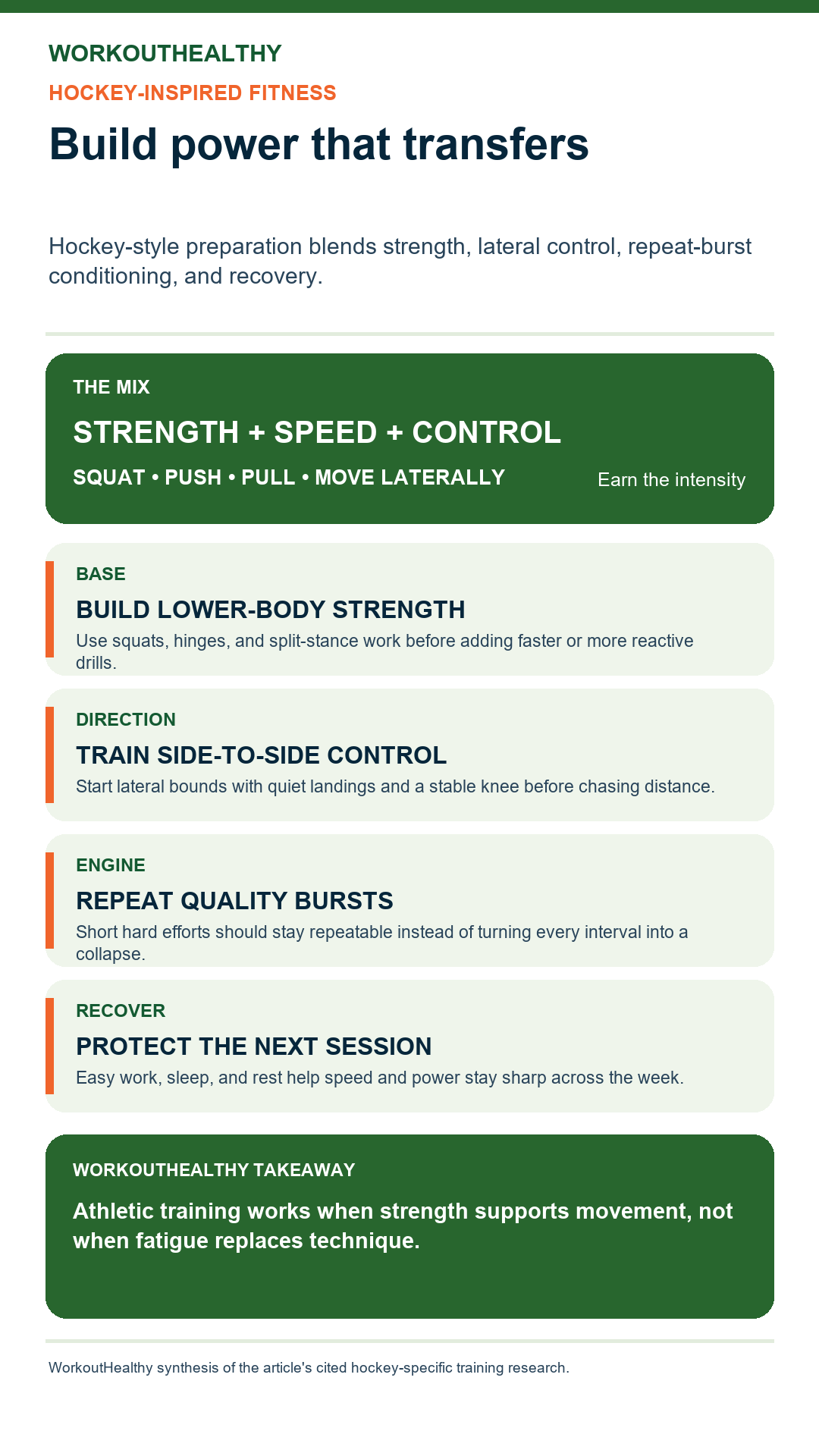
Start with two sessions a week built around compound lower body lifts, such as squats, deadlifts, and lunges.
These movements build the foundational strength that explosive power work depends on.
Add one or two sessions focused on explosive power, including jump variations and short sprint work.
Keep these sessions short and high quality rather than long and exhausting.
Introduce sled pushes or resisted sprints once basic strength and sprint mechanics are solid.
Start with a light load that allows a normal running posture, then increase gradually.
Add upper body pushing and pulling work to round out the program, since hockey also demands checking and stick handling strength.
Two balanced upper body sessions a week is typically enough alongside the lower body focus.
Build in at least one full recovery day between the most demanding sessions.
Explosive training places real demands on the nervous system, not just the muscles, and both need time to recover.
Track performance markers like sprint times or jump height, not just weight lifted.
For athletic training, how fast and how explosively you move matters as much as how much you can lift.
If you are training for a specific sport, add real sport skill practice on top of the gym work.
Off ice strength training supports on ice performance, but it does not replace time spent actually skating, passing, or shooting.
Reassess your program every six to eight weeks and adjust based on how your speed, power, and conditioning are actually changing.
Timing a small dose of caffeine before a hard training session can also help, and this guide on caffeine before a workout explains how to time it well.
References
Farlinger, C. M., Kruisselbrink, L. D., & Fowles, J. R. (2007). Relationships to skating performance in competitive hockey players. Journal of Strength and Conditioning Research, 21(3), 915-922.
Petrakos, G., Morin, J. B., & Egan, B. (2016). Resisted sled sprint training to improve sprint performance: A systematic review. Sports Medicine, 46(3), 381-400.
This article is for general educational purposes only.
It is not personalized fitness or medical advice. Talk with a doctor or a qualified strength coach before starting a new athletic training program, especially one that includes sprinting or explosive jump work.