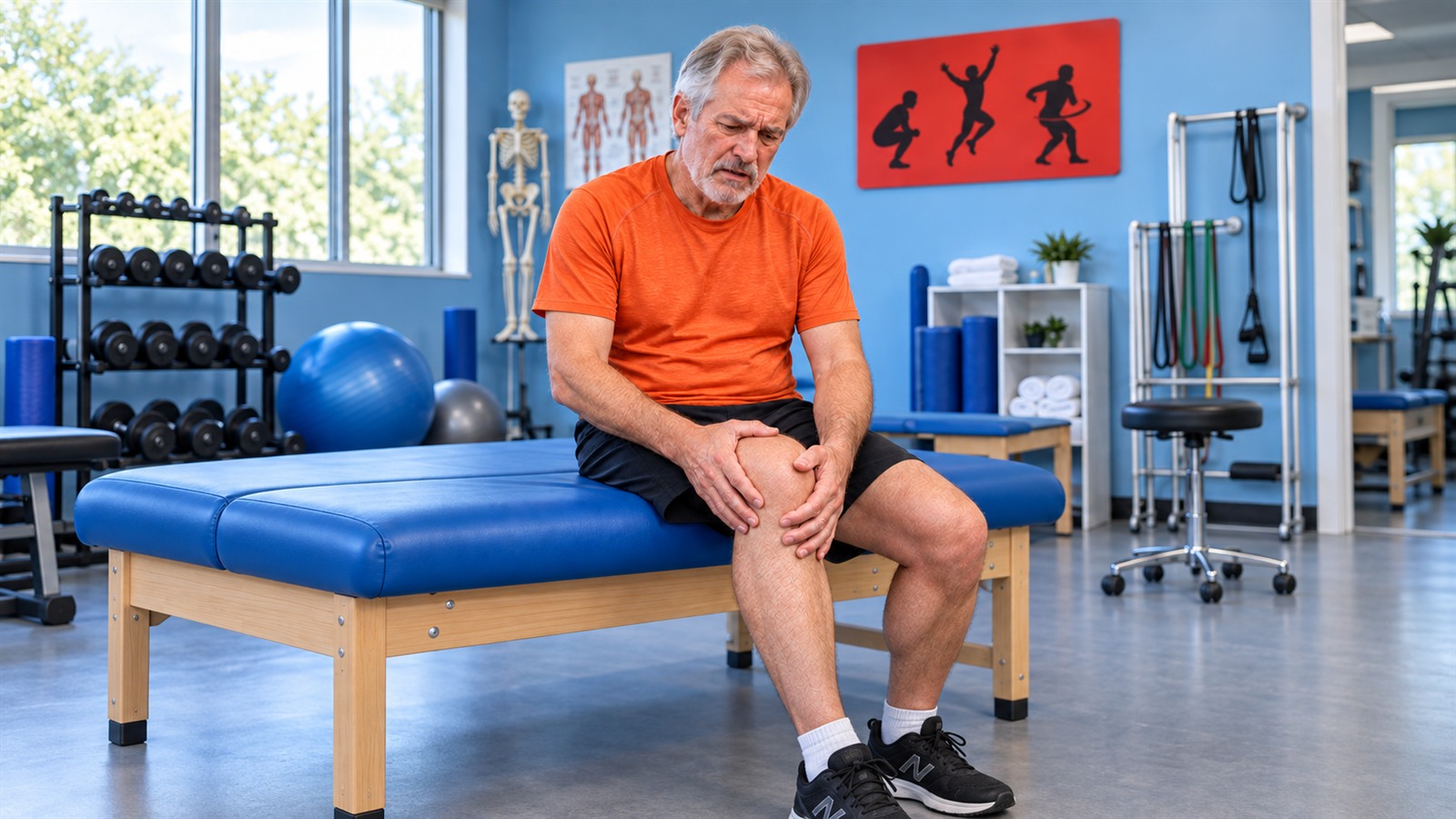

A physical therapy channel called El Paso Manual Physical Therapy posted a video with a blunt title.
It is called “If You Want to Avoid a Knee Replacement Don’t Do These Exercises.”
The message is simple.
Certain movements supposedly wear down your knees faster than others.
If that is true, avoiding those movements could help you keep your original knees longer.
But is it true?
Does research actually back up the idea that specific exercises push people toward a knee replacement?
That is the question this article tries to answer.
What the Video Claims and Why It Makes Sense on the Surface
The video does not lay out a full, citation by citation case for every claim it makes.
That is normal for a short video aimed at patients rather than researchers.
Its central idea still fits a common belief in physical therapy circles.
Movements that load the knee joint through a deep bend, especially under body weight or extra resistance, are often flagged as risky for people with existing knee wear.
Think deep squats, deep kneeling, or repeated jumping on hard surfaces.
The logic behind this warning is not far fetched.
Cartilage inside the knee absorbs more force as the joint bends deeper, especially when the foot is planted and body weight passes through a bent knee.
More force moving through cartilage that is already thin or damaged could plausibly speed up wear.
That reasoning deserves to be taken seriously, even though this article could not verify every exercise the video names one by one, since a full transcript was not available to check claim by claim.
What can be checked is the broader research on knee loading, high impact movement, and joint wear.
That is where the rest of this article focuses.
What the Research Actually Shows About Knee Loading
One of the more detailed studies on this topic looked directly at the squat.
Researchers measured the forces moving through the knee as people squatted to different depths carrying different amounts of weight.
They found that compressive force on the kneecap and shin bone rose sharply as the knee bent deeper, especially past ninety degrees.
In other words, a shallow squat and a very deep squat are not the same load on the joint, even with identical weight on the bar.
This was published in Medicine and Science in Sports and Exercise in 2001, and the full citation is listed in the references below.
This finding does not mean deep knee bending is dangerous for everyone.
It means the joint genuinely works harder the deeper it bends under load, which is exactly the mechanism the video’s warning seems to point at.
For someone with healthy cartilage, that extra load is usually just training stimulus.
For someone with worn cartilage or a bone on bone joint, the same load may cause pain or irritation sooner.
Impact exercise, like running or repeated jumping, is another category people fear.
A large review pooling data from multiple studies on runners found something that surprises a lot of people.
Recreational runners did not show a higher rate of knee osteoarthritis than non runners.
Competitive, high mileage runners showed rates similar to the general population as well.
The people with the highest rates of knee osteoarthritis in that review were those with a past knee injury, not those who logged the most miles.
That review was published in The American Journal of Sports Medicine in 2017 and is also listed in the references below.
That finding does not mean running is risk free for every knee.
It does mean that labeling all high impact movement as automatically bad for knees oversimplifies what the evidence actually shows.
Blaming “high impact” as a whole category misses the point. The real question is whether a specific joint can handle a specific load right now, not whether the movement belongs on a banned list.
Some research points to how a movement is done, not just what the movement is.
One widely cited biomechanics review focused on the hip’s role in controlling the knee during movement.
When the hip muscles are weak, the thigh bone tends to rotate and drop inward during landing, cutting, or single leg squatting.
This inward collapse is called dynamic knee valgus, and it shifts extra stress toward the inside of the knee and the kneecap.
This review was published in the Journal of Orthopaedic and Sports Physical Therapy in 2010, cited in full below.
This is a genuinely useful distinction.
A squat done with the knees caving inward is not the same load as the same squat done with the knees tracking over the toes.
The exercise on paper is identical.
The joint stress is not.
This supports one part of what physical therapy focused videos often get right. How you move usually matters more than a simple list of banned exercises.
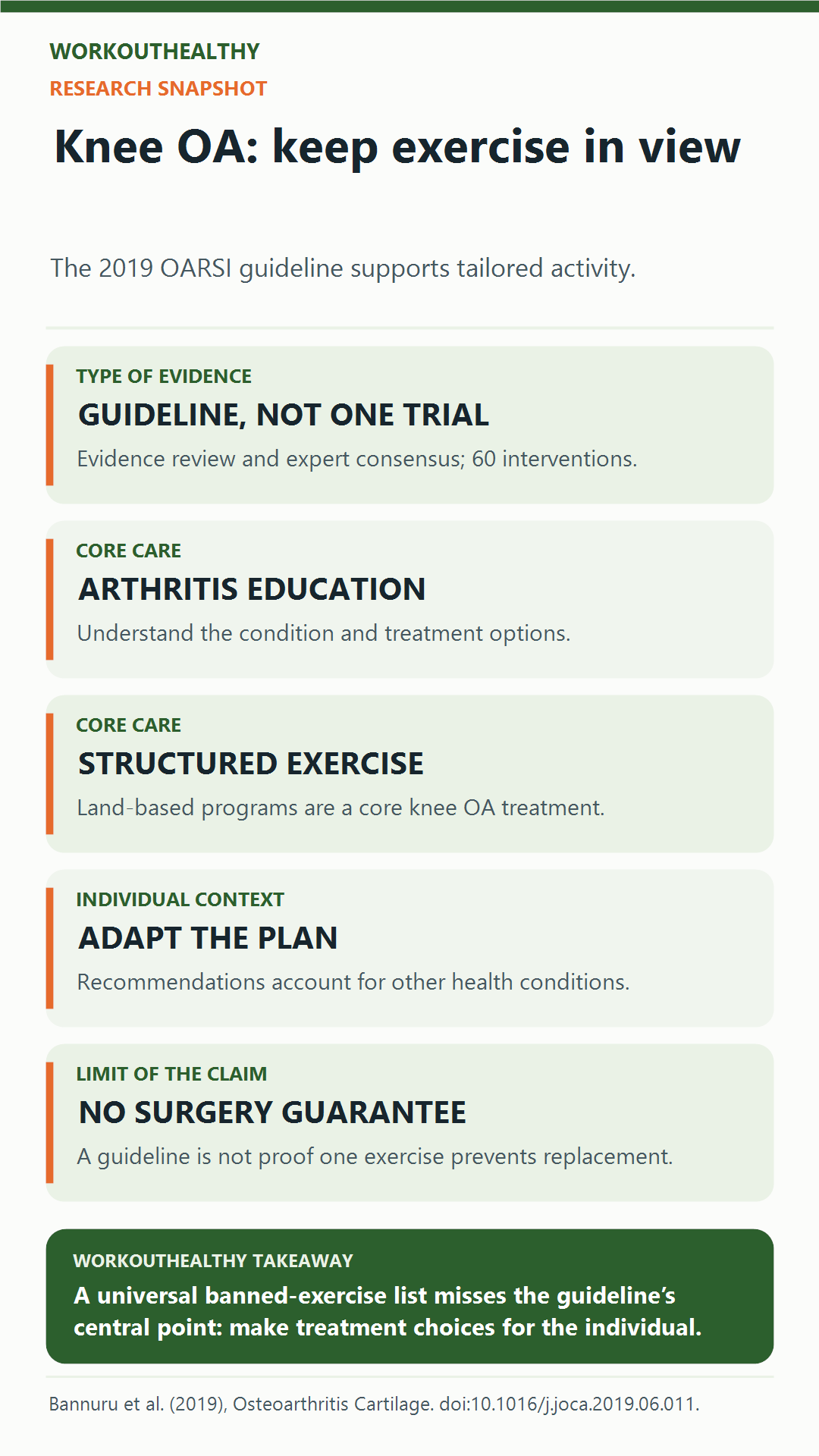
Major clinical guidelines support this same general idea.
An international group of researchers and clinicians published detailed guidelines for treating knee and hip osteoarthritis without surgery, listing exercise therapy and muscle strengthening as core, first line treatment rather than something to avoid.
Those guidelines were published in Osteoarthritis and Cartilage in 2019, and the full citation is listed below.
What This Evidence Does Not Prove
None of this proves that exercise choice alone decides who ends up needing a knee replacement.
Genetics, past injuries, body weight, occupation, and simple age all shape how a knee ages over time.
Two people can do the exact same workout for decades and end up with very different knees.
The studies above also measured groups of people, not individuals.
A group level finding, like “runners are not more likely to develop osteoarthritis,” does not guarantee that running is safe for any one specific knee, including yours.
If a knee already hurts during or after a specific movement, that pain is real information, whatever a study on a different population found.
Research can describe averages. It cannot examine your knee.
This is also part of why avoidance is not automatically the safer choice, which the next section covers in more detail.
Common Mistakes People Make When Trying to Protect Their Knees
The most common mistake is not doing one risky exercise too often.
It is doing almost nothing that bends the knee at all.
A knee that never has to bend under any real load loses strength in the muscles around it over time.
The quadriceps, hamstrings, and calf muscles all help absorb force and protect the joint during everyday movement, from walking to climbing stairs.
Weaker support muscles mean the joint itself has to absorb more of the force those muscles used to share.
A review of research on fear and avoidance in knee osteoarthritis found close to this exact pattern in patients.
People who avoided activity out of fear of pain or damage tended to become more disabled over time, not less.
That review was published in the Journal of Behavioral Medicine in 2014, listed in full in the references section.
Avoiding movement did not protect their knees. It often made function worse instead.
Protecting a joint by refusing to move it rarely works. Weak muscles around a joint tend to make that joint less protected, not more.
A second common mistake is treating every twinge of soreness as damage.
Muscles and tendons often feel sore after new or harder movement, and that soreness is not the same thing as joint injury.
A third mistake is chasing a single “bad exercise” list instead of paying attention to total training load.
Doing one deep lunge is very different from doing several hundred deep lunges in one workout with no rest days built in.
Volume and recovery matter as much as which specific exercise made the list.
Who Should Check With a Doctor or Physical Therapist First
Some people genuinely do need individual guidance before changing how they load their knees.
Anyone with diagnosed knee osteoarthritis should get a physical therapist’s input before starting new deep knee bending or high impact training.
The same goes for anyone recovering from a recent knee injury, a meniscus tear, or a ligament sprain.
People who have already had knee surgery, including a partial or full knee replacement, should follow their surgeon’s specific movement guidelines rather than a general video or blog article, including this one.
Recovery timelines and safe movement ranges vary by procedure and by surgeon.
Recovery after a joint replacement is highly individual, which is clear in how differently the process can unfold for different people, as shown in this breakdown of Misty Copeland’s hip replacement recovery.
People planning a future knee replacement should ask their surgeon which movements to modify beforehand, since strength before surgery often affects how recovery goes afterward.
Anyone who feels sharp pain, joint locking, or a knee that gives way during exercise should get that checked instead of pushing through it.
Safer Ways to Load Your Knees Without Guessing
Instead of memorizing a list of banned exercises, a more useful approach is adjusting range, load, and speed to match what your knee can currently handle.
A squat can be done to a comfortable depth instead of the deepest possible depth.
A lunge can be shortened. A jump can be replaced with a step.
Walking is one of the most underrated ways to load the knee joint safely and consistently.
It is lower impact than running or jumping, and it still asks the muscles around the knee to do real, repeated work, a point covered in more depth in this guide to how many miles you should walk in a day.
Stair climbing is also a useful, real world gauge of how your knees are handling daily load, not just something to avoid on principle.
That is part of why a simple stair climbing test can say so much about a person’s overall fitness and joint function.
Higher impact movements like jumping are not automatically off limits either.
The research on jump training points to how jumping is programmed, not whether it should be allowed at all.
Starting height, total volume, and landing technique all change how much force ultimately reaches the knee.
This idea is explored further in this look at whether box jumps actually build muscle, which digs into how the body absorbs force from jumping.
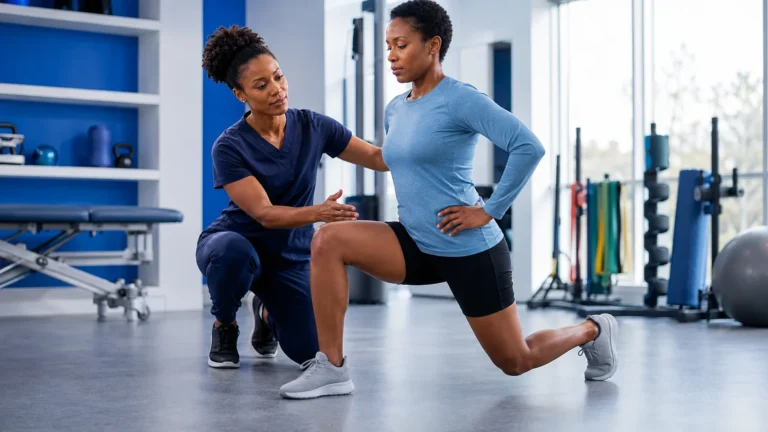
None of this replaces a real evaluation from a physical therapist who can watch how your specific knee moves.
But it is a more useful starting point than avoiding an entire category of movement based on a video title alone.
Watch the Original Video
Want more like this? Subscribe to WorkoutHealthy Insider for practical explanations behind popular fitness claims.
References
Escamilla, R. F. (2001). Knee biomechanics of the dynamic squat exercise. Medicine and Science in Sports and Exercise, 33(1), 127 to 141. https://doi.org/10.1097/00005768-200101000-00020
Timmins, K. A., Leech, R. D., Batt, M. E., & Edwards, K. L. (2017). Running and knee osteoarthritis: A systematic review and meta-analysis. The American Journal of Sports Medicine, 45(6), 1447 to 1457. https://doi.org/10.1177/0363546516657531
Powers, C. M. (2010). The influence of abnormal hip mechanics on knee injury: A biomechanical perspective. Journal of Orthopaedic & Sports Physical Therapy, 40(2), 42 to 51. https://doi.org/10.2519/jospt.2010.3337
Holla, J. F. M., Sanchez-Ramirez, D. C., van der Leeden, M., Ket, J. C. F., Roorda, L. D., Lems, W. F., Steultjens, M. P. M., & Dekker, J. (2014). The avoidance model in knee and hip osteoarthritis: A systematic review of the evidence. Journal of Behavioral Medicine, 37(6), 1226 to 1241. https://doi.org/10.1007/s10865-014-9571-8
Bannuru, R. R., Osani, M. C., Vaysbrot, E. E., Arden, N. K., Bennell, K., Bierma-Zeinstra, S. M. A., Kraus, V. B., Lohmander, L. S., Abbott, J. H., Bhandari, M., Blanco, F. J., Espinosa, R., Haugen, I. K., Lin, J., Mandl, L. A., Moilanen, E., Nakamura, N., Snyder-Mackler, L., Trojian, T., Underwood, M., & McAlindon, T. E. (2019). OARSI guidelines for the non-surgical management of knee, hip, and polyarticular osteoarthritis. Osteoarthritis and Cartilage, 27(11), 1578 to 1589. https://doi.org/10.1016/j.joca.2019.06.011
This article is for general information only and is not medical advice. If you have an injury, ongoing pain, or a medical condition, talk to a doctor or physical therapist before you change how you train or eat.