

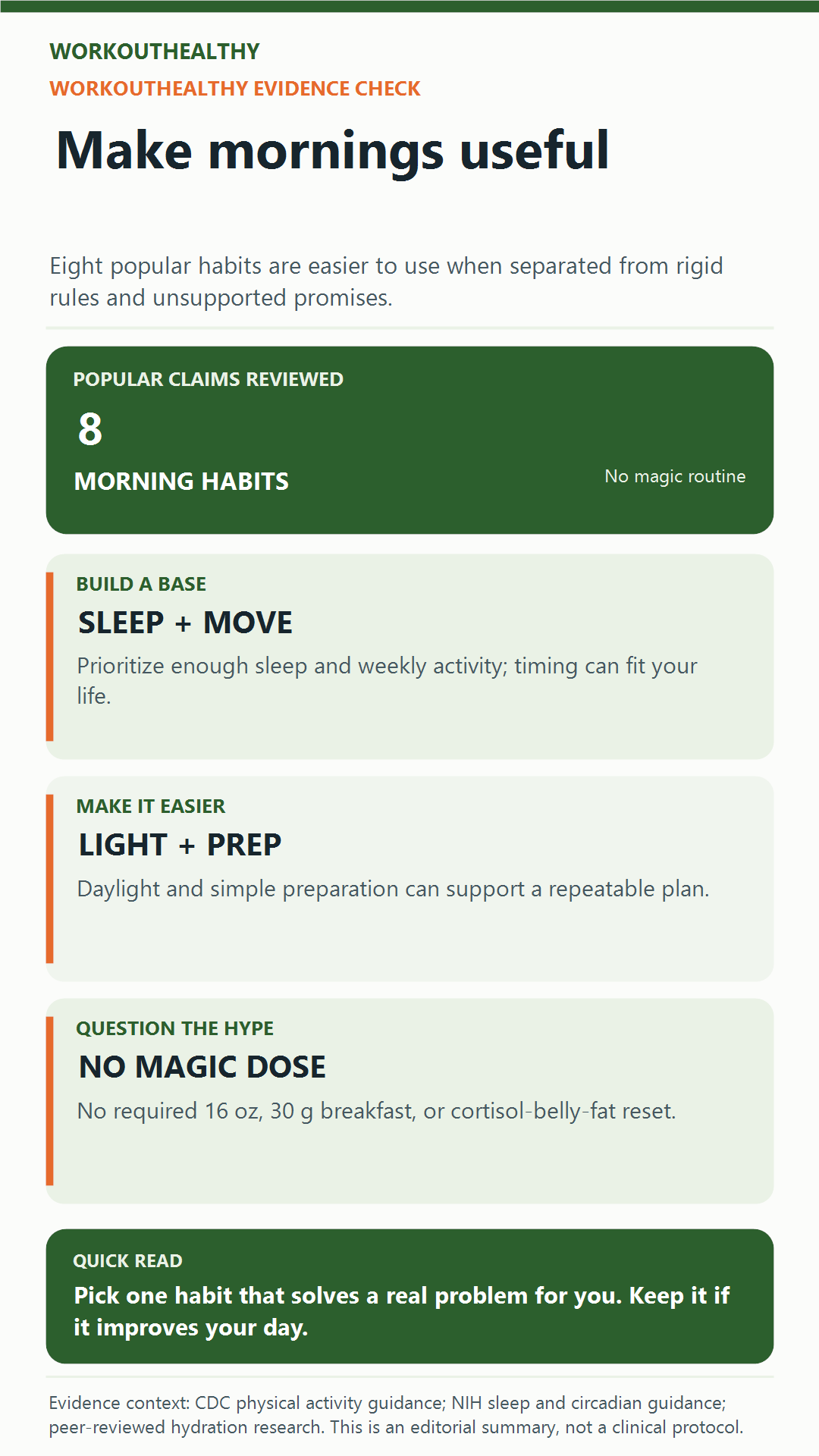
A viral list says eight morning habits separate “exceptionally fit” people from everyone else. It promises that water jump-starts metabolism, exactly 30 grams of breakfast protein stabilizes blood sugar all day, sunlight must arrive within 30 minutes, and five minutes of journaling can lower the cortisol that supposedly holds onto belly fat.
Some of the actions are sensible. The rigid doses and sweeping outcomes are a different matter. The post does not provide the schedules it says were analyzed, a study of those eight habits together, or evidence that a single morning routine explains why people stay lean. We checked the individual ideas against public-health guidance and research so readers can build a useful morning without a fantasy checklist.
A good morning routine helps you do what matters later. It does not need to control every minute after waking.
1. Drink Water if You Need It
Water is essential, and drinking some in the morning may be an easy way to meet fluid needs. You lose water through breathing, sweat, and bathroom trips overnight. Yet waking after eight hours does not prove that every person is clinically dehydrated or that everyone needs 16 ounces before coffee.
NIH’s hydration guidance says needs vary with age, body size, activity, climate, illness, and other factors. It recommends responding to thirst and making fluids available through the day. Coffee and tea can contribute fluid too. Someone with a fluid restriction or another medical reason to manage intake should follow their clinician’s advice rather than a social-media volume target.
The metabolism claim is the weak part. A controlled study comparing 500 milliliters of water with a sham condition found no meaningful water-specific increase in resting energy expenditure or fat oxidation. Water can replace a higher-calorie drink and help you feel better when you are thirsty. It is not a switch that turns on fat loss at sunrise.
2. Make Breakfast Work for You
Adding protein to breakfast can make a meal more satisfying for some people. In a small randomized study of young women with overweight or obesity, a protein-rich breakfast increased feelings of fullness before lunch but did not reduce total daily energy intake compared with the other breakfast conditions. That is an interesting short-term result, not an all-day guarantee.
The viral 30-gram number is a possible meal-planning example, not a universal threshold. Protein needs depend on body size, age, activity, medical conditions, and the rest of the day’s food. A breakfast can also include fiber-rich carbohydrates, fruit, and healthy fats. Sugary cereal is not the only alternative to a large protein shake.
If you have diabetes, meal choices and glucose responses deserve an individualized plan. No one breakfast amount reliably stabilizes everybody’s blood sugar for an entire day. Ask what breakfast helps you feel and function well until your next meal, then adjust with appropriate professional guidance where needed.
3. Get Daylight Without a Stopwatch
Light is a real signal for the body’s daily clock. The NIH explains that light and darkness help coordinate sleep and wakefulness. CDC’s shift-work education notes that appropriately timed morning light can move the circadian clock earlier, whereas bright evening light tends to move it later.
That does not establish a mandatory 30-minute-after-waking deadline for every reader. The effect depends on a person’s schedule, the timing and intensity of light, and whether they work nights or have a circadian disorder. For someone with a standard daytime schedule, stepping outside in the morning can be a pleasant, practical cue.
Keep the advice realistic: natural daylight while walking or commuting is useful; staring toward the sun is unnecessary and unsafe. People working shifts may need a different light plan, especially when they are trying to sleep during daylight hours.
4. Move Before Scrolling if It Helps
A short walk, stretch, or exercise session before opening social media can protect time for movement if the phone normally absorbs your morning. It is a habit-design choice, not a special physiological window. The CDC recommends adults build toward 150 minutes of moderate aerobic activity a week plus two days of muscle-strengthening activity, and says activity can be spread across the week.
Five minutes of walking on each of seven mornings adds up to 35 minutes. That is real movement and a useful start, but it is about 23% of a 150-minute weekly moderate-activity target if the walks are brisk enough to count. The arithmetic shows why a small cue can help without pretending the cue is the whole plan.
Some people have childcare, medication, disability, or work needs that make morning activity difficult. Moving later is still movement. For a deeper look at how walking and strength work complement each other, see our review of walking and leg strength after 60.
5. Put a Hard Task Where It Fits
“Eat the frog” means doing the most difficult task first. Some people like the idea because a clear priority can reduce dithering. It is a productivity preference, not a proven route to better hormone regulation or physical fitness.
The difficult task may be better handled after breakfast, later in a work shift, or after a necessary warm-up. A morning workout is also not automatically the hardest or most important task. If this tactic makes you dread getting up, it is working against the habit you want to build.
Try a more flexible version: decide on one action that will make the day easier, and give it a realistic place in your schedule. That may be preparing food, taking a short walk, or sending one overdue message. It does not need to be your most intimidating job.
6. Prepare the Night Before
Setting out workout clothes or packing lunch can remove small obstacles. It may be especially useful when the morning is rushed. Research on exercise “implementation intentions” suggests that plans naming when and where an activity will happen can help some people turn an intention into action, although results vary with motivation and confidence.
That is a more defensible explanation than saying everyone suffers a fixed amount of “decision fatigue” that vanishes when shoes are by the door. Preparation is a practical experiment: if it helps you leave on time or eat a meal you enjoy, keep it. If the setup becomes another chore, simplify it.

Our article on quiet consistency in wellness routines uses a similar filter: look for repeatable actions while setting aside claims that a ritual has a special power.
7. Use Quiet Time for Stress, Not Fat Loss
Five minutes of breathing, journaling, prayer, or quiet may help someone feel less rushed. NCCIH reports that slow deep breathing may reduce stress and can modestly affect measures such as blood pressure or cortisol in some studies. The evidence depends on the method and outcome; it does not establish a guaranteed effect for a five-minute diary entry.
The phrase “cortisol holds onto belly fat” reduces a complex hormone and body-composition story to a slogan. Cortisol is also part of a normal waking response. There is no basis for promising that a morning silence ritual lowers a specific person’s cortisol enough to remove abdominal fat.
Use the time because it helps you think or regulate stress, not because a particular hormone number is the goal. If stress is persistent or severe, a short ritual may be supportive but is no substitute for appropriate care. Our Miranda Kerr yoga evidence review similarly distinguishes a person’s self-care routine from what clinical research can prove.
8. Keep Sleep Timing Reasonably Consistent
Regular sleep and wake timing can help the circadian system anticipate sleep. The NIH describes light and other daily cues as part of that timing. A steady schedule may make it easier to get enough sleep, but a fixed wake time is not useful if it means routinely cutting sleep short.
The viral list says waking at roughly the same time, even on weekends, “regulates hormones and recovery.” That is too broad. Sleep quality and duration, work shifts, family duties, and individual health all matter. A consistent bedtime and wake time are a useful direction where life permits, with enough total sleep as the priority.
For an exercise-specific view, our sleep and muscle recovery article explains why recovery claims need more care than a single hormone slogan.
Build One Useful Morning
Start with the obstacle that actually affects you. If you regularly forget to drink, put a glass or bottle where you will notice it. If a morning walk feels good but the phone takes over, lay out shoes and decide when you will go. If sleep is the problem, moving bedtime may matter more than adding another 6 a.m. task.
Try one change for a week or two and observe whether it makes the day easier. An example plan might be: after getting dressed, walk outside for five comfortable minutes on three workdays. That is a behavioral cue you can test, not a research-proven dose or a promise of weight loss.
Do not measure success by whether you complete all eight ideas. A routine that fits your life and can survive a disrupted morning is more useful than an “elite” list that depends on perfect conditions.
The best morning habit is the one that removes a real barrier and remains workable next week.
The Takeaway
Hydration, satisfying meals, daylight, movement, preparation, stress relief, and regular sleep are reasonable parts of a healthy life. The evidence does not show that eight specific morning habits are shared by nearly all exceptionally fit people or that rigid numbers unlock a special metabolism.
Keep the action that helps you. Drop the stopwatch and the hormone promises. Your health is shaped across the full day and week, not decided in the first half hour after waking.
Sources and Further Reading
- NIH News in Health: Hydrating for Health
- Human trial reassessing water-induced thermogenesis
- CDC adult physical activity guidance
- NIH sleep-wake cycle overview
- NCCIH stress and breathing evidence
- Randomized study of a protein-rich breakfast and satiety
Get the next verified fitness story.
Five practical fitness stories worth your time, every Friday.
One email a week. No product pitches. Unsubscribe in one click.
Health disclaimer: This article is general information, not medical or nutrition advice. Individual fluid, food, sleep, and exercise needs vary. Ask a qualified clinician for guidance if you manage a medical condition or have concerning symptoms.