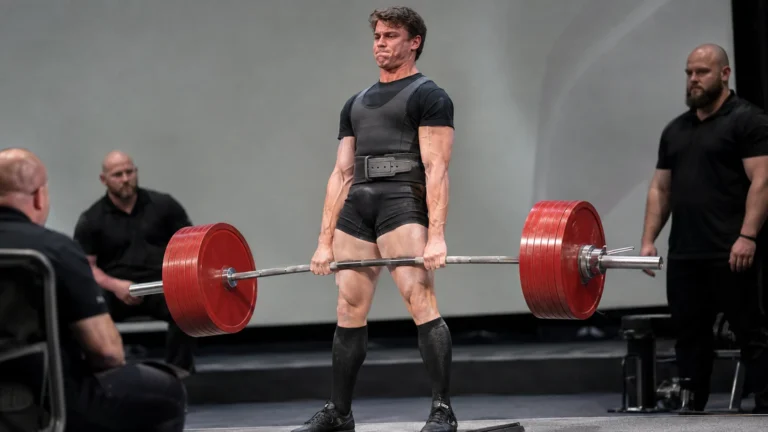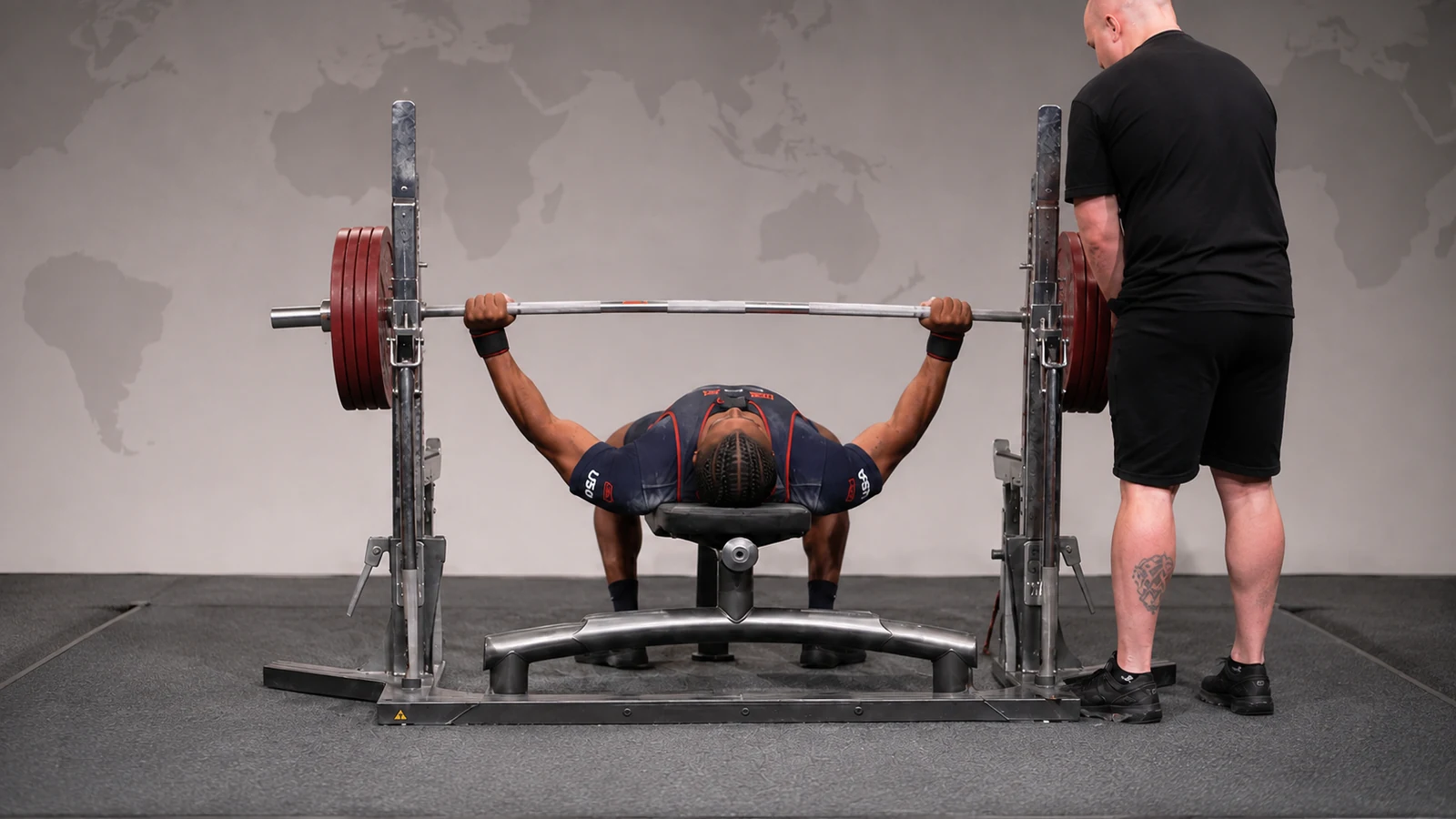

On June 8, 2025, Devin Williams loaded a bare bar to 265.5 kilograms and pressed it off his chest.
No shirt, no wrist wraps beyond what raw rules allow, no assistance beyond his own hands and a spotter standing by in case it went wrong.
That is 585.33 pounds.
It was enough for the International Powerlifting Federation to call it a new world record in the men’s 120 kilogram raw bench press class.
The number is real, and it is genuinely one of the heaviest raw bench presses ever recorded in that weight class.
But the more interesting story is not the single lift.
It is the year and a half of smaller lifts that came before it, each one a few kilograms heavier than the last, until the record was simply the next step in a pattern rather than a shock.
What Devin Williams Actually Lifted
Williams competed at the 2025 IPF World Classic Powerlifting Championships in the men’s 120 kilogram class, weighing in at roughly 119.4 kilograms.
His competition bench press that day was 265.5 kilograms, which converts to 585.33 pounds.
That figure matches the workbook caption almost exactly and lines up with the official result posted on OpenPowerlifting’s IPF results database.
The International Powerlifting Federation’s own YouTube channel uploaded the lift with the title “World Record Bench Press Classic with 265.5 kg by Devin Williams USA in 120 kg class,” which is about as close to a primary source as this kind of claim gets.
He finished third overall in the Open division that day.
A bronze medal and a world record in the same afternoon is not a contradiction.
In powerlifting, the overall placing is decided by squat, bench, and deadlift added together, while an individual lift record is judged only against everyone who has ever attempted that lift in that weight class.
Williams could lose the overall trophy to a stronger squatter or deadlifter and still walk away owning the heaviest raw bench in his class.
That is exactly what happened.
The Long Climb to 585 Pounds
The caption that inspired this article calls the record something Williams “climbed to over time,” and that framing holds up under scrutiny.
His own competition results, verified against OpenPowerlifting’s public database, show a lifter who added weight to his best bench in small, deliberate increments across four meets and three federations.
In March 2024, at the AMP Classic Raw Open Nationals, he benched 260.5 kilograms.
In August 2024, at the North American Powerlifting Federation’s continental championships, he raised that to 261 kilograms, or 575.41 pounds, matching the earlier mark the workbook credited to him almost to the decimal.
In April 2025, at the AMP Classic Open Nationals, he pushed to 263 kilograms, then added another 2.5 at the actual IPF Worlds that June to reach 265.5.
Four meets, four small jumps, one world record.
Nobody adds 25 kilograms to a competition bench in one attempt and keeps it. The lifters who own these numbers get there by beating their own best mark by a kilogram or two, meet after meet, for years, until the sum of those small wins is a record nobody else has touched yet.
Each individual jump in that chain looks unremarkable.
Two and a half kilograms is roughly five and a half pounds, the kind of jump a strong intermediate lifter might add to a training set in a single training block.
The record was never one dramatic leap.
It was four ordinary ones, stacked in the same direction, over roughly fifteen months.
Has This Record Already Been Broken?
The honest answer is yes, and this article would be incomplete without saying so plainly.
Verification against the IPF’s own affiliated results database, OpenIPF, shows a Trinidad and Tobago lifter named Rondel Hunte pressing 270 kilograms in the same 120 kilogram raw class on January 24, 2026, at that country’s national championships, which is 4.5 kilograms heavier than Williams’s mark.
Hunte climbed to it the same way: 260 kilograms in April 2025, then 266 at a bench only meet that October, then the 270 kilogram lift that took the record outright.
Devin Williams’s 265.5 kilogram bench held the title for roughly seven months.
That is not a failure or a footnote.
Records at this level rarely last long, because the entire sport is a rotating cast of lifters chasing the exact same number.
Williams’s lift is still the correct answer to “what did Devin Williams bench,” and it was, for a real stretch of 2025, the correct answer to “what is the world record.”
Both things can be true at once, and pretending otherwise would misrepresent a sport that moves this fast.
One caveat is worth stating clearly: IPF-recognized world records can be set at any meet sanctioned by an IPF member federation, not only the IPF’s own World Championships, which is how a national meet in Trinidad and Tobago produced a record that outranks a lift made at the Worlds itself.
No official IPF press release naming Hunte’s lift could be independently located at the time of writing, so this section reflects the strongest evidence available rather than a confirmed federation announcement.
What “Raw” Actually Means in This Lift
The word raw does a lot of work in that headline number, and it is worth unpacking.
In powerlifting, “equipped” lifting allows a tight, supportive bench shirt that can add well over 100 kilograms to a lifter’s press by storing and returning elastic energy at the bottom of the movement.
“Raw,” sometimes called “classic” in IPF terminology, strips that support away.
A raw lifter is allowed a shirt for skin contact, wrist wraps, and not much else.
Every kilogram of a 265.5 kilogram raw bench comes from the lifter’s own muscle, leverage, and technique, not from a garment doing part of the work.
This is part of why raw and equipped world records are tracked as entirely separate categories rather than compared directly.
The current equipped world record in similar weight classes sits well above 400 kilograms, a number that reflects the equipment as much as the athlete.
Comparing a raw lift to an equipped one is a bit like comparing a marathon time run in normal shoes to one run in the newest carbon plated racing shoe.
Both are real, but they are not measuring quite the same thing.
The Mechanics Behind a Bench Press This Heavy
Pressing 585 pounds off the chest requires more than raw shoulder and chest strength.
Research on maximal bench pressing has found that the difference between a successful heavy attempt and a missed one usually comes down to bar path and the speed the bar carries through the lift’s hardest point, not just how much force the lifter can produce in a vacuum.
A 2009 biomechanical study published in Medicine & Science in Sports & Exercise compared successful and failed maximal bench press attempts and found that lifters who missed typically slowed down more sharply as the bar crossed the sticking point, the spot a few inches off the chest where the leverage is worst (van den Tillaar & Ettema, 2009).
Elite raw lifters train specifically to carry bar speed through that exact point, often by strengthening the triceps and building a tighter, more stable arch that shortens the bar’s overall travel distance.
Our comparison of the floor press and the bench press breaks down how removing leg drive and shortening the range of motion changes which muscles do the work, a smaller and more approachable version of the same leverage principles at play here.
None of this happens without a technical setup, either.
IPF rules require a visible pause on the chest before the press begins, removing any stretch reflex or bounce a lifter might otherwise use to help drive the weight back up.
A paused, dead stop press at this weight is a different and harder task than the same number moved with any bounce.
Why Small Jumps Beat Big Swings
The four meet progression behind this record is not just a nice story detail.
It reflects something sports scientists have documented about how strength is actually built over time.
A widely cited 2016 review in Sports Medicine on the role of muscular strength in athletic performance concluded that maximal strength develops through consistent, progressive overload applied over long training histories, rather than through occasional large jumps in load (Suchomel, Nimphius, & Stone, 2016).
The review describes strength as a foundational quality other qualities, like speed and power, are built on top of, and notes that the strongest athletes are almost always the ones with the longest, steadiest training histories.
Williams’s own numbers are a small, concrete example of that same principle in action: five kilograms across fifteen months and four competitions, which is closer to what the research predicts happens at the elite level than any dramatic transformation story would be.
Our piece on DonnaJean Wilde’s push up world record looks at the pacing math behind a different kind of record, and the lesson is similar: records built on repeated, sustainable effort tend to hold up better than ones built on a single extraordinary day.
Our article on George Foreman’s comeback training makes a related point about patience paying off over a much longer timeline than most people expect from a strength sport story.
Common Mistakes Lifters Make Chasing Bigger Numbers
Watching a 585 pound bench press understandably makes people want to chase bigger numbers of their own.
A few mistakes show up constantly in that pursuit.
The first is skipping the pause: lifters who train exclusively with a bounce off the chest build a press that falls apart the moment a paused, judged rep is required.
The second is chasing weight before technique is consistent, since elbow flare, an uneven bar path, and a grip that changes from set to set all cost pounds that have nothing to do with actual strength.
The third is ignoring the legs and upper back, which is what lets the arms and chest transmit force efficiently in the first place.
The fourth is adding weight faster than the joints can adapt, a mistake with real consequences covered in the next section.
Who Should Be Cautious With Max-Effort Bench Training
Maximal or near maximal bench pressing puts real strain on the shoulders, elbows, and pectoral tendons, and it is not a training style everyone should adopt without guidance.
Anyone with a history of shoulder impingement, a previous pectoral strain, or elbow pain that lingers after pressing should talk to a doctor or physical therapist before attempting heavy singles, not after symptoms show up.
Beginners in particular tend to underestimate how much technical skill a heavy raw bench requires and can develop bad habits that increase injury risk long before they are anywhere near an elite number.
Working with a qualified coach, at least while learning the setup and the paused technique, is one of the more reliable ways to avoid that outcome.
Our guide on deciding whether you need a personal trainer walks through how to tell whether coaching is worth the cost at your current stage, which is a genuinely useful question to answer honestly before loading a bar heavier than you have ever pressed.
How to Build Toward a Heavier Bench the Right Way
Nobody needs to bench 585 pounds to benefit from training the way Devin Williams appears to have trained.
The pattern behind his progression translates to any lifter’s own numbers.
Start with a true one rep max, tested carefully and with a spotter, so every future jump is measured against a real baseline.
Add weight in small increments, ideally no more than two to five percent of the current best at a time, and hold each new number for several weeks before pushing again.
Train the paused bench specifically, with a genuine one to two second dead stop on the chest, so the competition version of the lift is never a surprise on meet day.
Build accessory strength deliberately: triceps work, upper back rows, and shoulder stability drills all support the main lift even though they rarely show up as the headline number.
Track every session.
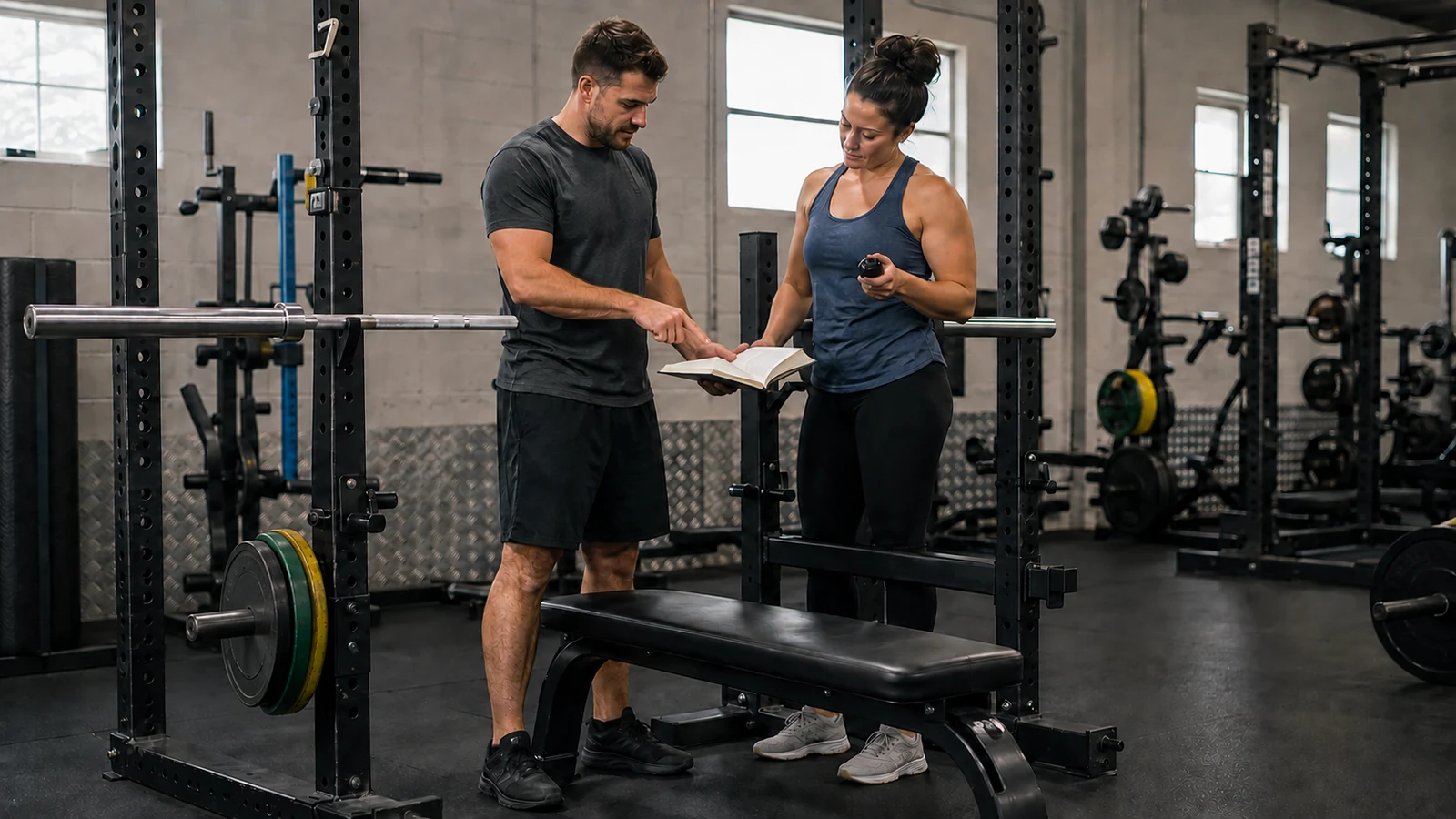
A lifter who can see the actual pattern of small jumps over months is far less likely to force a jump the body is not ready for.
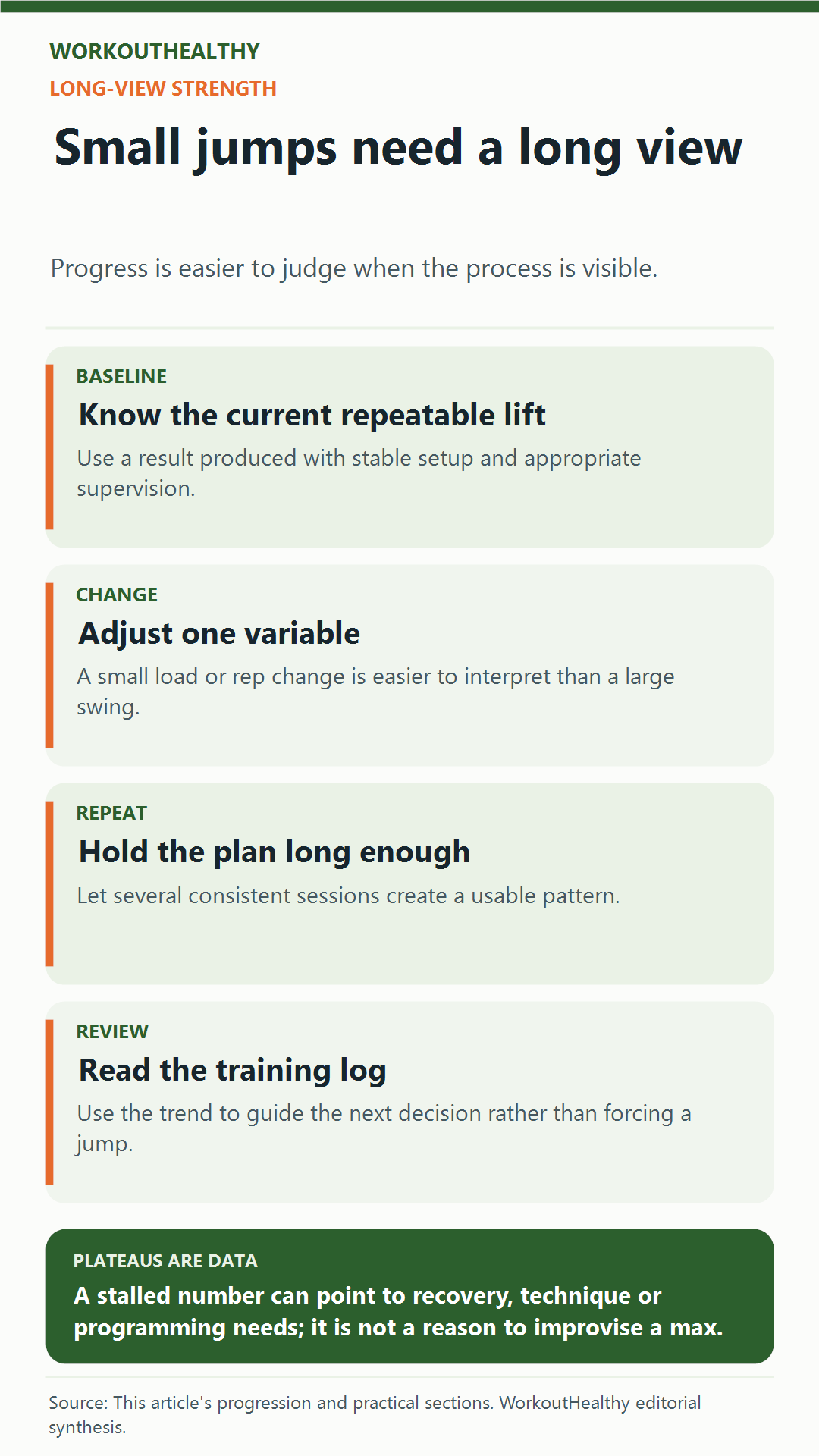
Finally, treat a plateau as information rather than failure, the same way Williams’s own results show meets where his number barely moved before the next real jump.
What a Single Lift Record Does Not Prove
A world record bench press is a genuinely impressive, well documented feat, but it is worth being precise about what it does and does not show.
It does not prove Williams is the strongest lifter in his weight class overall, since that title depends on the combined total of three lifts, and his own result that day placed him third.
It does not transfer directly to other pressing movements, either: a raw competition bench with a wide, IPF legal grip and a long pause is a different skill than a close grip triceps focused bench, even though both train overlapping muscles.
It also does not mean the number is permanent, a point already covered honestly: it stood for roughly seven months before a Trinidad and Tobago lifter surpassed it.
None of that diminishes what Williams accomplished.
It simply places the number where it belongs, as one real, verified data point in a sport where the record book keeps moving.
Watch the Original Video
Want more records like this one, verified before they’re written up? Subscribe to WorkoutHealthy Insider for practical explanations behind popular fitness claims.
References
Suchomel, T. J., Nimphius, S., & Stone, M. H. (2016). The importance of muscular strength in athletic performance. Sports Medicine, 46(10), 1419–1449. https://doi.org/10.1007/s40279-016-0486-0
van den Tillaar, R., & Ettema, G. (2009). A comparison of successful and unsuccessful attempts in maximal bench pressing. Medicine & Science in Sports & Exercise, 41(11), 2056–2063. https://doi.org/10.1249/MSS.0b013e3181a8c360
This article is for general information only and is not medical advice. If you have an injury, ongoing pain, or a medical condition, talk to a doctor or physical therapist before you change how you train or eat.