
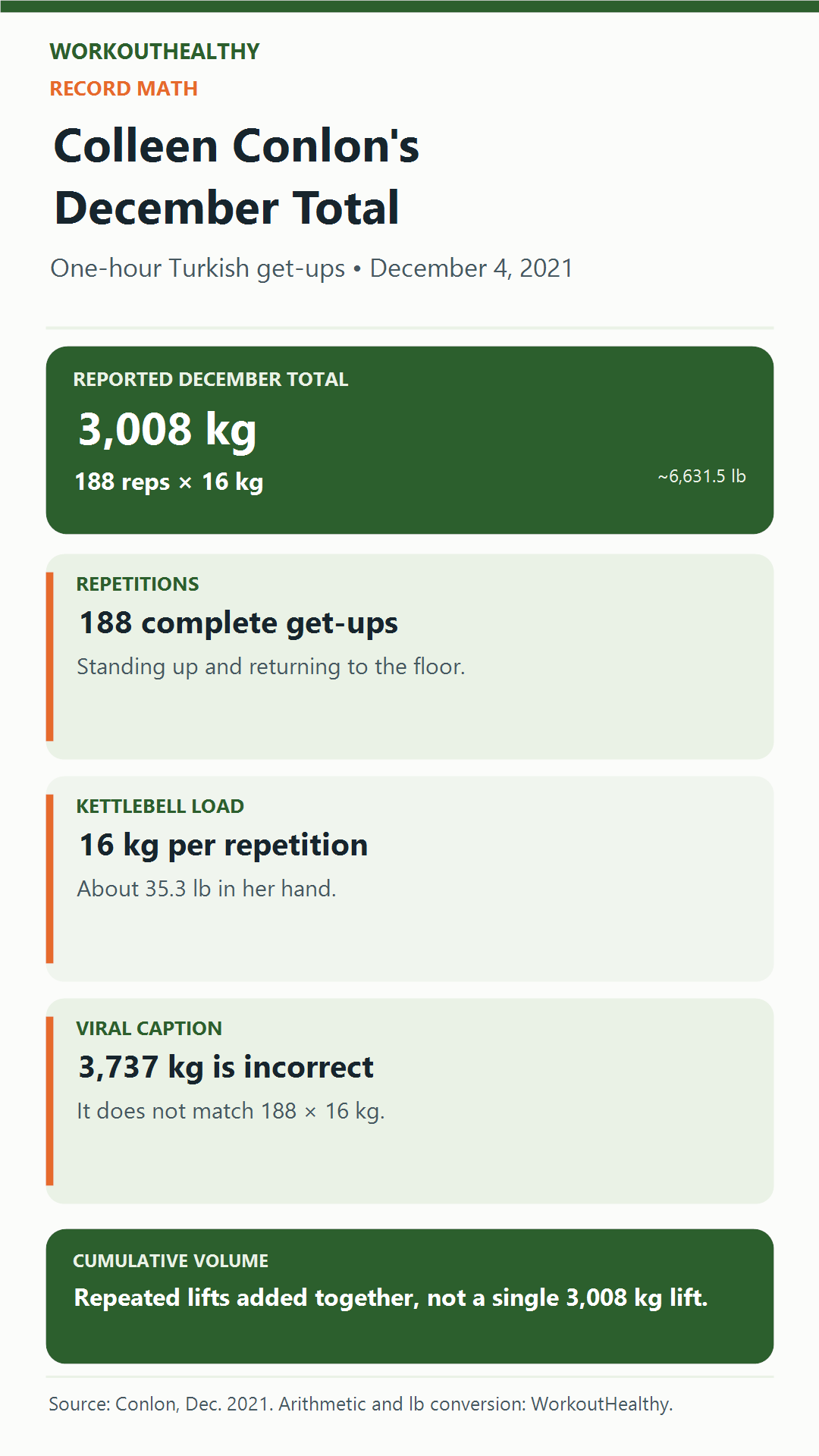
Colleen Conlon reported a Guinness Turkish get-up total of 3,008 kilograms, about 6,631.5 pounds, on December 4, 2021: 188 repetitions with a 16-kilogram kettlebell in one hour. The viral 3,737-kilogram claim is incorrect. Guinness’s public listing, checked September 29, 2026, names Jaclyn Vazquez as the subsequent holder.
The December Total Adds Up to 3,008 Kilograms
The calculation is straightforward: 188 completed repetitions × 16 kilograms per repetition = 3,008 kilograms. Conlon’s December account supplies both inputs and the matching result.
Using 2.2046226 pounds per kilogram, that cumulative total converts to approximately 6,631.5 pounds. The bell itself weighed about 35.3 pounds throughout the attempt.
The caption’s 3,737 kilograms is 729 kilograms above the documented calculation, an overstatement of about 24.2 percent. Changing the units does not resolve that difference.
Dividing 3,737 by a 16-kilogram bell gives 233.5625 repetitions. A completed-repetition total must be a whole number, so that figure cannot come from the stated bell and counting method.
A vehicle comparison can illustrate a large cumulative number, but it must keep the repetition count visible. Adding repeated lifts does not turn a 16-kilogram kettlebell into a vehicle-sized load.
The record total is an addition of completed lifts. The load in her hand was 16 kilograms.
Each Get-Up Includes the Return to the Floor
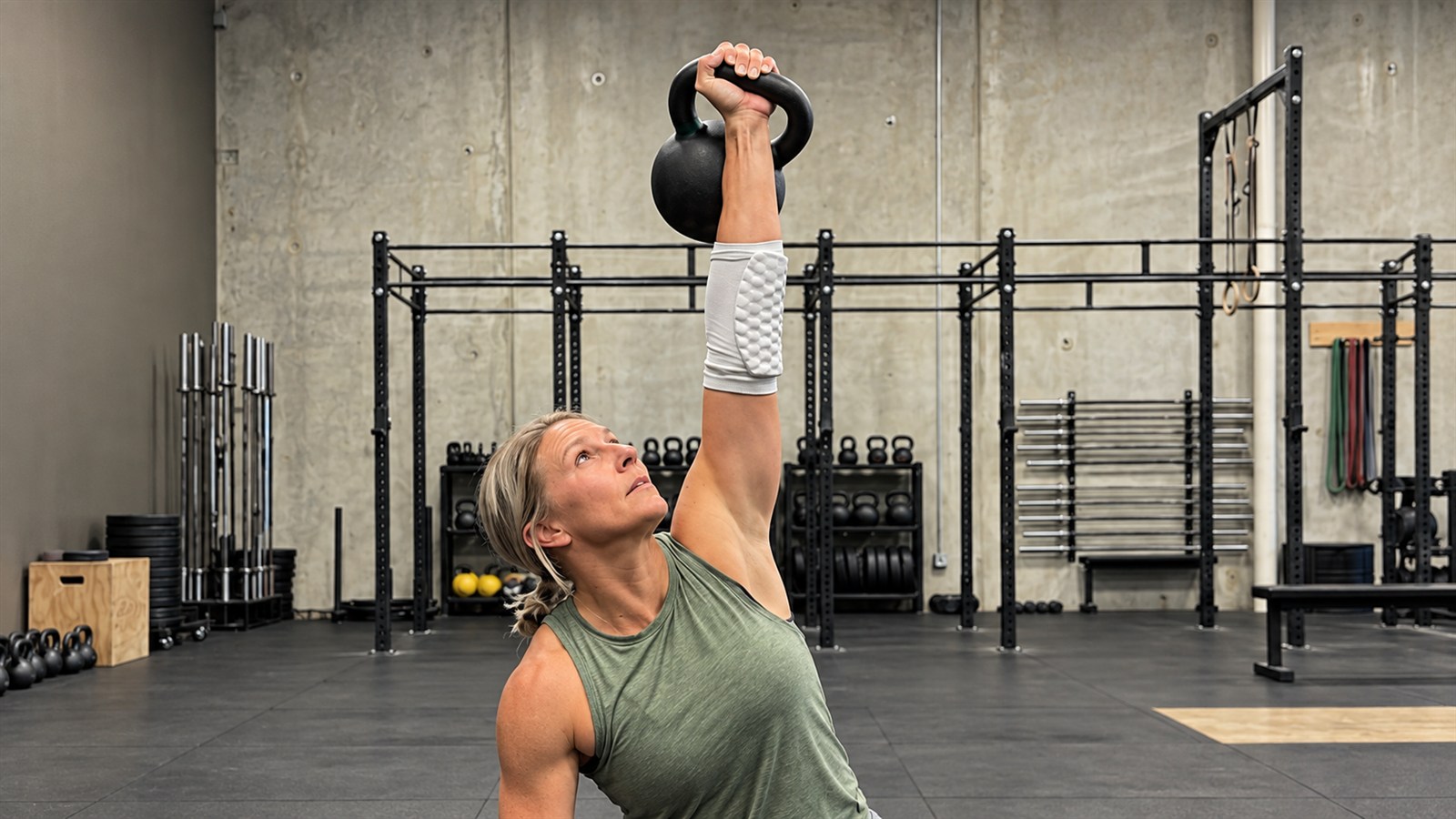
A Turkish get-up is a sequence of changing body positions while controlling a weight overhead. It includes rising from the floor and reversing the movement to return.
The American Council on Exercise describes transitions through supported sitting, a bridge, kneeling and standing. The arm holds the kettlebell overhead while the rest of the body changes position.
ACE classifies the exercise as a full-body movement. Calling the performance an abdominal feat alone leaves out the shoulder, hips, legs and supporting arm used in its description.
With 188 repetitions spread across 60 minutes, the average was approximately 3.13 per minute, or one complete get-up every 19.1 seconds. Those are WorkoutHealthy calculations, not measured split times.
A clock average cannot reveal when she accelerated, slowed down or rested. It divides the entire hour evenly for comparison; it does not imply identical pacing on every repetition.
July and December Need Separate Calculations
Conlon’s first-person account dates her earlier attempt to July 17, 2021, with 133 repetitions and the same 16-kilogram bell. It prints a July total of 2,182 kilograms.
Those inputs produce 2,128 kilograms, a 54-kilogram difference from the printed figure. The source does not explain the discrepancy, so the table distinguishes its wording from our arithmetic.
| Attempt | Reported reps and bell | Calculated total |
|---|---|---|
| July 17, 2021 | 133 × 16 kg | 2,128 kg |
| December 4, 2021 | 188 × 16 kg | 3,008 kg |
The December attempt added 55 repetitions. With the load unchanged, every added repetition contributed another 16 kilograms, producing an 880-kilogram increase from the calculated July baseline.
That is about 41.4 percent more completed repetitions. Keeping the baseline explicit matters: calculating a percentage from the conflicting printed July total would yield a different answer.
The December repetition count, bell weight and stated total agree. That internal consistency supports the corrected December number without silently fixing the separate July source discrepancy.
A Single-Arm Rule Changed the Load Decision
Conlon wrote that her initial plan used 20 kilograms. A week before the July attempt, she learned that qualifying repetitions required pressing and lowering the bell with one arm.
She had practiced an assisted press and could not single-arm press the planned load. She used 16 kilograms for the attempt instead, then worked on pressing afterward.
The scoring tradeoff is clear in the arithmetic: 150 repetitions with 20 kilograms would total 3,000 kilograms, slightly below 188 repetitions with 16 kilograms. These are comparison scenarios, not additional performances.
To exceed 3,008 kilograms with a 20-kilogram bell would require at least 151 completed repetitions, totaling 3,020 kilograms. A heavier bell improves the value of each repetition only if enough repetitions qualify.
The change from 20 to 16 kilograms reduced the load by 20 percent. Matching the same cumulative target would consequently require 25 percent more repetitions, illustrating why load and repeatability must be considered together.
A heavier bell earns more per repetition. A successful strategy still needs enough completed repetitions to win the total.
Guinness Later Listed Jaclyn Vazquez at 3,960 Kilograms
Guinness’s public page names Jaclyn Vazquez with 3,960 kilograms, or 8,730.3 pounds, achieved in West Bend, Wisconsin, on January 22, 2022.
That listed total is 952 kilograms above Conlon’s December result, approximately 31.6 percent higher. Guinness does not supply Vazquez’s repetition count or bell weight on that page.
Without those inputs, we cannot say whether the difference came from a heavier bell, more repetitions or a combination. The cumulative result establishes the comparison; it does not establish the strategy.
Guinness also cautions that records can change before website updates appear. “Publicly listed holder” therefore describes the evidence more precisely than an unrestricted claim about every subsequent attempt.
For related coverage, our endurance records archive groups other timed achievements. Comparisons still need the same event rules and units to be meaningful.
The Achievement Survives Accurate Reporting
The sources answer two different questions. Conlon describes her attempts, while Guinness identifies its later listed holder. Our calculations check whether the reported repetitions and load support the social claim.
Neither a caption nor a cumulative total establishes a clinical result from exercise. The record evidence does not document whether training restored abdominal sensation or treated effects of surgery.
Likewise, the record number cannot establish an exact late-attempt crisis or a medical explanation for it. Those details would require their own reliable documentation rather than an inference from repetitions.
No verified full-attempt video was located for this article. A training clip or another athlete’s performance would not establish all 188 repetitions, so neither is presented as attempt footage.
The useful lesson is measurable progress with clear standards. That connects with Sydney Hunter’s account of consistent strength practice, while our full-body dumbbell research guide addresses a separate question about ordinary training.
Conlon’s December account describes a substantial improvement over her first attempt. Reporting 3,008 kilograms preserves that achievement, identifies how the total was produced and leaves the later holder correctly named.
Get the next evidence check.
Five practical fitness stories worth your time, every Friday.
One email a week. No product pitches. Unsubscribe in one click.
References
- Conlon, C. (2021, December 25). How I set a Guinness world record for Turkish get-ups… and then beat it! Dragon Door; authorized republication by RKC Kettlebell. July’s printed total differs from its stated inputs.
- Guinness World Records. (n.d.). Heaviest weight lifted by Turkish get-up in one hour (female). Retrieved September 29, 2026.
- American Council on Exercise. (n.d.). Turkish get-up. ACE Exercise Library.
Medical disclaimer: This article is for general information only and is not medical advice. If you have an injury, ongoing pain, or a medical condition, talk to a doctor or physical therapist before you change how you train or eat.