
Colin Farrell had never run a marathon before. Then he ran 26.2 miles through the streets of Dublin, and the slowest stretch of it mattered the most.
He spent the final two and a half miles pushing his friend Emma Fogarty’s wheelchair.
Fogarty was born with a rare skin condition called epidermolysis bullosa, often shortened to EB.
The two have been friends for more than 15 years.
On October 27, 2024, Farrell finished the race beside her, not ahead of her.
“That run was nothing compared to the pain she is forced to endure every single day, even though she doesn’t show it,” Farrell said afterward.
“I’ll never forget it,” he added.
Who Colin Farrell Is and What He Actually Did
Colin Farrell is an Irish actor known for films including “In Bruges,” “The Banshees of Inisherin,” and “The Batman.”
He was born and raised in Dublin and now lives primarily in Los Angeles and New York.
In 2024, he agreed to run the Dublin Marathon to raise money for Debra Ireland, a charity that supports people living with EB.
The campaign set an initial goal of 400,000 euros. After Farrell appeared on “The Late Late Show” to talk about the run, donations surged.
By race day, the campaign had raised more than 800,000 euros, well over 872,000 US dollars at the time.
Farrell trained for months leading up to the race. He mostly trained by running around Central Park near his home in New York.
He was candid that his preparation was far from perfect. “I haven’t been getting the miles in,” he admitted before the race.
After one six kilometer training run, he joked about how much further he had left to go.
“Only another 38 to go,” he said, only half joking about the math of marathon training.
He described finishing that shorter run “in a heap.”
Race day itself mixed real physical effort with real humor and real emotion, especially in the final miles beside Fogarty.
An Important Clarification: This Was for a Friend, Not His Son
Colin Farrell is also known publicly as the father of a son, James, who lives with a different and unrelated condition called Angelman syndrome.
Angelman syndrome is a rare genetic neurological disorder. It affects development, movement, and communication.
Farrell has spoken publicly about James and has worked to raise awareness for Angelman syndrome.
But the Dublin Marathon fundraiser was not connected to that cause.
It was organized specifically to support Emma Fogarty and Debra Ireland’s work with epidermolysis bullosa.
That is a completely separate condition. The two causes are easy to blur together in casual conversation, since both involve a rare condition affecting someone close to Farrell.
They deserve to be kept distinct, both out of respect for accuracy and out of respect for the different communities each condition affects.
What Epidermolysis Bullosa Actually Is
Epidermolysis bullosa is a rare, mostly inherited condition that makes skin extremely fragile.
People sometimes call it “butterfly skin disease.” Skin affected by EB can tear or blister as easily as a butterfly’s wing.
Most forms come from genetic mutations that affect proteins holding layers of skin together. Without those proteins working properly, even ordinary friction can cause painful blisters and wounds.
A hug, a shoe, or normal daily movement can be enough. There are several forms of EB, ranging from relatively mild to severe.
Dystrophic epidermolysis bullosa, one of the more severe forms, affects roughly 3 out of every 1 million people.
Emma Fogarty is widely described as Ireland’s oldest living person with a severe form of EB.
Reports on her condition describe bandages covering roughly 80 percent of her body. Those bandages are changed regularly to manage wounds and prevent infection.
She turned 40 in 2024, a milestone once considered unlikely for someone with her form of the condition.
There is currently no cure for EB. Treatment focuses on wound care, infection prevention, nutrition, and pain management, along with ongoing research into gene and protein based therapies.
What Training for a First Marathon as a Beginner Actually Looks Like
Farrell was not a lifelong runner before this race.
His own comments about “not getting the miles in” reflect a common experience for first time marathoners juggling training with a demanding schedule.
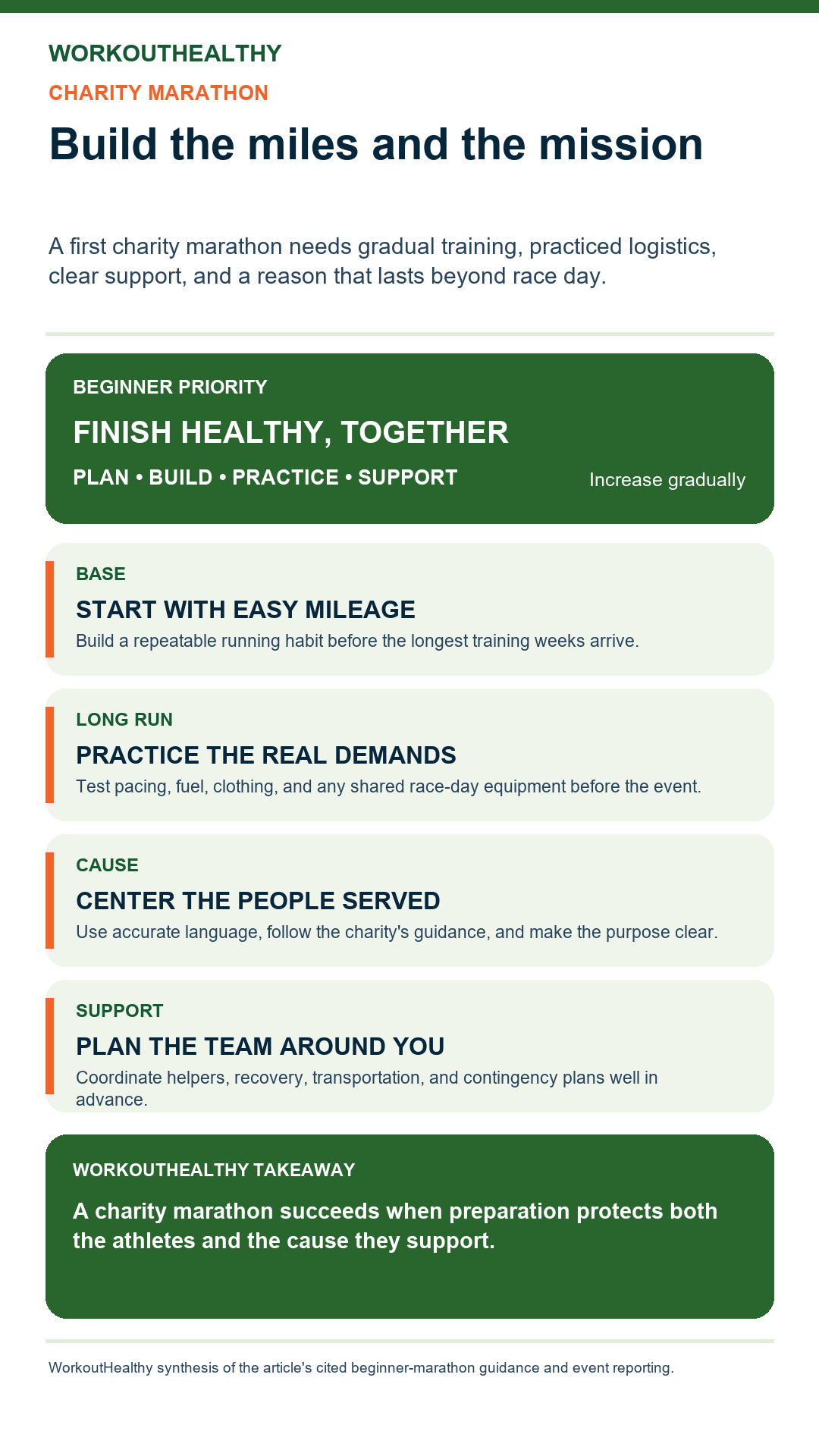
Most beginner marathon plans run 16 to 20 weeks and build mileage gradually. Runners typically increase their longest weekly run by no more than about 10 percent from one week to the next.
That gradual approach protects tendons, joints, and muscles from injury.
The body needs time to adapt to new physical demands. A long training run of 18 to 20 miles is common before race day, even though the race itself covers 26.2.
The final few miles are traditionally the hardest, both physically and mentally, regardless of a runner’s fitness level.
Farrell built his own version of a run walk approach into race day. He planned to walk some sections and slowed dramatically to push Fogarty’s wheelchair over the final stretch.
That pacing decision, whether planned in advance or improvised on the day, reflects smart practice, not a lack of effort.
Beginner runners who insist on running every step of a marathon at a hard pace are more likely to hit a wall.
Mixing in walking breaks strategically often gets people to the finish line faster and safer.
What Current Understanding Says About Endurance Training and the Body
Endurance training like marathon preparation drives real physiological change over weeks and months.
The heart grows more efficient at pumping blood. The body increases its number of small blood vessels feeding working muscles.
Muscles build more mitochondria, the structures inside cells that produce energy.
These changes happen gradually. That is exactly why sudden, large jumps in training volume raise injury risk instead of speeding up fitness gains.
Farrell was in his late 40s at the time of the race, and that mattered for his training.
Bones, tendons, and connective tissue naturally become somewhat less resilient with age, which makes a gradual buildup even more important for an older first time marathoner, a pattern seen in other later in life athletic pushes like George Foreman’s boxing comeback.
Gradual mileage increases, adequate rest days, and proper running shoes all reduce the risk of common injuries like stress fractures, tendinitis, and shin splints.
None of this is exotic advice. It is the same guidance any running coach would give a first time marathoner, famous or not.
Colin Farrell and Emma Fogarty, In Their Own Words
Fogarty has spoken about what the friendship and the fundraiser meant to her beyond the money raised.
She has described their bond as one of the most meaningful relationships in her life.
She has said it grew from more than a decade of genuine friendship, not a celebrity gesture.
Farrell, for his part, has been consistent about where the credit belongs.
“That run was nothing compared to the pain she is forced to endure every single day, even though she doesn’t show it,” he said.
He was redirecting attention away from his own effort and toward hers.
That framing matters. Farrell used his public platform to point at Fogarty’s daily reality rather than his own athletic accomplishment.
That is a meaningfully different choice than many celebrity fundraising efforts make.
What This Kind of Fundraising Effort Does and Does Not Change
It is worth being clear about what a marathon and a fundraiser can and cannot do.
The money raised, more than 800,000 euros, genuinely helps Debra Ireland fund nursing care and wound care supplies.
It also supports other services for people living with EB. Awareness campaigns like this one can help other families feel less alone with a rare diagnosis.
None of it cures epidermolysis bullosa. There is currently no cure, and a single fundraiser, however successful, does not change the underlying biology of the condition.
What it can do is fund research and ease financial and caregiving burdens on affected families.
It can also raise the public profile of a condition most people have never heard of.
Those are real, meaningful outcomes, even though they fall well short of a cure.
Common Mistakes First Time Charity Marathoners Make
People inspired by stories like Farrell’s often sign up for a marathon with more enthusiasm than preparation.
A few mistakes come up again and again. Committing to a marathon with less than four months of training time is a common one.
Most coaches recommend at least 16 weeks for a first marathon, even for people with some existing fitness.
Skipping strength training is another mistake.
Runners who only run, without any strength work for the hips, core, and legs, tend to see more injuries.
Adding two short strength sessions a week can meaningfully lower that risk.
Ignoring pain signals is a bigger mistake still.
Sharp or worsening pain during training is different from normal muscle fatigue, and it is a sign to see a doctor, physical therapist, or a qualified running coach or trainer rather than push through.
New gear on race day trips up plenty of first timers too.
Wearing brand new shoes on race day is risky. So is trying a new fuel source for the first time instead of testing it in training.

Practical Takeaways for Readers Who Want to Run for a Cause
Farrell’s story offers a workable template for anyone considering a charity race, even without his level of fame or fundraising reach.
Pick a cause that means something personal to you. That personal connection tends to matter more for motivation than the race itself, the way Fogarty’s friendship gave Farrell a reason to keep training on hard days.
Start training earlier than feels necessary, and build mileage slowly rather than trying to catch up all at once.
Building a walking base first, before layering in running, is a common way to add mileage without injury.
General guidance on how many miles to walk a day is a reasonable place to start.
Give yourself permission to walk parts of the race, especially if it is your first one.
Finishing is the actual goal, not a specific pace.
Use the race as a platform to talk about the cause, not just the fundraising total.
Awareness often outlasts any single donation.
Finally, remember that the person the cause represents matters more than the runner raising money for them.
Farrell’s own comments made that priority clear from the finish line.
References and Sources
- Newsweek, “Colin Farrell Raises Over $800,000 for Charity in Dublin Marathon”
- CNN, “Colin Farrell finishes Dublin Marathon while pushing friend in wheelchair”
- TODAY.com, “Colin Farrell To Run Dublin Marathon For Friend With EB Emma Fogarty: EXCLUSIVE”
- Debra (Ireland), “Magic Still Exists, Emma and Colin raise 800k for EB in Irish Life Dublin Marathon”
- The Irish Star, “Colin Farrell reveals how he’s preparing for difficult challenge in October”
- The Washington Post and ABC News, reporting on Colin Farrell’s son James and Angelman syndrome
- Healthline, “Butterfly Skin Disease (Epidermolysis Bullosa): A Rare Disorder”
This article is for general information only and is not medical advice. Anyone starting marathon training, especially as a beginner or after a long break from running, should check with a doctor first and consider working with a running coach or physical therapist.