
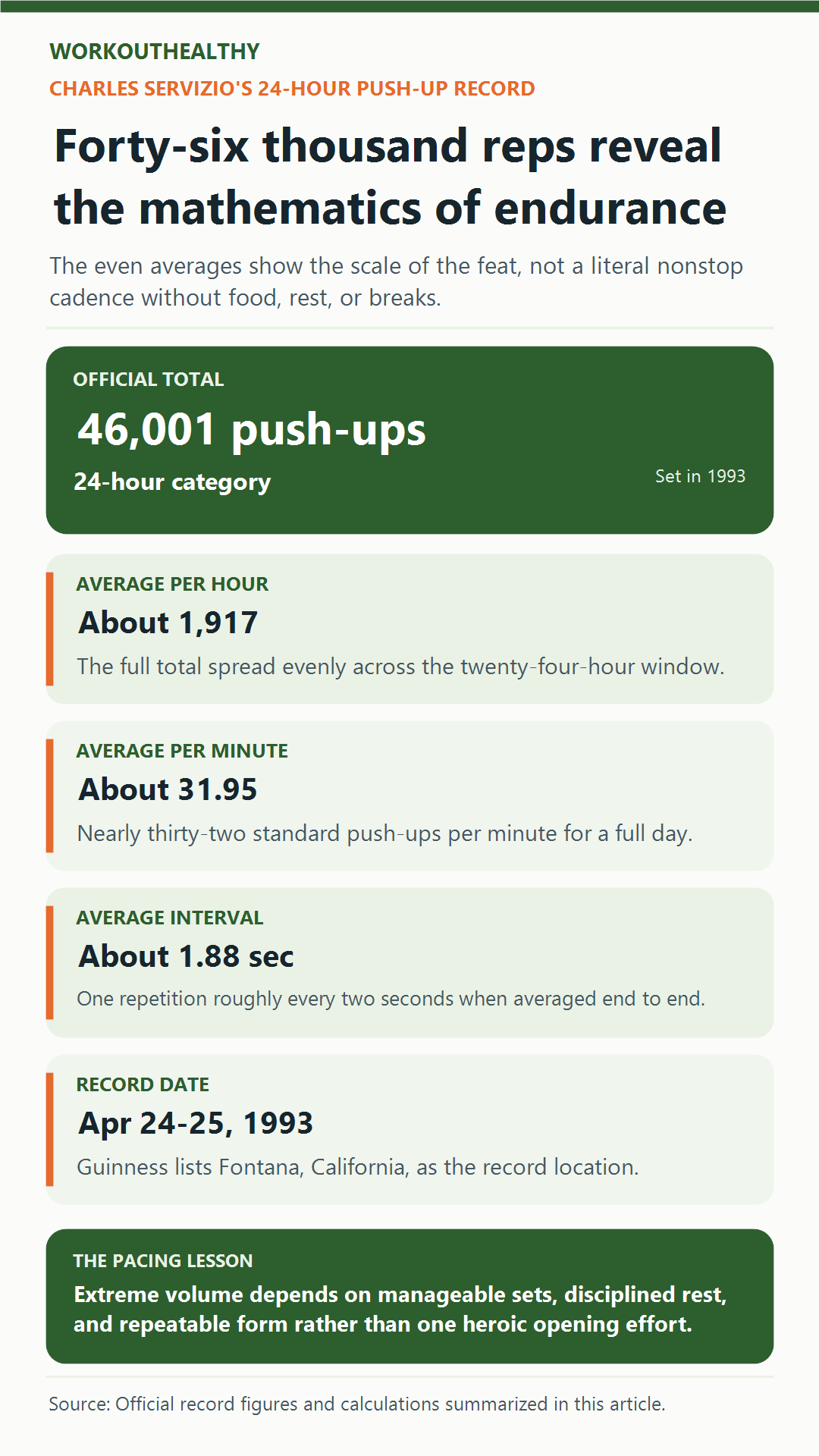
As of September 16, 2026, Guinness World Records still lists Charles Servizio’s 46,001 push-ups in Fontana, California, on April 24 to 25, 1993, as the men’s 24-hour record.
The total is extraordinary, but the official listing is brief. The verified result and the stories told around it are not the same kind of evidence.
What Servizio Actually Did, and What We Verified
The current Guinness World Records listing names Servizio, the 46,001 total, Fontana, and the April 24 to 25, 1993 dates.
Its men’s 24-hour category still names him as holder at the time of this check. Records can change, so that status is dated rather than presented as permanent.
A separate Guinness report from 2015 also called his total unbeaten then. The current category page is the stronger evidence for its status today.
The public listing does not give a set-by-set log, exact active time, bodyweight, or the judging sheet from 1993.
Some retellings say he finished before the full 24 hours expired, but Guinness does not publish an elapsed-time figure on that record page. We cannot verify an exact finishing hour from the official listing.
Guinness has described a straight-body, roughly 90-degree elbow standard for other push-up attempts. That does not prove which specific judging details governed Servizio’s 1993 attempt.
What is solid is the counted total within the named 24-hour record category. Beyond that, precision requires evidence the public record does not provide.
The Math Behind Nearly One Push-Up Every Two Seconds
Spread evenly across a full 24 hours, 46,001 push-ups works out to about 1,917 push-ups per hour.
That is close to 32 push-ups per minute as a full-window average, including any rests. It is not a measured minute-by-minute pace.
Put another way, dividing the full 24-hour window by 46,001 gives roughly 1.9 seconds per push-up. This is WorkoutHealthy arithmetic, not an official split.
No human being holds a pace like that literally nonstop. Nobody sleeps, eats, or uses a bathroom at a dead sprint.
A 24-hour total almost certainly required changes of pace and rest. Without a published set-by-set log, the exact pattern remains unknown.
A record like this is not won in one heroic set.
It is won by refusing to stop showing up for the next short set, over and over, for hours after the excitement wears off.
Why Pacing Beats One Heroic Effort
Sports scientists who study pacing describe a well known pattern across long events.
A 2008 review in the journal Sports Medicine by Chris Abbiss and Paul Laursen looked at how athletes distribute effort across events of different lengths.
Their review found that in longer efforts, athletes typically hold back early rather than going out at their absolute maximum pace.
That restraint protects against the kind of early fatigue that can end an attempt hours before the finish line.
The same logic applies to an event built entirely out of push-up reps instead of miles or minutes on a track.
Applying the review to push-ups suggests that an all-out opening could make the later hours harder. That is an inference, not a documented account of Servizio’s strategy.
How Servizio actually divided the repetitions and breaks is not shown on the official record page. Pacing science offers context, not a reconstruction.
This is the same pacing principle WorkoutHealthy found behind DonnaJean Wilde’s one hour push-up world record, just stretched across a day instead of an hour.
The Muscles and Joints Carrying Every Single Rep
A push-up uses far more than the chest. Stephanie Freeman and colleagues measured muscle activation and spine load across several push-up variations in 2006.
They recorded activity in the chest, triceps, shoulder, abdominal, and back muscles. The study tested individual movements, not a 24-hour record attempt.
It helps explain why maintaining form across many repetitions can tax both the pushing muscles and the trunk that stabilizes them.
It cannot tell us which muscle failed first during Servizio’s attempt or how his technique changed. No published lab measurements from that day are available in the sources we checked.
Why Extreme Volume Is Not a Training Prescription
Cook and Purdam’s 2009 tendon-pathology model describes how repeated loading and recovery interact in tendons. It is a general model, not a study of Servizio or of 46,001 push-ups.
That distinction matters. A one-day world-record attempt exposes wrists, elbows, and shoulders to a volume far beyond an ordinary exercise session, but the public record does not report his injuries or recovery.
The record proves what was counted under Guinness’s category. It does not show that copying the volume is safe, useful, or needed to improve fitness.
A reader with pain or a joint condition should not treat this feat as a plan. The story is about an exceptional performance, not medical or training advice.
What This Record Does Not Prove
The verified number does not prove that extreme repetition builds maximal strength. Muscular endurance and maximal strength overlap, but they are not the same outcome.
It also cannot establish Servizio’s exact set sizes, rest pattern, food intake, or elapsed active time. Those details are not published on the official category page.
The safest conclusion is narrower and more impressive: Guinness currently recognizes 46,001 push-ups by Servizio within its 24-hour men’s category.
A shorter time window changes the pacing question, but it does not make the underlying records interchangeable.
Our Bodyweight & Calisthenics Records hub keeps this feat alongside other verified record categories.
Get the next evidence check.
Five practical fitness stories worth your time, every Friday.
One email a week. No product pitches. Unsubscribe in one click.
References
Abbiss, C. R., & Laursen, P. B. (2008). Describing and understanding pacing strategies during athletic competition. Sports Medicine, 38(3), 239 to 252. https://doi.org/10.2165/00007256-200838030-00004
Cook, J. L., & Purdam, C. R. (2009). Is tendon pathology a continuum? A pathology model to explain the clinical presentation of load-induced tendinopathy. British Journal of Sports Medicine, 43(6), 409 to 416. https://doi.org/10.1136/bjsm.2008.051193
Freeman, S., Karpowicz, A., Gray, J., & McGill, S. (2006). Quantifying muscle patterns and spine load during various forms of the push-up. Medicine & Science in Sports & Exercise, 38(3), 570 to 577. https://doi.org/10.1249/01.mss.0000189317.08635.1b
Medical disclaimer: This article is for general information only and is not medical advice. If you have an injury, ongoing pain, or a medical condition, talk to a doctor or physical therapist before you change how you train or eat.