
Can Exercise Really Heal Knee Cartilage?
A viral physical therapy video makes a bold promise.
It claims that ten specific exercises can heal damaged knee cartilage.
The video goes even further and suggests these moves could help you avoid a knee replacement altogether.
That is an exciting idea if you deal with knee pain.
Millions of people are told they have thinning cartilage or worn joints, and many worry surgery is their only future option.
But cartilage is not like skin or muscle.
It does not have its own blood supply, and it heals very slowly, if it heals at all.
So the real question is this: can targeted exercise actually repair cartilage, or is something else happening when people say their knees feel better?
What the Video Claims About Cartilage and Knee Health
The video comes from El Paso Manual Physical Therapy, a channel run by licensed physical therapists.
It presents ten exercises the creators say can help heal cartilage and protect the knee joint over time.
The framing leans on a common idea in the fitness world, that certain movements can regrow or repair cartilage tissue the same way a muscle rebuilds after a workout.
The video also implies that consistently doing these exercises could remove the need for a future knee replacement.
These are strong, hopeful claims.
They are also the kind of claims that need to be checked against what cartilage research actually shows, not just what sounds encouraging.
This article looks at the video’s core idea, exercise as a way to protect and support knee cartilage, and compares it to the actual science on cartilage biology and joint loading.
Why Research Supports Loading Your Knees, Not Resting Them
Cartilage is the smooth, rubbery tissue that covers the ends of bones inside the knee joint.
It lets your thigh bone and shin bone glide against each other without grinding bone on bone.
Unlike skin or bone, cartilage has no blood vessels and very few cells.
According to a widely cited review of cartilage biology, this lack of blood supply is a major reason cartilage repairs itself so slowly compared to other tissues in the body (Sophia Fox et al., 2009).
Cartilage relies almost entirely on the fluid that moves through it during activity to feed its cells, which is one reason gentle, repeated loading matters so much for joint health.
That fluid movement is not automatic.
It largely depends on a person moving the joint and putting some load through it.
Every time you bend and straighten the knee, fluid moves in and out of the cartilage almost like a sponge being squeezed and released.
Doctors and researchers sometimes call this process joint pumping.
A joint that barely moves gets less of this nutrient exchange, not more.
This is why long term rest is not automatically protective for a joint with early cartilage wear.
Research backs this up directly.
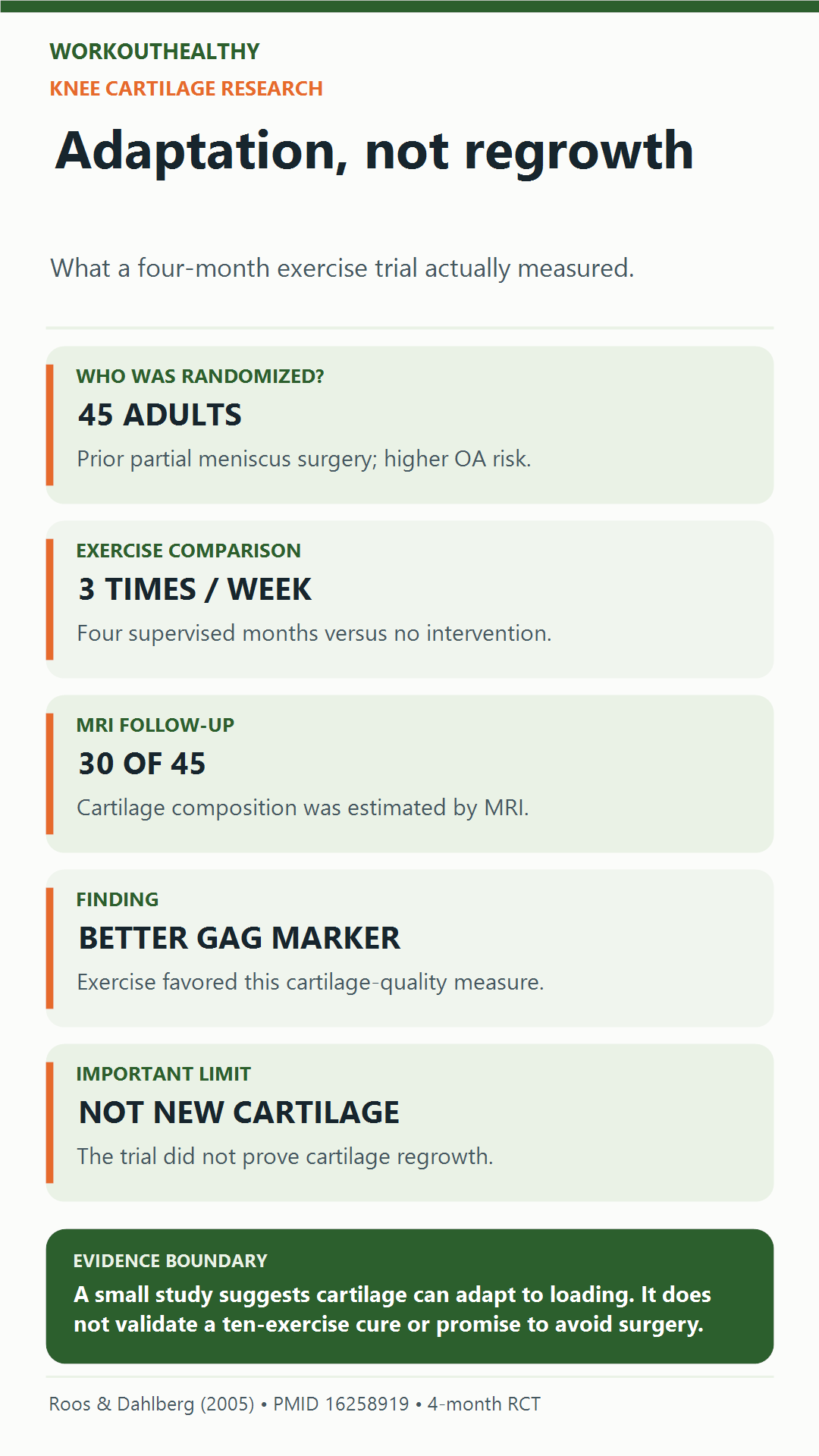
A study published in Arthritis and Rheumatism tracked patients at risk of knee osteoarthritis through a four month, randomized, controlled exercise program (Roos and Dahlberg, 2005).
The researchers found that moderate exercise actually increased the glycosaminoglycan content of knee cartilage, a marker linked to healthier, more resilient cartilage tissue.
That does not mean the exercise regrew cartilage from scratch.
It means moderate, controlled loading appeared to support the tissue that was already there.
Strength also seems to matter beyond the cartilage tissue itself.
A separate study followed people with or at risk of knee osteoarthritis over time and measured quadriceps strength (Amin et al., 2009).
People with stronger quadriceps muscles had a lower risk of cartilage loss and slower symptom progression than people with weaker quadriceps.
Stronger muscles around the knee likely absorb more of the force that would otherwise land directly on the joint surface.
This is probably the real mechanism behind exercises like the ones in the video.
They are not regrowing cartilage tissue.
They are building the surrounding muscle so the joint carries less direct stress.
Readers who want to see how a specific impact based movement affects the body can look at our breakdown of what the research actually shows about box jumps and muscle, since not every loaded exercise affects joints the same way.
What This Evidence Does Not Prove
None of this research proves that exercise heals cartilage the way a cut on your skin heals.
Cartilage has extremely limited capacity to regenerate once it is significantly damaged or worn away.
A large systematic review and network meta-analysis of exercise therapy for knee osteoarthritis, covering 39 randomized trials, found real improvements in pain and function from various forms of exercise (Mo et al., 2023).
It did not find that exercise rebuilds lost cartilage tissue on imaging scans.
The improvements researchers measured were mostly in pain, strength, and movement, not in the actual thickness of cartilage.
This distinction matters a lot.
Feeling less pain and moving better is a genuinely good outcome.
It is just a different outcome than healing cartilage in the literal sense the video’s title implies.
People with advanced cartilage loss or bone on bone arthritis should not expect exercise alone to reverse structural damage that has already happened.
For some people, exercise plus other treatment will manage symptoms well for years.
For others, especially with severe joint damage, surgery may still eventually be necessary regardless of how consistently they exercise.
Body weight also plays a role that exercise alone cannot fully address.
Carrying extra weight increases the force that travels through the knee with every step, which is a separate factor from cartilage biology itself.
Common Mistakes People Make Chasing Cartilage Repair
The biggest mistake is treating a heal your cartilage claim as a guarantee rather than a possibility worth exploring carefully.
Another common mistake is doing too much too soon.
Someone excited about a new exercise list may jump into high volume training on a knee that has not tolerated much loading in months or years.
That sudden jump in stress can cause pain flares that have nothing to do with whether the exercises are good ones.
People also frequently skip the strength building basics and go straight for trendy or complicated movements.
Simple, well known exercises like sit to stands, step ups, and controlled squats have far more research behind them than most viral exercise lists.
Ignoring pain signals is another frequent error.
Mild muscle fatigue during exercise is normal.
Sharp or worsening joint pain, swelling, or a knee that gives way are signals to stop and reassess, not signs to push through.
Many people also stop tracking their overall daily activity while over focusing on a short list of exercises.
Skipping a proper warm up before loading a sensitive knee is another avoidable mistake.
A few minutes of easy walking or cycling before strength work helps the joint tolerate load better.
Readers curious about a simple way to gauge lower body function might find our look at the four flights of stairs test useful, since everyday movement capacity matters just as much as any single exercise routine.
Who Should Check With a Doctor or Physical Therapist First
Exercise is generally safe for most people with knee pain, but a few groups should get individual guidance before starting a new program.
Anyone with an existing diagnosis of moderate to severe knee osteoarthritis should talk to a doctor or physical therapist before changing their routine.
The same goes for anyone recovering from a recent knee injury, including a meniscus tear, ligament sprain, or fracture.
People who have had recent knee surgery need a plan built around their specific healing timeline, not a generic exercise list from a video.
Anyone considering or already approved for a knee replacement should also check first.
Our article on Misty Copeland’s hip replacement recovery shows how individualized and gradual real joint replacement rehabilitation actually is, which applies to knees as well as hips.
People with sudden, unexplained knee swelling, locking, or instability should see a doctor before doing any of these exercises, since those symptoms can point to something that needs medical evaluation first.
Anyone managing an autoimmune joint condition, like rheumatoid arthritis, should also loop in their care team, since flare timing changes what exercise looks like week to week.
Older adults starting a new strength routine for the first time in years may also benefit from at least one session with a physical therapist to check form before training alone.
Safe Exercises That May Support Knee Cartilage Health
The exercises most likely to help, based on the research above, share a few features.
They load the knee gradually.
They build strength in the quadriceps, hamstrings, and hips.
They avoid sudden, high impact stress on a joint that is not ready for it.
Bodyweight squats to a comfortable depth are a reasonable starting point for most people.
Step ups onto a low, stable surface build single leg strength in a controlled way.
Wall sits and other isometric holds let a person strengthen the quadriceps without moving the joint much at all.
Straight leg raises are useful for people who cannot yet tolerate a full squat or step up.
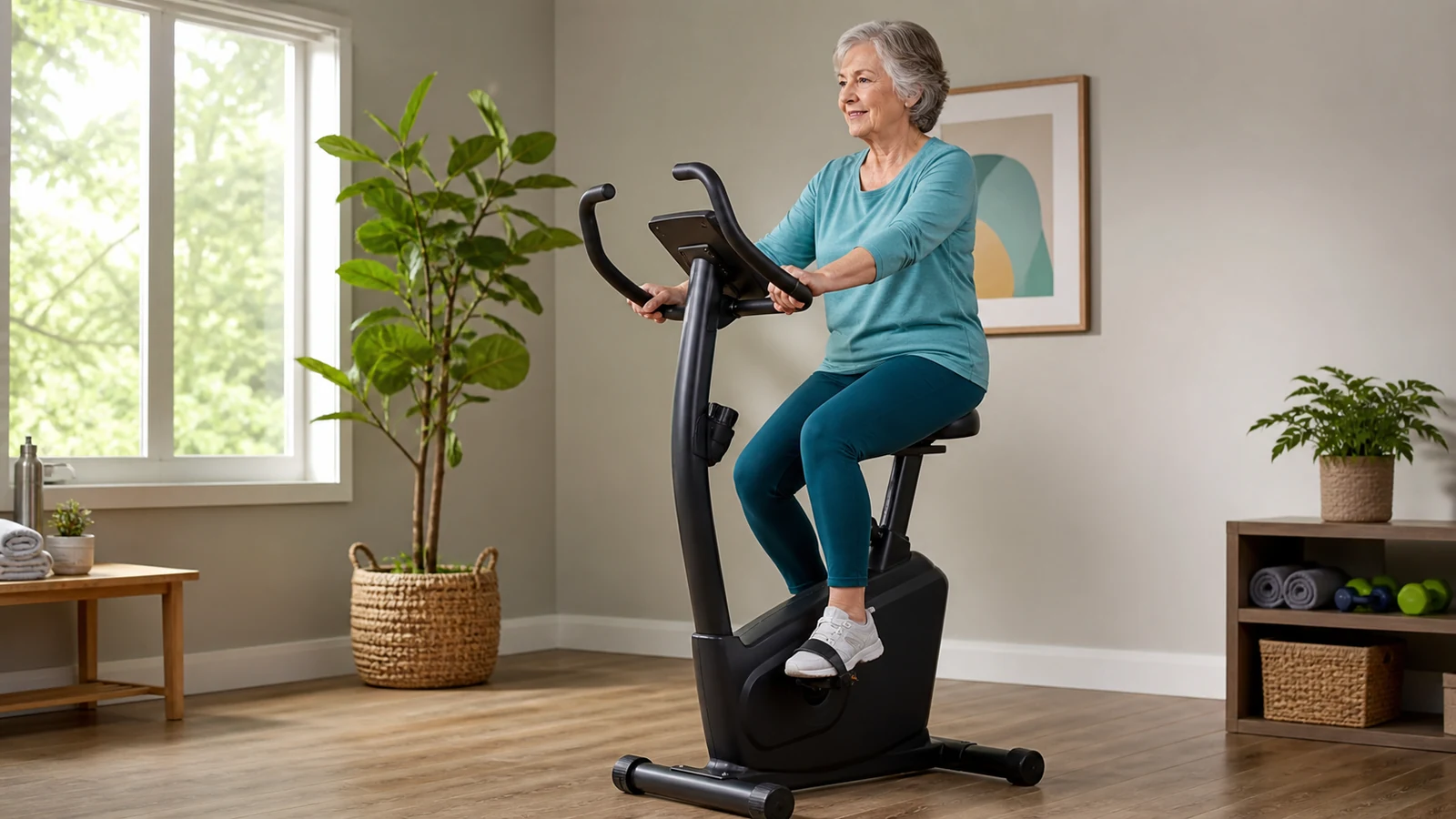
Stationary cycling with light resistance is a low impact way to move the joint frequently, which supports the fluid exchange cartilage depends on.
An elliptical machine offers a similar low impact option for people whose knees do not tolerate running.
Walking remains one of the simplest, best studied ways to keep the whole lower body active.
Our guide on how many miles you should walk a day breaks down practical targets that fit alongside a strength routine like this one.
Most people do well starting with two to three sessions a week, leaving at least one rest day between sessions early on.
The goal is not a dramatic before and after picture, but steady, unglamorous loading repeated over many months.
Progress slowly, add resistance or reps every couple of weeks rather than every session, and expect changes in pain and function to show up over months, not days.
Watch the Original Video
Want more like this? Subscribe to WorkoutHealthy Insider for practical explanations behind popular fitness claims.
References
Amin, S., Baker, K., Niu, J., Clancy, M., Goggins, J., Guermazi, A., Grigoryan, M., Hunter, D., & Felson, D. (2009). Quadriceps strength and the risk of cartilage loss and symptom progression in knee osteoarthritis. Arthritis and Rheumatism, 60(1), 189 to 198. https://doi.org/10.1002/art.24182
Mo, L., Jiang, B., Mei, T., & Zhou, D. (2023). Exercise therapy for knee osteoarthritis: A systematic review and network meta-analysis. Orthopaedic Journal of Sports Medicine, 11(5). https://doi.org/10.1177/23259671231172773
Roos, E. M., & Dahlberg, L. (2005). Positive effects of moderate exercise on glycosaminoglycan content in knee cartilage: a four-month, randomized, controlled trial in patients at risk of osteoarthritis. Arthritis and Rheumatism, 52(11), 3507 to 3514. https://doi.org/10.1002/art.21415
Sophia Fox, A. J., Bedi, A., & Rodeo, S. A. (2009). The basic science of articular cartilage: structure, composition, and function. Sports Health, 1(6), 461 to 468. https://doi.org/10.1177/1941738109350438
This article is for general information only and is not medical advice. If you have an injury, ongoing pain, or a medical condition, talk to a doctor or physical therapist before you change how you train or eat.