
Your feet touch the ground on every single rep.
They touch down on every sprint, every jump, and every cut.
Most training plans still skip right over them.
A lot of online fitness content now argues that flat arches, stiff big toes, and weak foot muscles quietly limit how explosive you can be.
The same content often claims that fixing foot posture also lowers your injury risk.
Those are big claims for two small feet to carry.
So we looked at the actual research behind foot strength, jump power, and injury risk to see what holds up.
What “Foot Posture” Actually Means
Foot posture is not just about flat feet versus high arches.
It refers to how well your foot’s small muscles, joints, and connective tissue work together under load.
Your foot has more than 20 bones, over 100 muscles, tendons, and ligaments, and a network of small intrinsic muscles that live entirely within the foot itself.
Those intrinsic muscles support the arch, control how your toes grip the ground, and help manage force when you push off.
Most people never train them on purpose.
Cushioned shoes support the arch for you, so the muscles underneath rarely have to work hard.
Standing on hard floors for hours, a habit our guide to standing versus sitting covers in more detail, adds fatigue without necessarily adding strength.
Over years, that combination can leave the foot’s own muscles weak and undertrained, even in people who train everything else hard.
What the New Research Found
A 2025 randomized controlled trial gives the clearest look yet at whether foot strengthening changes explosive performance.
Tourillon and colleagues assigned 28 highly trained athletes to either an 8 week forefoot strengthening program or a control group.
The training group did two sessions a week.
One session was supervised and lasted about 35 minutes.
The other was done at home in about 30 minutes.
The exercises targeted the muscles that flex the big toe and the ball of the foot, using isometric holds, some with electrical stimulation, plus small rebound jumps done specifically through the forefoot.
Compliance was excellent, with participants completing more than 92% of both supervised and home sessions.
After 8 weeks, toe flexion strength rose by roughly 30%, a large jump by research standards.
Horizontal jump distance improved significantly too, with a moderate to large effect size.
Cutting speed, the ability to change direction quickly at a sharp angle, also improved on both feet.
Sprinting speed itself did not improve overall.
But the athletes did produce significantly more vertical force late in a sprint, when running near top speed.
Vertical jump height improved only slightly, and the gain was too small to call clinically meaningful for most athletes.
Notably, most of these improvements were still present a month after the athletes stopped the specific foot training, which suggests a real adaptation rather than a short lived warm up effect.
Eight weeks of forefoot strengthening did not turn these athletes into faster sprinters. It made them noticeably better at pushing off sideways and driving force late in a sprint, which matters just as much for most sports.
The Mechanism: Why Foot Strength Might Affect Power
To understand why foot training would change jump or cutting performance, it helps to know how researchers think about the foot itself.
A widely cited 2015 paper in the British Journal of Sports Medicine described the foot as its own “core system.”
The idea borrows directly from how trainers think about the trunk.
Just like your spine needs both passive structure (bone and ligament) and active muscle control to stay stable under load, your foot needs the same two things working together.
The bones and ligaments of the arch provide passive support.
The intrinsic foot muscles provide active support, tightening to stiffen the arch the instant your foot hits the ground.
That stiffening matters for power output.
A foot that collapses too much under load acts like a soft spring.
Some of the force your leg generates gets absorbed by the foot itself instead of being transmitted into the ground and back up through your body.
A foot that can stiffen appropriately, at the right moment, transmits more of that force efficiently.
This is the same principle behind why athletes who do plyometric jump training like box jumps often see gains in power that go beyond simple muscle size, because tendons and connective tissue, including in the foot, get better at storing and releasing energy quickly.
Big toe function plays a specific role here too.
Your big toe helps lock the arch into a rigid lever right before push off, a mechanism sometimes called the windlass effect.
A stiff, weak, or poorly mobile big toe can blunt that lever action.
That is one reason the Tourillon study targeted toe flexion strength specifically, rather than general foot strength.

The Injury Prevention Evidence
Explosiveness is only half the claim in most foot posture content.
The other half is injury prevention, and here the evidence runs deeper.
A 2020 study published in the American Journal of Sports Medicine followed 118 recreational long distance runners for a full year.
Taddei and colleagues put 57 runners through an 8 week foot and ankle strengthening program, then tracked injuries in both that group and a 61 person control group for 12 months.
The results favored the training group by a wide margin.
Runners in the control group were about 2.4 times more likely to suffer a running related injury over the study period.
The protective effect became most noticeable between 4 and 8 months into the study, suggesting the benefit builds gradually rather than appearing overnight.
Foot strength gains and improvements in foot posture score both tracked with how long it took someone to get injured.
This does not prove foot training prevents every injury type.
The study tracked general running related injuries, a broad category that includes things like shin pain, knee pain, and Achilles issues, not just plantar fascia problems or ankle sprains specifically.
Still, a nearly two and a half times difference in injury rate is a meaningful signal, especially from a randomized trial rather than an observational study.
Runners who skipped the foot training were roughly two and a half times more likely to get hurt over the following year than runners who did eight weeks of it.
What This Evidence Does Not Prove
It is worth being honest about the limits here.
The explosiveness study used only 28 athletes, split across two groups.
That is a real, well designed trial, but it is still a small sample, and results in a bigger, more varied group of athletes could look different.
Vertical jump height, the single number most people care about most, barely moved in that study.
The clearest gains showed up in horizontal jumping, cutting, and late stage sprint force, not in how high someone can jump straight up.
The injury study also has a gap.
It only followed recreational runners.
Whether the same protective effect shows up in basketball players, sprinters, or field sport athletes has not been directly tested the same way.
Neither study proves that foot training alone can replace strength training for the hips, hamstrings, or calves.
Foot strength appears to be one contributing piece of a larger system, not a replacement for the rest of it.
Finally, both studies used structured, supervised programs lasting 8 weeks.
A few sets of toe curls done occasionally is a different exposure than what these athletes actually did.
Common Mistakes People Make When Training Foot Strength
The biggest mistake is expecting fast results.
Both studies that showed real change ran for a full 8 weeks, with sessions happening twice a week.
A single foot workout will not rebuild years of undertrained foot muscles.
Another common mistake is confusing foot care with foot training.
Rolling your foot on a ball or getting a foot massage can feel great and may ease tension.
Neither one builds the active strength that stiffens your arch under load.
Those are recovery tools, not training tools, and the research above does not support treating them as substitutes.
People also tend to skip the big toe specifically.
Most foot exercise routines focus on the arch and forget that toe flexion strength was the primary target in the explosiveness study.
A final mistake is jumping straight into high volume barefoot training or minimalist shoes without building foot strength first.
Removing cushioning and support before the muscles underneath can handle the new demand is a common way people end up sore or hurt, not stronger.
Who Should Check With a Doctor First
Foot training is not risk free for everyone.
Anyone with a current plantar fasciitis flare, a stress fracture, or a recent ankle sprain should get cleared before adding new foot loading.
People with diabetes, peripheral neuropathy, or any condition that reduces feeling in the feet need medical guidance first, since reduced sensation makes it harder to notice early signs of overuse.
A structural issue like severe flat feet, a rigid high arch, or a bunion that is already causing pain deserves a proper evaluation from a podiatrist or physical therapist.
That professional can confirm whether foot strengthening is appropriate or whether the shape of the problem calls for a different approach first.
Anyone training for a specific sport at a competitive level should also loop in a coach or physical therapist before changing footwear habits or adding a new loading program, since the wrong progression can interact badly with an already high training load.
How to Rebuild Foot Posture: A Step by Step Guide
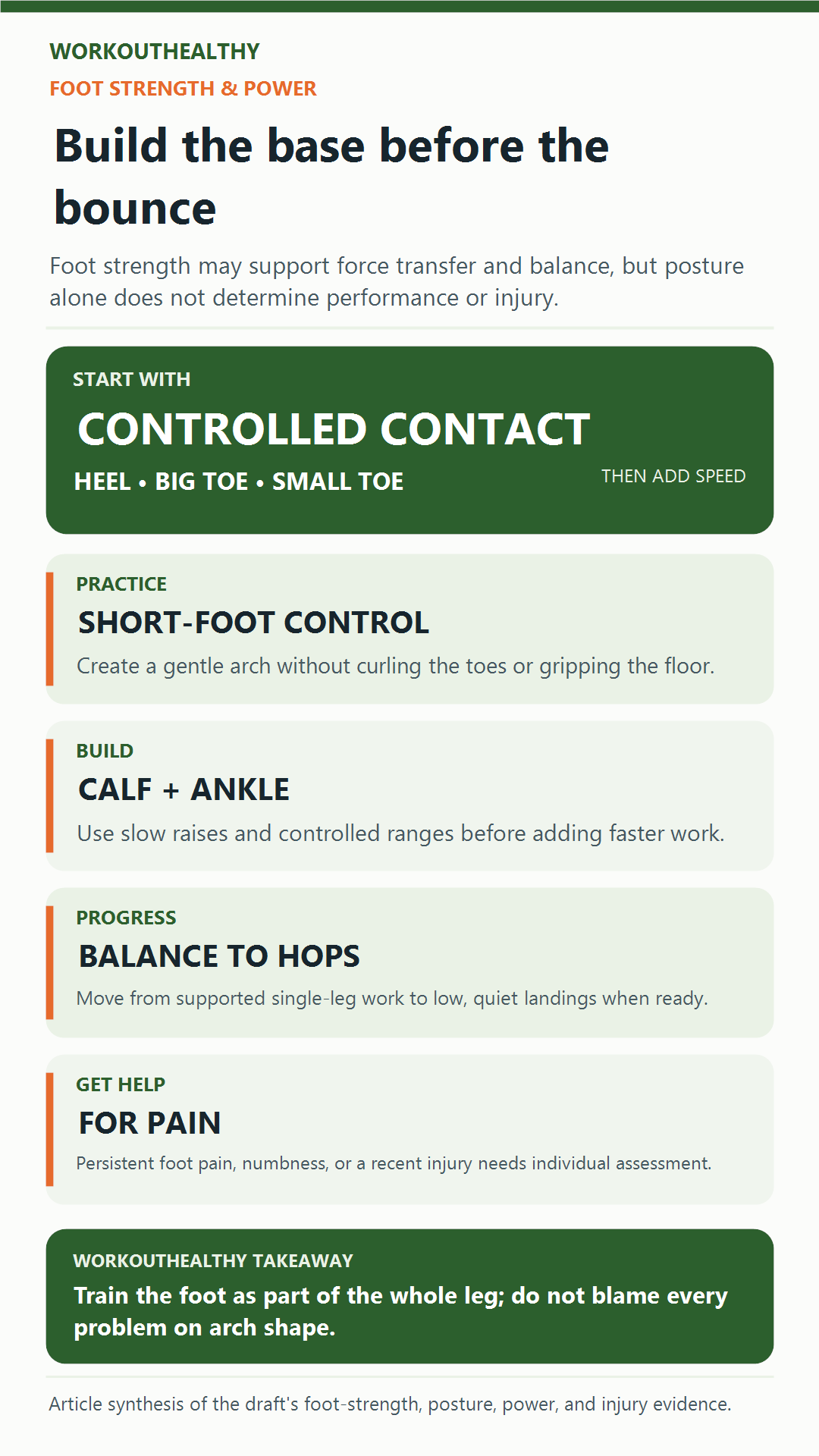
The programs in the research above followed a similar shape, so this walks through a comparable, conservative version.
Always check the “who should check with a doctor” section above before starting.
Step 1: Test where you are.
Stand barefoot and try to lift your big toe off the ground while keeping the smaller toes flat.
Then try the reverse, pressing the big toe down while lifting the smaller toes.
Most untrained feet struggle to separate the two movements at first, and that is useful information, not a failure.
Step 2: Start with the short foot exercise.
Sit with your foot flat on the floor.
Without curling your toes, try to shorten your foot by pulling the ball of the foot toward the heel, drawing the arch upward.
Hold for 5 seconds, then release.
Do 2 to 3 sets of 8 to 10 reps per foot, most days of the week.
Step 3: Add toe flexion work.
Since big toe strength was the specific target in the explosiveness study, add direct work for it.
A simple version is pressing the big toe down into a towel or the floor while keeping the rest of the foot relaxed, holding for 5 seconds per rep.
Towel scrunches, curling a towel toward you using only your toes, are another accessible option.
Step 4: Progress to standing and single leg work.
Once the seated version feels easy, perform the same short foot hold while standing.
Progress further by holding it on one leg, then by adding a slight forward lean.
This step connects the strength work to the postures your foot actually has to control during real movement.
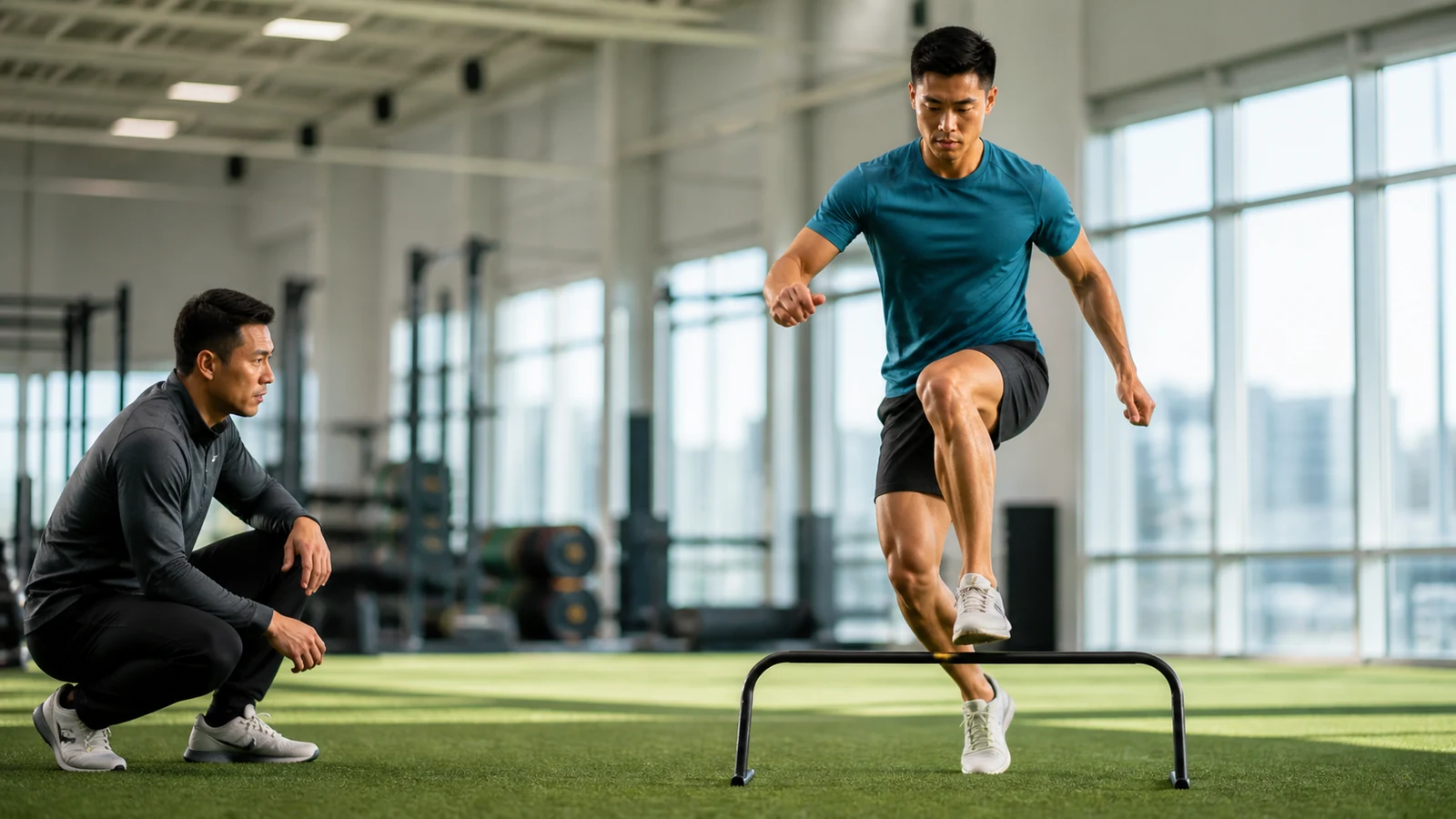
Step 5: Add controlled rebound work.
The explosiveness study used small rebound jumps through the forefoot as part of its protocol.
A simple version is a series of low, quick ankle hops, landing softly on the ball of the foot each time.
Keep the reps low at first, around 10 to 15, and focus on quiet, controlled landings rather than height.
Step 6: Reintroduce less supportive footwear gradually.
If you want to move toward less cushioned or more minimalist shoes, do it slowly, over weeks, not days.
Start by wearing them for short walks or warm ups only.
Our guide to daily walking distance covers footwear features worth considering, including flexible soles and a roomier toe box, as you make this transition.
Step 7: Give it real time.
Both studies referenced here ran for a minimum of 8 weeks, with two sessions a week.
Track toe strength, jump distance, or simply how your feet feel after a hard training session, and expect gradual change over that timeframe rather than an instant fix.
Watch the Original Video
Want more evidence based breakdowns like this one? Subscribe to WorkoutHealthy Insider for practical explanations behind popular fitness claims.
References
McKeon, P. O., Hertel, J., Bramble, D., & Davis, I. (2015). The foot core system: A new paradigm for understanding intrinsic foot muscle function. British Journal of Sports Medicine, 49(5), 290. https://doi.org/10.1136/bjsports-2013-092690
Taddei, U. T., Matias, A. B., Duarte, M., & Sacco, I. C. N. (2020). Foot core training to prevent running-related injuries: A survival analysis of a single-blind, randomized controlled trial. American Journal of Sports Medicine, 48(14), 3610 to 3619. https://doi.org/10.1177/0363546520969205
Tourillon, R., Fourchet, F., Edouard, P., & Morin, J. B. (2025). Effects of a forefoot strengthening protocol on explosive tasks performance and propulsion kinetics in athletes: A single-blind randomized controlled trial. PLOS ONE, 20(6), e0313979. https://doi.org/10.1371/journal.pone.0313979
This article is for general information only and is not medical advice. If you have an injury, ongoing pain, or a medical condition, talk to a doctor or physical therapist before you change how you train or eat.