
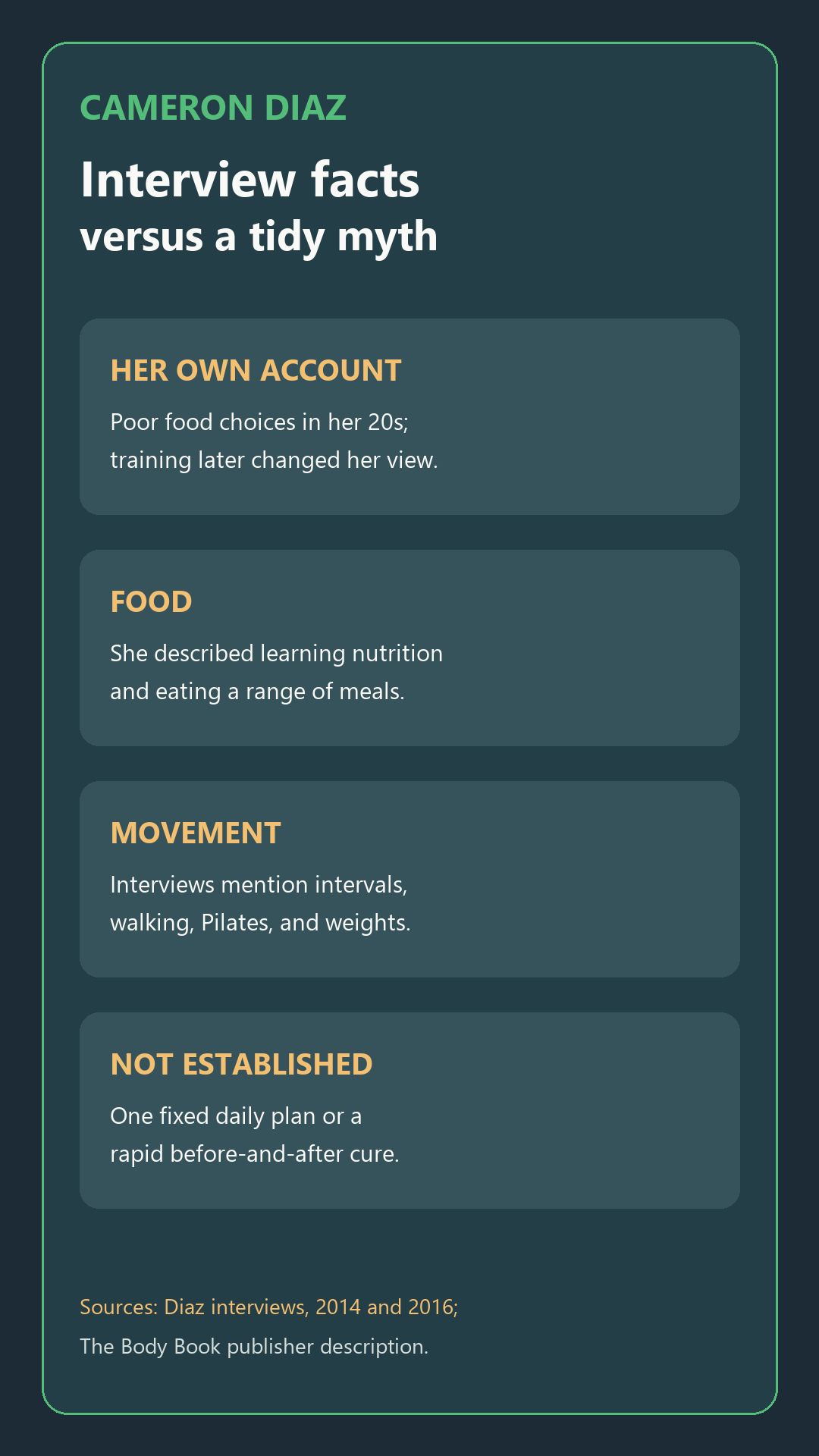
Cameron Diaz has spoken candidly about eating poorly in her 20s, then learning to pay closer attention to food and movement. The social post tied to this article turns that history into a tidy before-and-after story: junk food out, whole foods and interval training in. Her own interviews support the broad direction, but the timeline and day-to-day routine are more varied than a single graphic can show.
Diaz has described the physical training for Charlie’s Angels as a turning point in her relationship with exercise. She later wrote The Body Book to encourage a more informed relationship with food, strength, and the body. She also described short treadmill intervals, weight training, Pilates, hiking, and simply staying active. The useful takeaway is a pattern of learning and adaptation, not a celebrity diet to copy exactly.
Did Cameron Diaz say she used to eat junk food?
Yes. In a 2014 interview with the Los Angeles Times, Diaz said that in her 20s she smoked, ate badly, and lacked much drive to do something with her body. She identified the intensive martial-arts preparation for Charlie’s Angels as the experience that showed her what her body could do. That is a firsthand description of a change in perspective. It does not establish that her later eating became flawless, or that one particular food caused a measurable health outcome.
Other interviews from that period mention familiar fast food and convenience choices. People sometimes turn those details into a dramatic “junk-food addict to clean eater” formula. Diaz’s own longer account is less theatrical. In a 2016 Bon Appétit conversation, she said she had been conscientious about nutrition since her mid-30s and that good nutrition was not something she had grown up knowing. That suggests a gradual education and adjustment across years rather than a one-week transformation.
Her comments are personal history, not a controlled study. They also come from different ages and career stages. A 2014 training interview and a 2016 breakfast description should not be combined into a claim that she eats and trains in precisely the same way today. The social caption’s general lesson about gradual progress is reasonable; its simplified chronology should be read as a summary, not a documented program.
What did her food shift look like in practice?
Diaz has described paying more attention to how food supports her energy and activity. In the Bon Appétit interview, she gave concrete examples of a first breakfast before a workout—such as eggs, toast, avocado, oats, or fruit with nut butter—and a fuller meal afterward with chicken, grains, and vegetables. These were examples of her routine at that time, not an assigned plan for readers. They show ordinary meals rather than a rule to ban every convenience food.
She also linked nutrition with sleep, physical activity, social connection, and purpose when discussing well-being. That is a broader message than “eat clean.” It makes room for recovery and the rest of life. It also avoids suggesting that someone can solve every health problem by replacing one snack or copying a famous person’s breakfast.
Celebrity coverage often labels food “good” or “bad” in a way that can make eating feel like a moral test. The stronger practical idea is to include more foods that help you meet nutrient needs—vegetables, fruit, grains, and protein sources you enjoy—while making convenient choices work for your schedule. A packaged meal can be useful; a “whole food” label alone does not tell you whether a meal is balanced or affordable.
The repeatable part of Diaz’s story is learning what helps her feel and function better. A rigid imitation of her menu misses that point.
What is the philosophy in The Body Book?
The publisher’s description presents The Body Book as a guide to nutrition, movement, strength, and the mind-body connection, rooted in Diaz’s own experience and an interest in how the body works. It explicitly says the book does not set a seven-day or thirty-day goal. That matters because a social-media before-and-after graphic can make her message look like a fast makeover. The book’s positioning is a long-term approach to caring for the body.
In her 2014 Los Angeles Times interview, Diaz said she did not offer one diet or fitness plan for everyone. She discussed experimenting with foods and emphasized that carbohydrate can be useful fuel for active people. Her movement examples ranged from hiking and Pilates to weight training. This is more flexible than a single “intervals plus whole foods” prescription.
The title’s attention to understanding and loving the body also needs care in an article about a celebrity image. Health literacy means being able to evaluate claims, recognize uncertainty, and make workable choices. It is not a promise that learning anatomy will change appearance. Diaz’s own writing is a personal perspective, not a substitute for individualized medical or nutrition advice.
Did Cameron Diaz describe interval training?
Yes. In a 2014 SELF interview, she described doing brief treadmill intervals during gym visits. She also said that some days she went to the gym for a very short time and valued showing up. These are firsthand reports of what she did then. They do not prove that she follows the same schedule now or that everyone should try her stated treadmill speed.
Her broader exercise descriptions include hiking, Pilates, walking quickly in a city, and heavy weight training. Interval training is one tool within that mix. A five-minute interval bout can be a useful way to move on a busy day, but it does not replace a full weekly activity pattern by itself. If you are new to exercise, a maximal sprint on a treadmill is a poor place to start. Easier pace changes while walking or cycling can teach the same work-and-recovery rhythm with more control.
The Facebook caption says interval training “builds cardio fitness efficiently in less total time than steady cardio alone.” That is plausible in some protocols, but not a guarantee for every five-minute session. Training studies vary in interval length, intensity, total work, and comparison program. For examples of different ways to structure pace changes, see our running workout guide.
What does interval-training research actually support?
A meta-analysis of 53 randomized trials found that high-intensity interval training can improve maximal oxygen uptake, a measure of cardiorespiratory fitness. Short and low-volume protocols improved fitness compared with doing no training in the included studies. When compared directly with moderate continuous training, the results depended on the length and volume of the interval program; longer, higher-volume programs had clearer advantages in that analysis. The main point is that interval training works, not that every short burst is automatically superior.
Another review of middle-aged and older adults found improvements with both interval and moderate continuous training, with an average advantage for intervals in that particular set of studies. Participants, protocols, and supervision varied. These group averages do not tell us which format a person will enjoy, tolerate, or maintain. Steady walking and cycling are valuable, especially when hard intervals are unpleasant or inappropriate.
U.S. physical activity guidelines recommend adults accumulate 150 to 300 minutes of moderate aerobic activity per week, or the vigorous equivalent, plus muscle-strengthening activity on at least two days. Short sessions count toward the total. Diaz’s reported mix of intervals, walking, and lifting illustrates variety, but it is the repeatable weekly pattern that matters. Our interval-training timing guide offers more detail for people building a harder session.
Does eating more whole food require perfection?
No. A more useful target is a dietary pattern with enough produce, grains, protein sources, and other foods that meet your needs. USDA MyPlate materials advise making half the plate fruits and vegetables, making half of grains whole grains, and limiting added sugar, saturated fat, and sodium. These are practical guides, not a requirement to prepare every ingredient from scratch or avoid all packaged food.
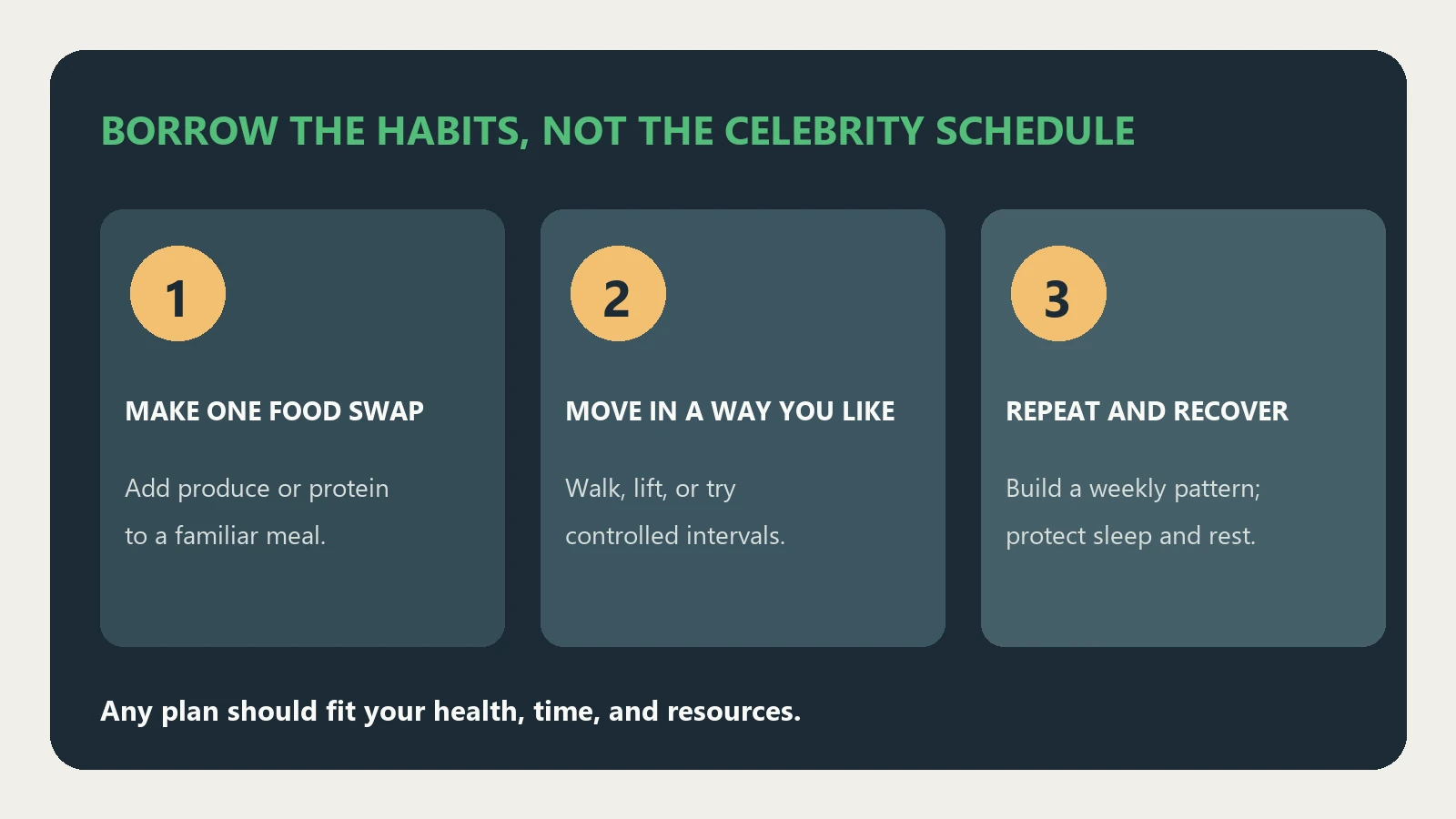
Start with one repeatable change. Add a vegetable to a meal you already make, choose fruit with breakfast, or keep a protein option available when time is tight. Prepared and frozen foods can help. The point is to make a better default easier, especially when work and family demands are real. Diaz had resources, a training role, and professional support that many readers do not have. The sensible part to borrow is a willingness to learn and adjust; the exact menu is not a universal blueprint.
Nutrition does not work in isolation. Physical activity, sleep, stress, access to food, medical conditions, and personal preferences shape what is sustainable. If food rules cause anxiety or make eating harder, speak with a qualified clinician or dietitian. For another example of a celebrity food shift with important context, see our Arnold Schwarzenegger plant-forward diet review.
What realistic habits can a reader take from this story?
First, identify one ordinary meal that could use more nutrient variety. Add produce or a protein source without requiring the meal to become photogenic. Repeat that change until it is easy. Second, pick an activity you are willing to do this week. That could be a walk, a simple strength session, or short controlled intervals. Third, protect recovery. A training pattern that erodes sleep or makes you dread the next session is unlikely to last.
If you want to try intervals, warm up, alternate a comfortable faster pace with a slower recovery pace, and cool down. Keep the fast portions controlled enough that your form stays steady. Build duration and intensity gradually, especially if you have been inactive. A person with cardiovascular symptoms or a condition that affects exercise tolerance should follow medical guidance rather than copy a celebrity routine.
Track useful signals over weeks: whether you are showing up, whether meals leave you satisfied, and whether the exercise feels more manageable. Appearance can change for many reasons and is a poor daily measure of health. Diaz’s public message is most useful when it helps someone make informed, durable choices rather than pursue an exact replica of her body or schedule.
What does the Facebook illustration leave out?
The post’s image is a 3D illustration. It is not a photo of Diaz doing the depicted workout, a record of an event, or proof of a specific diet. The overlay’s message compresses years of interviews into a single line. Her own accounts verify that she talked about poor eating in her 20s, later nutrition awareness, and exercise that included intervals. They do not establish one permanent, precisely timed “junk food to whole foods and intervals” protocol.
What can be said with confidence is simpler: she has described a gradual change in how she thinks about food and movement, and she has advocated learning how the body works rather than relying on quick fixes. Research supports both balanced eating patterns and regular physical activity. Interval training is one effective way to build fitness, while steady activity and strength training also have clear roles. You can use that evidence without adopting celebrity rules or demanding perfection.
Sources
- Cameron Diaz interview, Los Angeles Times, 2014, her earlier habits and varied exercise.
- Cameron Diaz interview, Bon Appétit, 2016, breakfast examples and broader well-being.
- Cameron Diaz interview, SELF, 2014, short gym sessions and intervals.
- The Body Book publisher description, long-term food and movement philosophy.
- HIIT protocol meta-analysis, 2019, cardiorespiratory fitness outcomes.
- Interval versus continuous training review, 2021, middle-aged and older adults.
- USDA MyPlate menu guide, practical food-group targets.
- U.S. Physical Activity Guidelines, weekly aerobic and strength recommendations.