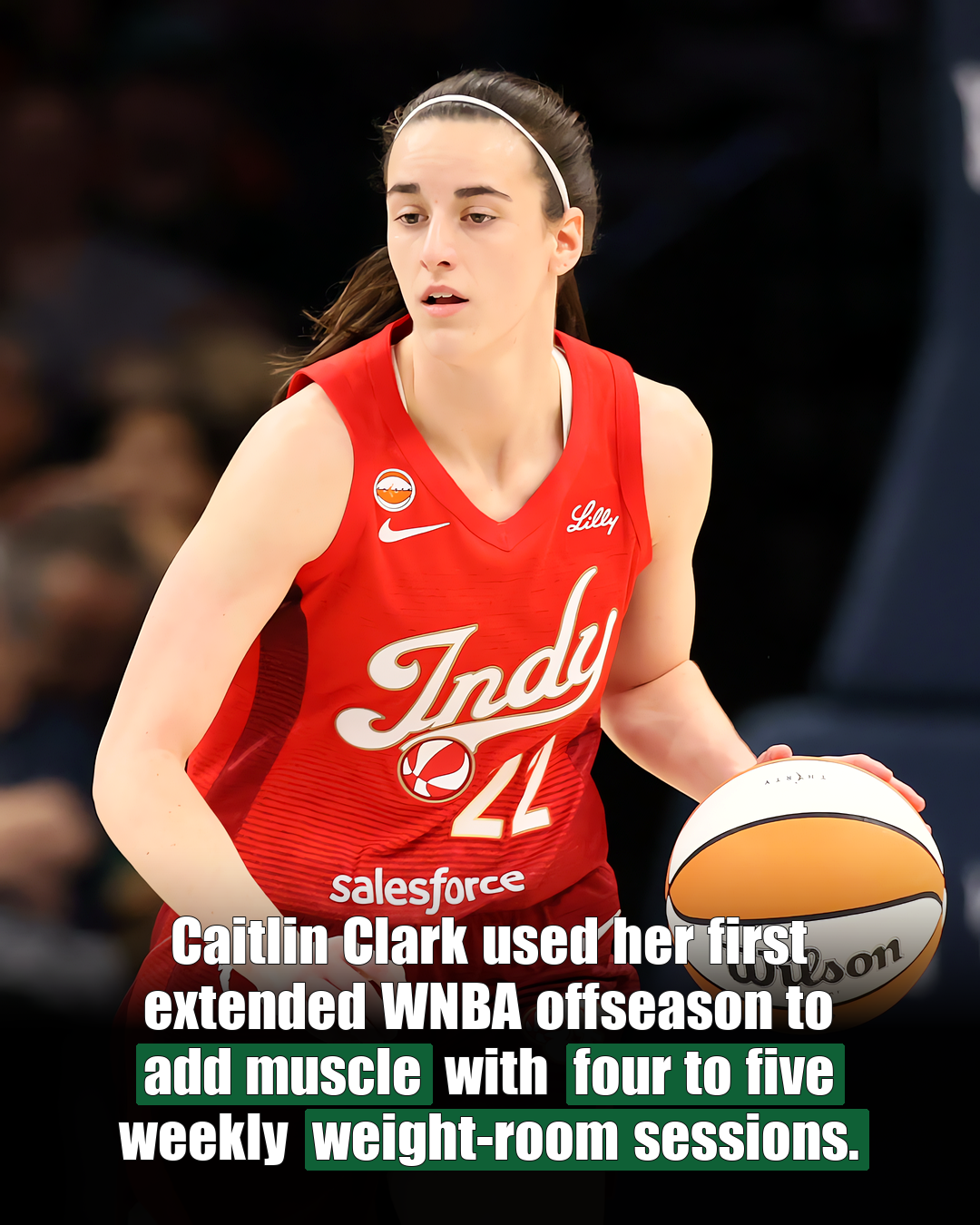

Caitlin Clark spent an offseason building noticeable strength in the weight room. Then her groin gave out anyway, twice, and ended her 2025 season early.
That combination sounds contradictory. It is not.
Her story is a useful window into how strength training actually works for a change of direction athlete, and why general strength alone does not guarantee protection from a specific kind of injury.
Who Caitlin Clark Is and What Happened in 2025
Clark is the Indiana Fever point guard who arrived in the WNBA as one of the most hyped rookies in league history.
Her 2024 rookie season drew record television audiences to women’s basketball, and expectations for her follow-up season were enormous.
Between her rookie season and 2025, reporting from ESPN described a visible change in her physique.
That included added arm size and tone that fans noticed right away.
That offseason work was built around a specific weight room program, one designed to make her stronger and more explosive heading into her second year.
The 2025 season did not go the way that offseason suggested it might. Clark suffered a left quad strain that sidelined her for three weeks, then a left groin injury that cost her two more weeks.
She returned, but on July 15, 2025, a right groin injury began that never fully resolved.
A left ankle bone bruise, picked up while rehabbing the groin, added yet another setback on top of it.
On September 5, 2025, Clark announced she would not return for the rest of the season.
She had appeared in only 13 games that year. She still averaged 16.5 points and 8.8 assists, and was named an All-Star despite the limited availability.
She described the situation in her own words: “I spent hours in the gym every day with the singular goal of getting back out there, disappointed isn’t a big enough word to describe how I am feeling.”
What Her Strength Training Actually Looked Like
According to ESPN’s reporting on her 2024 to 2025 offseason program, Clark worked in the weight room four to five times per week.
The program was designed by Sarah Kessler, the Fever’s head athletic performance coach, and was tailored specifically to Clark’s game and body.
The training emphasized single-leg exercises meant to build explosiveness. It also included isometric exercises, which involve holding a position under tension rather than moving through a full range of motion, aimed at improving time under tension and a lower center of gravity.
Single-arm exercises were part of the plan too. Reporting noted that Clark’s left arm had previously been a weak point for certain passes, so the program worked to even out strength between her two sides.
She also added creatine, a widely studied supplement that helps muscles produce energy faster during short, intense efforts like sprints and jumps.
Creatine is one of the most researched supplements in sports science. Decades of studies support its safety and its ability to help athletes push a little harder in short, repeated bursts of effort, exactly what a basketball possession requires.
The Exercise Science Behind Single-Leg and Isometric Work
Basketball is not a symmetrical sport. Guards plant on one leg to cut, decelerate on one leg to change direction, and jump off one leg as often as two.
Traditional strength training, built around bilateral lifts like the back squat, trains both legs together.
That builds general leg strength. But it does not necessarily train the stability and force control an athlete needs on a single leg, at game speed, under fatigue.
Single-leg exercises close that gap. Isometric holds add another layer, teaching muscles and tendons to handle sustained tension without collapsing.
That matters when an athlete has to stick a hard landing or hold a defensive stance for several seconds at a time.
This kind of training is standard in modern strength and conditioning for basketball. It is a reasonable, well supported way to build the specific qualities the sport demands, similar in spirit to how plyometric jump training builds power and coordination in other explosive sports.
Why Groin and Hip Injuries Happen Anyway
General leg strength and groin specific strength are not the same thing. The muscles most responsible for groin injuries are the hip adductors, the muscles along the inner thigh that pull the legs toward the midline of the body.
Adductors get loaded hardest during fast lateral cuts, sudden stops, and quick direction changes. Those are exactly the movements a guard like Clark makes over and over during a game.
A program built around single-leg squats, lunges, and isometric holds can build a lot of overall lower body strength.
It can still do that without specifically targeting this one muscle group.
That gap between general strength and adductor specific strength is a well documented pattern in sports medicine, not something unique to Clark or to basketball.
Soccer, hockey, and other cutting-heavy sports have studied this same injury pattern for years, since adductor strains are among the most common soft tissue injuries in those sports too.
What the Research Says About Preventing These Injuries
A 2019 cluster randomized trial published in the British Journal of Sports Medicine tested a specific exercise for this exact problem.
The study, led by researcher J. Haroy, looked at male football players and a movement called the Copenhagen adduction exercise.
The exercise involves lying on one’s side with the top leg supported on a bench.
The athlete then raises and lowers the body using the inner thigh muscles of the bottom leg.
It loads the adductors eccentrically, meaning the muscle lengthens under tension as it works. That builds a different kind of resilience than a standard squat does.
Players in the intervention group experienced substantially fewer groin problems over the course of the study.
The researchers concluded that adding this kind of targeted eccentric adductor work reduced both how often groin injuries happened and how severe they were when they did happen.
There is no public reporting confirming whether Clark’s own program specifically included Copenhagen style adductor work.
That is a genuine gap in what is publicly known about her training, not a claim this article can settle either way.
How Clark’s Approach Compares to Older-Style Offseason Training
Older-style basketball offseason programs often centered on running, conditioning drills, and general strength work, with less attention paid to sport specific movement patterns.
Clark’s program, built around single-leg work, isometrics, and targeted weak point training, reflects a more modern, data informed approach.
Her 2025 to 2026 offseason also included skill focused sessions with Brandon Payne, the trainer known for his work with Stephen Curry.
Those sessions were aimed at ball handling and decision making rather than pure strength.
Both eras of training have value. But the shift toward individualized, movement specific programming is one of the clearer changes in how professional athletes train today.
Common Mistakes People Make Copying Pro Athlete Strength Programs
A common mistake is assuming a general strength program covers every injury risk. As Clark’s season showed, strong legs overall does not automatically mean strong, resilient adductors specifically.
Another mistake is skipping the eccentric, slow controlled portion of an exercise in favor of only the concentric, or lifting, portion.
Eccentric strength is often what protects a joint during a sudden, forceful movement, which is exactly the kind of movement that causes most groin strains.
People also tend to increase training intensity too quickly after returning from a similar injury.
Rushing back before full strength and confidence return raises the risk of a repeat injury.
That pattern of repeat, related setbacks was part of what made Clark’s own 2025 season so difficult.
Who Should Be Cautious With This Kind of Training
Anyone with a history of groin or hip strains should be cautious about jumping into high volume change of direction training without a gradual buildup.
Young athletes, in particular, should progress single-leg and isometric loading slowly, since their tendons and growth plates respond differently to heavy eccentric loading than an adult’s do.
Anyone returning from a recent lower body injury should get clearance from a physical therapist or doctor before resuming full speed cutting and direction change drills.
People with a history of hip or pelvic issues, or anyone who feels sharp inner-thigh pain during a workout, should also stop and get evaluated rather than pushing through the discomfort.
A Practical How-To: Building Hip and Groin Resilience
Readers who play sports involving cutting and direction changes, at any level, can build some of this same resilience with a few targeted additions to their training.
- Add a dedicated adductor exercise, like a supported side-lying leg raise or a modified Copenhagen plank, once or twice a week.
- Start with a shortened range of motion or added support, and only progress to the full, unsupported version once the movement feels controlled.
- Include single-leg work like split squats or step-ups alongside traditional bilateral lifts, not instead of them.
- Build in lateral movement, like lateral lunges or shuffles, since most sports injuries happen in directions straight-ahead training does not prepare the body for.
- Progress training volume and intensity gradually after any injury, rather than returning at full speed as soon as pain subsides.
- Work with a coach or physical therapist to assess any existing strength imbalance between your two sides before ramping up intensity. If you are unsure where to start, a qualified personal trainer can help design a program suited to your sport and injury history.
Clark’s setback does not mean her training program was wrong. It is a reminder that even excellent, well designed strength work targets specific qualities, and a smart program still has to account for the specific demands, and specific muscles, a sport puts under the most stress.
References
ESPN, “How Caitlin Clark got healthy for the Fever’s 2026 WNBA season,” reporting on her physical training changes.
CBS Sports, “Caitlin Clark injury update: Fever star out for rest of 2025 WNBA season, calls it ‘incredibly frustrating,'” 2025.
The Big Lead, “Caitlin Clark provides injury update ahead of 2026 WNBA season,” reporting on her 2026 training camp status.
TotalProSports, “Caitlin Clark Details Offseason Workouts With Stephen Curry’s Trainer,” May 29, 2026.
Haroy, J., Clarsen, B., Wiger, E.G., et al. (2019). Cluster randomized trial on the Copenhagen adduction exercise and groin injuries in male football players. British Journal of Sports Medicine.
This article is for general information only and is not personalized medical or training advice. Talk with a certified strength coach, physical therapist, or doctor before starting a new training program, especially after a recent injury.