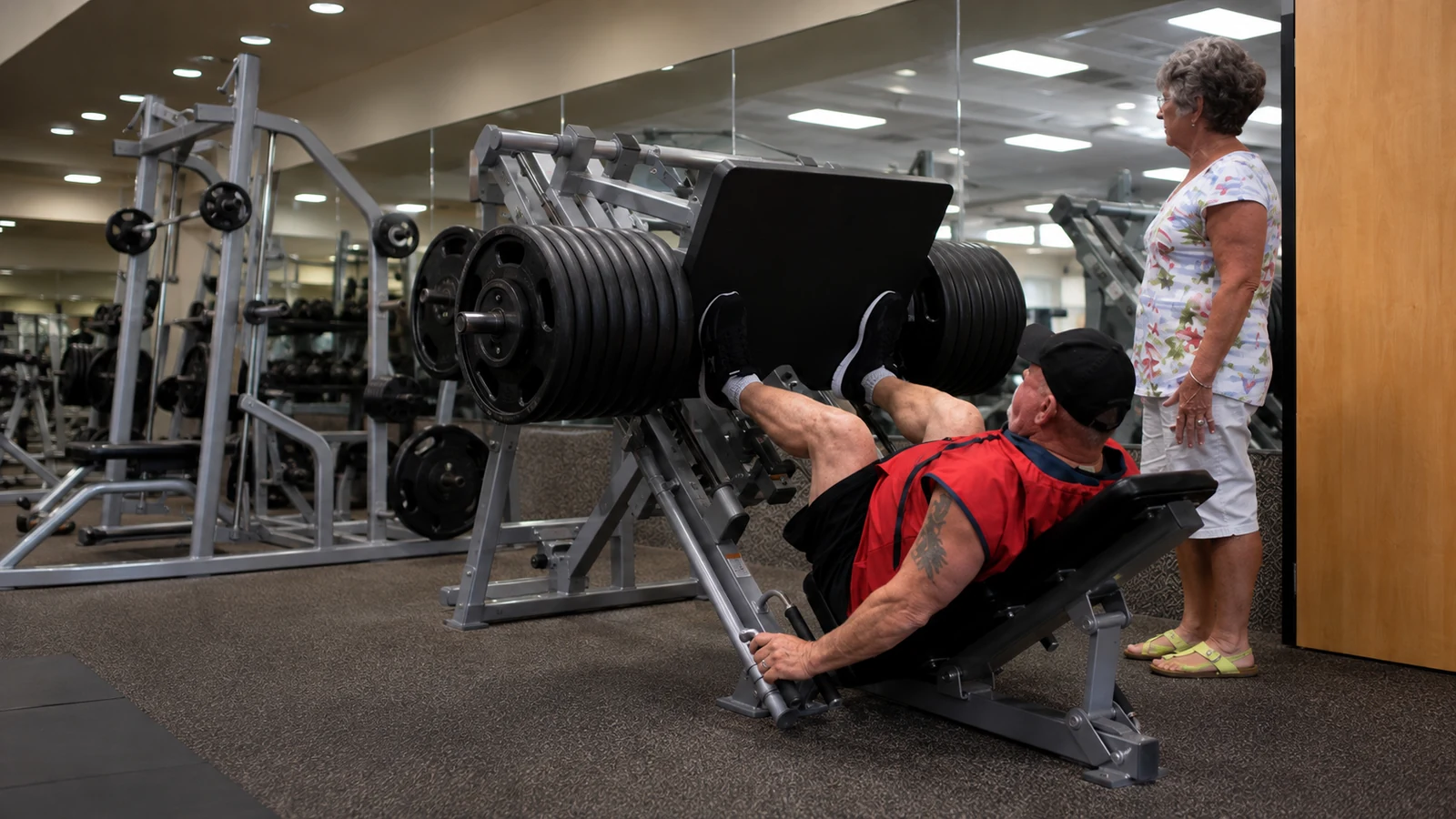

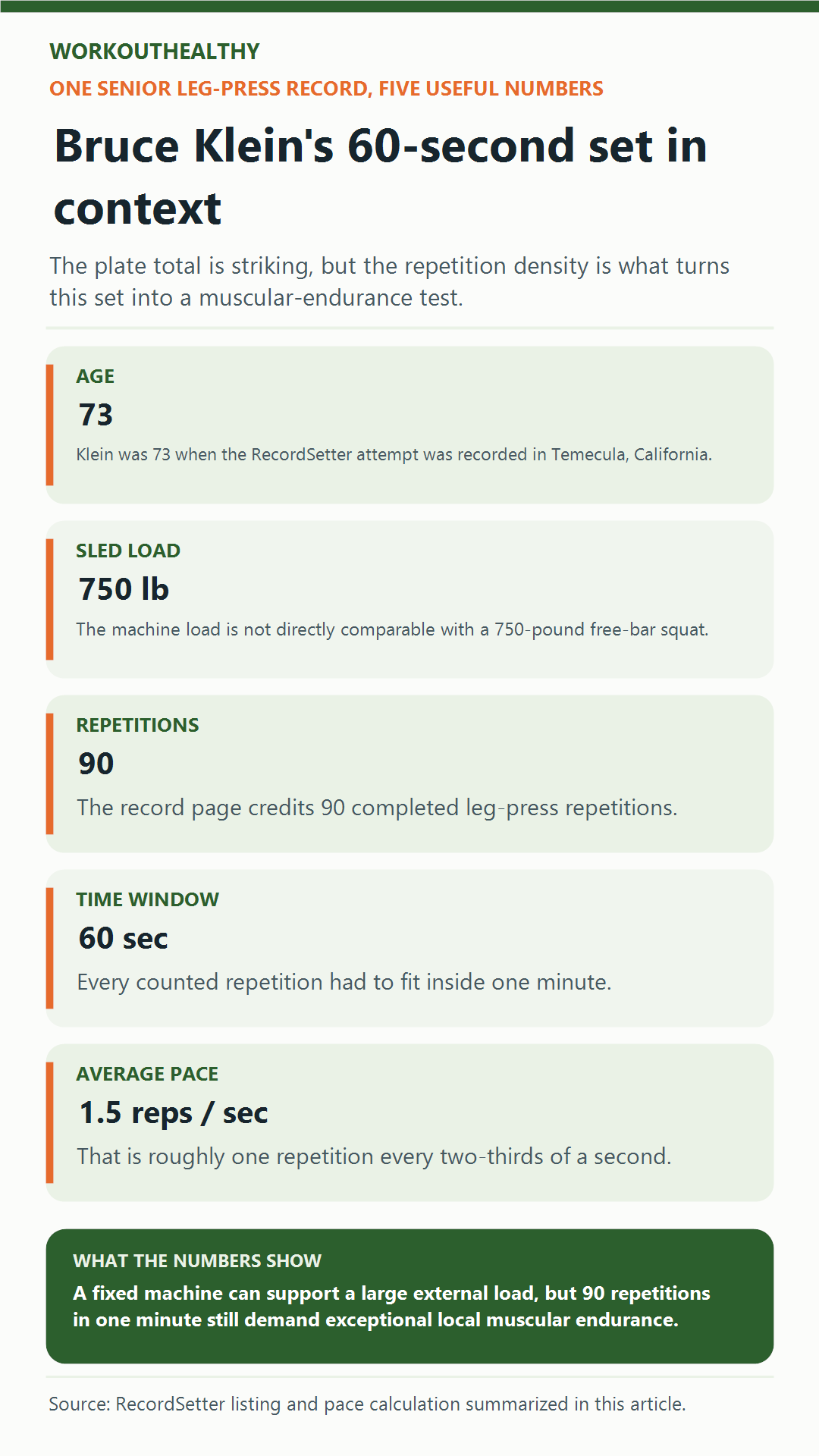
Bruce Klein was 73 years old when he sat down at a leg press machine, loaded it to 750 pounds, and did not stop moving for a full minute.
By the time the clock ran out, he had completed 90 reps.
That works out to a rep every two thirds of a second, at a weight that would make most lifters in their twenties think twice about even one.
The attempt happened on July 7, 2016, in Temecula, California, and it still shows up today in the database of RecordSetter, the crowd sourced record tracking platform that logged it.
This article checks that claim against RecordSetter’s own listing, explains exactly what kind of record RecordSetter hands out and how that differs from a Guinness World Record, and looks at what the science actually says about high rep leg press training and strength training after 70.
What Actually Happened on the RecordSetter Page
RecordSetter’s own record page lists the feat under a specific, narrow title: “Most 750-Pound Leg Presses In One Minute (Senior).”
The listing credits Bruce K. with 90 leg presses at 750 pounds in one minute, and states his age as 73 at the time of the attempt.
The location given is Temecula, California, and the date is July 7, 2016.
The page also carries video evidence of the attempt, hosted directly on RecordSetter’s own servers rather than a third party platform like YouTube.
That detail matters for verification. A private video someone could edit or splice together would be one thing.
A video attached directly to the platform’s own record listing, matching the claimed reps and weight, is a meaningfully stronger form of evidence.
Every detail in the Notion workbook that generated this article, the 750 pound weight, the 90 reps, the one minute window, and the age of 73, matches what RecordSetter’s own page shows today.
What RecordSetter Actually Is
This is the part worth slowing down for, because it changes how a reader should weigh the word “record” in this story.
RecordSetter is not Guinness World Records.
It was built as an open, low barrier alternative, and one press writeup described it as this generation’s Wikipedia to Guinness’ Encyclopedia Britannica.
Guinness runs a centralized review process with paid adjudicators, detailed rule books, and a formal evidence submission system that can take months to clear.
RecordSetter works differently.
Anyone anywhere can submit an attempt at a new or existing record, as long as they provide video evidence and an honest description of what they did.
Submissions get reviewed through community peer feedback and an internal council, not a formal panel of paid adjudicators.
That openness is also why RecordSetter’s leg press categories are so narrow.
A search of RecordSetter’s leg press listings turns up separate records at 500, 600, 700, 800, 805, 900, 1,000, and even 2,465 pounds, several sitting in a general open category rather than a senior division.
Bruce Klein’s record sits inside its own lane: 750 pounds specifically, one minute specifically, and the senior division specifically.
None of that makes the feat less real.
Ninety controlled reps at 750 pounds is still serious work for a lifter of any age.
It does mean the word “record” here describes a self reported, community verified claim inside a narrow category, not a Guinness adjudicated title carrying the same formal weight as the world record for the heaviest raw deadlift.
RecordSetter measures a genuine feat inside a category anyone was free to define and anyone was free to attempt. That is a different kind of achievement than a Guinness title, not a lesser one, and readers deserve to know which kind they are looking at.
Has Anyone Broken This Specific Record Since 2016?
As of this writing, RecordSetter’s own record page still lists Bruce Klein as the holder of the “Most 750-Pound Leg Presses In One Minute (Senior)” title.
A broader search of RecordSetter’s leg press category did not turn up a newer senior division entry at 750 pounds that would supersede his mark.
That search did surface other, different leg press records nearby, including a general non senior 805 pound entry and separate listings at 900 and 1,000 pounds, but a different weight or age division is a different record, not a challenge to this one.
RecordSetter categories work this way by design.
A new attempt at a slightly different weight or time window creates its own category rather than automatically overwriting an existing one.
Based on everything checked for this article, Bruce Klein’s senior 750 pound, 90 rep, one minute leg press record from July 7, 2016 still stands in its specific category.
How a Leg Press Machine Actually Works
The leg press looks simple.
You sit or lie back, plant your feet on a plate, and push a loaded sled away from your body.
The mechanics underneath that simple motion explain why 750 pounds on a leg press is not directly comparable to 750 pounds on a barbell squat.
A seated or angled leg press machine runs on fixed rails, and those rails carry part of the total load for you.
A back pad also supports your spine, removing much of the balance and core stabilization demand a free standing squat requires.
Research measuring muscle activation with electromyography across different leg press stances found real, measurable differences in how much the quadriceps, hamstrings, and glutes each contribute, even at matched effort levels on the same machine (Da Silva et al., 2008).
Foot placement and sled angle both change how much of the plate load actually reaches your legs versus the machine’s own rails.
None of this is a knock on Klein’s feat.
Ninety reps at 750 pounds is still a genuinely hard set no matter how the sled geometry works.
It does explain why leg press numbers, in general, run well above squat numbers for the same lifter, and why comparing a leg press weight straight across to a barbell squat weight is not an apples to apples comparison.
What Makes a Rep Controlled Instead of Bounced
Anyone who has spent time near a leg press machine has seen the other version of a heavy set: a lifter loads the sled, drops it fast toward the stops, and lets the weight bounce back up on momentum instead of muscle.
That bounced version of a rep is a different exercise from a controlled one, even when the weight on the plates is identical.
A controlled leg press rep lowers under muscle control until the knees reach a safe working depth, pauses briefly without slamming into the stops, and then pushes back up under muscle control the entire way.
Bouncing the weight off the stack shifts load onto the joint and connective tissue instead of the muscle.
It can also mask a real strength or endurance limitation behind fast, uncontrolled reps that look impressive on video but train very little.
RecordSetter’s evidence standard for this record includes video, and a 90 rep, 750 pound set sustained across a full minute is consistent with a controlled tempo rather than a series of stack bounces.
Bouncing that much weight repeatedly for a full minute would carry real injury risk to the knees and lower back, which is itself a reason to read the pace of this set as deliberate rather than reckless.
Why Ninety Reps in a Minute Is an Endurance Test, Not Just a Strength One
Ninety reps in sixty seconds is not how most people picture heavy leg press training.
Strength training research generally separates rep ranges into different training zones, and each zone tends to produce a somewhat different adaptation.
A frequently cited study comparing three different training zones found that lower rep, heavier sets built more raw strength, while higher rep, lighter sets built more short term local muscular endurance, with each zone producing its own distinct pattern of adaptation (Campos et al., 2002).
Ninety reps against a fixed external load falls well outside a traditional low rep strength zone.
That puts this feat closer to a muscular endurance and cardiovascular challenge than a pure one rep max test, even at 750 pounds.
That distinction changes what the record actually proves.
It is not really evidence of Klein’s single heaviest possible leg press.
It is evidence of his ability to sustain repeated, submaximal effort against a heavy load without his legs failing or his heart rate spiking out of control.
Our breakdown of Arnold Schwarzenegger’s famous rep quote covers a related idea: the point in a set where reps stop being about raw strength and start being about the will to keep pushing through real discomfort.
The Research on Strength Training Past Age 70
The most famous study in this space is not about leg presses specifically, but it is directly relevant to anyone wondering whether a 73 year old body can handle this kind of load at all.

Researchers at Tufts University put frail nursing home residents, average age in the late eighties, through eight weeks of high intensity resistance training and found dramatic strength gains, with several participants more than doubling their muscle strength (Fiatarone et al., 1990).
That study is now more than three decades old, and it remains one of the clearest demonstrations that skeletal muscle keeps responding to resistance training input well into very old age, not just middle age.
A later meta analysis pooling data across dozens of resistance training studies in older adults confirmed the pattern held broadly, with structured resistance training reliably producing meaningful strength gains in adults well into their seventies and eighties, and higher training intensities generally producing larger gains than very light training (Peterson et al., 2010).
Bruce Klein was 73, not in his eighties or nineties, and the research base on strength training at that age is even deeper and more consistent.
None of it suggests 73 is some kind of hard ceiling on what a well trained body can still do under load.
Our piece on Edith Connor’s Guinness record for oldest competitive female bodybuilder covers a similar story from a different angle: someone who built serious strength capacity well past the age most people assume that window has already closed.
Common Mistakes People Make Chasing High Rep Leg Press Numbers
Loading the sled heavy and chasing a big rep number is a common way lifters get hurt on a leg press, and a few specific mistakes show up again and again.
Locking the knees out hard at the top of each rep, instead of stopping just short of full lock, puts repeated compressive stress directly on the knee joint rather than the surrounding muscle.
Letting the lower back round or lift off the pad as fatigue builds shifts load toward the spine, in a machine that was supposed to remove spinal loading in the first place.
Cutting the range of motion short as reps pile up can inflate a final rep count without actually training the muscle through a useful range.
Chasing someone else’s weight number before building a real base of controlled reps at a lighter load is probably the single most common mistake of all, since a heavy sled moved with poor control is a worse training stimulus than a lighter sled moved well.
Who Should Talk to a Doctor Before Loading Up a Leg Press
Anyone with a history of knee replacement, hip replacement, or recent joint surgery should get individual clearance before attempting heavy or high rep leg press work, since the loading pattern differs from what a surgeon may have cleared for ordinary daily activity.
People managing high blood pressure should know that heavy resistance training, especially sets pushed close to failure, can spike blood pressure sharply during the set itself.
That spike is worth discussing with a doctor if blood pressure is not already well controlled.
Anyone with existing lower back pain, disc issues, or sciatica should be especially careful with the tendency to round the lower back under fatigue described earlier in this article.
A general rule holds for almost everyone starting later in life: build up load gradually over weeks and months, not over a single session, and treat a first return to heavy leg press work as a skill building phase rather than a numbers chasing one.
A Safer Way to Build Toward a High Rep Leg Press Set
Nobody needs to leg press 750 pounds to get real value from this style of training, and building toward higher rep endurance work on a leg press can follow a fairly simple progression.
Start with a weight that allows a full, controlled range of motion for at least 15 to 20 reps without the form breaking down anywhere in the set.
Add reps at that same weight over several weeks before adding more load, since chasing rep count first builds the motor control that heavier loading later depends on.
Once a working weight feels genuinely easy for 20 or more controlled reps, small load increases of roughly 5 to 10 percent, followed by a return to lower reps at the new weight, keep the progression from outrunning the joints and connective tissue.
Our look at DonnaJean Wilde’s push up world record pacing covers a related lesson from a completely different exercise: a sustainable pace across a full set, or a full hour, usually beats an all out sprint that collapses partway through.
Watch the Original Record
Want more verified strength stories like this one? Subscribe to WorkoutHealthy Insider for practical explanations behind popular fitness claims.
References
Campos, G. E., Luecke, T. J., Wendeln, H. K., Toma, K., Hagerman, F. C., Murray, T. F., Ragg, K. E., Ratamess, N. A., Kraemer, W. J., & Staron, R. S. (2002). Muscular adaptations in response to three different resistance-training regimens: Specificity of repetition maximum training zones. European Journal of Applied Physiology, 88(1–2), 50–60. https://doi.org/10.1007/s00421-002-0681-6
Da Silva, E. M., Brentano, M. A., Cadore, E. L., De Almeida, A. P. V., & Kruel, L. F. M. (2008). Analysis of muscle activation during different leg press exercises at submaximum effort levels. Journal of Strength and Conditioning Research, 22(4), 1059–1065. https://doi.org/10.1519/JSC.0b013e3181739445
Fiatarone, M. A., Marks, E. C., Ryan, N. D., Meredith, C. N., Lipsitz, L. A., & Evans, W. J. (1990). High-intensity strength training in nonagenarians: Effects on skeletal muscle. JAMA, 263(22), 3029–3034. https://doi.org/10.1001/jama.1990.03440220053029
Peterson, M. D., Rhea, M. R., Sen, A., & Gordon, P. M. (2010). Resistance exercise for muscular strength in older adults: A meta-analysis. Ageing Research Reviews, 9(3), 226–237. https://doi.org/10.1016/j.arr.2010.03.004
This article is for general information only and is not medical advice. If you have an injury, ongoing pain, or a medical condition, talk to a doctor or physical therapist before you change how you train or eat.