
The British Heart Foundation posted a 10-minute knee strengthening workout aimed at people dealing with everyday knee pain.
In the British Heart Foundation video, cardiac rehabilitation specialist Hara Markos demonstrates knee extensions, calf raises, sit-to-stands, hamstring curls, step-ups, clamshells, bridges, leg lifts, and stretches.
It raises a fair question for anyone who has felt that ache going up stairs or after a long walk.
Does strengthening the muscles around the knee actually reduce pain, or is this just another feel good routine?
The short answer is that a real body of research does support exercise for knee pain, especially programs that target the quadriceps and hip muscles.
But the research also comes with limits worth understanding before anyone builds a routine around a single video.
What the Workout Actually Targets
The exercises in the British Heart Foundation video target three main muscle groups: the quadriceps at the front of the thigh, the hamstrings at the back of the thigh, and the hip muscles that control the outside and back of the pelvis.
These muscles act like a support system for the knee joint.
The knee itself is mostly a hinge, and it relies heavily on the muscles crossing it for stability, since its own ligaments and cartilage cannot generate force on their own.
When those muscles are weak, the knee joint absorbs more of the load during walking, climbing stairs, or standing up from a chair.
When they are strong, they share more of that load.
That is the basic logic behind almost every knee strengthening program used in physical therapy clinics today.
Why Stronger Quads and Hips Change Knee Pain
The mechanism is more specific than just saying stronger muscles help.
The quadriceps muscle sits directly in front of the knee and controls how the kneecap tracks in its groove as the leg bends and straightens.
A weak or uneven quadriceps can let the kneecap drift slightly off center, which increases friction and pressure on the cartilage underneath it.
The hip muscles play a related role from higher up the chain.
Weak hip abductors and external rotators allow the thigh bone to rotate and drift inward during walking or squatting, a pattern often called dynamic knee valgus.
That inward drift changes the angle at which force passes through the knee, which can increase strain on the same cartilage and soft tissue that is already sensitive in someone with knee pain.
Strengthening the hips is one way to reduce that inward drift. Strengthening the quadriceps is one way to improve kneecap tracking.
These mechanisms may help explain why a plan built around leg raises, sit-to-stands, step-ups, and bridges can ease knee pain for some people. They do not prove that one movement pattern causes every case of pain.
Functional strength tests point at the same idea from a different angle.
The four flights of stairs test is a simple way researchers and clinicians estimate lower body strength and cardiovascular fitness outside a lab, and stair climbing leans heavily on exactly the quadriceps and hip muscles this workout trains.
A knee joint does not get stronger on its own. It gets more support from every muscle that crosses it.
What a Major Review of the Evidence Actually Found
The strongest evidence on exercise for knee pain comes from a 2024 Cochrane review, one of the most rigorous types of research summary that exists in medicine.
Cochrane reviews pool results from many separate clinical trials rather than relying on just one study.
This particular review analyzed 139 randomized trials with more than 12,000 participants who had knee osteoarthritis (Lawford et al., 2024).
The review found that land based exercise programs, meaning exercise done without special machines, produced a real but modest improvement in pain compared to no treatment at all.
Function improved by a moderate amount too, meaning people could move more easily during daily tasks like walking or climbing stairs.
Quadriceps strengthening exercises specifically, the type shown early in the British Heart Foundation video, were among the most studied exercise types included in that review.
The reviewers also compared exercise against usual care and against exercise added on top of other treatments, and pain and function scores improved in both comparisons as well.
The Hip Strengthening Angle: A Second Line of Evidence
The video also includes hip focused moves like clamshells and side leg raises, and that choice lines up with a separate body of research.
A 2021 systematic review and meta-analysis in the Journal of Pain Research looked specifically at patellofemoral pain, the kind of ache many people feel around or behind the kneecap (Manojlović et al., 2021).
The researchers combined data from multiple trials comparing hip strengthening, knee strengthening, and combined hip and knee programs.
Programs that included hip strengthening produced greater pain relief than knee strengthening exercises alone.
Programs that combined both hip and knee work produced the largest improvements in day to day function.
Hip focused programs also produced bigger gains in hip abduction and external rotation strength, which matches the mechanism described earlier about controlling how the thigh rotates during movement.
This is a big part of why physical therapists rarely prescribe knee exercises in isolation anymore.
What This Evidence Does Not Prove
None of this research proves that exercise reverses the underlying joint damage seen in osteoarthritis.
Cartilage loss and joint space narrowing are structural changes, and strengthening exercises have not been shown to rebuild lost cartilage.
The Cochrane review authors were explicit that many of the benefits they found were of what they called uncertain clinical importance.
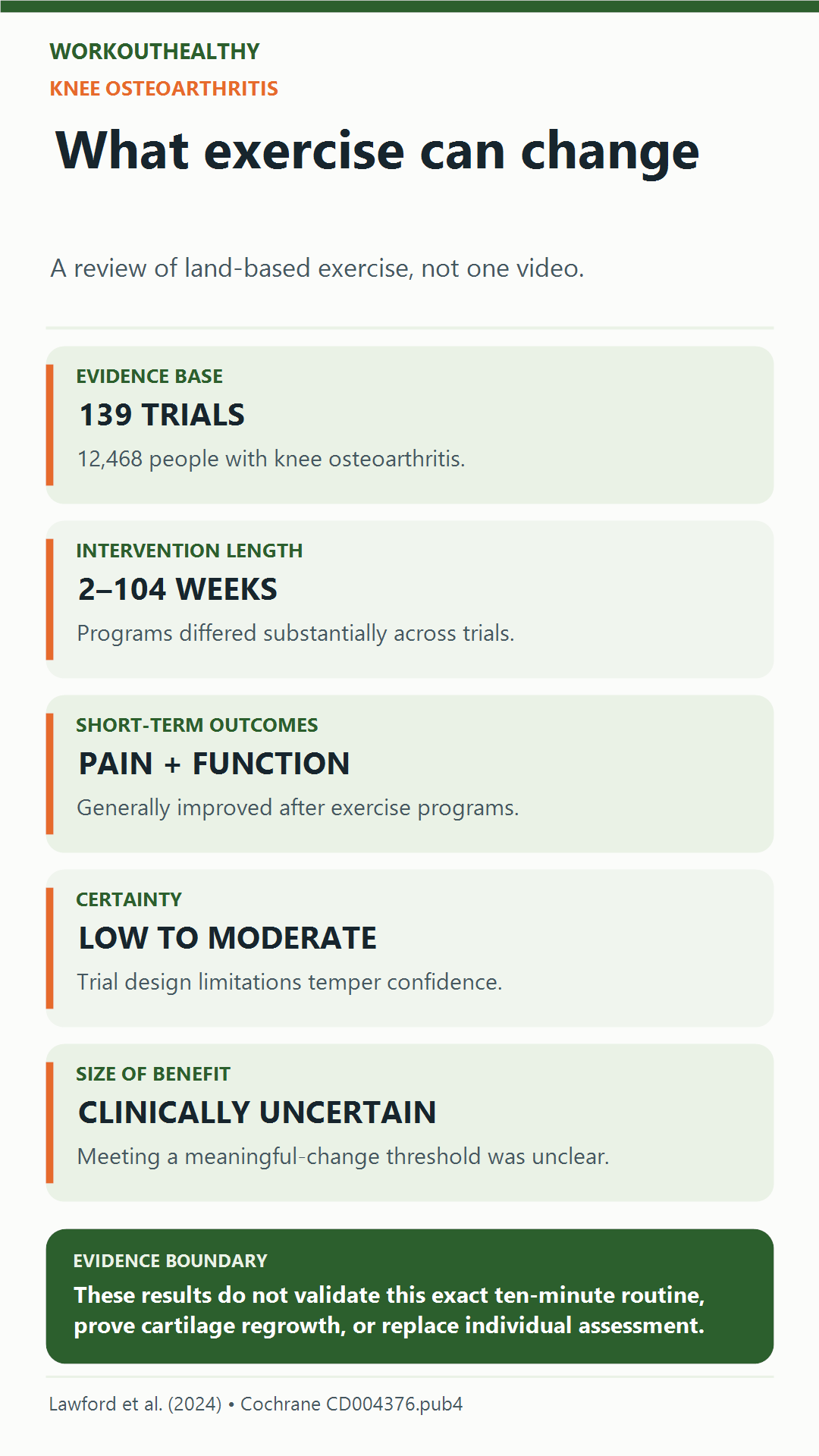
That phrase matters because it means the average improvement across a large group of people was sometimes smaller than the amount a person would need to actually notice a difference in daily life.
A treatment can move the needle on a research chart without a person necessarily feeling like their knee pain is solved.
The research also cannot say that any specific 10 minute video will work the same way for every viewer.
Trials measure average effects across groups of people, not guarantees for any one individual.
Someone with severe, advanced osteoarthritis may respond differently than someone with mild, early knee pain.
Most of the supporting trials also ran for eight to twelve weeks, so the evidence says less about what happens after months or years of consistent training.
Common Mistakes People Make With Knee Strengthening Exercises
The most common mistake is expecting fast results.
Most of the successful trials involved exercise programs lasting six weeks or longer, done several times a week.
A single 10 minute session is a reasonable starting point, but it is unlikely to change pain levels on its own.
Another common mistake is skipping the hip exercises and only doing quad focused moves like straight leg raises.
Based on the research above, that leaves out roughly half of the mechanism that actually helps.
A third mistake is pushing through sharp or worsening pain during an exercise.
Mild muscle fatigue is normal, but pain that spikes during or after a movement is a signal to modify it, not push harder.
Finally, many people do these exercises with poor form, letting the knee cave inward during squats or step ups, which recreates the exact movement pattern the exercises are meant to correct.
People who sit for most of the day sometimes assume ten minutes of exercise can undo hours of inactivity, and that assumption is worth questioning.
A closer look at whether standing is actually better than sitting suggests that regular movement throughout the day matters alongside, not instead of, a dedicated strengthening routine.
Who Should Check With a Doctor or Physical Therapist First
These exercises are not appropriate for everyone to start on their own.
Anyone recovering from recent knee surgery should get clearance from their surgeon or physical therapist before starting a new strengthening routine.
The same goes for anyone with a recent acute injury, like a suspected ligament tear or meniscus injury, since loading an unstable joint can make the injury worse.
Significant swelling, warmth, or redness around the knee is also a reason to see a doctor first rather than exercising through it.
Those symptoms can point to an active flare, infection, or inflammatory condition that needs its own treatment plan.
Sharp, locking, or catching sensations in the joint are worth mentioning to a doctor as well, since they can signal a mechanical problem that exercise alone will not fix.
People with advanced knee osteoarthritis who are already considering joint replacement surgery should still talk to their care team before starting a new routine, since pre-surgical strengthening programs are sometimes built differently than general pain management programs.
For a sense of what recovery from a major joint replacement can actually involve, this account of Misty Copeland’s hip replacement recovery is a useful, realistic read.
Anyone on blood thinners or with a history of blood clots should also mention a new exercise routine to their doctor, since some leg exercises increase strain on the lower body in ways worth flagging in advance.
Watch the British Heart Foundation Knee Routine
A Step by Step Guide to Five Core Exercises
The five moves below are a WorkoutHealthy starter selection drawn from the same quadriceps, hip, and combined lower-body categories discussed in the research. They are not the full 10-exercise British Heart Foundation video.
Keep a chair or wall nearby for balance if needed.
1. Straight Leg Raise
Lie on your back with one knee bent and the other leg straight.
Tighten the thigh muscle of the straight leg, then lift it to the height of the opposite bent knee.
Hold for two seconds at the top. Lower slowly, then repeat 10 to 15 times before switching legs.
2. Supported Sit-to-Stand
Stand with a sturdy chair behind you and your feet about hip width apart.
Reach your hips back, bend your knees only as far as feels controlled, and lightly touch the chair before standing again.
Repeat 8 to 10 times with a controlled descent. Use your hands on the chair if you need support.
3. Step Up
Use a low, sturdy step or the bottom stair of a staircase.
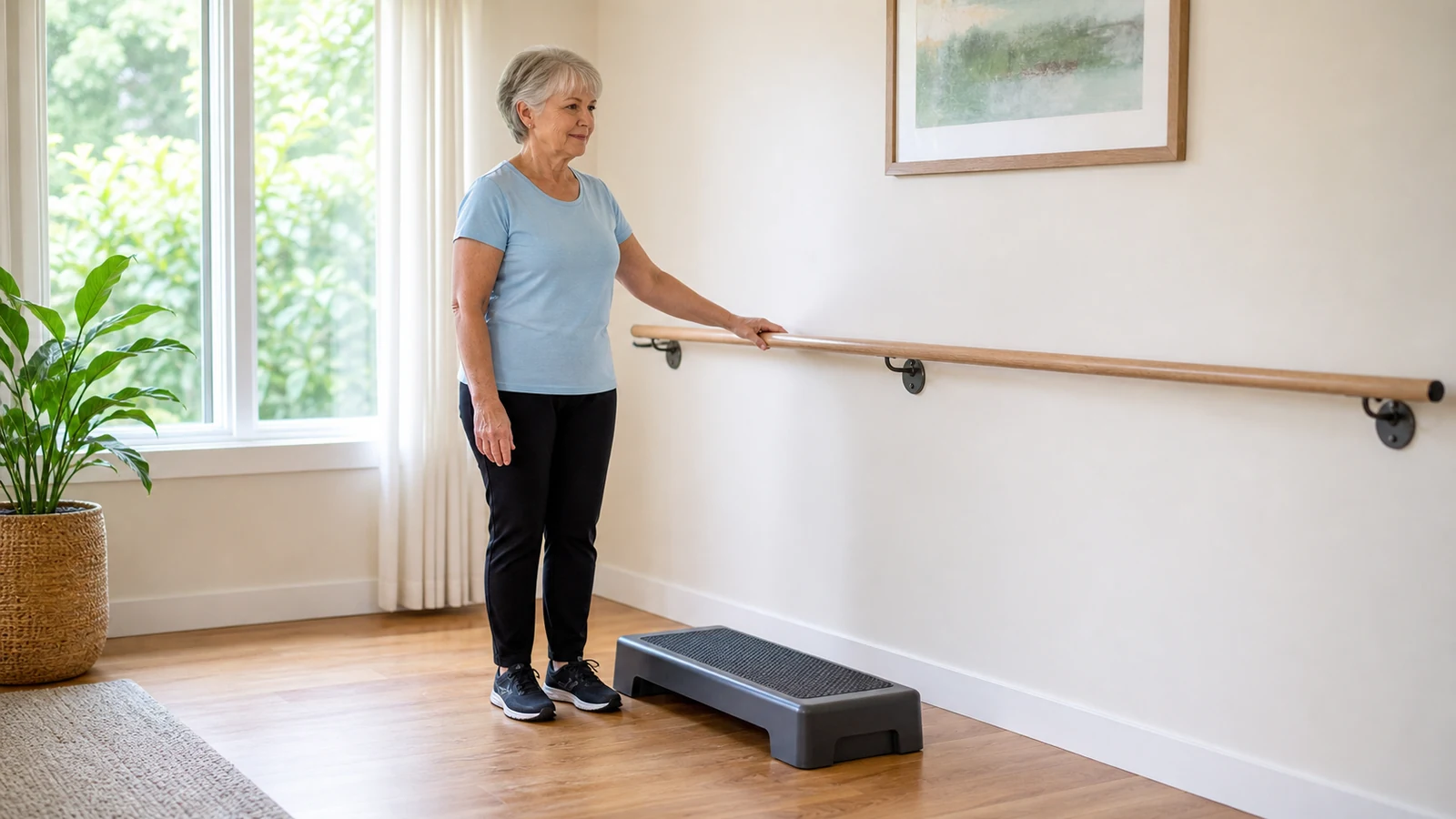
Step up fully with one leg, pressing through the heel rather than pushing off the back foot.
Bring the other foot up to meet it, then step back down with control.
Do 8 to 10 repetitions on each leg, keeping the movement slow on the way down.
4. Glute Bridge
Lie on your back with knees bent and feet flat on the floor, hip width apart.
Squeeze the glutes and lift the hips until the body forms a straight line from shoulders to knees.
Hold for two seconds at the top, then lower slowly. Repeat 10 to 15 times.
5. Clamshell
Lie on your side with knees bent and hips stacked directly on top of each other.
Keeping your feet together, lift the top knee like opening a clamshell, without letting the hips roll backward.
Lower slowly and repeat 10 to 15 times, then switch sides.
These five moves cover the same quad, hip, and combined categories studied in the research discussed above.
Doing them two to three times a week, alongside regular walking, lines up well with how most of the supporting trials structured their programs.
If walking is already part of the plan, this guide on how many miles to walk a day is a reasonable place to check that the rest of the routine is balanced too.
Progress by adding repetitions or a light resistance band before adding a lot of extra weight, since control matters more than load in the early weeks.
Get the next evidence check. Subscribe to WorkoutHealthy Insider for practical explanations behind popular fitness claims.
References
Lawford, B. J., Hall, M., Hinman, R. S., Van der Esch, M., Harmer, A. R., Spiers, L., Kimp, A., Dell’Isola, A., & Bennell, K. L. (2024). Exercise for osteoarthritis of the knee. Cochrane Database of Systematic Reviews, 2024(12), CD004376. https://doi.org/10.1002/14651858.CD004376.pub4
Manojlović, D., Kozinc, Ž., & Šarabon, N. (2021). Trunk, hip, and knee exercise programs for pain relief, functional performance, and muscle strength in patellofemoral pain: Systematic review and meta-analysis. Journal of Pain Research, 14, 1431 to 1449. https://doi.org/10.2147/JPR.S301448
This article is for general information only and is not medical advice. If you have an injury, ongoing pain, or a medical condition, talk to a doctor or physical therapist before you change how you train or eat.