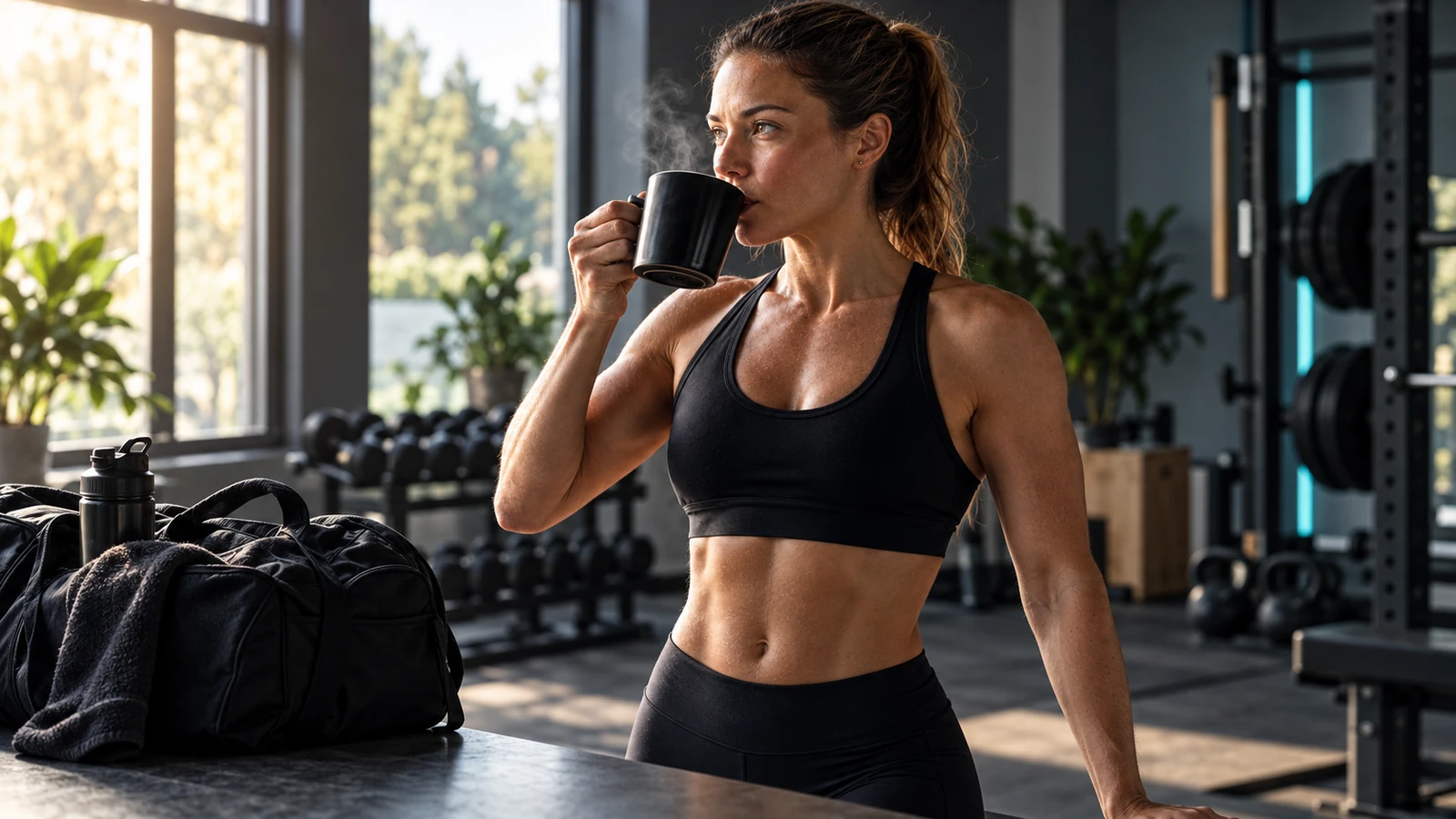

A black coffee before morning cardio can change which fuel your body uses during that workout. Controlled trials and reviews have found that caffeine can increase measured fat oxidation during submaximal exercise after an overnight fast. That is a real, narrow result. It is not proof that coffee plus fasted cardio removes more body fat over weeks or months.
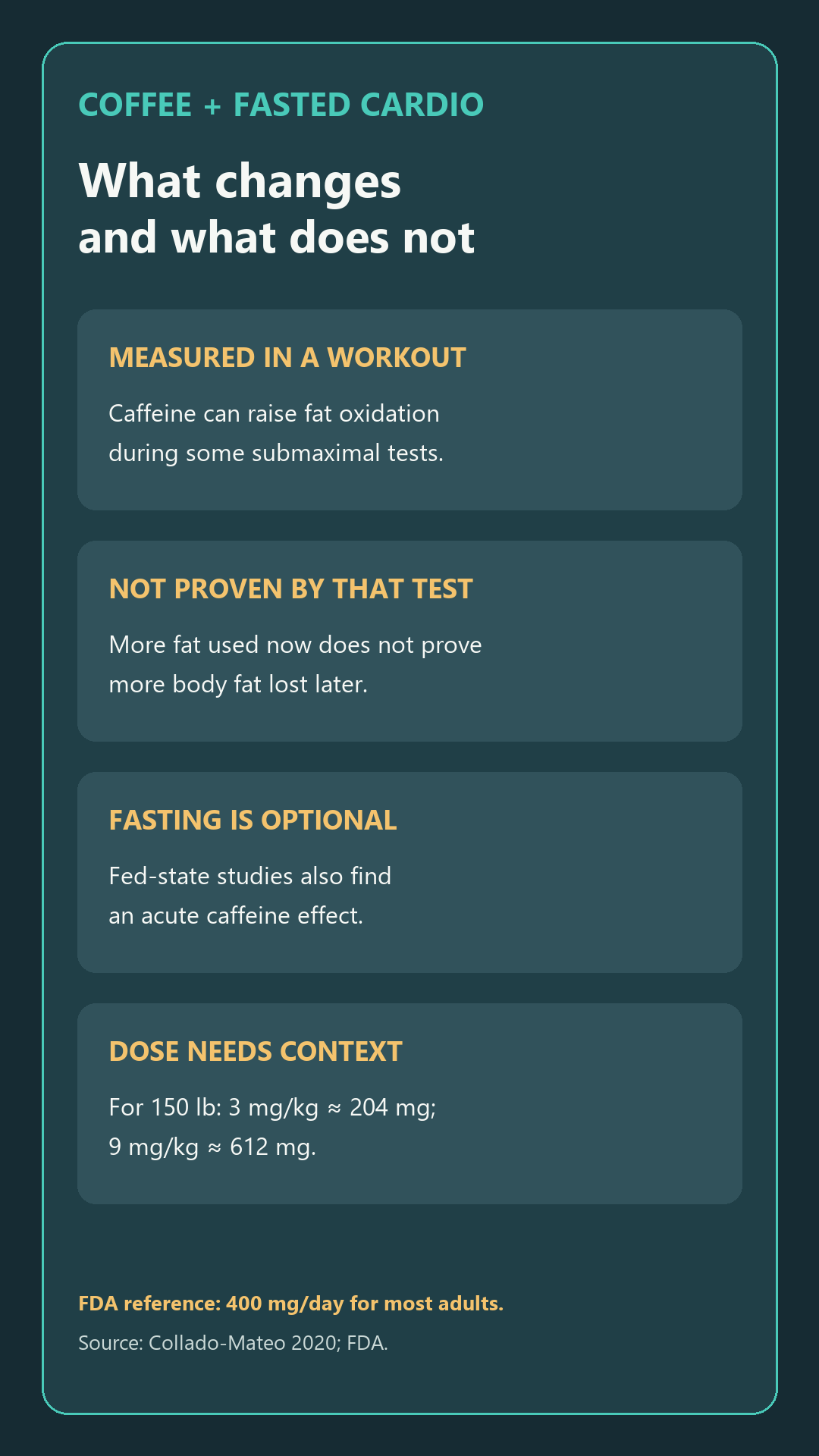
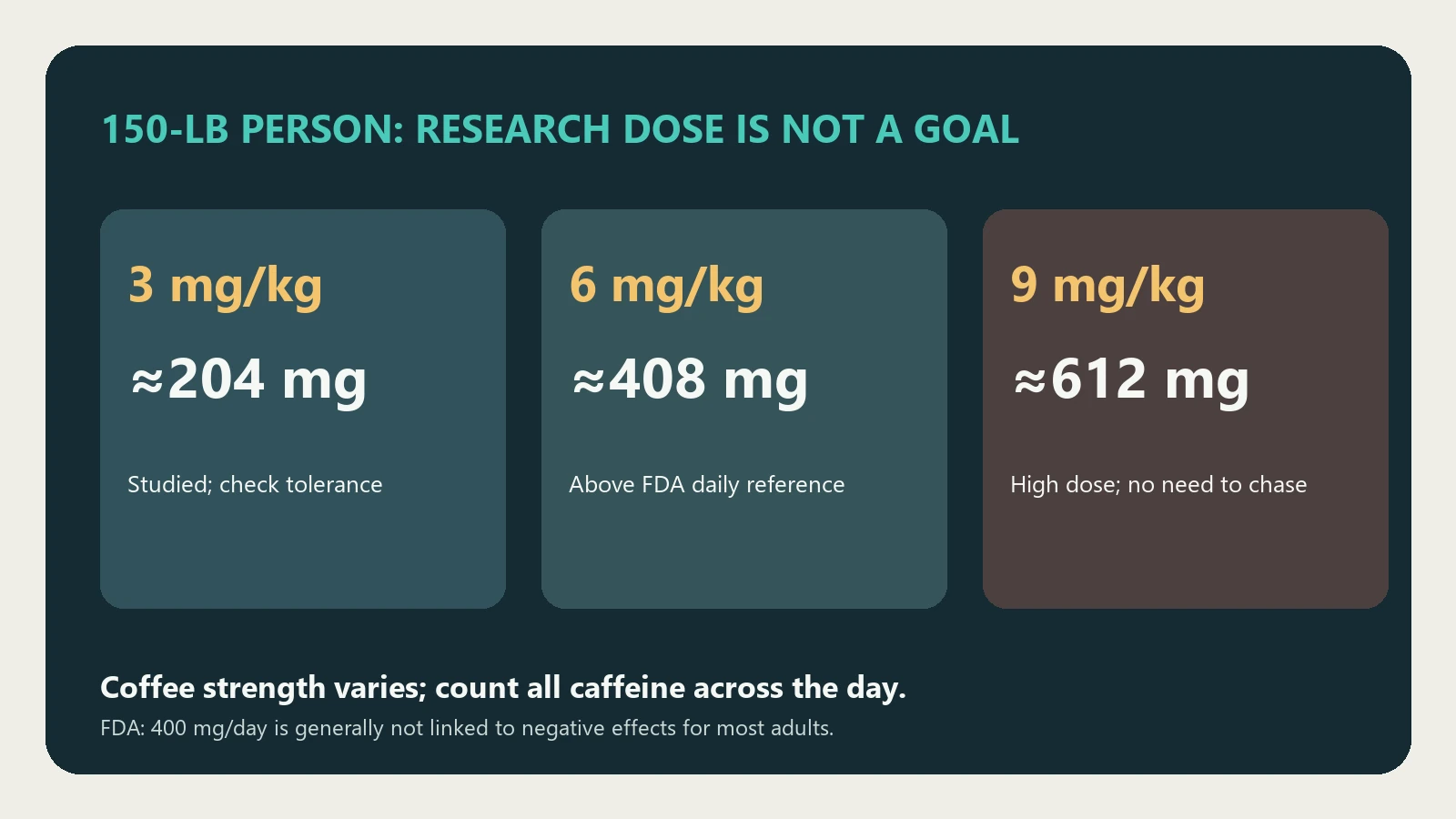
The Facebook post paired with this article describes doses from 3 to 9 milligrams per kilogram of body weight and translates them to roughly 200 to 600 milligrams for a 150-pound person. Those numbers need context: the upper end is a large stimulant dose and exceeds the FDA’s 400-milligram daily reference for most adults. Studies often use measured caffeine capsules; a cup of brewed coffee does not deliver a fixed dose. Here is what the experiments show, where the claims run ahead of the data, and how to make a safer training decision.
What does “burning more fat” during a workout mean?
Exercise uses a changing mix of fat and carbohydrate for energy. Researchers estimate this mix from oxygen consumed and carbon dioxide produced, often reporting a respiratory exchange ratio or calculated grams of fat oxidized per minute. When fat oxidation rises during a test, more of the energy used at that moment appears to come from fat. It does not tell us whether a person has lost more stored body fat by the end of a day, much less after a training program.
Exercise intensity matters. At an easy to moderate pace, fat supplies a larger share of energy than it usually does during a hard sprint. A person can still burn more total calories during a harder session, even if the percentage from fat is lower. Likewise, the body may shift fuel use later in response to what was burned earlier. This is why a single laboratory measure cannot stand in for a change in body composition.
Caffeine acts on the central nervous system and has several physiological effects. It may increase circulating catecholamines and the availability of fatty acids, but simply releasing fatty acids into blood does not guarantee that working muscle will oxidize them or that body fat will fall. The more useful evidence comes from trials that directly measure exercise metabolism under controlled conditions.
A workout fuel shift is an acute measurement, not a weight-loss outcome. The distinction is the key to reading the caffeine research honestly.
What do controlled trials show about caffeine and fat oxidation?
A 2020 systematic review pooled 19 crossover studies that compared caffeine with placebo before exercise. Participants followed fasting protocols, and caffeine doses ranged from 2 to 7 mg/kg. On average, caffeine increased measured fat oxidation during submaximal aerobic exercise. The review also reported variation among studies and suggested that training status may affect the size of the response. This supports an acute effect under the studied conditions; it does not establish a universal dose or a long-term fat-loss benefit.
A separate meta-analysis spanning 94 studies found a small overall effect of caffeine on fat-metabolism measures. The effect looked larger when investigators measured blood markers such as free fatty acids than when they used expired gas to estimate actual whole-body oxidation. That gap is another reason not to equate “fat released into the bloodstream” with “fat burned off the body.” The review did not find a clear dose effect across its broad collection of studies.
Individual trials can sharpen the picture. In a small double-blind cycling experiment with 14 healthy active women, both 3 and 6 mg/kg increased the maximum measured fat oxidation from about 0.24 g/min with placebo to about 0.29 g/min. The higher dose did not produce a larger maximum effect in that group. Results from a small, specific sample and an incremental cycle test should not be treated as a precise prediction for your treadmill session or coffee mug.
These studies measure short sessions, often with controlled capsules and a standard exercise protocol. They are useful mechanistic evidence, but they cannot tell us that a particular drink, person, or routine will produce the same change every day.
Does an overnight fast make caffeine uniquely effective?
Fasting changes the context of exercise. After a night without food, liver glycogen and circulating insulin may be lower, while muscle glycogen is not necessarily depleted by the overnight fast. The body often relies more on fat during a comparable low or moderate intensity workout performed before breakfast than after a carbohydrate-containing meal. The Facebook caption’s blanket statement that “glycogen stores” are naturally lower is too broad, especially if readers understand it to mean that working muscles have been drained of fuel.
Research on caffeine is not confined to fasted workouts. A systematic review of fed-state exercise trials also found that caffeine could increase fat oxidation under some conditions. Therefore, the evidence does not show that caffeine only works when you skip breakfast. Food timing, exercise intensity, habitual caffeine use, and the study design can all change the measured response.
For a hard or long workout, arriving underfueled may make it difficult to sustain the planned intensity. A carbohydrate-containing meal or snack can be valuable when performance is the priority. There is no need to protect a “fasted state” at the expense of a useful session. A splash of milk or cream also does not somehow cancel the physiological effects of caffeine; it simply means the drink is no longer calorie-free, and the specific fasting protocol of a study no longer applies exactly.
Is 3 to 9 mg/kg a sensible caffeine target?
It is a range used in parts of the research, not a recommendation to work toward 9 mg/kg. At 150 pounds (about 68 kilograms), 3 mg/kg is about 204 mg, 6 mg/kg about 408 mg, and 9 mg/kg about 612 mg. The last number is beyond the FDA’s cited 400 mg per day amount not generally associated with negative effects for most adults. Even 6 mg/kg slightly exceeds that reference for this example person before any other caffeine consumed that day.
The 2020 fasting-exercise review actually included doses of 2 to 7 mg/kg, not a clean test proving that all doses from 3 through 9 work equally well. The women’s cycling trial found similar maximum fat-oxidation changes at 3 and 6 mg/kg. A more recent small trial in sedentary women with overweight or obesity found no added metabolic benefit at 9 mg/kg compared with lower tested doses. That result is limited by its small sample, but it gives no reason to chase a high amount.
The International Society of Sports Nutrition’s caffeine position stand often cites 3 to 6 mg/kg for exercise performance, while acknowledging individual differences and that benefits may occur at lower amounts. Performance is a different endpoint from fat oxidation. None of these figures makes a high dose necessary for fitness or weight management.
If you already enjoy coffee before exercise, the relevant question is whether it helps the session without impairing sleep, comfort, or health. Our guide to caffeine before a workout covers performance timing and the tradeoffs in more detail.
Does black coffee deliver the same dose as a study capsule?
No. Many experiments use accurately weighed caffeine capsules so participants receive a dose based on body mass. Brewed coffee varies by bean, serving size, brewing method, and preparation. The FDA’s examples of cups and milligrams are general illustrations, not a promise that two cups equal a particular research dose. A large café drink can also contain more than one serving’s worth of caffeine.
Black coffee contains very few calories, so it is compatible with the no-calorie conditions used in many fasting studies. That makes it convenient, not uniquely “clean” in the scientific sense. Researchers cannot assume an unknown coffee’s caffeine content is equivalent to a measured capsule. Adding sugar or cream changes calorie intake; it does not make the caffeine disappear. For most exercisers, whether a small addition “breaks a fast” is less important than their overall eating pattern and workout quality.
Read labels when using packaged drinks or pre-workouts and count caffeine from all sources across the day. Be especially careful with concentrated powders or liquids: dosing errors can be dangerous. You do not need a supplement to get a useful workout, and a morning walk does not require a stimulant.
Will fasted coffee cardio make you lose more body fat?
That claim has not been established by the short-term oxidation experiments. To answer it, researchers would need to compare well-matched groups over time while measuring body composition, food intake, training, and adherence. The direct trials above mostly measured fuel use during a single exercise visit. A higher percentage of fat burned during that visit can be offset by later changes in fuel use or energy intake.
A small four-week randomized trial compared fasted and fed aerobic exercise in 20 young women following calorie-restricted diets. Both groups lost weight and fat, with no significant difference between groups. The trial did not test caffeine, and its size and duration limit certainty. It does show why a fasted fuel-use theory should not be automatically promoted into a long-term fat-loss promise.
Our fasted training and fat-loss review explains the broader evidence. The practical drivers of body-composition change remain a sustainable eating pattern, activity you can repeat, adequate recovery, and resistance training when preserving muscle matters. Caffeine can sometimes help a person feel ready to train, but that is a different claim from a special fat-loss effect.
You can choose breakfast or no breakfast based on comfort and performance. The evidence does not require fasting to make cardio count.
What are the side effects, and who should be cautious?
The FDA notes that too much caffeine can cause jitters, anxiety, upset stomach, nausea, headache, and other unwanted effects. People vary in sensitivity, and a dose that feels manageable to one person may feel unpleasant to another. Caffeine can also interfere with sleep, which may undercut training and recovery even if the workout feels easier. Our caffeine and sleep guide discusses that timing tradeoff.
Pregnancy, certain heart conditions, medication interactions, and other medical circumstances may call for lower limits or avoidance; ask a clinician who knows your situation. If caffeine causes palpitations, chest pain, faintness, or severe anxiety, stop using it and seek appropriate medical advice. Do not use a large dose to push through illness, inadequate sleep, or dehydration.
People who rarely consume caffeine may respond more strongly. Habitual use can also change how noticeable it feels. If you are considering a change, a modest amount you already tolerate is a more sensible starting point than calculating 6 or 9 mg/kg as a target. There is no reason to escalate simply because a social graphic lists a high number.
How to decide what to do before your next cardio session
First decide what the session is for. For easy aerobic activity, you can train after waking if you feel well, or eat beforehand if that is more comfortable. For a long or demanding session, plan fuel and hydration to support the work. If you enjoy coffee, keep the serving within your usual tolerance and account for any other caffeine that day. If you do not enjoy it, skip it; the workout still counts.
Watch the outcome you actually care about: consistent training, manageable effort, good sleep, and progress over weeks. Do not try to judge fat loss from how warm you feel, how much you sweat, or a wearable’s “fat burn” label. Keep the dose and routine simple enough that you can tell whether coffee is helping or causing problems.
The evidence supports a modest, short-term increase in measured fat oxidation from caffeine during many submaximal exercise tests. It does not prove a 3–9 mg/kg prescription, a unique advantage to fasting, or faster long-term fat loss. Coffee before cardio is an option, not a requirement or a metabolic shortcut.
Sources
- Collado-Mateo et al., 2020, systematic review and meta-analysis of caffeine and fat oxidation during fasting-state exercise.
- Caffeine and fat-metabolism meta-analysis, 2023, comparison of blood and whole-body gas measures.
- 3 versus 6 mg/kg crossover trial in active women, 2023.
- 3, 5, and 9 mg/kg trial in sedentary women, 2026.
- Fed-state caffeine and fat-oxidation systematic review, 2024.
- International Society of Sports Nutrition caffeine position stand, 2021.
- Fasted versus fed aerobic exercise body-composition trial, 2014.
- FDA caffeine guidance, daily reference and adverse effects.