

Doing 100 push-ups a day is not automatically a better muscle-building plan than doing fewer, harder sets—but high repetitions are not “just endurance,” either. A scheduled WorkoutHealthy post raised a useful question about progression, then overstated the answer. Research on resistance training shows that both lighter and heavier work can build muscle when the effort and program are appropriate, while higher resistance tends to have a clearer advantage for maximal strength. The smartest push-up plan depends on whether you want your first clean floor rep, a stronger press, more muscle, or better muscular endurance.
Push-ups are resistance training. A small randomized trial of progressive calisthenic push-up training found gains in strength and muscle thickness comparable with bench-press training over its study period. Another eight-week comparison found similar muscle growth when push-up and low-load bench-press conditions were matched. Those studies do not mean every push-up program equals every barbell program. They do show that bodyweight pressing can be a legitimate training tool.
First, name the goal
If your goal is a first standard push-up, you need practice at a level that lets you move well and repeat the work. If you can already do dozens, adding more repetitions may improve your ability to do repeated push-ups, but it may become an inefficient way to target maximal strength. For muscle growth, the relevant questions include how hard the set is, whether the muscle is challenged through a useful range, how much work you do across the week, and whether you recover.
A systematic review and network meta-analysis of resistance-training loads found that a range of loads can produce hypertrophy under studied conditions, particularly when sets were taken to high effort. Results in a gym trial do not map perfectly onto a daily push-up habit, but they rule out the categorical claim that high-rep sets cannot build muscle. Higher loads and harder variations can make strength-focused progression more practical.
The American College of Sports Medicine’s 2026 position-stand overview also emphasizes tailoring resistance training to outcomes such as strength, hypertrophy, power, and endurance rather than treating one prescription as the only correct one. A rep count is information, not a verdict.
Start with a movement you can own
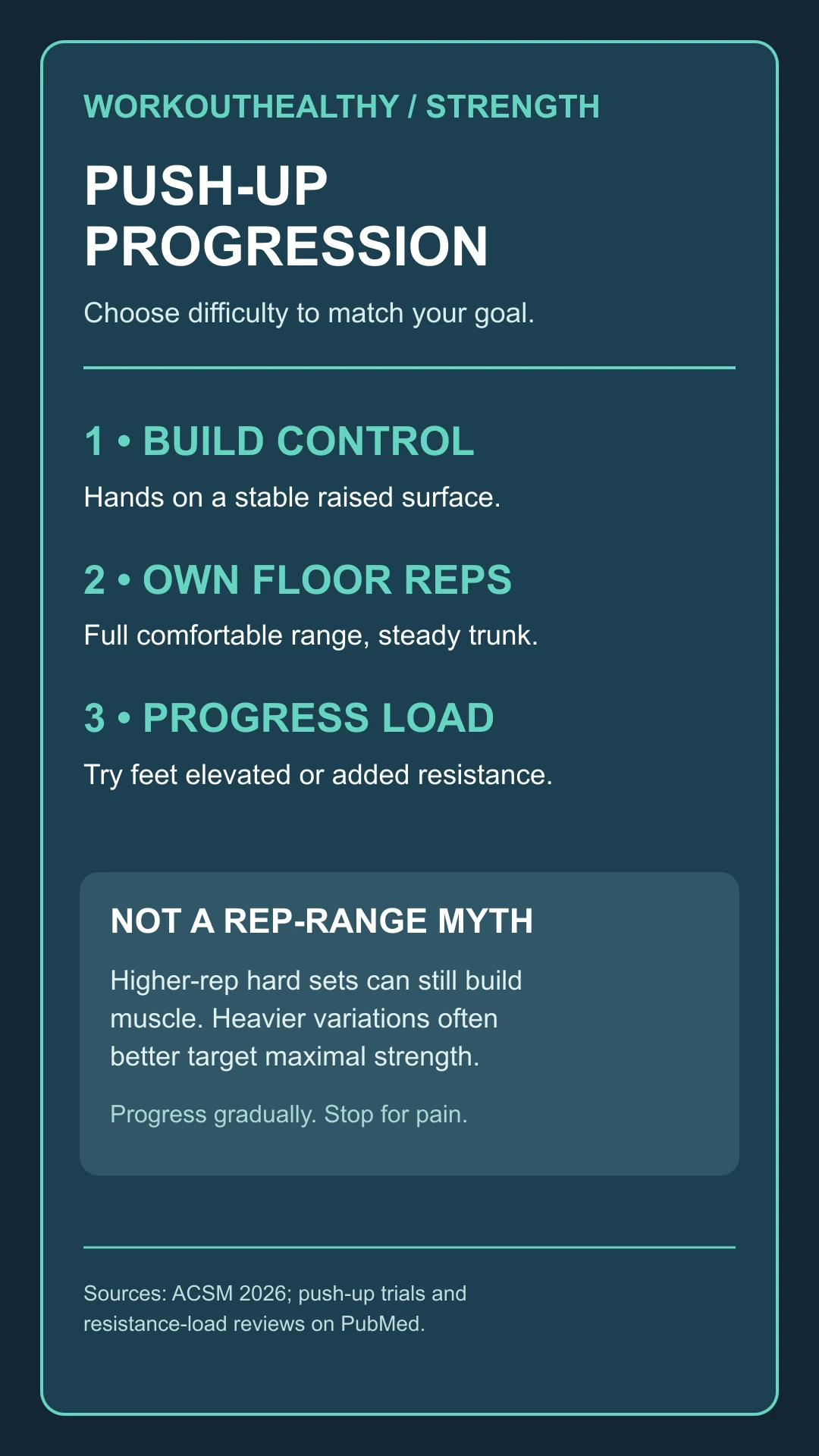
For many beginners, placing the hands on a stable raised surface is a better starting point than collapsing through floor reps. A countertop, sturdy bench, or fixed bar can reduce the effective load and allow a straighter body line. The higher the hands, the easier the movement usually feels. Lower the hand position gradually as strength and control improve. That is a regression toward the full push-up, not a “deficit” push-up.
A practical rep begins with hands placed comfortably, a trunk that stays relatively steady, and elbows moving in a way your shoulders tolerate. Lower under control to a comfortable depth and press back up without letting your hips sag or pike dramatically. There is no single mandatory elbow angle for every anatomy. If wrist position is uncomfortable, a stable handle or other suitable variation may help. Pain is a reason to stop and reassess, not proof that the exercise is working.
Once you can perform repeated hands-elevated sets with good control, move to a lower surface. Eventually practice floor reps. A short, clean set is more useful for learning than a long set where every repetition changes shape. Rest between sets and sessions enough that the next quality effort remains possible.
What counts as progression after floor reps?
Progressive overload means increasing the challenge over time in a way you can recover from. More repetitions are one option. More total sets, a harder leverage position, a longer range of motion, or added resistance can also change the task. The best choice depends on your goal and what equipment and technique you have.
For stronger pressing, a secure weighted vest, appropriate resistance band, or carefully chosen feet-elevated variation may increase difficulty. Feet elevated generally shifts more of the load toward the upper body, but shoulder comfort and setup matter. “Deficit push-up” normally means placing the hands on stable supports so the chest can travel below hand level, increasing range of motion—not merely elevating the hands. That version requires enough mobility and control to use the extra depth safely.
Forward-lean variations can be significantly more demanding on the wrists and shoulders. They are not a default next step for everyone. Likewise, a dramatic “explosive” press is not required for muscle growth. Speed and power work have their own purpose, and a person should establish basic control before adding them.
Does slowing the tempo build more muscle?
Controlling the lowering phase can make a sloppy rep more consistent and can help you notice where form breaks down. That is useful. But simply making every repetition very slow is not a guaranteed faster route to growth. A pause near the bottom increases the difficulty of that specific task, yet it can also reduce the number of repetitions you can perform. The total program still matters.
Use a deliberate tempo you can repeat: descend with control, avoid bouncing, and press strongly without losing position. If a brief pause helps you maintain an honest range, use it as a tool. Do not assume a particular number of seconds has a special muscle-building effect, and do not hold a painful bottom position just because a social post suggested it.
Why 100 daily reps can stall
A daily 100-push-up challenge may improve skill or muscular endurance, particularly for someone who starts with much lower capacity. But it may also crowd out recovery, reinforce rushed form, or become too easy to challenge strength and muscle effectively. If every set is far from your current limit, the stimulus can be modest even though the total number sounds impressive. If every set is all-out, daily training may become difficult to recover from.
The alternative is not necessarily “10 perfect reps.” Ten can be too many for a beginner and too few for an advanced trainee using an easy variation. A better rule is to choose a variation and set size that let you perform controlled repetitions while feeling meaningfully challenged. Track quality and performance over weeks, not only the day’s total.
For example, someone building a first floor push-up might use two or three sessions a week of hands-elevated sets and gradually lower the support. An experienced lifter may keep regular floor push-ups for warm-ups or endurance and use a weighted variation or bench press for heavier strength work. These are examples, not a medical or individualized training prescription.
Muscle growth versus maximal strength
It is tempting to say “high reps equal endurance, low reps equal muscle.” The evidence is more nuanced. When resistance-training sets are hard enough, lower-load and higher-load approaches can both increase muscle size in many studied populations. Heavier loads typically produce greater gains in the ability to lift a maximal weight, partly because that test is specific to heavy lifting. A push-up program has similar specificity: practice improves push-ups, but transfer to a one-rep-max bench press is not perfect.
That does not mean doing a hundred casual reps has the same effect as a well-designed hard set. Effort, progression, weekly volume, and recovery matter. Nor does it mean every person should train to complete failure. Pushing until form falls apart may create unnecessary fatigue or discomfort. The appropriate proximity to failure varies by experience, exercise, and goal.
A simple four-week decision framework
During week one, choose a version you can do with consistent range and no concerning pain, and record the sets and reps. In week two, aim to make the same work smoother or add a small amount of total work if recovery is good. In week three, if the variation has become easy, modestly lower the hand support or select a slightly harder version; keep form as the check. In week four, compare the movement quality and performance with week one. If pain or persistent fatigue appears, back off and get appropriate guidance.
This is not a promise of a specific number of new reps or a visible physique change in four weeks. It is a method for making a repeatable training decision. Add pulling work, lower-body training, and other activity as appropriate so your entire routine does not become one daily push-up test.
For a broader check, audit your complete training program rather than judging the plan by push-ups alone.
Takeaway
More push-ups are not always the best progression, but hard higher-repetition sets can still build muscle. Hands elevated generally makes the exercise easier; feet elevated, a true hand-supported deficit, or added resistance can make it harder. Progress the challenge for your goal, keep the movement controlled, recover between demanding sessions, and reject any universal rule that 100 daily reps are useless or that 10 reps are magic.