
Nina Dobrev’s home gym is a useful starting point for a practical question: what would make exercise easier to fit into your own home and week?
The celebrity setup draws attention, but a useful planning exercise starts with your space, the activities you want to do and the time you can actually protect. A room full of equipment is only one possible answer.
This article separates the interview record from an original home gym planning worksheet. The worksheet is an editorial aid, not a validated assessment or an individualized training prescription.
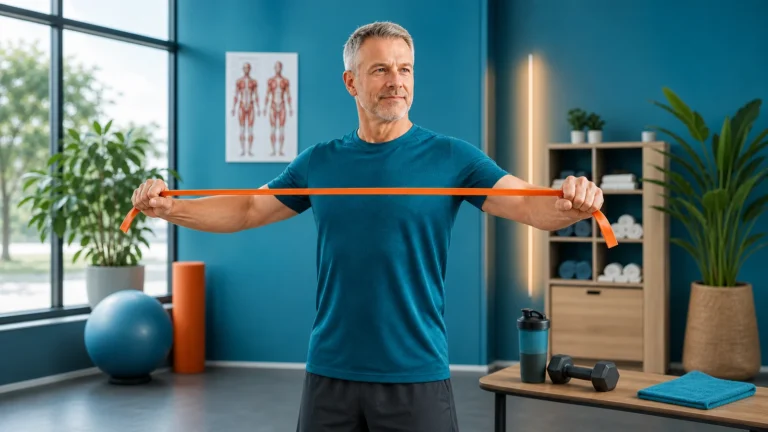
Illustration note: The hero is an editorial illustration of home training. It does not document Dobrev’s actual home, equipment layout or an actual workout.
What the interviews document
Dobrev told Shape she built a home gym and valued flexible training times (Hendricks, 2022).
In a separate SELF interview, she described varied activities and a home setup with weights, bands, a Mirror, a bike, a treadmill and a rowing machine. The interview also disclosed an Affirm partnership (McCoy, 2021).
Those interviews describe one person’s circumstances. They do not establish that buying the same collection will improve another person’s exercise attendance, strength or health.
The dates matter too. An interview about a pandemic-era setup is historical reporting, not an inspection of her home today. We are not presenting a current inventory, floor plan or product review.
Read the original Shape interview for its full reporting and context. Equipment mentioned in an interview is not a buying recommendation from WorkoutHealthy.
Identify the obstacle you want to remove
Before considering equipment, finish this sentence: “The part that most often prevents my workout is…” Be concrete. A long journey, an unpredictable finish time and a lack of exercise knowledge are different problems.
CDC guidance suggests looking at available time, placing activity on a calendar, choosing manageable activities and using convenient community resources when facilities or cost are barriers (Centers for Disease Control and Prevention [CDC], 2025).
A home setup may remove the trip to another building. It still needs room in the schedule. If the problem is uncertainty about what to do, another machine may leave that uncertainty intact.
Write the proposed change beside the obstacle. For example: “Use the available room immediately after work, with the session chosen in advance.” You can then evaluate whether that change actually fits.
For someone who values a class or training partner, a shared facility may remain useful. Home exercise can also be a backup option for days when the usual arrangement is unavailable.
A useful home gym begins with a session you can describe and a time you can protect.
Use a five-question planning worksheet
These questions are a WorkoutHealthy editorial checklist. There is no score, passing threshold or scientific claim that answering them guarantees adherence.
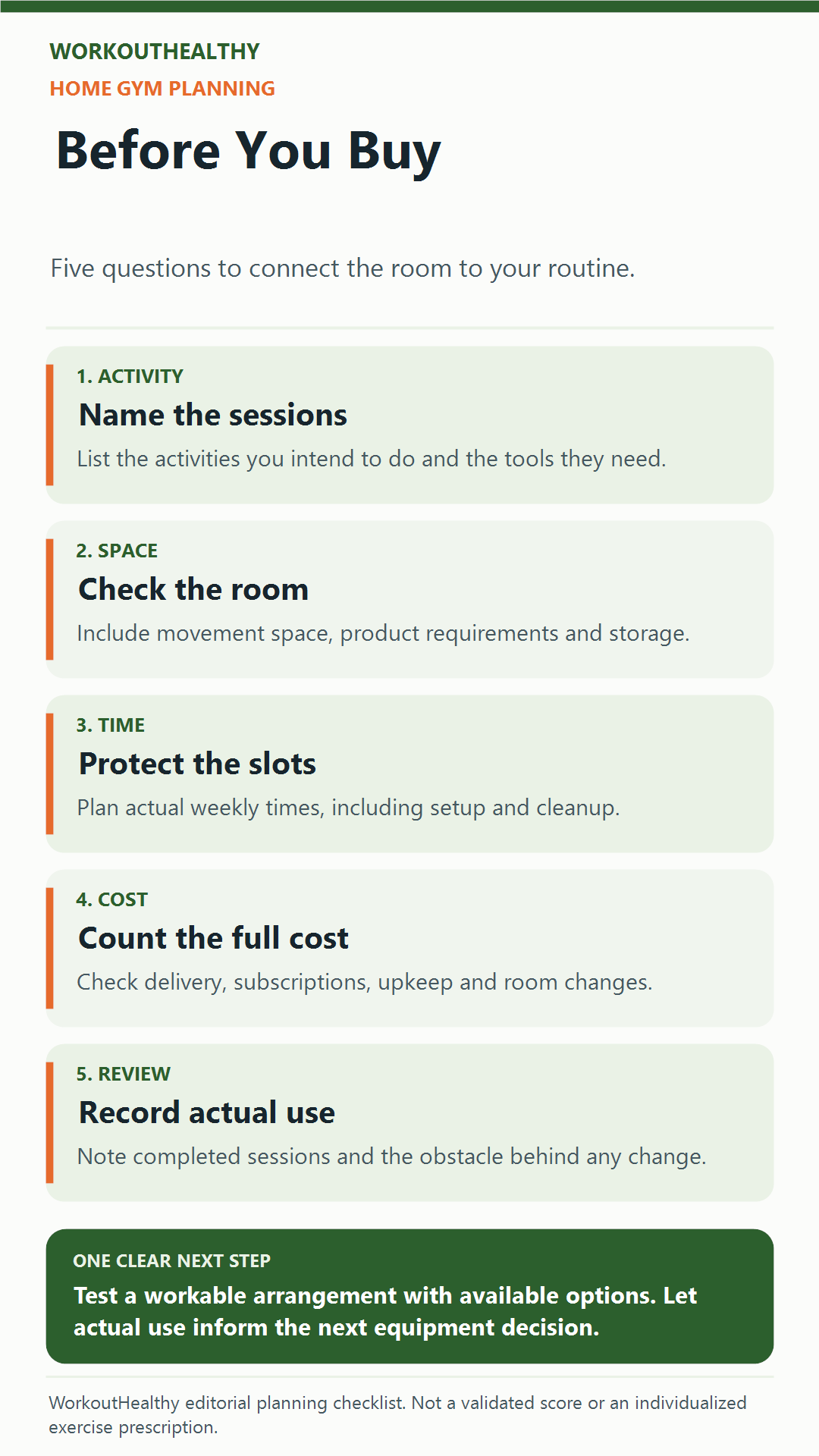
- Activity: Which sessions do you intend to complete, and what tools do those sessions require?
- Space: Where will the activity happen, including the movement area and equipment storage?
- Time: Which actual weekly slots will you protect, including setup and cleanup?
- Cost: What is the complete cost, including delivery, maintenance and any required subscriptions?
- Review: What will you record to decide whether the arrangement is useful?
Answer in ordinary language. “Two suitable strength sessions in the spare room” gives you something to plan. “A better lifestyle” leaves many decisions unresolved.
Keep the first version small enough to describe on one page. If every answer depends on several future purchases, consider whether you can test the activity with what is already available.
Someone with appropriate equipment already at home can use the same worksheet. The next decision may concern storage or scheduling rather than an additional purchase.
Here is an example of a completed planning entry, using a hypothetical shared spare room:
- Activity: Two suitable strength sessions using equipment the household already owns.
- Space: A measured movement area, with a storage location that leaves the doorway clear.
- Time: Two agreed evening slots, allowing for setup and returning the room to its usual use.
- Cost: No initial equipment purchase; any later addition must address a recorded limitation.
- Review: Note completed sessions and the practical reason for any change.
This example organizes decisions; it is not a complete exercise prescription. A different household might record a community class, outdoor walking and a smaller home backup instead. The worksheet remains useful because it makes those choices explicit.
Plan the room around the activity
Measure the usable area and consult the equipment manufacturer’s requirements. Include the space needed to move, access the controls and put equipment away. Product dimensions alone may not describe the whole operating area.
A useful sketch shows doors, furniture, storage and the place where each activity happens. Check whether the planned session requires rearranging the room every time, and decide whether that is realistic.
Consider the people who share the space. A room may also serve as an office, bedroom or play area. Agreeing on use and storage is part of making the arrangement workable.
Before installing heavy equipment or an anchored attachment, resolve the relevant structural and installation requirements with the manufacturer or a qualified professional. A photo of someone else’s gym cannot establish those requirements.
This is a planning check, not a building specification. No universal room size, floor rating or anchor capacity can be inferred from the celebrity illustration.
A smaller strength setup can still be useful
The American College of Sports Medicine’s 2026 guidance describes useful strength and function outcomes from options including elastic bands and home-based resistance training. It also emphasizes matching a routine to personal goals and circumstances (American College of Sports Medicine [ACSM], 2026).
That supports considering accessible options. It does not mean every band, exercise or loading scheme produces identical results, or that one piece of equipment covers every person’s training needs.
Start with the movements you understand and the sessions you intend to complete. List what you own, what those tools allow and which genuine gap remains. A tool has a clearer purpose when it solves a specific problem in that list.
If you already use dumbbells, our 30 minute dumbbell workout overview offers one routine to examine for suitability. It is not Dobrev’s program.
Exercise selection and progression may require instruction, especially when a movement is unfamiliar. Buying equipment and learning to use it are separate decisions that both deserve time.
Build a weekly plan you can see
For general adult health, CDC guidance calls for at least 150 minutes of moderate aerobic activity, 75 minutes of vigorous activity or an equivalent mix, plus strength work on at least two days covering major muscle groups (CDC, 2023).
Activity can be spread through the week in smaller chunks. Some activity is better than none; the guidance is a framework, not a requirement to buy a particular cardio machine (CDC, 2023).
On your worksheet, separate the activity from the location. A walk outdoors and a session in the home exercise area can belong to the same week. A home gym does not have to contain every activity you enjoy.
Write the start time, intended session and practical stopping time. Include the few minutes needed to retrieve equipment and restore a shared room. Those details belong in the real calendar.
Choose a fallback for a disrupted day. It can be a shorter appropriate session or another available activity. The point is to decide in advance what is feasible, without treating every interrupted plan as a failed week.
Compare the full commitment before buying
Make a list of the costs attached to the proposed setup. Alongside the equipment, check delivery, assembly, required accessories, subscriptions, upkeep and any changes to the room.
Use the actual terms and instructions for the item you are considering. An advertised starting price may not answer all of those questions, and an interview is not a source for today’s prices or service terms.
Then connect each proposed item to the activity column of your worksheet. If you cannot explain when you will use it and what role it serves, the planning work is incomplete.
A household can also compare an appropriate community option or keeping its present arrangement. CDC specifically includes inexpensive, convenient community resources among responses to cost and facility barriers (CDC, 2025).
This article provides no spending target, savings forecast or financing recommendation. Those decisions depend on your own budget and the current terms of the options you are considering.
Give every piece of equipment a job in your week before giving it a place in your room.
Review actual use before expanding
Try the planned arrangement for a short period that includes ordinary workdays and a weekend. This is an informal usability check, not a clinical test or a promise that a habit forms in a set number of days.
Record the sessions you planned and completed, the activity you did and any practical obstacle. You can also note whether retrieving and storing the equipment was manageable.
Review the entries without turning them into a moral judgment. A missed session might reveal a poor time slot, a shared-room conflict or a plan that was more ambitious than the available time.
Change the relevant detail and try again. If a session repeatedly requires a long room rearrangement, storage may deserve attention before the equipment list grows.
For training progress, our guide to five fitness basics when progress stalls discusses factors beyond equipment. Attendance is useful to record, but it is not the same measurement as strength or health improvement.
The takeaway
Dobrev’s home gym story invites a useful planning exercise. The transferable question is how to make your own activity accessible, appropriate and repeatable.
Define the sessions, check the space, protect the time, understand the cost and review what actually happens. That sequence gives each equipment decision a purpose.
You do not need to reproduce a celebrity room to complete the worksheet. Start with the available options and a clear next session, then let actual use inform the next change.
Get the next evidence check.
Five practical fitness stories worth your time, every Friday.
One email a week. No product pitches. Unsubscribe in one click.
References
American College of Sports Medicine. (2026, March 17). ACSM unveils landmark 2026 resistance training guidelines: First update in 17 years. https://acsm.org/resistance-training-guidelines-update-2026/
Centers for Disease Control and Prevention. (2023, December 20). Adult activity: An overview. https://www.cdc.gov/physical-activity-basics/guidelines/adults.html
Centers for Disease Control and Prevention. (2025, February 5). Overcoming barriers to physical activity. https://www.cdc.gov/physical-activity-basics/overcoming-barriers/index.html
Hendricks, J. (2022, October 22). Nina Dobrev reveals the big-ticket items she splurged on to create the ultimate home gym. Shape. https://www.shape.com/celebrities/interviews/nina-dobrev-home-gym-quarantine
McCoy, J. (2021, November 27). The one stretch Nina Dobrev loves to do after her workouts. SELF. https://www.self.com/story/nina-dobrev-favorite-stretch
Medical disclaimer: This article is general product information, not medical advice. The equipment described here is not a treatment for any condition. If you have an injury, ongoing pain, or a medical condition, talk to a doctor or physical therapist before using any of it.