

Nabela Noor says she has lost more than 60 pounds, yet the number is not the center of her story.
In a September 2026 account for Women’s Health, she described wanting to feel stronger, healthier, and more capable in ordinary life.
Her account includes type 2 diabetes, a prescribed GLP-1 medication, Pilates, resistance training, walking, and changes to how she eats.
Those pieces belong together in her story, but they should not be turned into a universal formula.
Noor’s treatment decisions were made with her doctor.
Another person’s medication, exercise capacity, and progress markers may look very different.
The useful question for a reader is not how to copy her weight change.
It is how to notice strength and function without treating a scale as the only measure of health.
A smaller number cannot tell you whether daily life feels easier, stronger, or more manageable.
What Noor Reported
Noor wrote that insulin resistance and a hormonal condition preceded her diagnosis of type 2 diabetes in her early thirties.
She described taking oral medication and later working with her doctor on a plan that included a GLP-1 medicine.
She did not frame the prescription as a shortcut that replaced movement or food choices.
She said she signed up for Pilates and weight training in the same week she began the medication.
That timing is part of her personal history, not an instruction to start several changes at once.
She reported more than 60 pounds of weight loss.
She also emphasized confidence, capability, and the experience of becoming stronger.
The article describes her current weight-training sessions with a trainer as once or twice a week.
She has also tried to raise her daily step count and to include protein and fiber in meals.
Those details come from Noor’s own account, not from an independent review of her medical records or training log.
Her account does not isolate which change caused any particular result.
It is reasonable to report what she says happened, but not to turn the story into a claim that one habit treated her diabetes.
Why Medication Is One Part of the Story
A GLP-1 medicine can be an appropriate part of diabetes or weight-management care for some people.
The drug choice, dose, benefits, side effects, and follow-up need a clinician’s individual assessment.
Neither Noor’s account nor this article tells a reader which medication to use.
The American Diabetes Association’s 2026 standards describe nutrition, physical activity, behavior support, and medication as possible parts of care.
The standards also emphasize individual needs and shared decisions.
That is a more accurate frame than setting medication against exercise as though one must make the other unnecessary.
Noor’s description illustrates how a treatment plan can contain several components at once.
It does not prove that the same combination, schedule, or weight change will work for someone else.
Weight loss can include changes in fat and lean tissue.
That is one reason the diabetes standards call attention to muscle-strengthening activity during obesity pharmacotherapy.
The guidance says it may help maintain lean body mass, not that lifting guarantees a particular body composition.
For a person with diabetes, medication adjustments and activity changes can also interact with blood-glucose management.
That practical safety question belongs with the treating care team, especially when a plan is changing.
A social post cannot supply an individualized glucose, medication, or exercise plan.
Pilates and Resistance Training Have Different Jobs
Noor described easing into Pilates after a difficult pregnancy and working with an instructor over time.
She wrote about feeling more capable as movements that once seemed daunting became familiar.
That is a description of her experience, not proof that a particular Pilates move treats diabetes.
Pilates can offer practice with controlled movement, body awareness, and coordination.
Its value depends on the session, the instruction, the person’s needs, and what else is in the weekly plan.
Noor also described slow, repeated weight-training sessions with a trainer.
Resistance work is a separate stimulus: muscles work against an external load or body weight.
In its 2026 standards, the American Diabetes Association recommends resistance exercise on nonconsecutive days for adults with diabetes who can do it safely.
It identifies strength, function, and glycemic management among possible benefits.
The standard is not a judgment that Noor trains too little or that every person needs her trainer.
Someone beginning from a low activity level may need a gentler starting point and medical guidance.
Comfortable walking, seated movement, or a short practice session can be useful first steps.
For another example of movement that fits outside a gym, see our Marisa Tomei walking story.
The goal is not to rank Pilates against weights.
It is to recognize what each activity asks of the body and build a plan that is possible to repeat.
The Role of Steps and Meals
Noor said she aims for more steps on days when a formal workout does not happen.
That keeps ordinary movement in the picture instead of making a gym session the only activity that counts.
Her reported goal of 10,000 steps is her own preference, not a required medical threshold.
A person whose baseline is lower can make progress with a smaller, more suitable change.
Public health guidance encourages adults to move more and reduce long stretches of sitting.
The diabetes standards also discuss breaking up prolonged sitting.
Neither source requires a reader to copy a celebrity’s daily step target.
Noor described adding protein and fiber to meals while keeping food enjoyable.
That account is a personal approach, not a menu or portion prescription.
Nutrition needs differ with age, health history, medications, preferences, and the rest of a person’s care plan.
Someone with diabetes who wants to change food intake substantially should discuss the change with a qualified clinician or registered dietitian.
The same caution applies when appetite changes during treatment.
A scale may reflect many influences at once, including medication, food, activity, and normal variation.
It cannot separate those influences or measure the quality of a person’s day.
Four Signs Beyond the Scale
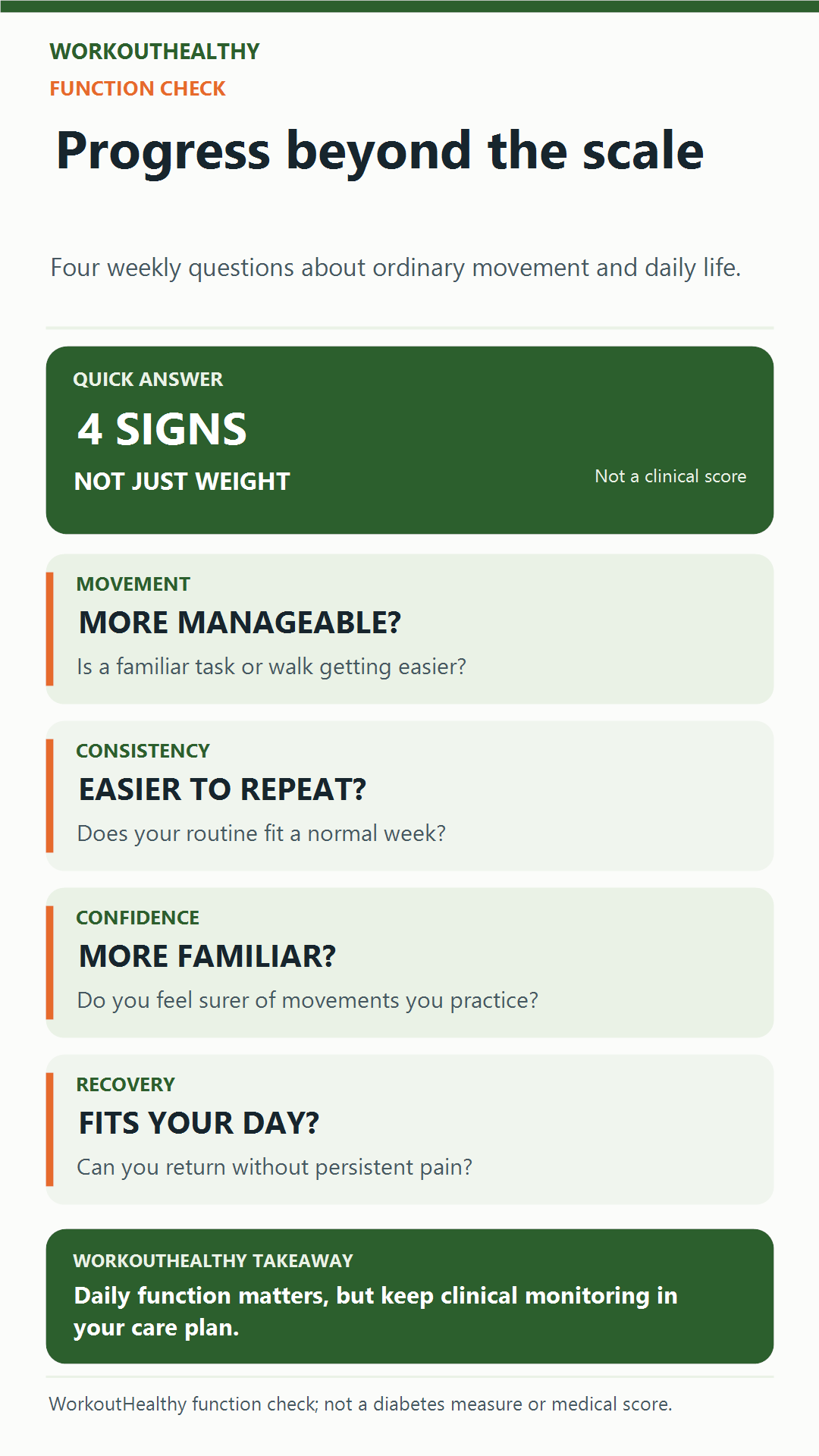
WorkoutHealthy’s Four-Sign Function Check is an original way to notice progress without claiming to diagnose health.
It asks four plain questions once a week, using the same ordinary task or activity when possible.
First, is a familiar movement becoming more manageable?
That could mean standing up from a chair, carrying groceries, or finishing a comfortable walk with less strain.
Second, is your chosen routine becoming easier to repeat?
A shorter plan completed regularly may matter more than a demanding plan that never fits.
Third, do you feel more confident with a movement you practice?
This could be knowing how to set up a lift safely or entering a class without as much uncertainty.
Fourth, is recovery compatible with your day?
Notice whether the activity leaves you able to work, care for others, and return to movement without persistent pain.
These are subjective observations, not measurements of blood glucose, muscle mass, or cardiovascular risk.
Write down a brief note if tracking helps, but do not treat one week as a verdict.
Sleep, stress, illness, and daily demands can change the answers.
A clinician’s measures remain important for diabetes care even when daily function feels better.
The infographic below condenses the four questions into a phone-friendly reminder.
It is WorkoutHealthy’s decision aid, not a validated clinical score or a tool Noor said she uses.
What Her Story Cannot Prove
Noor’s first-person account is strong evidence for what she chose to share about her own experience.
It is not a clinical trial, a full medical history, or a way to determine why every pound changed.
It cannot show that Pilates alone reversed diabetes or that a GLP-1 alone produced her reported strength gains.
It cannot prove the same outcome for someone with a different diagnosis, access to care, or activity history.
Before-and-after images are especially limited.
They show appearance at two moments, not blood-glucose trends, treatment details, strength, or wellbeing.
The more useful reading of her account is that she values being able to move and participate in her life.
That value can travel beyond the celebrity story without copying the exact routine.
Do not stop or start a prescribed medicine because a public figure describes her own plan.
Do not push through symptoms to imitate an exercise shown in a photograph.
For a gentler option when impact does not suit you, our standing-cardio guide explains what low-impact movement can and cannot do.
How to Build a Personal Plan
Start with the care plan you already have rather than a social-media comparison.
If you have type 2 diabetes or use a medication that affects glucose, ask your care team how activity changes fit your treatment.
Choose one movement you can do safely at your current level.
It might be a short walk, a supervised strength session, a gentle class, or an accessible home routine.
Decide when it fits and what a minimum version looks like on a busy day.
That minimum might be five minutes or one exercise practiced carefully.
Increase duration or resistance gradually, using comfort and professional guidance where needed.
Keep recovery, mobility limitations, and enjoyment in the plan rather than treating them as excuses.
Look for the four functional signs above, and continue any clinical monitoring your doctor recommends.
Ask what part of the routine is helping you feel more capable, not only what the scale displays.
Our 10-minute cardio routine offers a short general example, but it is not a diabetes prescription.
When a plan stops fitting, revise it instead of assuming that you failed.
A useful plan is one that respects both the person you are today and the care you actually need.
The Takeaway
Nabela Noor says her health story includes medication, Pilates, weight training, walking, and different food habits.
She reported losing more than 60 pounds, while emphasizing strength and capability over the number.
Those are her experiences and goals.
They should not be recast as a universal treatment or a promise of weight loss.
Current diabetes guidance supports individualized care and appropriate physical activity, including muscle-strengthening work when safe.
A reader can take a practical lesson from Noor’s account without copying her prescription or schedule.
Notice what makes everyday movement more possible, and use medical measures and professional guidance for medical decisions.
Want careful fitness reporting? Subscribe to WorkoutHealthy Insider for useful stories without transformation promises.
Medical disclaimer: This article is general product information, not medical advice. The equipment described here is not a treatment for any condition. If you have an injury, ongoing pain, or a medical condition, talk to a doctor or physical therapist before using any of it.