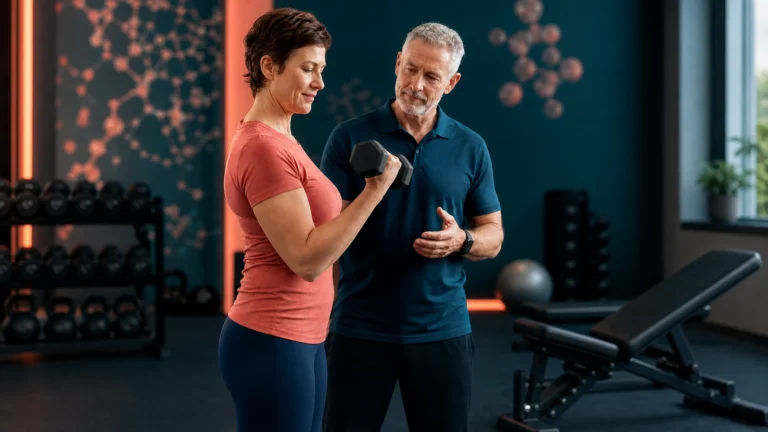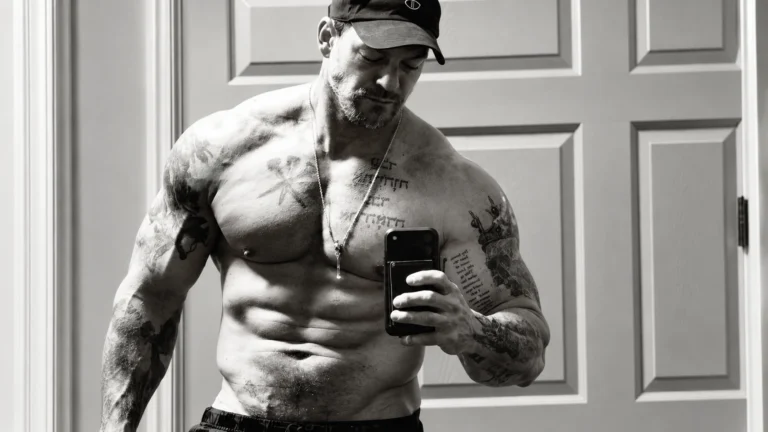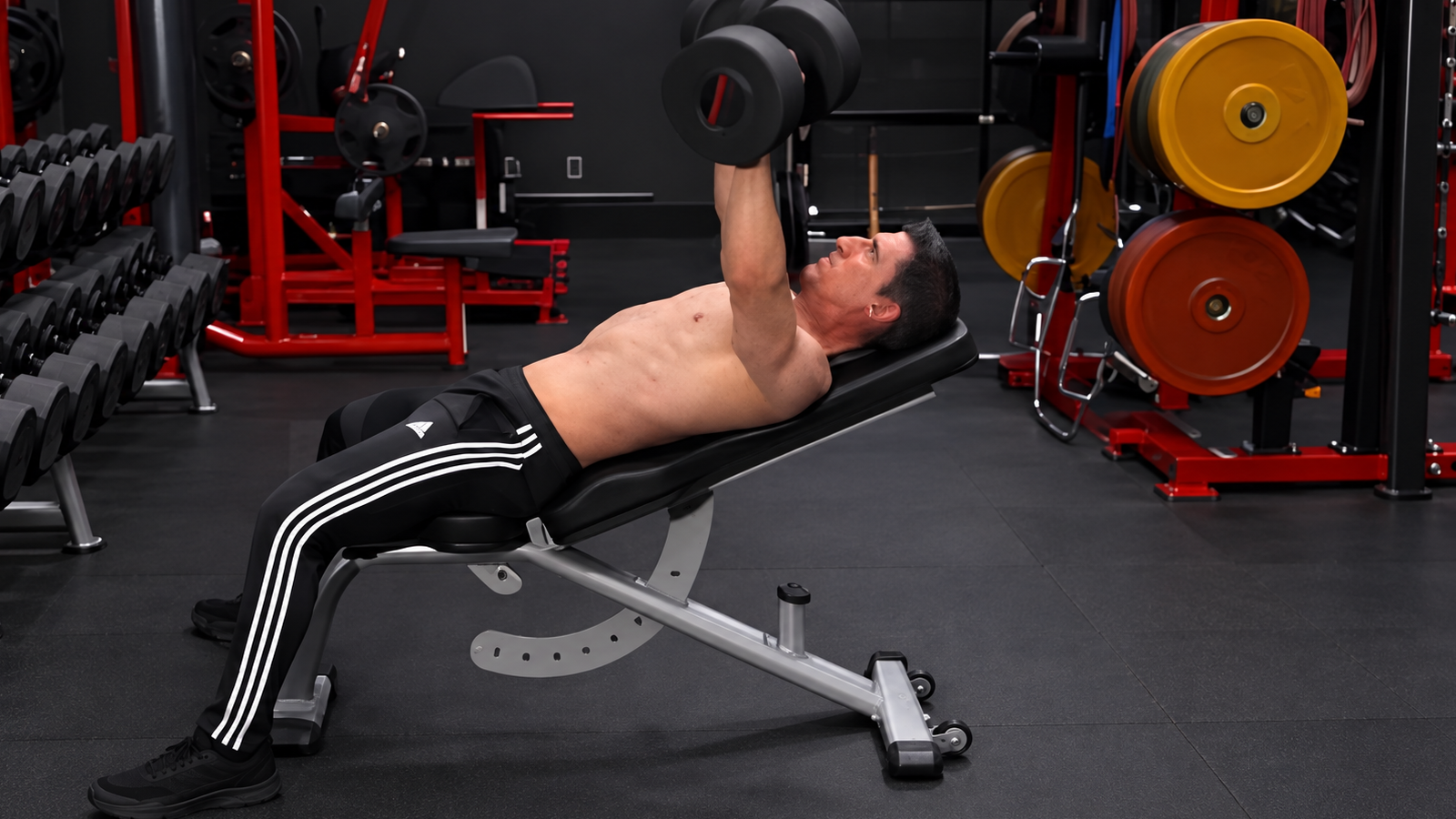

This two dumbbell chest workout comes from a real October 2025 ATHLEAN-X video by Jeff Cavaliere.
The two base exercises are a 30-degree dumbbell incline press and a dumbbell floor fly, with neutral-grip squeeze presses used as easier follow-up variations.
The structure can train the chest with little equipment, but the viral caption turns reasonable coaching choices into absolutes.
Thirty degrees is not a proven perfect angle, a floor stop does not remove every shoulder risk, and a squeeze press does not guarantee maximum chest activation.
Cavaliere’s original routine is also harder than the caption sounds.
He demonstrates sets to failure, a substantially lighter pair for the squeeze press, a mechanical drop from fly to press, and an optional giant set that connects every movement with almost no rest.
Verified source: ATHLEAN-X, “The ONLY 2 Dumbbell Chest Exercises You Need (NO, SERIOUSLY!).”
The video ID, title, exercise order, loads, and failure instructions were checked against the original transcript.
What the Original Routine Actually Is
Cavaliere starts with two dumbbell pairs.
The second pair is substantially lighter than the one used for the incline press, so the squeeze press can follow immediately with control.
He performs the 30-degree incline press for 8 to 10 repetitions to failure, then immediately switches to the lighter pair for a neutral-grip squeeze press.
That is a load drop combined with a movement variation.
On the floor, he performs flyes to failure and then changes to a neutral-grip press with the same dumbbells.
The press is mechanically easier than the fly, so this is a mechanical drop set even though the load stays the same.
The optional final version links incline press, lighter squeeze press, floor fly, and more press repetitions into one giant set.
Calling that sequence simple describes the equipment list, not the fatigue.
Exercise One: Incline Dumbbell Press
Set an adjustable bench to a low incline, place both feet firmly on the floor, and bring the dumbbells to the shoulders with help from the thighs.
Keep the forearms near vertical and use a grip that lets the shoulders move comfortably.
Lower the weights under control until the upper arms reach a comfortable depth. Press up and slightly inward without crashing the dumbbells together or losing the stable shoulder position against the bench.
The clavicular and sternocostal portions of the pectoralis major contribute, along with the anterior deltoid and triceps. The incline changes regional demand, but it does not switch the rest of the chest off.
Dumbbells allow each hand to rotate and follow its own path.
That freedom can feel better than a fixed bar for some shoulders, while other lifters prefer the stability of a bar or machine.
Is 30 Degrees the Perfect Angle?
Thirty degrees is a useful starting point because it creates a modest incline without turning the press into a near-vertical shoulder movement.
It is not a universal anatomical optimum established by a growth trial.
A small study of 14 trained men compared barbell pressing at decline, flat, 30 degrees, and 45 degrees.
Upper-pectoral electrical activity did not differ over the entire lifting phase, although 30 and 45 degrees were higher during one quarter of the movement.
The 45-degree condition reduced lower-pectoral activity compared with flat, decline, and 30 degrees. This supports avoiding an unnecessarily steep bench when the goal is broad chest work.
Surface electromyography measures an acute electrical signal, not long-term muscle growth.
Shoulder comfort, bench design, arm length, arch, grip, and the load a person can control all influence the best practical setting.
What the Squeeze Press Adds
For the squeeze press, turn the palms toward each other, press the dumbbells together, and keep that inward force while pressing.
The neutral grip and tucked elbows may feel more comfortable for some people.
Pressing the weights together creates voluntary isometric horizontal adduction.
It gives the chest another job even near the top, where gravity acting on vertical dumbbells creates little horizontal-adduction torque.
The technique does not guarantee maximum pectoral activation or remove the triceps.
Tucking the elbows and pressing still requires elbow extension, so the triceps can become a major limit as fatigue rises.
Treat the squeeze press as a useful variation and mechanical drop, not as a secret activation hack. If forcing the dumbbells together disturbs the wrist or shoulder, use a normal neutral-grip press.
Exercise Two: Dumbbell Floor Fly
Lie on the floor with the knees bent and dumbbells over the chest.
Keep a small, stable bend in the elbows, then open the arms until the backs of the upper arms meet the floor gently.
Reverse the arc by bringing the upper arms toward the midline. Do not turn the repetition into a press by changing the elbow angle substantially as the weights rise.
A fly uses a long lever, which means a light dumbbell can create a large shoulder moment. Load the movement by control and chest tension, not by copying the weight used for a press.
One acute study in 17 trained men found greater pectoral, anterior-deltoid, and triceps activity during a six-repetition-maximum barbell press than during dumbbell flyes.
Both movements can fit a program, but the fly is not automatically the superior chest isolator.
Does the Floor Make Flyes Safe?
The floor provides a clear depth stop because the upper arm cannot travel far below the torso. That can reduce exposure to the deepest shoulder-extension position and makes a failed repetition easier to contain.
No injury trial shows that the floor removes shoulder risk.
A heavy long-lever fly can still irritate a shoulder, and fatigue can still change the path before the arm touches down.
The floor also removes some lengthened range.
It is inaccurate to promise both the deepest possible stretch and complete protection from the position that creates that stretch.
Use a controlled touch rather than letting the arms slam into the floor. Stop earlier if the shoulder feels unstable, pinched, or painful before contact.
The Eccentric-Overload Claim
Muscles can usually lower more load than they can lift, which is why eccentric overload is a real training concept.
Simply lowering and raising the same dumbbell through a fly does not create a supramaximal eccentric load.
The floor fly provides eccentric loading, not automatic eccentric overload.
True overload would require more load during the lowering phase than the lifter can raise in the same movement, often through assistance or specialized equipment.
Cavaliere’s fly-to-press transition is better described as a mechanical drop set. Once the fly fails, bending the elbows and pressing changes the leverage so the same dumbbells can keep moving.
That can extend a set efficiently, but more fatigue is not automatically more growth. Technique and recovery still determine whether the extra repetitions are useful.
What Drop Sets Really Add
A 2023 meta-analysis found drop sets and traditional sets both increased muscle size, with no significant difference between them. Several drop-set protocols took one-half to one-third of the time.
A 2026 review reached a similar chronic conclusion while finding higher perceived effort and lactate with drop sets. They are a time-saving option, not a proven shortcut to more growth.
Taking the incline press and floor fly to failure in one giant sequence produces substantial local fatigue.
Beginners do not need that density to make progress, and even experienced lifters should count it as more than one ordinary set.
Research has not shown that momentary failure is consistently superior to hard nonfailure training for hypertrophy. Leaving one or two clean repetitions available often preserves technique and makes weekly volume easier to recover from.
Our guide to low and high repetitions for strength and size explains why effort and load both matter without making one rep range mandatory.
A More Repeatable Version
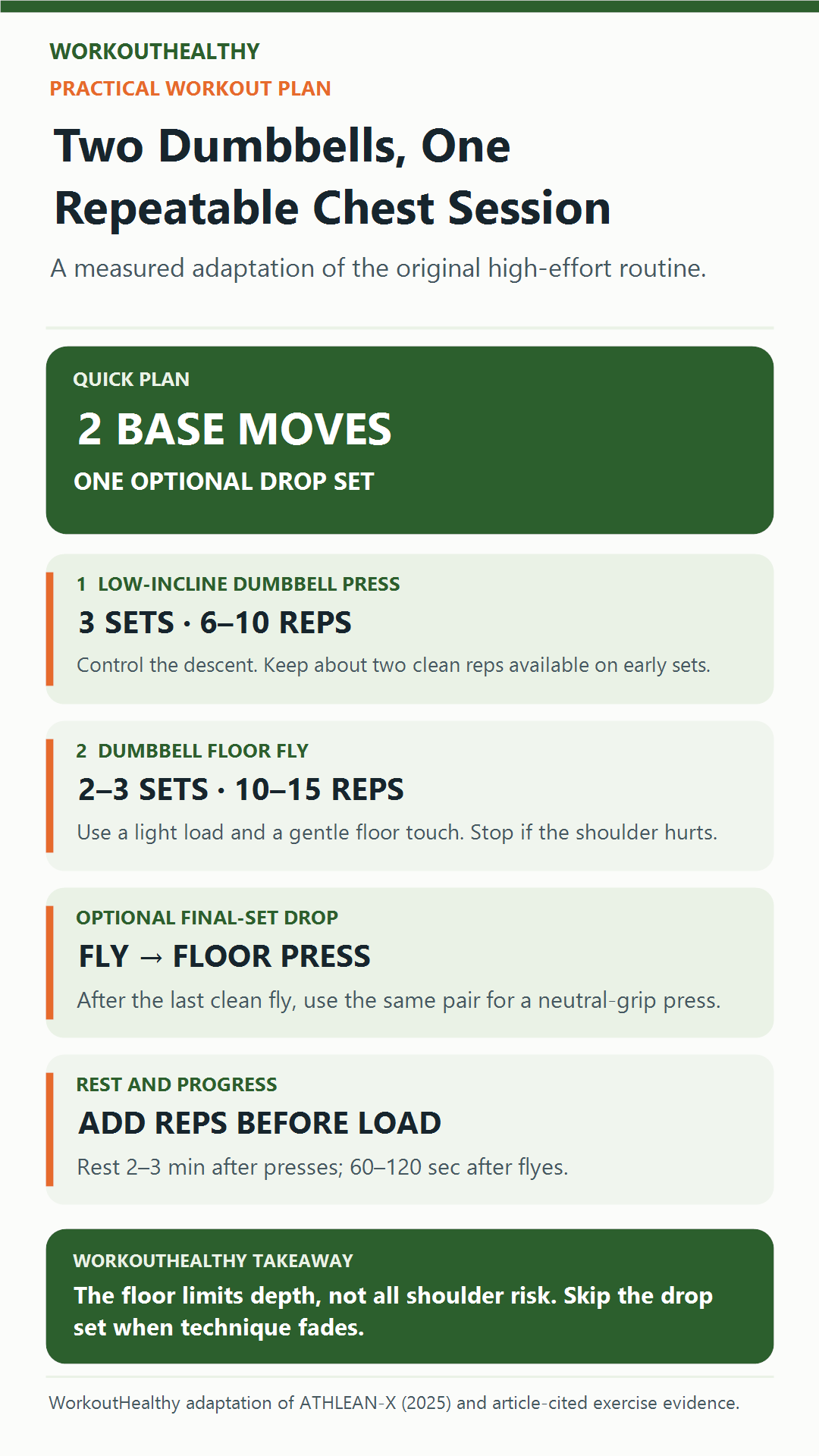
Perform the incline dumbbell press for three sets of 6 to 10 repetitions.
Stop the first two sets with about two good repetitions available, then take the final set closer to failure if the position remains stable.
Perform the floor fly for two or three sets of 10 to 15 controlled repetitions. On the final set only, switch to a neutral-grip floor press when another clean fly is not possible.
Use a clearly lighter pair for the incline squeeze press only when you want the optional drop. Choose the load by clean technique rather than a fixed percentage.
One drop set is enough to capture the time-saving feature without making every set a test of exhaustion.
Rest two to three minutes after hard presses and roughly 60 to 120 seconds after flyes. Add a repetition before adding load, and keep the floor touch and bench angle consistent.
Write down the angle, weight, repetitions, and variation used. The training-log guide shows how to record enough information to make progression visible.
Fit the session beside pulling, shoulder, arm, and lower-body work rather than repeating chest alone. Our complete training-program guide can help balance the week.
Who Should Modify the Plan?
Use straight sets instead of the giant set if you are new, training alone, or still learning to control flyes.
A dumbbell floor press or push-up is easier to exit safely than a fatigued long-lever fly.
Choose a lower incline or neutral grip when the shoulder dislikes the standard press.
Comfort does not prove a movement is universally safer, but it is a valid reason to select a repeatable variation.
Stop for sharp pain, instability, numbness, or symptoms that worsen with each repetition. Persistent shoulder pain deserves an appropriate assessment rather than another activation cue.
People returning from surgery or a significant shoulder injury should follow the range and loading plan given by their clinician.
A two-movement internet workout cannot account for tissue healing or individual restrictions.
The Bottom Line
Cavaliere’s two-exercise idea is authentic and useful.
A low-incline press plus a controlled fly pattern can cover a large share of chest training with two dumbbell pairs and an adjustable bench.
The strongest claims need limits.
Thirty degrees is reasonable rather than perfect, the floor limits depth without removing all risk, and the squeeze press adds voluntary inward force without guaranteeing maximum activation.
Use straight sets as the foundation, add one drop set when time is short, and avoid taking a compromised fly through failure just because the original video demonstrates it.
Minimal equipment works when progression and control are not minimal.
Get the next evidence check.
Five practical fitness stories worth your time, every Friday.
One email a week. No product pitches. Unsubscribe in one click.
References
- ATHLEAN-X. The ONLY 2 Dumbbell Chest Exercises You Need (NO, SERIOUSLY!). YouTube. October 13, 2025. https://www.youtube.com/watch?v=XgwXopZadqs
- Lauver JD, Cayot TE, Scheuermann BW. Influence of bench angle on upper extremity muscular activation during bench press exercise. European Journal of Sport Science. 2016;16(3):309-316. https://pubmed.ncbi.nlm.nih.gov/25799093/
- Cabral HV, et al. Non-uniform excitation of the pectoralis major muscle during flat and inclined bench press exercises. Scandinavian Journal of Medicine & Science in Sports. 2022;32(2):381-390. https://pubmed.ncbi.nlm.nih.gov/34644424/
- Solstad TE, Andersen V, Shaw M, et al. A Comparison of Muscle Activation between Barbell Bench Press and Dumbbell Flyes in Resistance-Trained Males. Journal of Sports Science and Medicine. 2020;19(4):645 to 651. https://pubmed.ncbi.nlm.nih.gov/33239937/
- Farias DA, et al. Maximal Strength Performance and Muscle Activation for the Bench Press and Triceps Extension Exercises Adopting Dumbbell, Barbell, and Machine Modalities Over Multiple Sets. Journal of Strength and Conditioning Research. 2017;31(7):1879-1887. https://pubmed.ncbi.nlm.nih.gov/27669189/
- Sødal LK, Kristiansen E, Larsen S, van den Tillaar R. Effects of Drop Sets on Skeletal Muscle Hypertrophy: A Systematic Review and Meta-analysis. Sports Medicine Open. 2023;9(1):66. https://pubmed.ncbi.nlm.nih.gov/37523092/
- Havers T, Micke F, Geisler S, Held S. Acute and Chronic Effects of Drop-Set Training: A Meta-Analysis and Systematic Review. Sports Medicine Open. 2026;12(1):38. https://pubmed.ncbi.nlm.nih.gov/41920484/
- Refalo MC, Helms ER, Trexler ET, Hamilton DL, Fyfe JJ. Influence of Resistance Training Proximity-to-Failure on Skeletal Muscle Hypertrophy: A Systematic Review with Meta-analysis. Sports Medicine. 2023;53(3):649 to 665. https://pubmed.ncbi.nlm.nih.gov/36334240/
- Currier BS, et al. Resistance training prescription for muscle strength and hypertrophy in healthy adults: a systematic review and Bayesian network meta-analysis. British Journal of Sports Medicine. 2023;57(18):1211 to 1220. https://pubmed.ncbi.nlm.nih.gov/37414459/
Medical disclaimer: This article is for general information only and is not medical advice. If you have shoulder pain, an injury, or another medical condition, consult a qualified clinician before changing your training.