
The best running workouts to get faster do not require turning every run into a test.
Strides, fartlek, intervals, tempo runs, and progression runs each organize faster running differently, which lets you train speed while preserving the easy mileage that supports recovery.
The useful question is not which workout has the most intimidating name.
It is which session matches your current goal, experience, and ability to recover.
The short answer
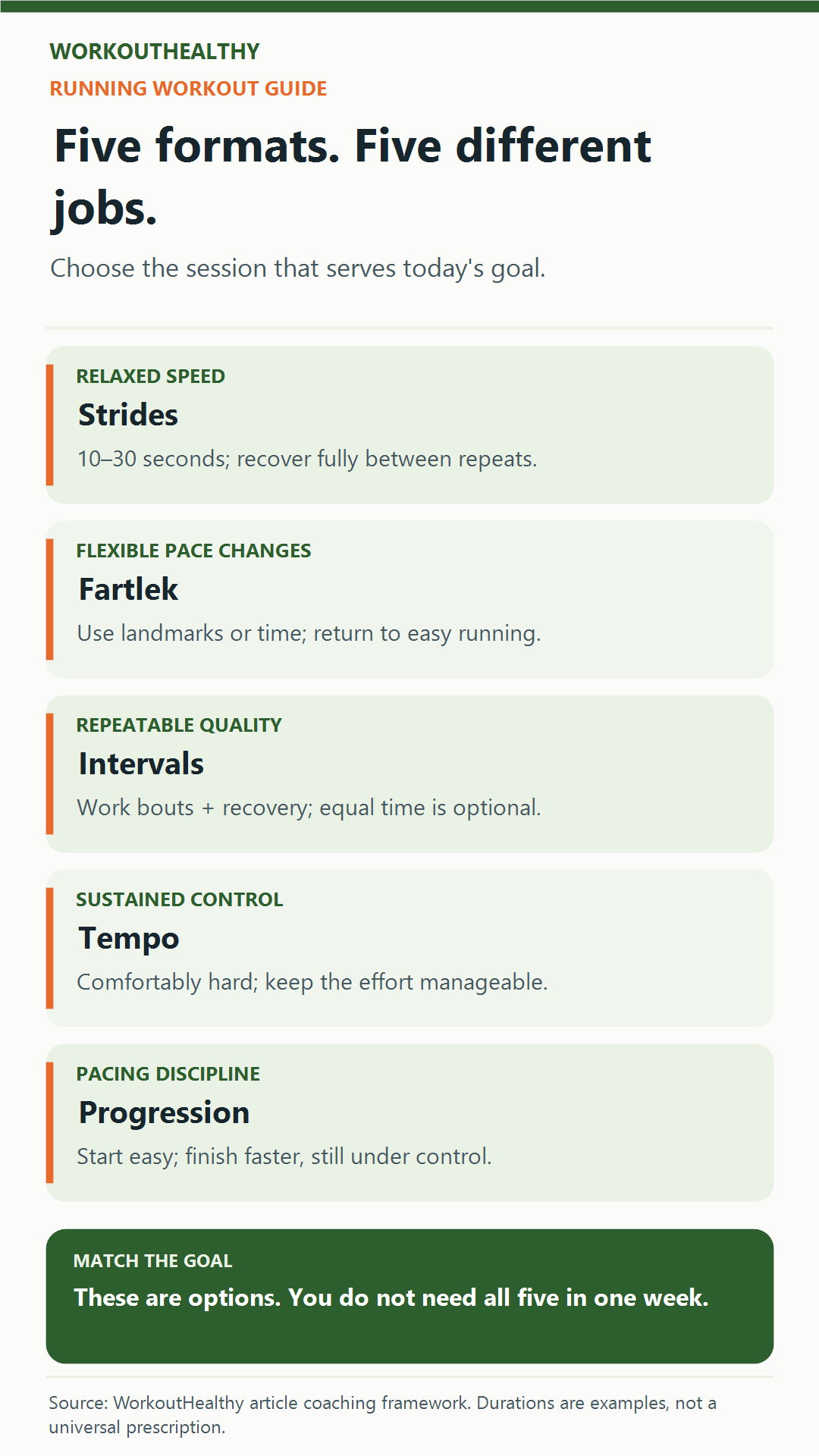
Use strides to practice relaxed speed, fartlek for flexible changes of pace, intervals for repeatable high-quality efforts, tempo running for sustained control near a demanding but manageable intensity, and progression runs for pacing discipline under growing fatigue.
They are tools rather than five requirements.
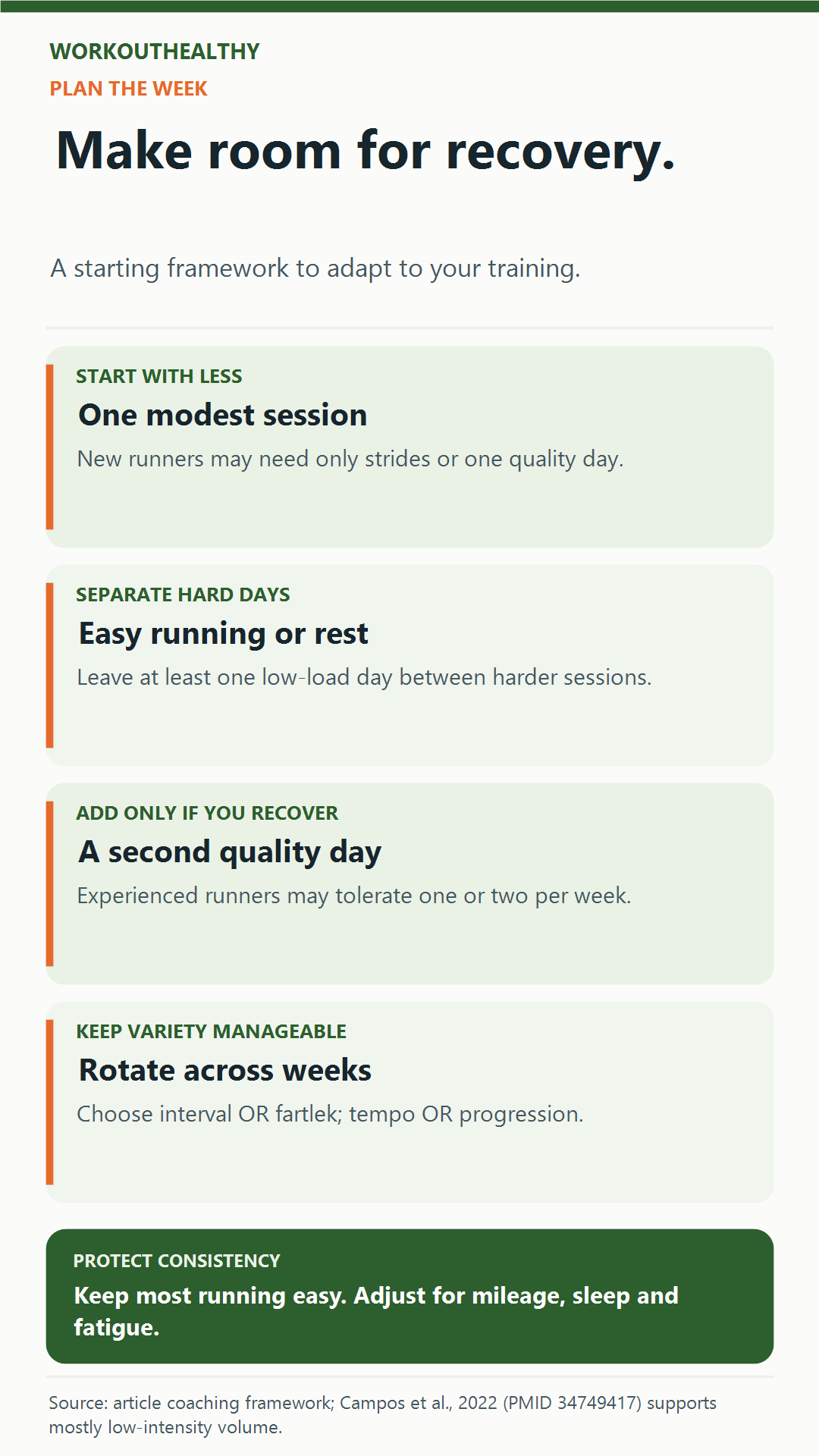
Most runners should select one or two quality sessions for a week, separate them with easy running or rest, and change the workout only when it serves a clear purpose.
Research on middle-distance and long-distance runners generally favors training distributions with most volume at low intensity and a smaller amount at threshold or high intensity.
The exact percentages change with the method used to define zones, so an 80/20 slogan is a guide rather than a universal law.
A faster session should give you a specific training signal, not just leave you exhausted. Keep most running easy enough to recover.
Build the base before adding speed
Faster work magnifies the demand of each step.
A runner who cannot yet complete several weeks of comfortable, consistent running should first build frequency and duration rather than adding multiple hard formats at once.
Easy running develops aerobic capacity, movement tolerance, and the ability to recover between harder sessions.
Continuous training can also improve running economy, and one meta-analysis in recreational runners favored continuous over interval training for reducing oxygen cost.
Easy does not mean useless or slow by someone else’s standard.
Our explanation of how low-impact movement becomes cardio shows why intensity depends partly on the person doing the work.
Start speed training when ordinary runs feel repeatable, not when boredom creates pressure to force a breakthrough.
The goal is to add a new stimulus without losing the consistency that made the new stimulus possible.
Five Running Workouts and What Each Trains
1. Strides
A stride is a short, controlled acceleration that usually lasts about 10 to 30 seconds.
You build smoothly toward a fast but relaxed pace, hold good form briefly, then slow down under control.
Strides are not all-out sprints.
They should finish while posture, cadence, and relaxation still feel coordinated, with generous walking or easy-jog recovery before the next repetition.
A common approach is four to eight strides after an easy run, although beginners may start with fewer.
Full recovery matters more than making the clock symmetrical because the goal is high-quality movement rather than accumulated exhaustion.
The claim that strides simply activate fast-twitch fibers is too narrow.
Their practical value is rehearsal of faster mechanics and pace changes with much less fatigue than a full interval session.
2. Fartlek runs
Fartlek means speed play in Swedish.
The classic idea is flexible alternation between faster and easier running using time, terrain, or landmarks instead of a rigid track prescription.
A beginner might run briskly to the next lamppost and recover easily for two lampposts.
A more experienced runner could alternate one to three minutes fast with enough easy running to restore control.
Fartlek can feel less mentally demanding because pace changes respond to the route and the day.
It can also become too hard when every fast section turns into a race and every recovery stays quicker than intended.
Decide the total amount of faster running before starting, even if the individual bursts remain playful.
That simple boundary keeps an unstructured session from becoming unlimited work.
3. Intervals
Intervals divide demanding running into repeatable work bouts separated by active or passive recovery.
Distance, time, pace, incline, recovery, and number of repetitions can all change the training effect.
The recovery does not need to equal the work interval.
Short recoveries can keep cardiovascular demand high, while longer recoveries help preserve speed and mechanics during faster repetitions.
A simple session might use six 200-meter repetitions with 200 meters of easy jogging, but that is an example rather than a universal prescription.
Longer repetitions at a controlled pace train a different quality than short efforts close to maximum speed.
Controlled trials show that high-intensity aerobic intervals can improve maximal oxygen uptake.
A small study of the 10-20-30 format also improved 1,500-meter and 5K performance, while a larger community study found better 5K time after eight weeks.
Those results do not mean every runner needs maximal efforts.
A later trial found similar 5K and maximal oxygen uptake gains when the fast 10-second segments were submaximal rather than maximal.
Weighted running is not a shortcut to better intervals.
Our review of running in a weighted vest explains how extra load changes the session and why more resistance is not automatically more useful.
4. Tempo runs
Tempo is one of the least standardized words in running.
Coaches may use it for a continuous threshold effort, controlled race-pace work, or any sustained run faster than easy pace.
For many recreational runners, a useful tempo feels comfortably hard and controlled rather than desperate.
Speaking is usually limited to short phrases, and the pace should not collapse in the final minutes.
A continuous block of 15 to 25 minutes is common, but shorter repeats such as three eight-minute segments with easy jogging can deliver a similar total dose with better control.
Pace should reflect current fitness and conditions, not an old personal record.
Threshold-heavy training is not necessarily superior when it crowds out easy volume and recovery.
Systematic reviews of intensity distribution generally favor pyramidal or polarized patterns over making a large share of training moderately hard.
5. Progression runs
A progression run starts easy and finishes faster.
The increase can be gradual throughout the run or organized into blocks, such as easy, steady, and controlled fast segments.
The final section should match the session goal rather than become a sprint.
Finishing around steady or tempo effort teaches pace control under fatigue without requiring an all-out race simulation.
Progression runs are useful for runners who start races too fast because the structure rewards patience.
They can also turn into hidden hard days when the finish is pushed beyond the planned intensity every week.
Leave enough easy running at the beginning to warm up and enough control at the end to cool down safely.
A successful progression should make the next scheduled training day possible.
How to choose the right session
Choose strides when you want a small dose of speed with little metabolic fatigue.
Choose fartlek when flexibility and enjoyment will improve adherence, especially away from a track.
Use structured intervals when the goal requires a defined pace, duration, and recovery.
Use tempo running when sustained control is the priority, and choose progression when pacing discipline or a strong finish matters.
Race distance changes the details.
A 5K runner may emphasize intervals and threshold work, while a half-marathon runner often needs more sustained running and race-specific pacing.
Let verified performance provide perspective without copying elite volume.
Our analysis of the women’s half-marathon world record shows how extraordinary pace depends on years of preparation, not one favorite workout.
How many fast sessions per week?
New runners may need only strides or one modest quality session per week.
Experienced runners often tolerate one or two quality sessions, but total mileage, strength training, sleep, work stress, age, and injury history change that answer.
A simple week might include easy runs, one interval or fartlek day, one tempo or progression day, and at least one low-load day between hard sessions.
Strides can follow an easy run because their total volume is small when they remain controlled.
Do not add all five formats in the same week simply because they appear on a list.
Rotating them across several weeks preserves variety without multiplying high-intensity load.
Strength training can improve running economy and time-trial performance when programmed alongside running.
Its placement should protect the most important quality session rather than leaving every day moderately fatigued.
Warm up and cool down
Begin with at least several minutes of easy running and extend the warmup when the weather is cold, the session is fast, or you feel stiff.
A few dynamic movements and gradual pickups can bridge the gap between easy pace and the first work interval.
The first fast repetition should not be the fastest.
Use it to confirm that the planned pace and recovery fit the day.
After the final effort, jog or walk easily until breathing settles.
Cooling down does not erase fatigue, but it creates a calmer transition and gives you time to notice unusual symptoms.
Common mistakes
The most common error is turning the label into a competition.
A stride becomes a sprint, a tempo becomes a time trial, and a progression becomes a desperate finish.
Another mistake is changing several variables at once.
Adding repetitions, increasing pace, shortening recovery, and choosing a hill in the same week makes it difficult to identify the dose you can tolerate.
Runners also copy paces from friends, online calculators, or an old race without adjusting for heat, hills, wind, surface, sleep, or current fitness.
Effort and form provide useful checks when a pace target no longer matches reality.
Finally, variety cannot replace progression.
Random hard workouts may feel exciting, but repeating a suitable session long enough to adapt is usually more useful than changing everything every week.
When to adjust or stop
End the fast work when form breaks down, pace drops sharply, or the planned effort becomes unsustainable.
Completing fewer high-quality repetitions is better than forcing poor ones to satisfy a number.
Stop for chest pain, faintness, severe shortness of breath, or sudden sharp pain.
Persistent localized pain, swelling, repeated limping, or symptoms that worsen from session to session deserve medical or physical-therapy evaluation.
Ordinary fatigue should improve with recovery.
If sleep, mood, resting heart rate, easy pace, or motivation remains disrupted, remove intensity before assuming another hard workout will solve the plateau.
The bottom line
Strides, fartlek, intervals, tempo runs, and progression runs are five useful ways to organize faster running.
They train overlapping but distinct skills, and none needs to be all-out to work.
Keep most running easy, choose one or two quality sessions that match the current goal, and separate them with enough recovery to preserve consistency.
Faster running grows from repeatable training, not from racing every run.
Get the next evidence check.
Five practical fitness stories worth your time, every Friday.
One email a week. No product pitches. Unsubscribe in one click.
References
- Campos Y, et al. Training-intensity Distribution on Middle- and Long-distance Runners: A Systematic Review. International Journal of Sports Medicine. 2022.
- Kenneally M, et al. The Effect of Periodization and Training Intensity Distribution on Middle- and Long-Distance Running Performance. International Journal of Sports Physiology and Performance. 2018.
- González-Mohíno F, et al. The Effects of Interval and Continuous Training on the Oxygen Cost of Running in Recreational Runners. Sports Medicine. 2020.
- Helgerud J, et al. Aerobic High-intensity Intervals Improve Maximal Oxygen Uptake More Than Moderate Training. Medicine & Science in Sports & Exercise. 2007.
- Gunnarsson TP, Bangsbo J. The 10-20-30 Training Concept Improves Performance and Health Profile in Moderately Trained Runners. Journal of Applied Physiology. 2012.
- Gliemann L, et al. 10-20-30 Training Increases Performance and Lowers Blood Pressure and VEGF in Runners. Scandinavian Journal of Medicine & Science in Sports. 2015.
- Skovgaard C, et al. Similar Improvements in 5K Performance with Submaximal and Maximal 10-20-30 Training. Scandinavian Journal of Medicine & Science in Sports. 2024.
Medical disclaimer: This article is for general information only and is not medical advice. If you have an injury, ongoing pain, or a medical condition, talk to a doctor or physical therapist before you change how you train or eat.